 Photograph · NASA Kennedy from United States NASA/Glenn Benson · Public domain
Spacecraft · Deep guide
Parker Solar Probe
The spacecraft that touched the Sun is also the fastest human-made object.
What is it?
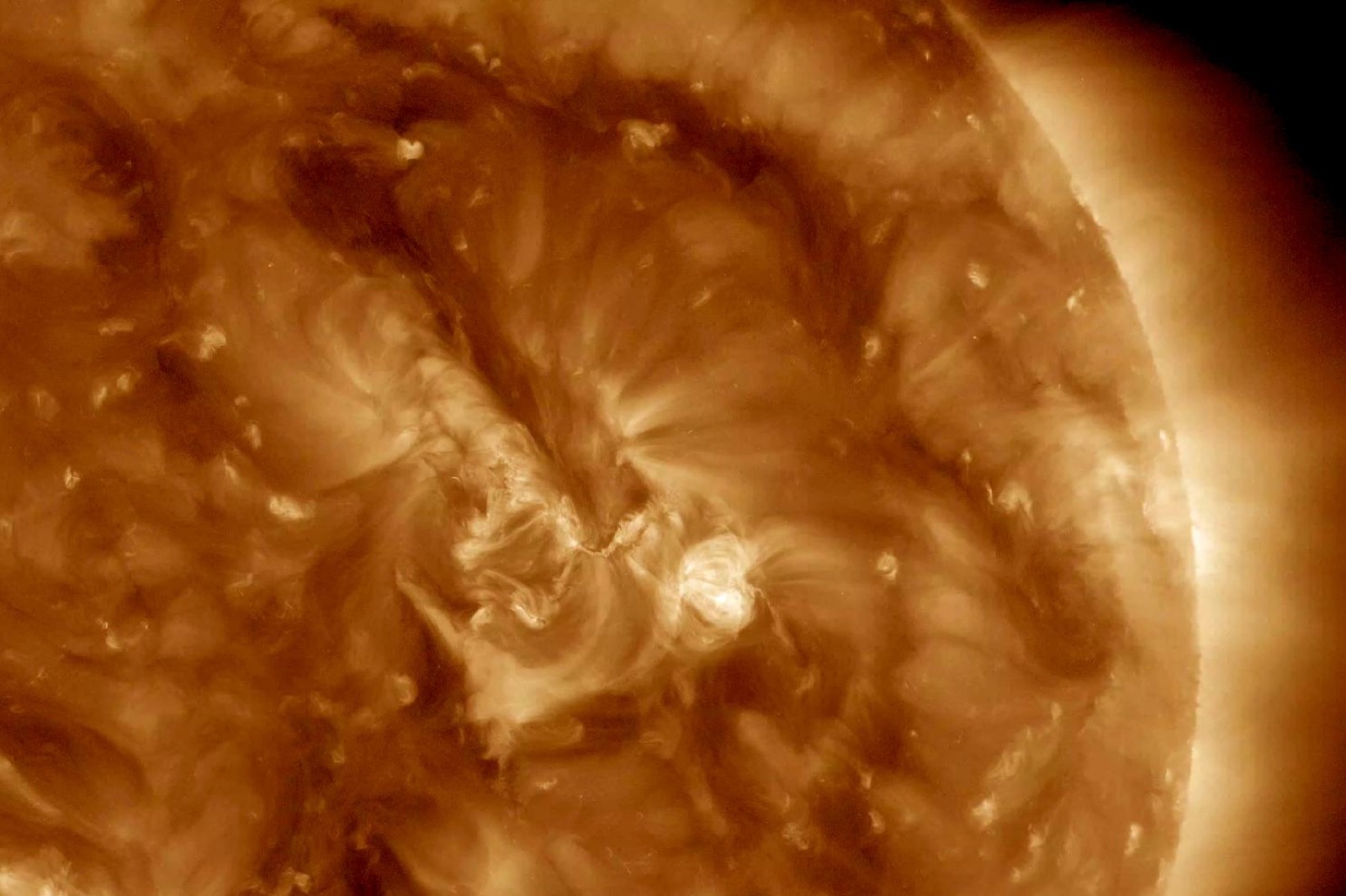
Parker Solar Probe is humanity's Sun-diver: in December 2024 it flew within 6.1 million km of the solar surface at about 690,000 km/h — the closest solar approach and the highest speed any human object has achieved. Behind a 11.4-cm carbon heat shield, its instruments fly through the corona itself, hunting the origins of the solar wind and the corona's million-degree mystery.
Go deeper
Getting sunward is energetically brutal — Parker shed Earth's orbital speed via seven Venus flybys over six years. In 2021 it became the first craft INSIDE the corona (below the Alfvén surface), directly sampling magnetic 'switchbacks' now central to solar-wind acceleration theory. At perihelion the shield face runs ~1,000 °C while instruments sit near room temperature. Its namesake, Eugene Parker — who predicted the solar wind in 1958 against fierce skepticism — became the first person to watch the launch of a mission named for them (2018; he died in 2022 having seen his wind touched).
01 Falling toward the Sun is hard Deeper
Earth orbits at 30 km/s sideways; to fall sunward you must cancel that speed. It takes 55 times more energy to reach the Sun than to leave the Solar System — which is why Parker borrowed Venus's gravity seven times, and why 'just throw it into the Sun' is the worst disposal idea in orbital mechanics.
The deep dive
Researched for the Atlas from Wikipedia — Parker Solar Probe (23,632 characters read) · updated Sep 20, 2026
02 A mission sixty years in the making
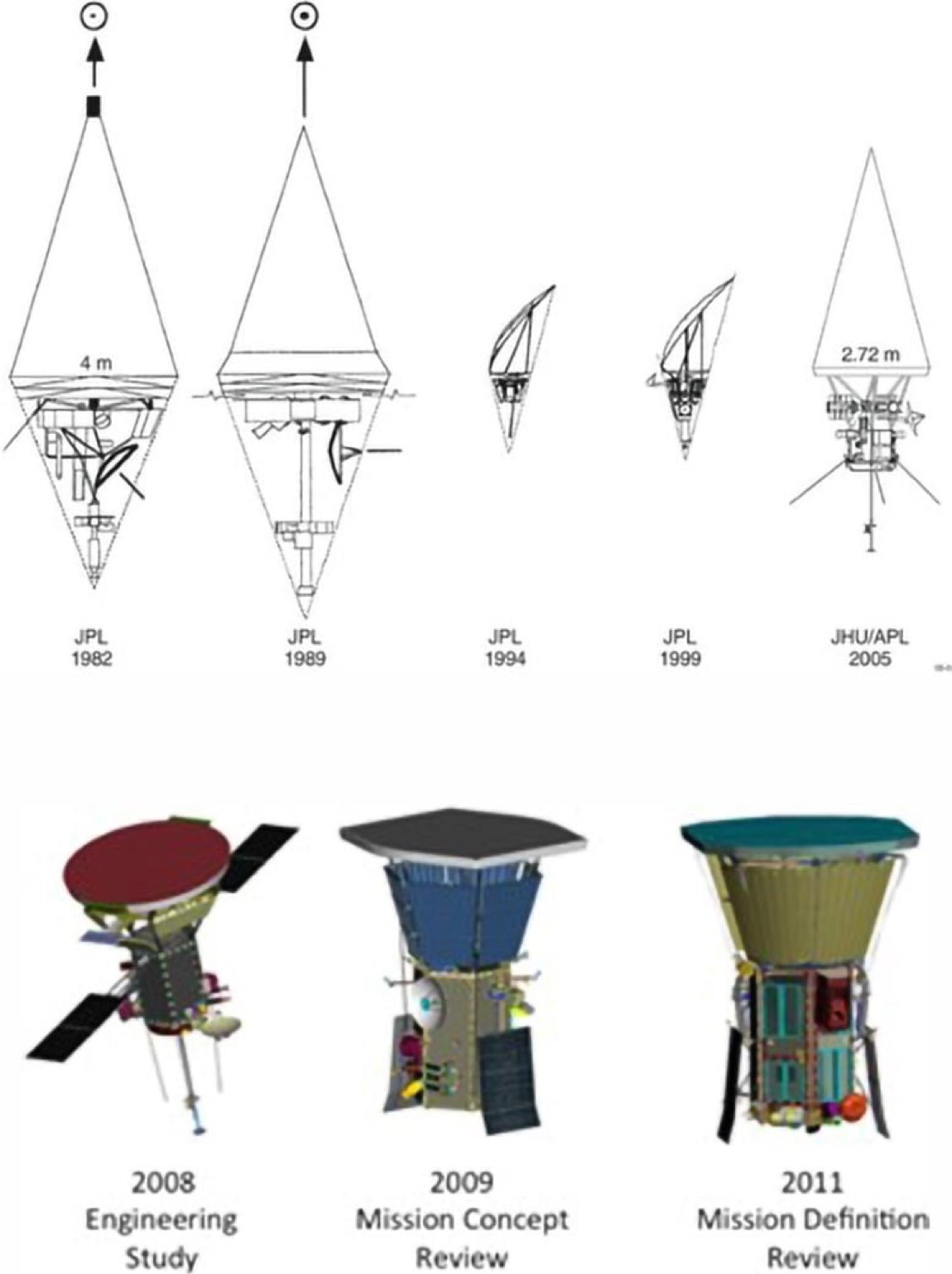
The idea behind Parker Solar Probe did not emerge from a single visionary moment — it was decades in the waiting. A 1958 report by the Fields and Particles Group of the National Academy of Sciences' Space Science Board first proposed a solar probe mission to study particles and fields close to the Sun. Studies in the 1970s and 1980s repeatedly confirmed its scientific importance, yet cost always pushed it down the priority list. A polar-orbit design studied in the late 1990s would have swung the probe past Jupiter first, taking three and a half years just to reach its first perihelion and eight years for its second. That version was cancelled outright after Administrator Sean O'Keefe restructured NASA's planetary program following President Bush's 2003 budget request. Only in the early 2010s did engineers find a cheaper path: swap the Jupiter flyby for repeated Venus gravity assists, use solar panels instead of a radioisotope generator, and accept a slightly higher perihelion. That redesigned mission became Solar Probe Plus, and eventually Parker Solar Probe — launched 60 years after the idea was first written down.
03 Named for a living legend
When NASA renamed the spacecraft in May 2017, it broke its own long-standing tradition. Parker Solar Probe became the first NASA spacecraft ever named after a living person. The honoree is Eugene Newman Parker, professor emeritus at the University of Chicago, whose contributions to solar physics are foundational. In 1958 Parker published a paper predicting that the Sun constantly sheds a stream of charged particles outward through the solar system — what we now call the solar wind. The scientific establishment of the day was so skeptical that reviewers initially rejected the paper. Parker also proposed the existence of nanoflares as a mechanism for coronal heating. Both ideas are central to what the probe now investigates in person. A memory card containing names submitted by more than 1.1 million members of the public was mounted on a plaque below the spacecraft's high-gain antenna, alongside photos of Parker and a copy of that very 1958 paper. When the probe was launched, Parker himself was present to witness it.
04 The shield that makes everything possible
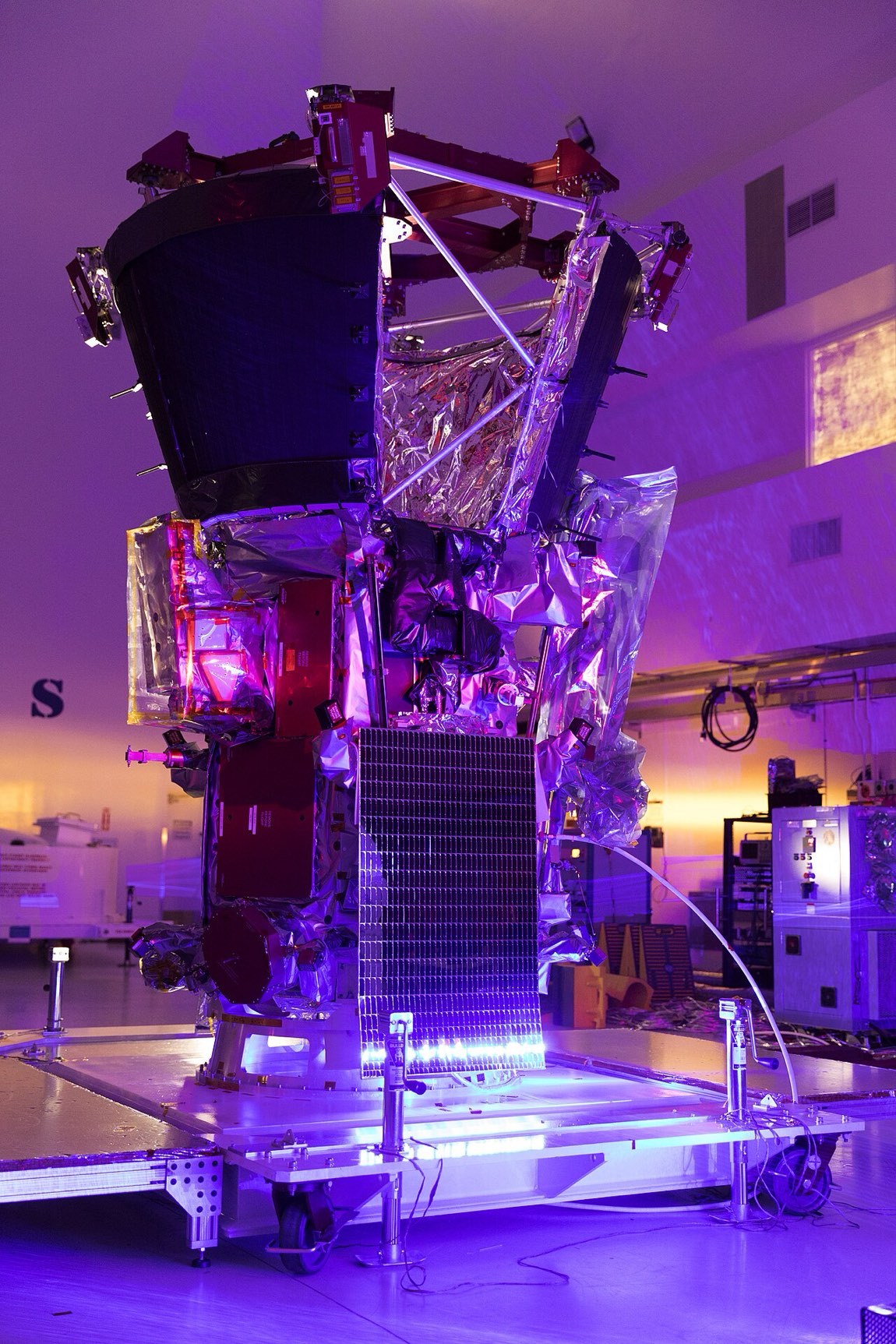
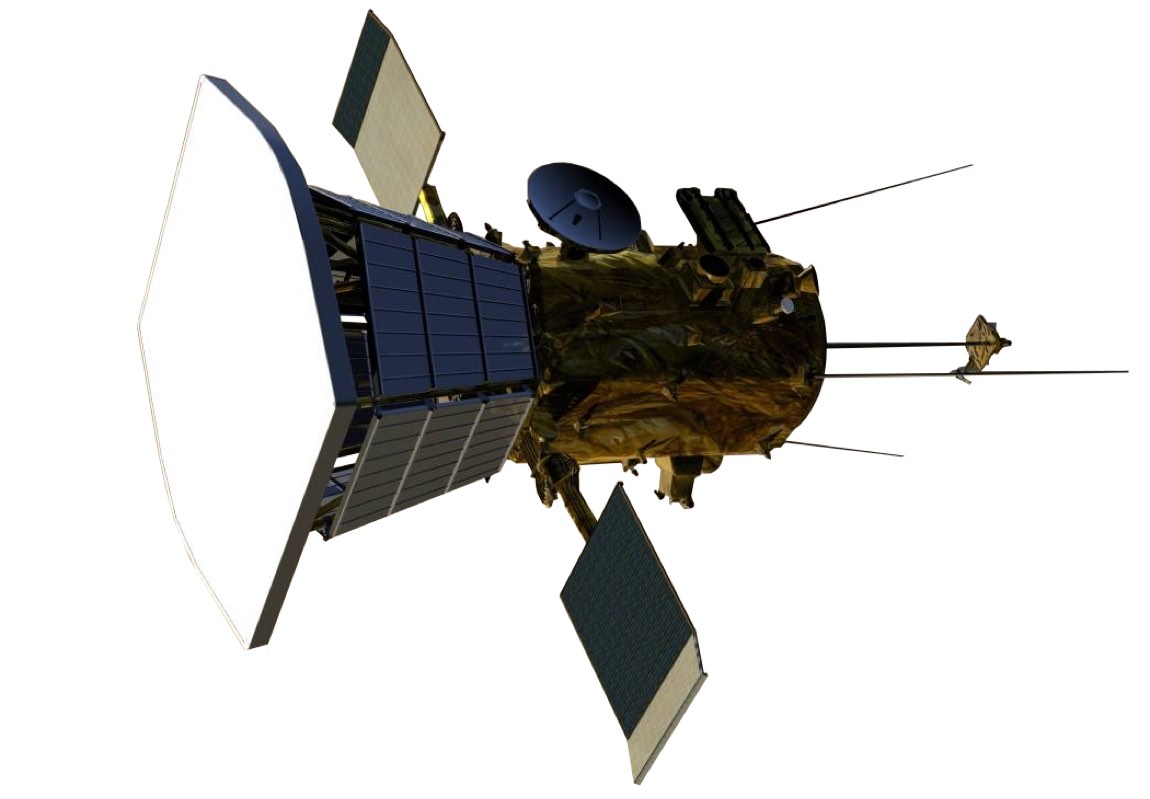
At closest approach, the Sun bombards Parker Solar Probe with roughly 650 kilowatts of radiation per square meter — about 475 times the intensity that reaches Earth orbit. Without protection, the probe would become inoperative within tens of seconds. The solution is a hexagonal thermal shield 2.3 meters in diameter and 11.4 centimeters thick. Its core is carbon foam sandwiched between two panels of reinforced carbon–carbon composite, the same material used in spacecraft re-entry nose cones. A white reflective alumina coating on the outer surface minimizes heat absorption. The whole shield weighs just 73 kilograms — about the weight of an average adult — yet it holds the instruments behind it at a comfortable 29 degrees Celsius while the Sun-facing surface reaches roughly 1,370 degrees Celsius. When the mission eventually ends and the probe runs out of thruster fuel, mission planners intend to rotate the spacecraft so the instruments face the Sun directly and are destroyed. The heat shield itself, however, is expected to survive and continue orbiting the Sun for millions of years.
 ⤢
⤢
05 Autonomous survival, seconds at a time Deeper
Controlling Parker Solar Probe from Earth is physically impossible during its closest solar passes. A radio signal takes about eight minutes to travel from Earth to the probe and another eight minutes for any response to return, making real-time commands useless when a threat could destroy instruments in seconds. The spacecraft therefore manages its own safety entirely. Four light sensors continuously watch for the first traces of direct sunlight leaking around the shield's edges. The moment any sensor detects an intrusion, onboard software commands reaction wheels to reposition the spacecraft until the instruments are fully back in the shield's shadow. Project scientist Nicky Fox described it as "the most autonomous spacecraft that has ever flown." Power management is equally ingenious: the primary solar array used at distances beyond 0.25 AU retracts behind the heat shield during closest approach, and a much smaller secondary array takes over, kept functional by an active pumped-fluid cooling system. This two-array design avoids frying the panels that power the spacecraft for most of its long elliptical orbit.
06 Seven Venus flybys, one tightening spiral
Parker Solar Probe did not fly straight at the Sun — it spiraled inward across nearly seven years using Venus as a series of gravitational brakes. The first Venus flyby came just 52 days after launch, passing within about 2,400 kilometers of the planet's surface. Each subsequent encounter trimmed the probe's orbital period: from 150 days after the first flyby, to 130 days after the second, then 112.5, 102, 96, 92, and finally 88 or 89 days after the seventh and last flyby on November 6, 2024. That final encounter also set the spacecraft on its current innermost orbit, passing just 6.1 million kilometers from the Sun's surface. Because this orbit now lies entirely inside Venus's orbit, no further planetary encounters are possible. The trajectory required so much launch energy that the probe flew aboard a Delta IV Heavy rocket supplemented by a Star 48BV solid-rocket upper stage — one of the most powerful launch combinations available. All that energy, combined with the Sun's gravity pulling the probe into progressively faster perihelion passes, ultimately produced a heliocentric speed record nearly three times higher than the previous record set by Helios-2.
07 What the four instrument suites actually measure Deeper
Each of Parker Solar Probe's four science packages targets a different slice of the solar environment. FIELDS, led by Stuart Bale at UC Berkeley, carries five electric-field antennas and three magnetometers; four antennas extend beyond the heat shield into direct sunlight and endure temperatures of 1,370 degrees Celsius, made possible by a niobium alloy construction. The search coil magnetometer within FIELDS can sample the magnetic field two million times per second. IS☉IS, led by David McComas at Princeton, counts and characterizes energetic electrons, protons and ions; its EPI-Lo detector carries 80 viewfinders arranged on an octagonal dome and can distinguish between helium-3 and helium-4 isotopes to discriminate between competing acceleration theories. EPI-Hi can detect up to 100,000 particles per second at closest approach. WISPR, led by Russell Howard at the Naval Research Laboratory, is a pair of optical telescopes using radiation-hardened CMOS detectors to photograph the corona and inner heliosphere. SWEAP, led by Justin Kasper at the University of Michigan and the Smithsonian Astrophysical Observatory, includes a Faraday cup called the Solar Probe Cup that literally peeks over the heat shield and can measure plasma at 146 samples per second; its collector grids glow red at up to 1,650 degrees Celsius during measurements.
08 Magnetic switchbacks and the coronal mystery
One of the mission's earliest and most intriguing findings arrived on November 6, 2018 — just weeks after launch — when Parker Solar Probe observed its first magnetic switchbacks: sudden, sharp reversals in the direction of the magnetic field carried by the solar wind. Switchbacks had first been spotted by the Ulysses spacecraft, but never studied up close. Parker found them to be remarkably common, recording roughly a thousand of these rogue magnetic waves. Each one can instantly boost solar wind speeds by as much as 480,000 kilometers per hour and in some cases completely flip the local magnetic field direction. Research papers published in December 2019 confirmed that these measurements support Alfvén waves as leading candidates for explaining the coronal heating problem — the long-standing puzzle of why the Sun's atmosphere runs at millions of degrees while the surface below sits at only about 5,500 degrees Celsius. Scientists also found a surprisingly large sideways component to plasma velocity, which appears to result from the Sun's rotation slingshotting plasma outward when it is released from the coronal magnetic field.
 ⤢
⤢
09 Touching the Sun for the first time
On April 28, 2021, Parker Solar Probe crossed a boundary that no spacecraft had ever reached. During its eighth flyby of the Sun, at a distance of 18.8 solar radii, the FIELDS and SWEAP instruments detected the specific magnetic and particle conditions that indicated the probe had penetrated the Alfvén surface — the outer boundary of the solar corona where the Sun's magnetic field becomes too weak to contain plasma. Inside this surface, solar material is still gravitationally and magnetically bound to the Sun; beyond it, the solar wind breaks free and streams outward into interplanetary space. NASA described the event as "touching the Sun." By crossing in and out of the Alfvén surface multiple times, the probe gave scientists their first in situ measurements of the true corona rather than observations from a distance. This is what the mission was fundamentally designed to accomplish, and achieving it during the eighth of twenty-four planned orbits showed how rapidly the scientific returns were accumulating.
10 A dust-free zone and a comet discovery
Parker Solar Probe's cameras have delivered two unexpected bonus science results. The probe found evidence for a dust-free zone extending roughly 5.6 million kilometers (3.5 million miles) outward from the Sun's center. This region exists because the Sun's intense radiation vaporizes cosmic dust particles before they can approach any closer — a zone long predicted theoretically but never directly confirmed until the probe flew through it. Then, on September 25, 2022, images from the probe's twelfth approach to the Sun yielded the first comet discovery ever made using Parker Solar Probe data. The comet, named PSP-001, was spotted in images from May 29, 2022, by Peter Berrett, a participant in the NASA-funded Sungrazer project. Since that first discovery, 19 additional sungrazing comets have been identified in Parker Solar Probe imagery, including three that belong to no known comet group. Finding comets was never a primary mission goal, yet the probe's close-in vantage point near the Sun makes it uniquely positioned to observe objects in the final moments of their solar approach.
11 First detection of a theorized plasma instability Deeper
In 2024, Parker Solar Probe added another "first" to its scientific ledger by detecting a Kelvin-Helmholtz instability during an observed coronal mass ejection. A Kelvin-Helmholtz instability occurs when two adjacent fluid or plasma layers move at different speeds, generating rolling vortex-like waves at the boundary between them — the same physics that curls ocean waves when wind blows across the water's surface. Theorists had long predicted that this phenomenon should occur in solar plasma, particularly at the edges of fast-moving coronal mass ejections, but no spacecraft had ever been close enough to measure it directly. Parker Solar Probe's position deep within the inner heliosphere placed it in the right location at the right moment to record the event in situ. This detection matters because Kelvin-Helmholtz instabilities can drive turbulent mixing between different plasma populations and may contribute to the transport of energy and momentum through the solar wind — processes directly relevant to understanding space weather events that affect Earth.
12 Working alongside other spacecraft
Parker Solar Probe does not work in isolation. Its most sustained collaboration has been with the ESA-NASA Solar Orbiter, a separate spacecraft designed to observe the Sun from a different vantage point. In 2022, the two missions coordinated to investigate why the Sun's corona is roughly 150 times hotter than its visible surface. While Solar Orbiter observed the Sun from 140 million kilometers away, Parker Solar Probe simultaneously sampled the corona directly at a distance of nearly 9 million kilometers. In March 2024, both spacecraft reached their closest solar approaches nearly simultaneously — Parker at 7.3 million kilometers and Solar Orbiter at 45 million kilometers — allowing scientists to compare in situ plasma measurements from the inner corona with remote imaging from further out. The missions also coordinated observations with the older SOHO and STEREO-A spacecraft. This multi-spacecraft approach is important because no single probe can be everywhere at once; linking measurements across different distances and viewing angles lets researchers trace solar wind and eruptions from their origin at the Sun's surface all the way out into interplanetary space.
 ⤢
⤢
13 What happens when the fuel runs out
Parker Solar Probe's primary mission ended in 2025, and an extended mission was approved to run through 2029. Eventually, however, the probe's thrusters will exhaust their fuel supply, and without the ability to repoint its transmitters toward Earth, full functioning will no longer be possible. The plan at that point is deliberate and final: rotate the spacecraft so its scientific instruments face the Sun directly for the first time. Exposed to the full intensity of solar radiation — 650 kilowatts per square meter at its current orbit — the instruments are expected to ablate and be destroyed. The heat shield, built from reinforced carbon–carbon composite, is far more durable; it is expected to survive and remain in solar orbit for millions of years, a silent monument to the mission long after its scientific work is complete. In 2025, the teams from NASA, Johns Hopkins, and mission partners were awarded the 2024 Collier Trophy, one of American aviation and aerospace's most prestigious honors, for their achievements on the project.
Weird & wonderful
- At top speed it would cross the USA in 20 seconds.
- Its shield's shadow is the only reason it exists — a few degrees of mispointing would end the mission.
- It is the first NASA mission named for a living scientist.