 Photograph · Andrey Butko · CC BY-SA 3.0
Spacecraft · Deep guide
Sputnik 1
The beep that started the Space Age.
What is it?
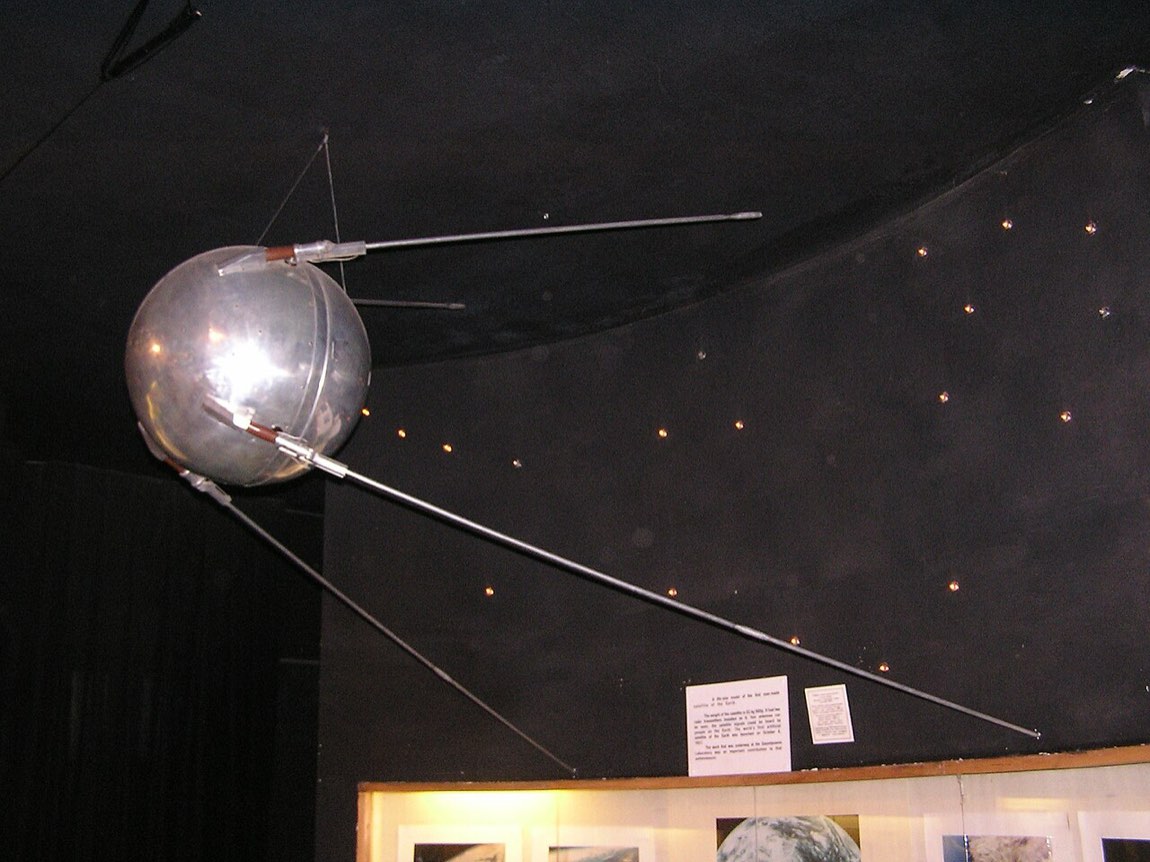
On October 4, 1957, the Soviet Union lofted a polished 58-cm sphere into orbit — and changed history overnight. Sputnik 1 did nothing but transmit a steady beep, yet that beep, audible to amateur radio operators worldwide, proved spaceflight real, ignited the Space Race, and led directly to NASA's creation within a year. It circled Earth for three months before burning up.
The deep dive
Researched for the Atlas from Wikipedia — Sputnik 1 (32,282 characters read) · updated Sep 20, 2026
01 The Word Behind the Name
The name Sputnik carries more meaning than most people realize. The Russian word sputnik was coined in the eighteenth century by fusing the prefix s-, meaning 'fellow,' with putnik, meaning 'traveler.' The result, 'fellow-traveler,' mirrors almost perfectly the Latin root satelles — meaning 'guard, attendant, or companion' — from which English gets the word satellite. So when Soviet state media announced Sputnik-Odin, they were announcing 'Satellite-One' in a word whose etymology stretches across centuries and languages. There was an awkward political undercurrent in the West, though: since the 1930s, 'fellow traveler' had been used as a pejorative for people sympathetic to communism, which gave the name an unintended double edge for English-speaking audiences. The full romanized form, Sputnik-Odin, is pronounced roughly as 'SPUT-neek ah-DEEN,' with stress landing on the final syllable of each word.
02 The Satellite That Almost Was Not Built
The satellite that actually reached orbit in 1957 was a last-minute substitute for a far grander machine. The original plan, hatched after Sergei Korolev's December 1954 proposal to the Minister of Defense Industry, called for 'Object D' — a spacecraft massing between 1,000 and 1,400 kg and carrying 200 to 300 kg of scientific instruments to measure atmospheric density, ion composition, the solar wind, magnetic fields, and cosmic rays. By the end of 1956, engineers realized Object D could not be built on time. The R-7 rocket engines were producing a specific impulse of only 304 seconds against a target of 309 to 310 seconds, and the scientific instruments were proving too complex. Rather than concede the first-launch title to the United States, OKB-1 proposed a stripped-down substitute: a simple sphere of roughly 100 kg with nothing but a radio transmitter. Approved on 15 February 1957 under the designation 'Object PS' — short for prosteishiy sputnik, or 'elementary satellite' — it was the spacecraft that became Sputnik 1. Object D eventually flew anyway, as Sputnik 3.
03 Engineering a Sphere: What Was Inside Deeper
Beneath Sputnik 1's mirror-bright exterior lay a carefully engineered small world. The 585-millimetre sphere was assembled from two hemispheres just 2 mm thick, sealed with O-rings and locked by 36 bolts. Over those hemispheres sat a 1 mm heat shield of an aluminium-magnesium-titanium alloy designated AMG6T, polished to a high shine. The interior was filled with dry nitrogen pressurized to 1.3 atm (130 kPa). A barometric switch stood ready: if internal pressure fell below 130 kPa — signaling a leak or a meteorite puncture — the switch would alter the duration of the radio pulses, encoding the emergency in the beeps themselves. Temperature was managed by a fan controlled by a dual thermal switch that activated above 36 °C (97 °F) and deactivated below 20 °C (68 °F). A separate control thermal switch changed the radio pulse duration if temperature exceeded 50 °C (122 °F) or dropped below 0 °C (32 °F). The power supply, shaped like an octagonal nut and weighing 51 kg, housed three silver-zinc batteries: two for the transmitter and one for temperature regulation. Those batteries outlasted their expected two-week lifetime by eight days, operating for a total of 22 days.
04 How the Radio Signals Actually Worked Deeper
Sputnik 1's transmitter was a one-watt unit weighing 3.5 kg, developed by Vyacheslav I. Lappo at NII-885, the Moscow Electronics Research Institute. It broadcast simultaneously on two frequencies: 20.005 MHz and 40.002 MHz. Signals on the first frequency were transmitted in 0.3-second pulses close to a cadence of 3 Hz, with the pauses between pulses filled by signals on the second frequency — creating the famous alternating 'beep-beep-beep' heard around the world. The system was cleverer than it sounds. Temperature and pressure inside the satellite were encoded in the varying duration of those beeps, turning the audible signal into a continuous stream of telemetry. Analysis of the radio signals across both frequencies also allowed scientists to study how the electron density of the ionosphere affected radio wave propagation. The choice of frequencies was accessible by design: amateur radio operators with short-wave receivers around the world could tune to 20 megacycles and, after finding the time-signal reference, search slightly higher to catch Sputnik's tones on every pass. The American Radio Relay League published step-by-step tuning instructions so that any hobbyist could participate.
05 A Launch That Nearly Failed
The rocket that put Sputnik into orbit had a troubled path to the launch pad. The first R-7 test, on 15 May 1957, ended when a strap-on booster caught fire almost immediately at liftoff; the vehicle flew for 98 seconds before crashing 400 km downrange. Three attempts with the second rocket in June were defeated by an assembly defect. The third rocket, on 12 July, suffered an electrical short that sent the vehicle into an uncontrolled roll, shedding all strap-ons just 33 seconds after launch and crashing 7 km from the pad. The fourth rocket, launched on 21 August, finally succeeded, boosting a dummy warhead 6,000 km before it broke apart at 10 km altitude during reentry. Even the actual Sputnik launch on 4 October was not flawless: several engines failed to ignite on time, a fuel regulator failed around 16 seconds in causing excessive RP-1 consumption and thrust running 4% above nominal, and core-stage cutoff came one second early — at T+295.4 seconds instead of the planned T+296 — because a sensor detected the turbopump overspeeding on nearly empty propellant lines. At cutoff, 375 kg of liquid oxygen remained unused. Despite all this, the satellite reached orbit, though its apogee ended up roughly 500 km lower than the intended 1,450 km.
06 The Orbit, the Speed, and the Numbers
Sputnik 1 settled into an elliptical orbit with a perigee of 223 km and an apogee of 950 km, inclined 65.10° to the equator. That inclination was deliberate in its effect: it meant the satellite's ground track swept over virtually the entire inhabited surface of the Earth on successive passes. The orbital period was 96.20 minutes, meaning Sputnik circled the planet roughly 15 times every 24 hours at a peak speed of about 8 km/s — roughly 18,000 mph, or about ten times faster than a rifle bullet. Over its 92 days of active orbital life the satellite completed 1,440 full orbits and travelled approximately 70,000,000 km, a distance comparable to nearly half the average separation between Earth and the Sun. Aerodynamic drag from the uppermost traces of atmosphere gradually lowered the orbit until Sputnik 1 reentered and burned up on 4 January 1958. The satellite's batteries had gone silent 69 days earlier, on 26 October 1957, after completing 326 orbits.
 ⤢
⤢
07 Tracking a Dot Across the Sky
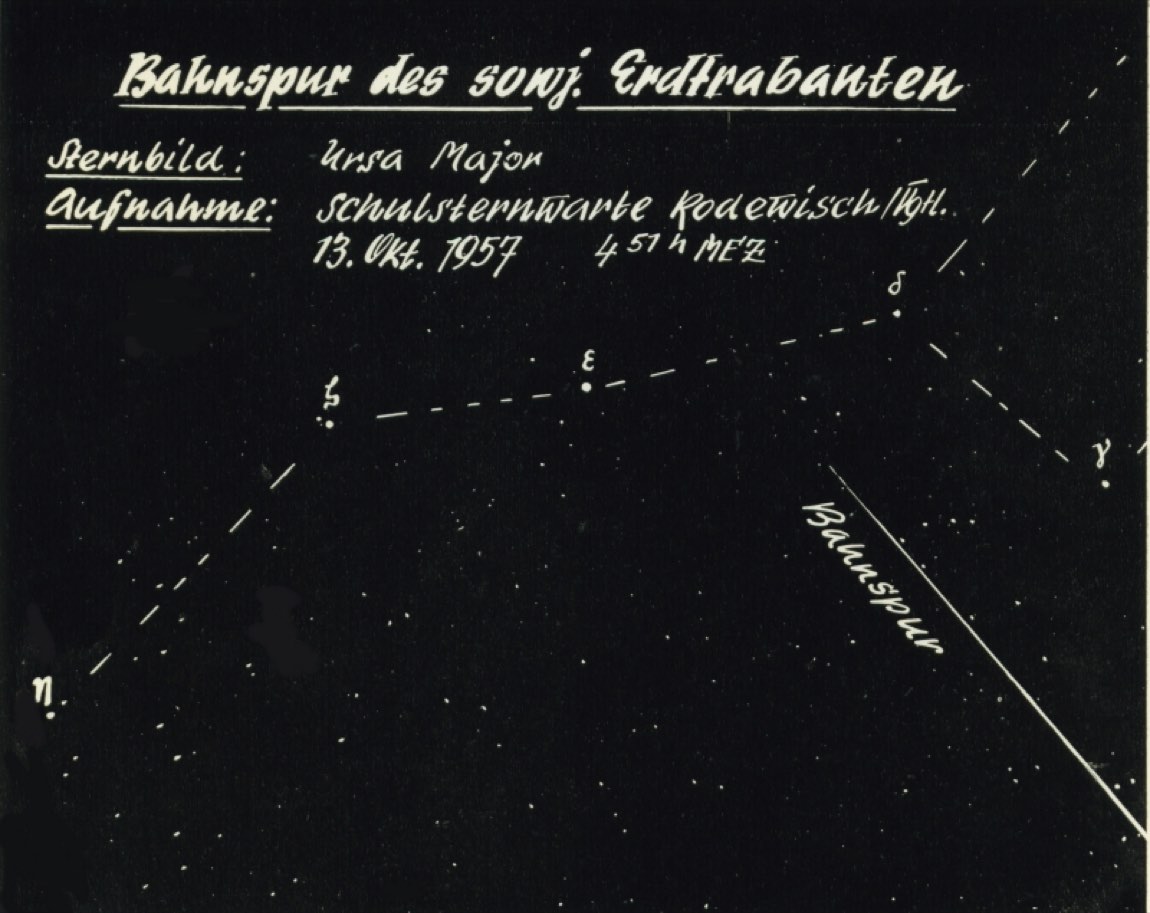
Millions of people tried to watch Sputnik, but most of them were actually watching something else. The satellite itself was a small polished sphere barely visible at sixth magnitude — near the limit of naked-eye detection under dark skies. What most observers actually saw was the spent R-7 core stage, a 26-metre, 7.5-tonne cylinder that had also reached orbit and shone at first magnitude. Soviet engineers had fitted deployable reflective panels onto the booster precisely to make it easier to track optically. Outside the Soviet Union, the booster was pinpointed by radar using the Lovell Telescope at Jodrell Bank Observatory in Britain — described in the article as the only telescope in the world then capable of radar tracking at that scale. Canada's Newbrook Observatory became the first North American facility to photograph Sputnik 1. Inside the Soviet Union, six observatories clustered near the Tyuratam launch site fed data by telegraph to NII-4 in Moscow, while a second nationwide network of seven distant tracking stations equipped with radar, optical instruments, and communications relayed orbital parameters to ballistics specialists.
08 The Birth of Satellite Navigation
Within hours of Sputnik's launch, two American physicists at Johns Hopkins University's Applied Physics Laboratory — William Guier and George Weiffenbach — began monitoring the satellite's radio transmissions and realized something remarkable. Because of the Doppler effect, the shifting frequency of the signal as Sputnik moved toward and then away from them let them calculate precisely where the satellite was along its orbit. The APL director gave them access to the lab's UNIVAC computer to handle the mathematics. Early the next year, Frank McClure, the deputy director of the APL, turned the problem around: if you know the satellite's orbit exactly, can you use the same Doppler measurements to determine the receiver's position on Earth? The U.S. Navy was simultaneously developing the submarine-launched Polaris missile and needed to know the precise location of submarines at sea. The convergence of these two problems led Guier, Weiffenbach, and their APL colleagues to develop the TRANSIT system — a direct forerunner of the Global Positioning System (GPS) satellites that today guide navigation worldwide.
09 Science Extracted from a Simple Beep Deeper
For all its apparent simplicity, Sputnik 1 returned genuinely useful science. Tracking how aerodynamic drag gradually decayed its orbit allowed researchers to calculate the density of the upper atmosphere at altitudes that no balloon or sounding rocket could then sample directly. The satellite's spherical shape had been specified partly for this purpose: a known geometry meant that scientists could isolate atmospheric effects from any shape-dependent variables. Meanwhile, radio physicists around the world analyzed how Sputnik's transmissions on 20.005 and 40.002 MHz changed as the satellite rose and set, extracting measurements of electron density in the ionosphere — the charged layer of the upper atmosphere through which all radio waves must travel. Temperature and pressure data were encoded in the pulse durations, and the barometric switch design meant the satellite would have automatically reported any loss of internal pressure, which would have been the first space-based detection of a meteorite strike on a spacecraft. These modest data streams were part of what the International Geophysical Year was organized to collect, and they fed directly into planning for more sophisticated Soviet and American satellites that followed.
10 Sputnik's Long Shadow over American Life
The shock of Sputnik reshaped American institutions in ways that lasted decades. Congress passed the National Defense Education Act in 1958, offering low-interest loans for college tuition specifically to students majoring in mathematics and science. NASA was created through the National Aeronautics and Space Act. The Advanced Research Projects Agency — later renamed DARPA in 1972 — was established in February 1958 expressly to recover a technological lead. A University of Michigan poll conducted after the launch found that 26% of Americans believed Soviet science and engineering were superior to American; one year later that figure had dropped to 10% as U.S. satellites began reaching orbit. The crisis also generated a cultural vocabulary: the word 'beatnik' was coined by writer Herb Caen in the San Francisco Chronicle on 2 April 1958, riding the sudden productivity of the suffix -nik in English. Astronauts Alan Shepard and Deke Slayton later wrote that seeing Sputnik pass overhead inspired them toward their careers, and designer Harrison Storms — who would go on to lead design of the Apollo command and service module — credited the launch with convincing him that space was America's next step.
11 Physical Survivors: Backups and Replicas
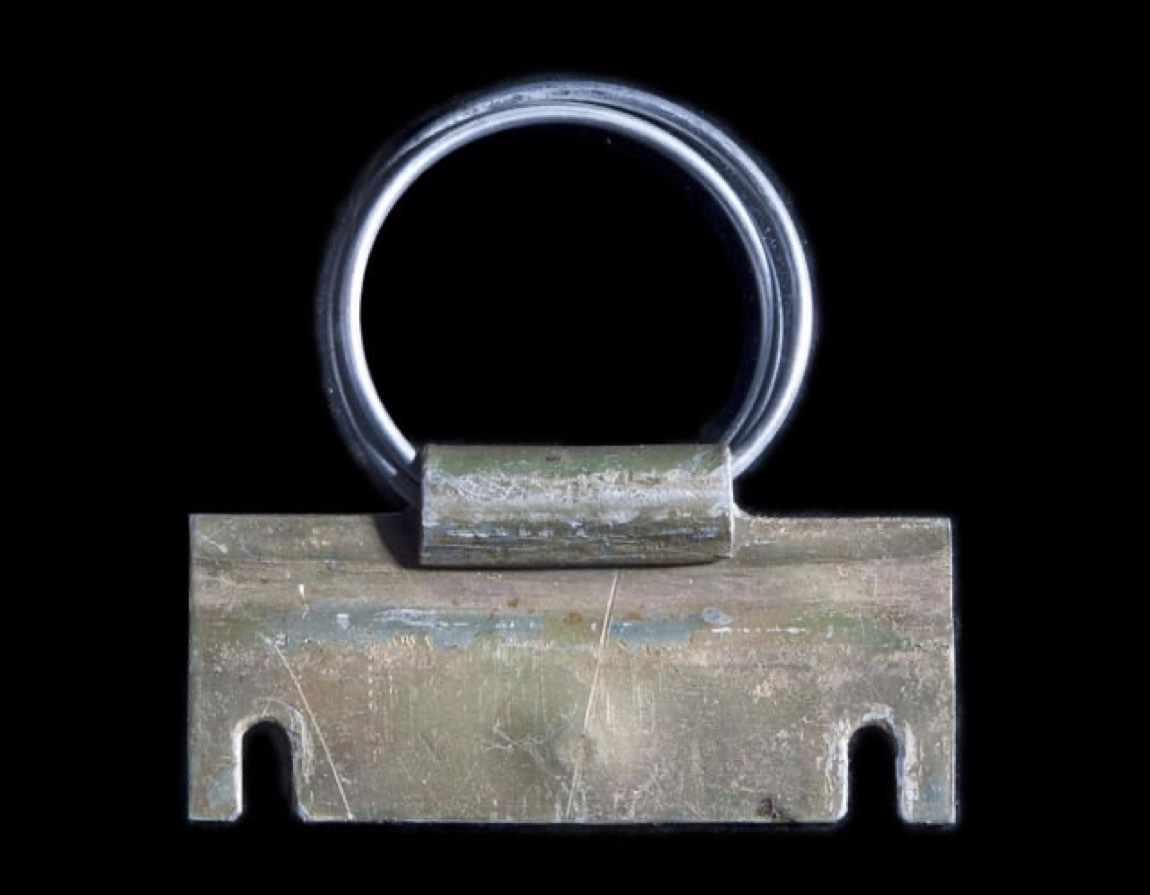
No part of the actual Sputnik 1 survived reentry, but several physical artifacts from the program exist. At least two vintage duplicates, apparently built as flight-ready backup units, are preserved: one is in the corporate museum of Energia near Moscow — the direct institutional descendant of Korolev's design bureau — viewable by appointment, and the other is at the Cosmosphere space museum in Hutchinson, Kansas. A unit at the Museum of Flight in Seattle lacks internal components but retains casings, moulded fittings, and evidence of battery wear; authenticated by the Memorial Museum of Cosmonautics in Moscow, it was auctioned in 2001 and donated anonymously to the museum. Between 1997 and 1999, three student-built replicas at one-third scale were deployed from the Mir space station: Sputnik 40 in November 1997, Sputnik 41 a year later, and Sputnik 99 in February 1999. A fourth replica was launched but never deployed and was destroyed when Mir was deorbited. Full-size replicas are also on public display at the National Air and Space Museum in the United States, the Science Museum in the United Kingdom, the Powerhouse Museum in Australia, and outside the Russian embassy in Spain.
12 The Rocket That Shared the Orbit Deeper
Sputnik 1 was not alone in orbit. The R-7 core stage — 26 metres long and massing 7.5 tonnes, roughly the weight of a fully loaded commercial van times ten — also achieved Earth orbit and remained there for two months, reentering on 2 December 1957, more than a month before Sputnik itself. Engineers had fitted the booster with deployable reflective panels specifically to boost its visibility for ground-based tracking, since at first magnitude it was far easier for observers to follow than the sixth-magnitude satellite. The core stage's orbital path was also scientifically useful: the Soviet 'Tral' telemetry system tracked transponders mounted on the rocket stage even after PS-1 had separated, and Sputnik's own position was then calculated from the known separation distance between the two objects. This elegant workaround compensated for the fact that PS-1 itself carried no active tracking transponders beyond its radio transmitters. The modified R-7 that carried Sputnik, designated 8K71PS, had been trimmed from 280 to 272 tonnes and was 29.167 metres tall with the satellite attached, generating 3.90 MN of thrust at liftoff.
 ⤢
⤢