 Photograph · JSC / NASA Image Library
Spacecraft · Deep guide
International Space Station
Also called: ISS
Humanity's outpost in orbit has been continuously inhabited for a quarter of a century.
What is it?
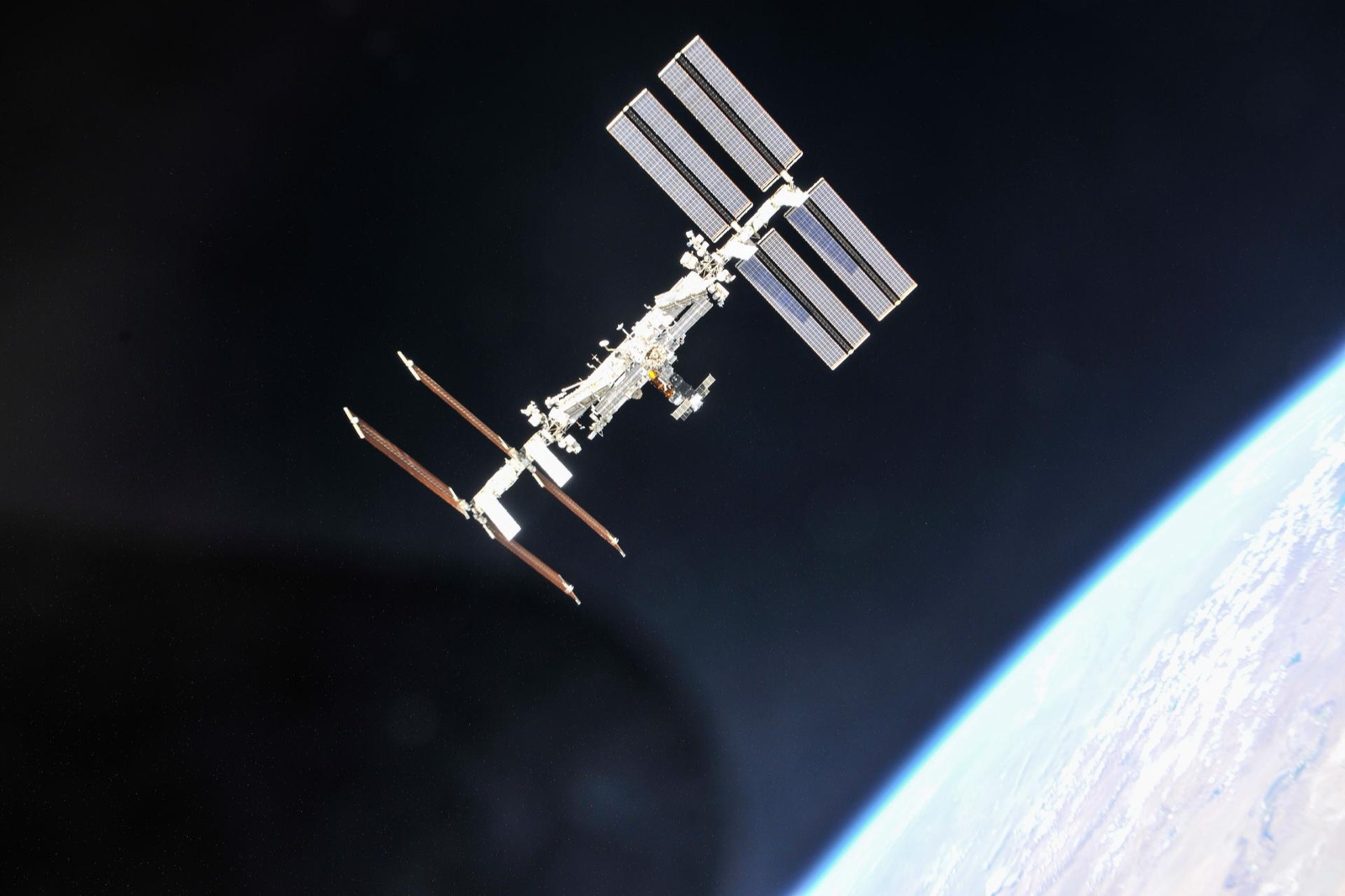
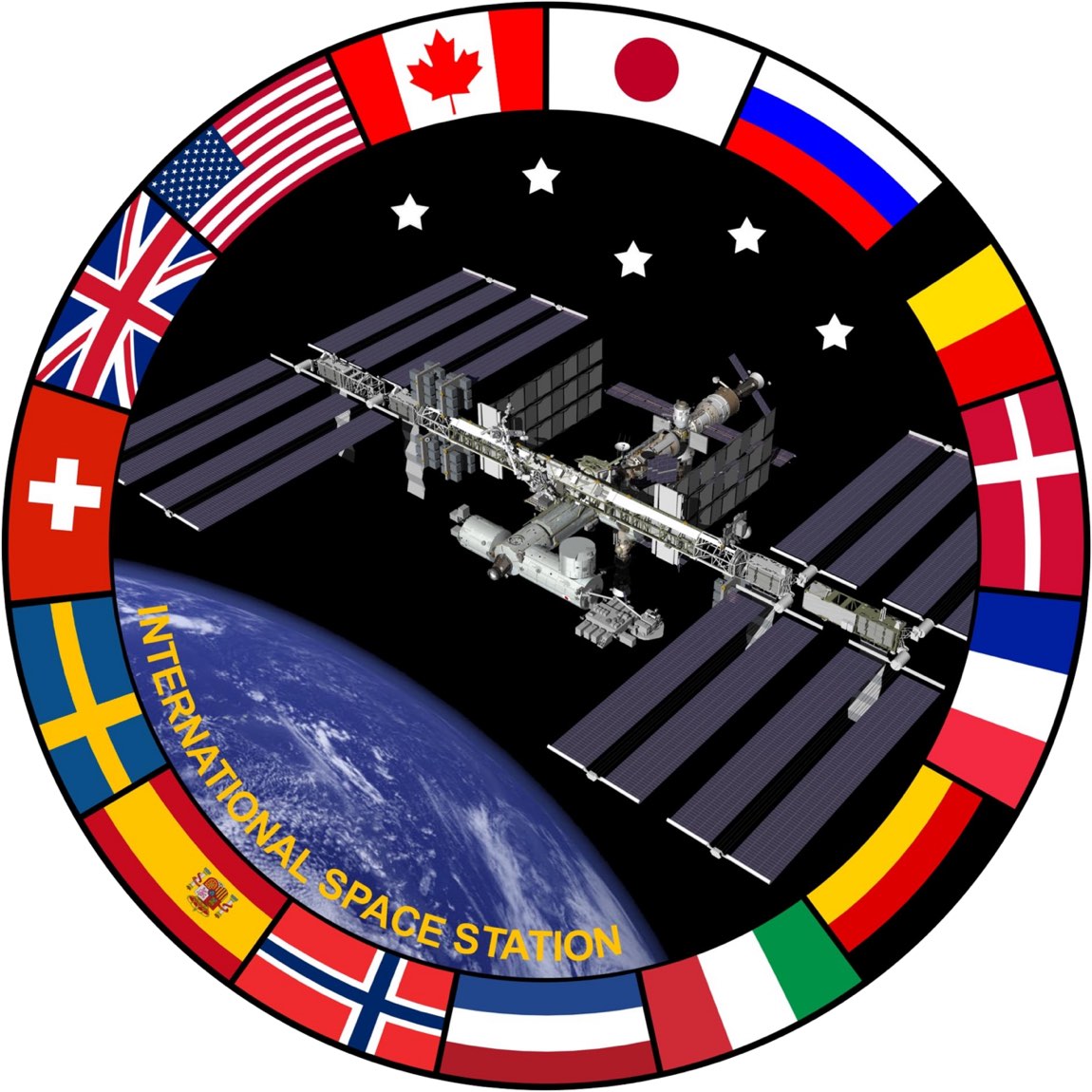
The International Space Station is the largest structure humans have built in space — a football-field-sized laboratory 400 km up, circling Earth every 92 minutes at 28,000 km/h. People have lived aboard continuously since November 2000: every human younger than that has always shared the sky with someone. You can see it with your naked eye — it outshines every star when it passes.
Go deeper
The ISS is a 15-nation partnership assembled over 40+ launches (1998–2011), masses ~420 tonnes, and has hosted 270+ visitors from 20+ countries. Its microgravity lab produced protein-crystal, combustion, and human-physiology research underpinning everything from osteoporosis drugs to Mars-mission medicine (astronauts lose ~1% bone density per month unexercised). It is aging — small Russian-segment leaks are managed — and NASA plans deorbit around 2030–31 via a SpaceX-built tug into Point Nemo, with commercial stations (Axiom, Orbital Reef, Starlab) intended as successors; see News for current status.
01 See it tonight
The ISS looks like a brilliant, silent, non-blinking star crossing the whole sky in about five minutes — typically within an hour or two of sunset or sunrise, when it catches sunlight against a dark sky. NASA's 'Spot the Station' service lists pass times for your town. Wave; there are people on it.
02 What is it FOR? Deeper
Three answers. Science: a laboratory where gravity is removed as a variable — flames burn as spheres, crystals grow purer, and the human body reveals what weight was doing for it. Engineering: 25 years of practice keeping people alive in space — recycling 98% of water, fixing failures — knowledge every Moon/Mars plan inherits. And diplomacy: through every geopolitical storm since 1998, its partners kept flying together.
The deep dive
Researched for the Atlas from Wikipedia — International Space Station (58,000 characters read) · updated Sep 20, 2026
03 How 16 Modules Became One Station
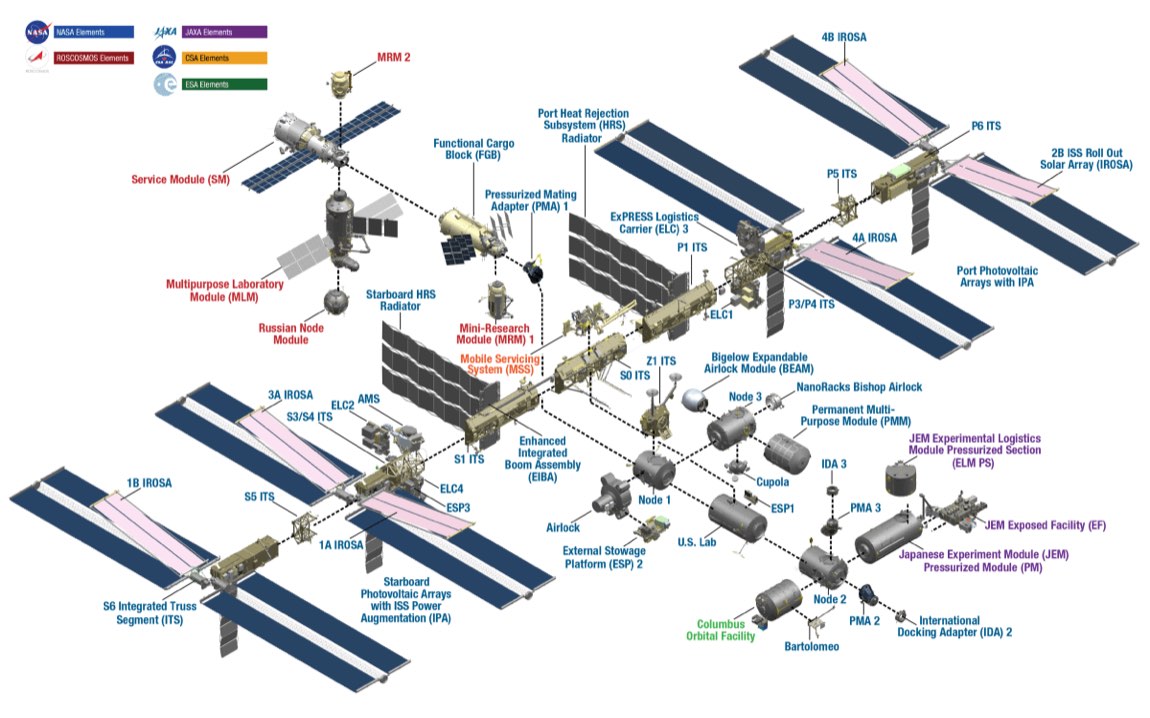
The ISS is not a single vessel but a jigsaw puzzle of 43 modules and elements snapped together over more than a decade. The process began on 20 November 1998 when Russia's Zarya module rode a Proton rocket into orbit, carrying propulsion, attitude control, communications, and electrical power for the embryonic station. Just two weeks later, the American-built Unity node arrived aboard Space Shuttle Endeavour on STS-88 and physically joined Zarya, linking two modules built on different continents by nations that had been bitter Cold War rivals. Even so, neither module had life-support systems, so the joined pair sat empty for nearly two years while work continued on Earth. The real breakthrough came in July 2000 when the Zvezda module — originally manufactured in 1985 as hardware for the Soviet Mir-2 project that was never launched — docked and provided living quarters that made continuous human habitation possible. The station then grew steadily through Russian rockets and 37 dedicated Space Shuttle flights, a construction project so large that by 5 June 2011 astronauts had conducted more than 159 spacewalks totaling more than 1,000 hours outside the station just to bolt it all together.
04 The Truss: the Station's Steel Spine Deeper
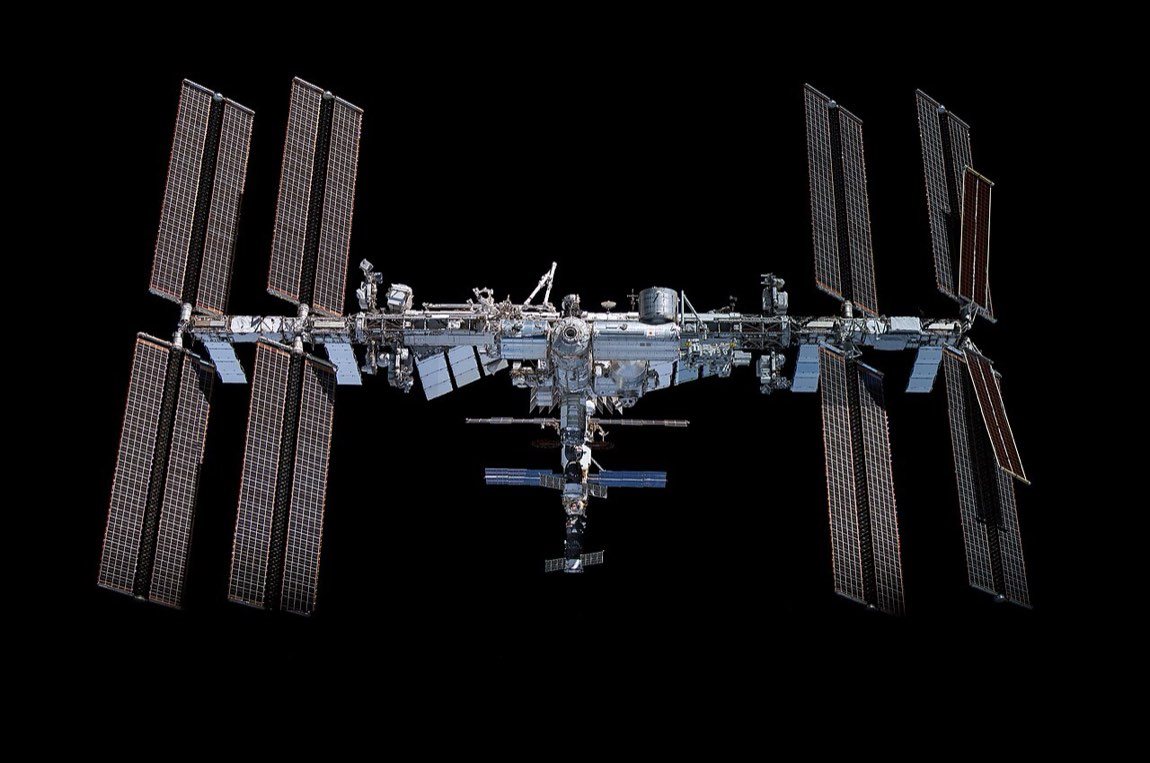
Most visitors to the ISS page focus on the habitable modules, but the skeleton holding everything together is the Integrated Truss Structure, a ten-segment girder stretching 108.5 metres — roughly the length of a regulation American football field end zone to end zone, plus half the field again. Every one of the USOS's major solar arrays and thermal radiators hangs off this backbone. The four pairs of solar array wings together produce 75 to 90 kilowatts of electricity. Each individual array spans about 375 square metres and extends 58 metres in length. Because the station orbits at a relatively low altitude, aerodynamic drag is still a real concern even in near-vacuum, so at night the arrays rotate to a 'Night Glider' position parallel to the ground to reduce drag. During the day, an alpha gimbal rotates each array once per orbit to track the Sun, while a slower beta gimbal compensates for the changing angle between the Sun and the orbital plane. Power is distributed internally at 160 volts DC and then converted down to 124 volts DC for actual use — the higher distribution voltage keeps conductors lighter, though at a cost to crew safety that engineers explicitly acknowledged.
 ⤢
⤢
05 Breathing Recycled Air 400 Kilometres Up
The air inside the ISS is remarkably ordinary: maintained at 101.3 kilopascals, exactly sea-level pressure on Earth, with a normal oxygen-nitrogen mix rather than the pure-oxygen cabins used by early American spacecraft. Generating and scrubbing that air in microgravity requires an entire ecosystem of machinery. The Elektron system in Zvezda and a similar unit in Destiny split water into oxygen and hydrogen by electrolysis, consuming about one litre of water per crew member per day — water brought from Earth or recycled from other onboard systems. Mir was the first spacecraft to use recycled water for oxygen production, and the ISS continues that tradition. When the Elektron fails or demand spikes, the crew can burn Vika oxygen candles: each cartridge decomposes over 5 to 20 minutes at temperatures between 450 and 500 degrees Celsius, releasing 600 litres of oxygen. Carbon dioxide is scrubbed by the Vozdukh system, while activated charcoal filters catch methane from digestion and ammonia from sweat — metabolic byproducts that would otherwise quietly accumulate to dangerous levels in the sealed habitat.
06 The Alpha Magnetic Spectrometer's Dark-Matter Hunt Deeper
Bolted to the outside of the Integrated Truss Structure since May 2011, the Alpha Magnetic Spectrometer is arguably the most ambitious physics experiment ever operated in space. NASA compares its scientific importance to the Hubble Space Telescope — a striking claim for a device most people have never heard of. The AMS was mounted externally specifically because its extraordinary power and data-bandwidth requirements made it impossible to fly as a free-flying satellite. Its mission is to measure cosmic rays streaming through space and search within them for signatures of dark matter and antimatter. On 3 April 2013, the AMS science team reported a first significant finding: an unexplained excess of high-energy positrons in Earth-bound cosmic rays, a pattern consistent with — though not yet definitively proven to be — dark matter annihilation. The scientists themselves described the result as confirming an 'unexplained excess' rather than a discovery, a carefully honest framing that reflects the genuine uncertainty still surrounding the result. The experiment could not have generated its volumes of data without the station's power supply and broadband downlink, a reminder that the ISS is infrastructure as much as it is a laboratory.
07 A Robot Arm That Walks Like an Inchworm
Canadarm2 is the ISS's primary robotic workhorse, a 1,800-kilogram arm that can grab visiting spacecraft, hold astronauts steady during spacewalks, and shuffle Dextre — the station's fine-manipulation robot — to wherever delicate repairs are needed. What makes Canadarm2 genuinely unusual is how it moves: rather than being fixed at one end like a traditional crane, it can detach one tip and reattach the other, inching its way across grapple fixtures along the station's exterior like a mechanical inchworm. A grapple fixture was added to the Russian Zarya module during STS-134 specifically so Canadarm2 could extend its reach onto the Russian Orbital Segment. Riding along the truss on a Mobile Base System that rolls on rails the length of the station, the arm can theoretically reach any point on the US Orbital Segment. Alongside Canadarm2, the 1,560-kilogram Dextre carries two arms, power tools, lights, and cameras precise enough to swap out orbital replacement units — pumps, batteries, antennas — without a spacewalk. Together the system is controlled from Earth or the station itself, reducing the number of dangerous EVAs the crew must perform.
08 Keeping Cool: the Ammonia Radiator System Deeper
The ISS generates enormous amounts of waste heat: nearly all of the electrical power the solar arrays produce is eventually converted to heat by onboard experiments and systems. In the vacuum of space there is no air to carry that heat away by convection, so the station relies entirely on radiation. The External Active Thermal Control System works in two loops. An internal water-based loop absorbs heat from the pressurised modules and dehumidifies the atmosphere; that heat is then transferred to an external loop filled with liquid ammonia. The ammonia circulates through large radiator panels mounted on the truss, emitting heat as infrared radiation into space, before cycling back to start again. The system can reject up to 70 kilowatts of heat — five times the capacity of the Early External Active Thermal Control System it supplemented, which could only handle 14 kilowatts via an Early Ammonia Servicer launched on STS-105. The ammonia used is deliberately toxic to prevent leaks from going undetected, though this also means that any ammonia contamination of a spacesuit during an EVA is a serious emergency requiring crew decontamination procedures before re-entry into the station.
 ⤢
⤢
09 Bacteria That Survived Three Years in Space
In August 2020, scientists announced one of the more startling biological results to come out of ISS research: Deinococcus radiodurans bacteria, placed on the outside of the station and exposed directly to the space environment, survived for three years. Deinococcus is already known on Earth as extraordinarily resistant to radiation and other environmental hazards, but enduring the vacuum, temperature extremes, and intense radiation of low Earth orbit for three consecutive years pushed the boundaries of what biologists expected living organisms could tolerate. The researchers connected their findings to the concept of panspermia — the hypothesis that life could spread between worlds aboard meteoroids, asteroids, comets, or even contaminated spacecraft, distributing organisms across space rather than requiring life to originate independently on each planet. The ISS itself is also home to a finding about small invertebrates called tardigrades, which along with certain extremophile microbes can survive the space environment in an extremely dry, desiccated state. Neither result proves panspermia occurs in nature, but both demonstrate that the barrier between life and space is lower than once assumed.
10 The Political Architecture Behind the Hardware
The ISS is described in the article as the most politically and legally complex space exploration program in history, involving five space agencies and fifteen countries. Its legal foundation is the 1998 Space Station Intergovernmental Agreement, which established the primary framework for cooperation, with a series of subsequent agreements covering jurisdiction, astronaut conduct, and liability. The station is the direct descendant of two programmes that never flew separately: the United States' planned Space Station Freedom and the Soviet Union's Mir-2, whose core module Zvezda was already physically manufactured in 1985 before being repurposed for the ISS. Brazil was the only developing country invited to participate, negotiating an agreement to provide six pieces of hardware in exchange for ISS utilisation rights, but was unable to deliver any of the elements due to funding shortfalls and dropped out officially in 2007. Following Russia's 2022 invasion of Ukraine, the partnership came under serious strain: Roscosmos head Dmitry Rogozin publicly threatened that Russian withdrawal could cause an uncontrolled de-orbit, though his claim that the ISS does not fly over Russia was factually incorrect — the station's 51.6-degree inclination takes it over all landmasses between 51.6 degrees north and south latitude, which includes most of Russia.
11 What 43 Modules Actually Look Like Inside
The 16 major pressurised modules of the ISS each have distinct identities and functions. Destiny, NASA's primary laboratory, hosts experiments in medicine, biotechnology, physics, materials science, and Earth science, and also houses the Oxygen Generating System. The European Columbus module cost the European Space Agency €1.4 billion to build, outfit, and operate, and is controlled from a dedicated Columbus Control Center at the German Aerospace Center in Oberpfaffenhofen near Munich. Japan's Kibō — meaning 'hope' — is the largest single module on the station and uniquely features an external 'porch', the Kibō Exposed Facility, where experiments can be placed directly in the space environment. The seven-windowed Cupola, with its 80-centimetre central window, gives crews a panoramic view of Earth and is used for visual observation, docking operations, and photography. Node modules — Unity, Harmony, and Tranquility — serve as the connective backbone of the US segment, with Harmony alone providing sleeping quarters for four crew members and routing power, data, and life support to the US, European, and Japanese laboratories. Together the pressurised volume of 1,005 cubic metres is comparable to the interior of a Boeing 747 airliner.
12 Radio Hams, Student Calls, and Space Music
The ISS has an unexpectedly rich cultural dimension that the article traces in specific, concrete detail. Amateur Radio on the ISS, known as ARISS, is an international volunteer programme with delegations from nine countries; it allows licensed amateur radio operators to contact the station directly, and connects students worldwide to live conversations with crew members using speakerphones where radio equipment is unavailable. In May 2013, Canadian commander Chris Hadfield recorded a music video of David Bowie's 'Space Oddity' aboard the station and released it on YouTube — the first music video ever filmed in space. In 2011, documentary filmmaker Christopher Riley and ESA astronaut Paolo Nespoli matched the ISS orbit as closely as possible to Vostok 1's 1961 path to film new footage for First Orbit, a feature-length documentary about Yuri Gagarin's pioneering flight; Nespoli is credited as director of photography, having recorded most of the footage himself during Expedition 26/27. Most unusually, in November 2017 Nespoli recorded spoken-word audio in English and Italian during Expedition 52/53 specifically for use on Wikipedia articles — the first content ever created in space for Wikipedia.
 ⤢
⤢
13 What Happens After 2030
The ISS is officially expected to remain operational until the end of 2030, but what happens next is genuinely unsettled. NASA awarded SpaceX a contract in June 2024 to build a US Deorbit Vehicle — a dedicated spacecraft intended to perform a controlled re-entry and destruction of the station in the ocean. Critics of the plan, however, have proposed instead parking the station at a higher, more stable orbit rather than destroying it, and as of 2026 that alternative has gathered congressional support. Meanwhile, Axiom Space has a NASA contract to attach at least one commercial module — the Payload Power Thermal Module — no earlier than 2027, forming a commercial segment that Axiom plans to eventually detach and develop into the independent Axiom Station, which would serve as a successor to the ISS. On the Russian side, modules including Nauka and Prichal are planned to separate around 2030 and form the core of a Russian Orbital Service Station, with the NEM module expected to dock to the ISS in 2029 before joining that new Russian station. Canadarm2 is planned to continue operating on Axiom Station after ISS retirement, giving the 1,800-kilogram robotic arm a lifespan potentially stretching well past the station it was built to serve.
How would we get there?
Crew capsules reach it in as little as 4 hours from launch.
| Technology | Status | Travel time (one way, straight line) |
|---|---|---|
| Apollo-style spacecraft, about 39,000 km/h | Flown technology | 37 seconds |
| Ion-propulsion probe, about 90,000 km/h | Flown technology | 16 seconds |
| Voyager 1, about 61,000 km/h | Flown technology | 24 seconds |
| Parker Solar Probe, about 690,000 km/h | Flown technology | 2 seconds |
| Nuclear-thermal rocket, about 120,000 km/h cruise | In development | 12 seconds |
| Laser light-sail at 20% of light speed | Proposed concept | 0 seconds |
| Light itself, 299,792 km/s | Physical limit | 0 seconds |
Simplified straight-line times at cruise speed. Real missions fly curved orbital paths and take longer. Full travel calculator →
Weird & wonderful
- Astronauts aboard see 16 sunrises and 16 sunsets every day.
- The station has been hit by tiny debris many times — its windows carry the scars.
- Its water recycler turns yesterday's coffee into tomorrow's coffee.
- It has traveled the equivalent of Neptune's distance — 4.5 billion km — without leaving Earth's orbit.