 Photograph · JSC / NASA Image Library
Spacecraft · Deep guide
Apollo 11
The first crewed Moon landing: the day the species left home.
What is it?
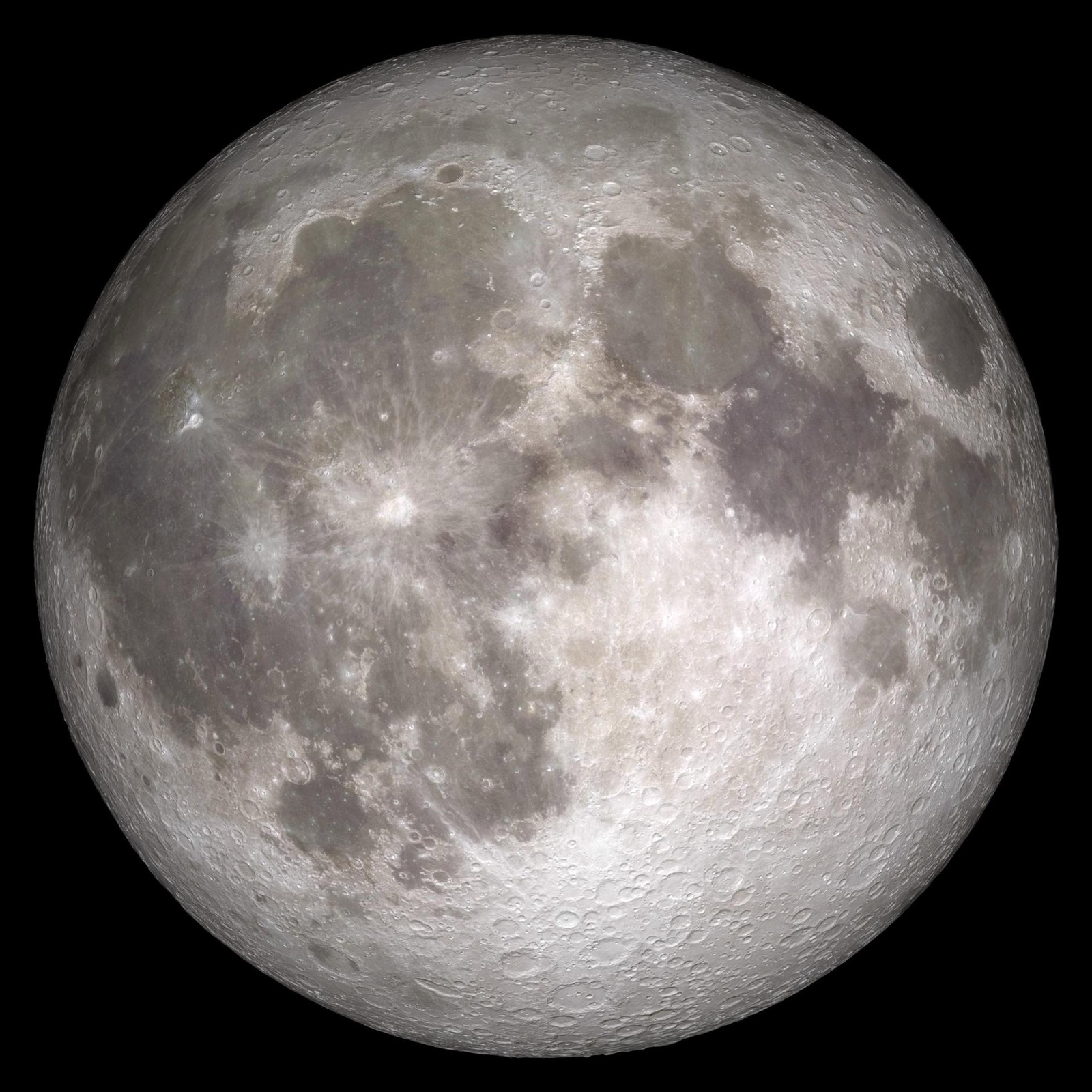
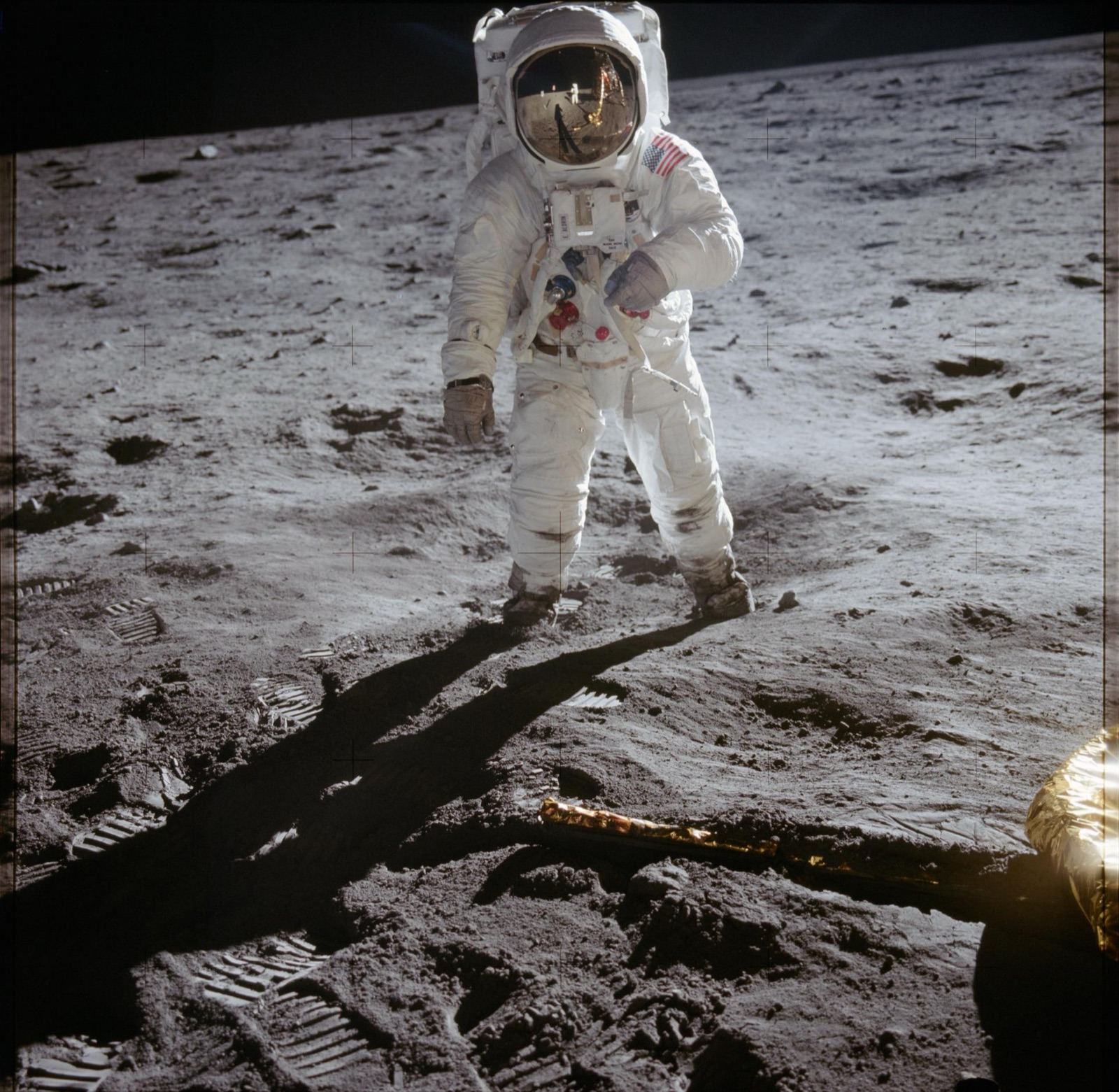
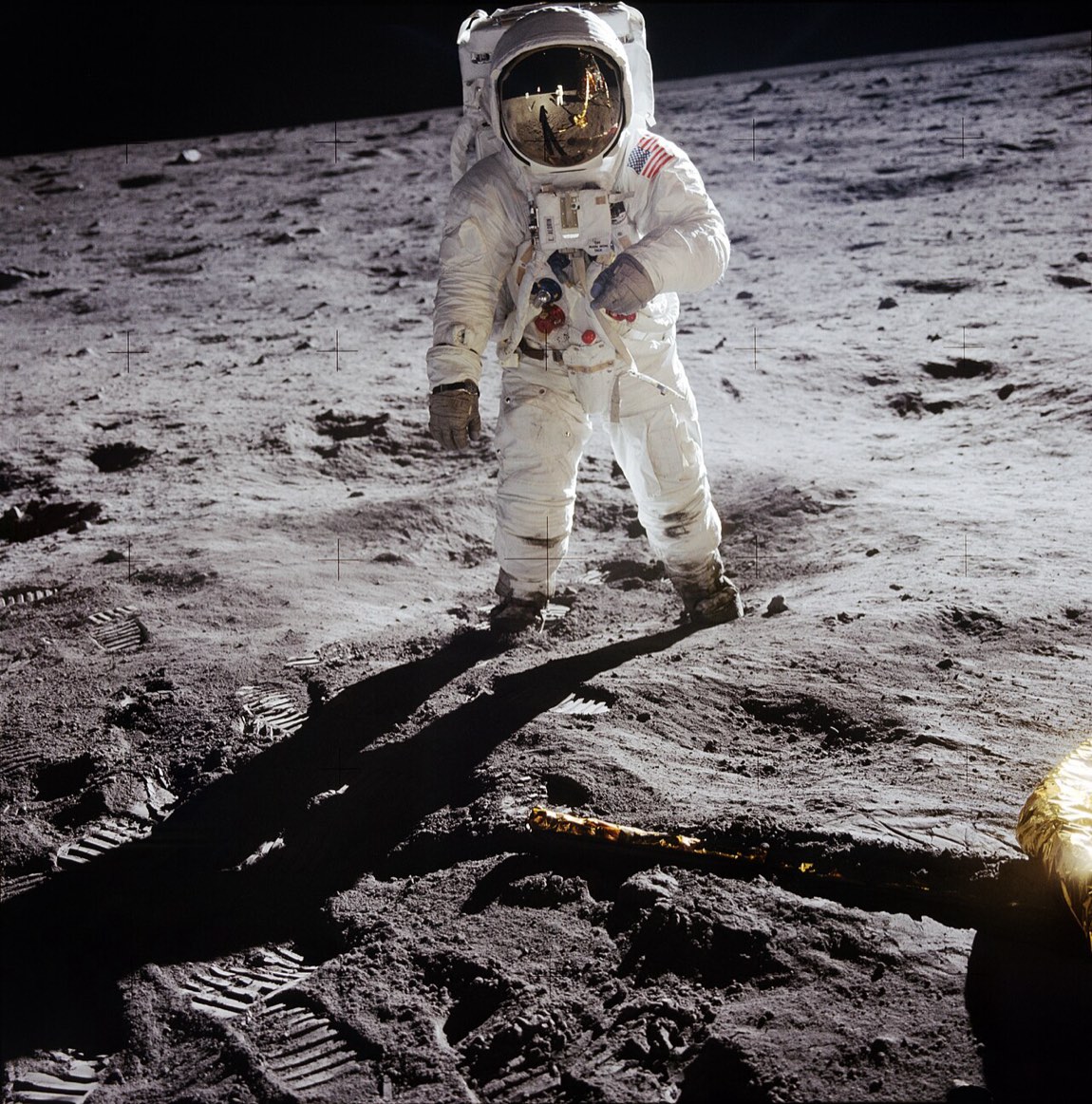
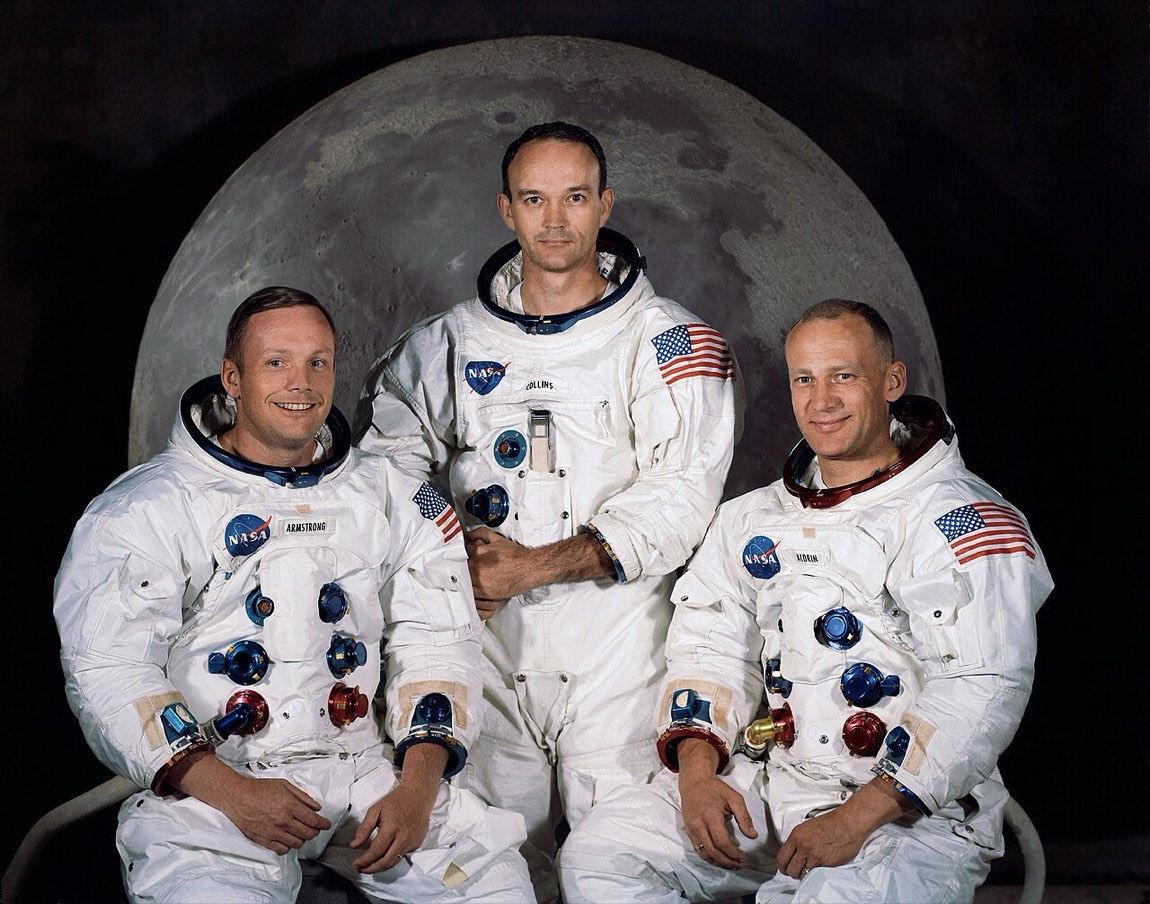
Apollo 11 carried Neil Armstrong, Buzz Aldrin, and Michael Collins to the Moon in July 1969. On July 20, the lunar module Eagle touched down in the Sea of Tranquility with about 25 seconds of fuel margin, and Armstrong stepped onto another world: 'one small step for [a] man, one giant leap for mankind.' An estimated 600 million people — a fifth of humanity — watched live.
Go deeper
Apollo 11 closed an eight-year national commitment made when the US had 15 minutes of human spaceflight experience. The landing overrode a boulder field manually; the 1202 computer alarms (executive overflow from a checklist radar setting) were correctly waved off in real time by 26-year-old guidance officer Steve Bales's team. The crew left a seismometer, a laser retroreflector still used to measure the Moon's recession, and returned 21.5 kg of basalt that anchored the giant-impact origin theory. Six landings followed through 1972; twelve humans have walked there.
01 The computer that couldn't crash Deeper
The Apollo Guidance Computer had less memory than a greeting card that plays music — but its software, led by Margaret Hamilton's team, pioneered priority scheduling: overloaded during the landing, it shed low-priority tasks and kept flying. Those 1202 alarms were the system WORKING. Modern operating systems descend from decisions made for that landing.
02 Why did we stop?
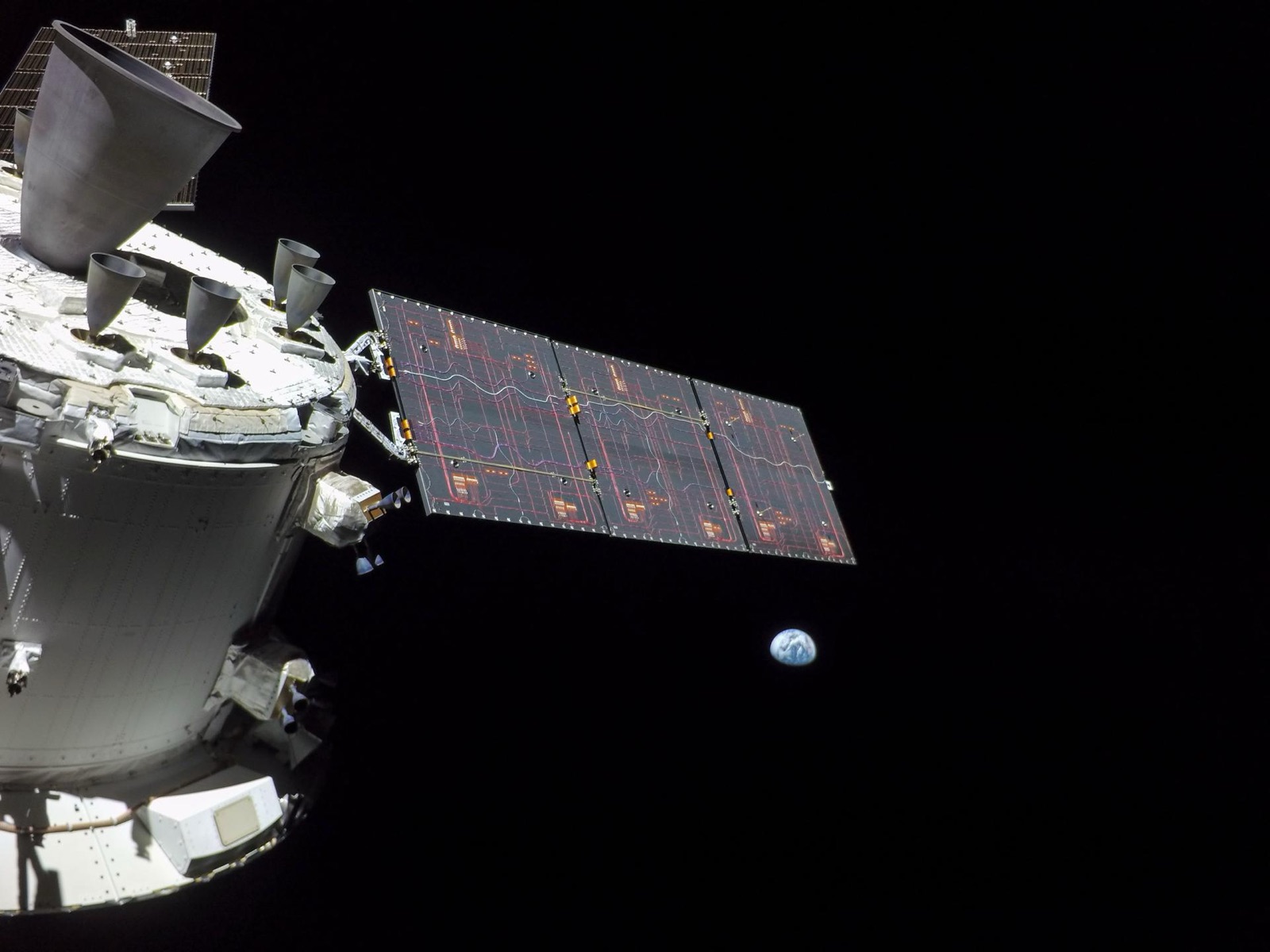
Apollo was a Cold War sprint — once won, its budget (over 4% of federal spending at peak) collapsed. The final three planned landings were cancelled with the rockets already built. Fifty years of low-orbit consolidation followed. The Artemis program is the return attempt — this time aiming to stay.
The deep dive
Researched for the Atlas from Wikipedia — Apollo 11 (58,000 characters read) · updated Sep 20, 2026
03 A rocket so big it shook the ground
The vehicle that hurled Apollo 11 toward the Moon was Saturn V AS-506, and its scale still strains belief. The fully assembled stack weighed 5,443 tonnes — roughly as heavy as a modern Nimitz-class aircraft carrier — and it crawled to Launch Pad 39A atop a crawler-transporter so slowly that the journey from the Vehicle Assembly Building was measured in hours, not minutes. On the morning of July 16, 1969, an estimated one million spectators lined the beaches and highways near Kennedy Space Center, making it one of the largest crowds ever assembled to watch a launch. The television broadcast reached an estimated 25 million viewers in the United States alone, with the launch simultaneously transmitted live to 33 countries. Dignitaries ranged from four cabinet members and 19 state governors to 60 ambassadors and 200 members of Congress. President Nixon watched from the White House with Apollo astronaut Frank Borman serving as his NASA liaison. The first-stage engines shut down just 2 minutes and 42 seconds into the flight, and the spacecraft reached a near-circular Earth orbit at an altitude of 100.4 nautical miles by 98.9 nautical miles only twelve minutes after liftoff.
 ⤢
⤢
04 Three spacecraft disguised as one
What most people picture as "Apollo 11" was actually three distinct spacecraft bolted together for the journey. The command module Columbia housed all three astronauts and was the only piece designed to return to Earth. The service module, attached directly behind it, supplied propulsion, electrical power, oxygen, and water for the whole voyage. Farthest forward during launch — cocooned inside a protective shroud — was the lunar module Eagle, itself a two-piece vehicle: a descent stage with a large engine and fuel tanks for landing, and a lighter ascent stage containing the crew cabin and a small engine for the return trip to lunar orbit. About 30 minutes after the trans-lunar injection burn, Michael Collins performed a critical maneuver called transposition, docking, and extraction, separating Columbia from the spent third stage, rotating the spacecraft 180 degrees, and docking nose-first with Eagle. The spent S-IVB stage then flew past the Moon on a trajectory that flung it into a long orbit around the Sun — deliberately routed to prevent any collision with the Moon, the Earth, or the spacecraft.
05 The Soviet race to beat Apollo home
While Armstrong and Aldrin walked on the Moon, a Soviet spacecraft was racing to steal at least a symbolic victory. Luna 15 launched on July 13, 1969 — three days before Apollo 11 — and reached lunar orbit first. Its mission was to land, scoop up soil, and return it to Earth automatically, beating the Americans in at least one category of the Space Race. The plan failed dramatically: a malfunction during descent caused Luna 15 to crash in Mare Crisium at 15:50 UTC on July 21, just about two hours before Armstrong and Aldrin lifted off the lunar surface. The Nuffield Radio Astronomy Laboratories radio telescope in England recorded Luna 15's transmissions during its final descent, and those recordings were released in July 2009 to mark the 40th anniversary of Apollo 11. A British astronomer listening in reportedly remarked, "I say, this has really been drama of the highest order." The Soviet failure stemmed partly from their inability to develop the N1 rocket — a booster that would have been comparable to the Saturn V — leaving them unable to match the Americans in a crewed landing attempt.
06 How landing site 2 was chosen Deeper
Selecting where to land was far more constrained than it might appear. NASA's Apollo Site Selection Board announced five candidate sites on February 8, 1968, after two years of analysis using high-resolution imagery from five uncrewed Lunar Orbiter probes and surface data from the Surveyor program. Earth-based telescopes simply could not resolve features at the resolution the mission required. The final criteria ran to seven specific requirements: a relatively smooth surface with few craters; approach paths free of large hills, cliffs, or deep craters that might confuse the landing radar; minimum propellant consumption; tolerance for launch delays; a free-return trajectory allowing the spacecraft to loop around the Moon and coast safely home if an engine failed; a Sun angle between 7 and 20 degrees behind the lunar module to limit glare; and a general surface slope of less than two degrees. The Sun-angle requirement was so restrictive it limited the possible launch date to roughly one day per month. A just-after-dawn landing was chosen to moderate temperature extremes. In May 1969, Apollo 10's lunar module flew to within 15 kilometers of the chosen site, Site 2 in the Sea of Tranquility, and confirmed it was acceptable. The final touchdown point lay about 12 miles (19 km) southwest of the crater Sabine D.
 ⤢
⤢
07 A flag, a phone call, and a plaque
The ceremonial moments of the moonwalk were harder to execute than they looked on television. Armstrong and Aldrin struggled to plant the Lunar Flag Assembly because the telescoping rod would only penetrate about 2 inches (5 cm) into the hard lunar surface. Aldrin worried the flag might topple in front of the watching world; he later admitted the flag raising was the job he most wanted to go smoothly. Before Aldrin could photograph Armstrong beside it, President Nixon placed a telephone-radio call from the Oval Room — what Nixon himself called "the most historic telephone call ever made from the White House." Frank Borman, present at the White House as a NASA liaison, persuaded Nixon to keep his remarks brief, cutting a longer speech the president had prepared. The astronauts also unveiled a plaque on Eagle's ladder bearing drawings of the Eastern and Western Hemispheres, the signatures of the crew and President Nixon, and the inscription: "Here men from the planet Earth first set foot upon the Moon July 1969, A.D. We came in peace for all mankind." The initials A.D. — Anno Domini, meaning "in the year of our Lord" — were included at the request of the Nixon administration as a veiled religious reference, using the date format as a pretext.
08 New minerals born in the lunar soil Deeper
Among the 21.55 kilograms (47.5 lb) of lunar material Armstrong and Aldrin collected and hauled up to Eagle using a flat cable pulley called the Lunar Equipment Conveyor were samples that contained minerals never previously identified by science. Analysis back on Earth revealed three new minerals: armalcolite, tranquillityite, and pyroxferroite. Armalcolite was named directly from the crew — ARMstrong, ALdrin, COLlins. The geological samples also contained two familiar rock types: basalt and breccia. Not all of the collection went smoothly; Aldrin was unable to drive core-sample tubes more than 6 inches (15 cm) into the surface even using the geologist's hammer — the only time that hammer was used during the entire Apollo 11 EVA. With surface activities consistently running over schedule, the astronauts had to stop formally documenting sample collection halfway through the allotted 34 minutes. Aldrin shoveled 6 kilograms (13 lb) of loose soil into the rock box purely to pack the samples tightly for the journey home. All three new minerals have since been identified in terrestrial rocks as well, cementing their place in the broader catalogue of known minerals rather than remaining uniquely lunar curiosities.
09 The patch, the coin, and the call signs
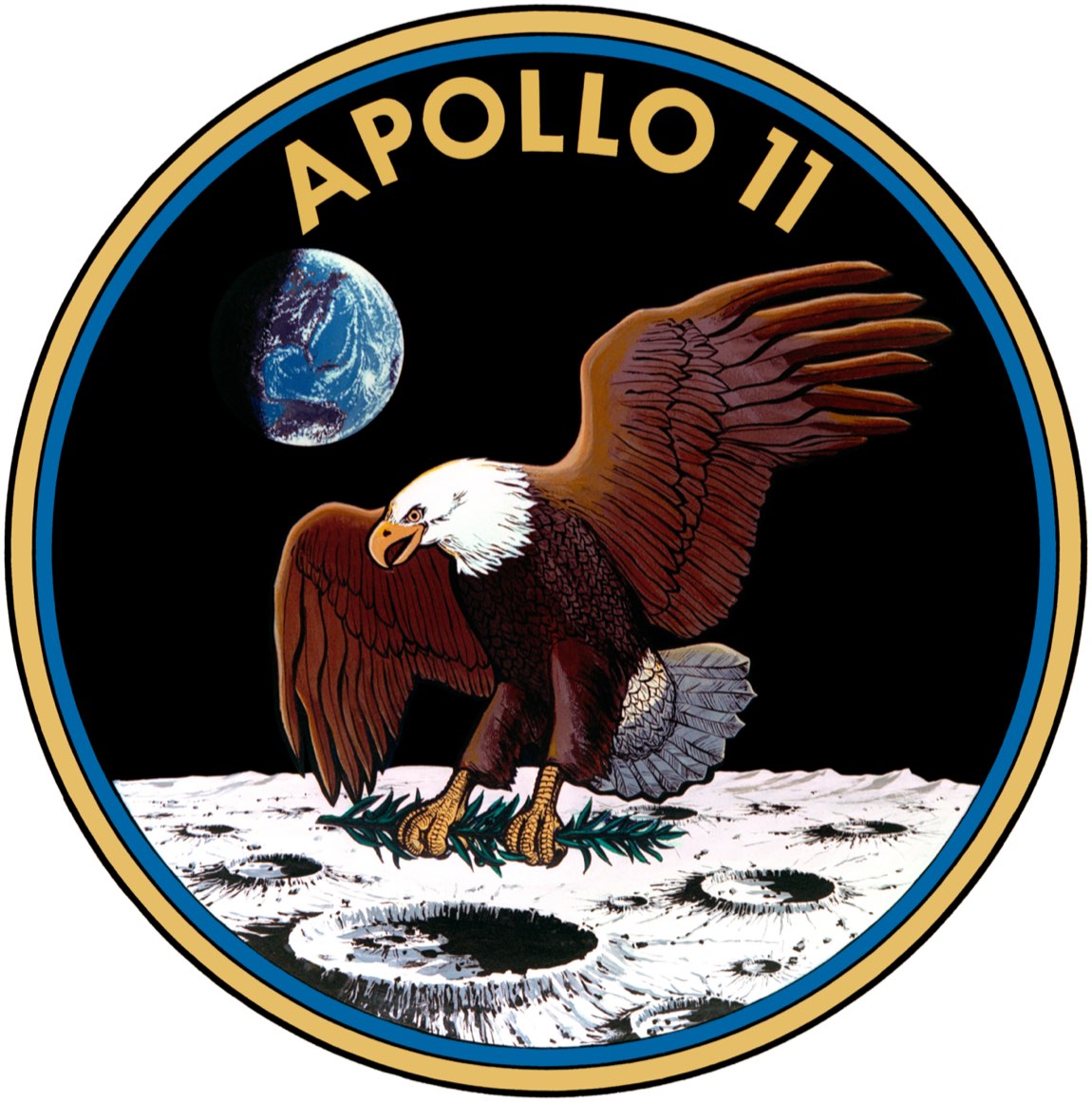
Michael Collins designed the Apollo 11 mission emblem himself, aiming for a symbol of "peaceful lunar landing by the United States." Jim Lovell suggested the bald eagle, and simulator instructor Tom Wilson proposed an olive branch in its beak to signal peaceful intent. The original design placed the olive branch in the eagle's beak, but NASA director Bob Gilruth thought the talons looked "too warlike," so the branch was moved to the talons in the final version. Armstrong insisted the patch carry no astronaut names, so it would represent everyone who worked toward the lunar landing, and he replaced the word "eleven" with "Apollo 11" because numerals cross language barriers more easily. The design proved durable: when the Eisenhower dollar coin was released in 1971, its reverse side used the patch's eagle, and the same image appeared on the smaller Susan B. Anthony dollar unveiled in 1979. The spacecraft call signs had their own stories: Eagle was named for the patch's central motif, while Columbia took its name from Columbiad — the fictional cannon that launched a Moon-bound spacecraft from Florida in Jules Verne's 1865 novel From the Earth to the Moon.
 ⤢
⤢
10 Solitude and suspense in lunar orbit
While Armstrong and Aldrin were on the surface, Michael Collins orbited alone in Columbia, completing 30 orbits of the Moon. For 48 minutes of each orbit, when Columbia passed around the far side, he lost all radio contact with Earth — a silence more total than any human had experienced since the dawn of the space age. Collins later wrote that the feeling during those stretches was not fear or loneliness but rather "awareness, anticipation, satisfaction, confidence, almost exultation." He described his role not as peripheral but essential: "this venture has been structured for three men, and I consider my third to be as necessary as either of the other two." His practical tasks during this time were decidedly unglamorous: dumping excess water produced by the fuel cells, monitoring a coolant temperature problem that briefly threatened to freeze parts of the spacecraft, and repeatedly scanning the lunar surface trying — and failing — to spot the landed Eagle. Mission Control told him the lander had touched down about 4 miles (6.4 km) off target, but even with that guidance he could not locate it from orbit. Collins was also prepared for a contingency plan in which he would fly Columbia down toward the surface to meet Eagle if the ascent stage could not reach him.
11 The speech Nixon hoped he'd never read Deeper
Before Apollo 11 launched, presidential speechwriter William Safire drafted a contingency address titled "In Event of Moon Disaster" for Nixon to deliver if Armstrong and Aldrin became stranded on the lunar surface. The memo, addressed to Nixon's Chief of Staff H. R. Haldeman, also outlined a protocol: Mission Control would "close down communications" with the lunar module, and a clergyman would then "commend their souls to the deepest of the deep" in a public ritual explicitly compared to a burial at sea. The final line of the prepared text contained an allusion to Rupert Brooke's World War I poem "The Soldier." The script made no mention of Collins, since it was assumed he would be able to pilot Columbia back to Earth regardless of what happened on the surface. The disaster scenario very nearly had a real-world precedent during the mission: Aldrin accidentally broke the circuit breaker that armed the ascent engine, the only means of leaving the Moon. The crew discovered that the nonconductive tip of a Duro felt-tip pen could press the switch adequately, allowing liftoff to proceed. It was a solution so improvised that no training exercise had ever anticipated it.
12 A storm, a spy satellite, and a last-minute swerve Deeper
The safe return of the crew very nearly came undone not in space but over the Pacific Ocean. Weather satellites were not yet common in 1969, but US Air Force Captain Hank Brandli had access to classified spy satellite imagery and spotted a dangerous storm front moving toward the planned recovery area. He warned that poor visibility would make locating the capsule difficult, and that fierce upper-level winds would, in his words, have "ripped their parachutes to shreds." Brandli alerted Navy Captain Willard S. Houston Jr. at the Fleet Weather Center in Pearl Harbor, and on their recommendation Rear Admiral Donald C. Davis advised NASA to relocate the splashdown zone — each officer aware that recommending such a change risked his career if it proved unnecessary. A new location was chosen 215 nautical miles (398 km) northeast of the original site. The course change required running a sequence of computer reentry programs never before used in combination: instead of the standard P64 followed by P67, the revised reentry ran P65 directly into P67, skipping P66 entirely. The first program subjected the crew to 6.5 standard gravities (64 m/s²), and the second to 6.0 standard gravities (59 m/s²) — a sequence with no prior operational precedent.
 ⤢
⤢
13 What the astronauts left behind
The list of items deliberately left on the lunar surface reveals both the mission's solemnity and its political complexity. Beyond the scientific instruments — a Passive Seismic Experiment Package to measure moonquakes and a retroreflector array for laser ranging experiments — the crew deposited a remarkable collection of mementos. An Apollo 1 mission patch honored Gus Grissom, Roger Chaffee, and Ed White, who died in the launchpad fire of January 1967. Two memorial medals commemorated Soviet cosmonauts Vladimir Komarov and Yuri Gagarin, who had died in 1967 and 1968 respectively — an acknowledgment of shared human sacrifice across the Space Race divide. A gold olive-branch replica symbolized peace, and a silicon disk carried goodwill messages from leaders of 73 countries along with statements from four American presidents. Armstrong also carried personal mementos in his lunar module preference kit, including a piece of wood from the left propeller of the Wright brothers' 1903 Flyer and a piece of fabric from its wing — a direct material link stretching from the first powered flight in human history to the first steps on another world, separated by just 66 years.
14 Fame, parades, and what came next
After splashing down in the Pacific Ocean on July 24, 1969, the crew of Apollo 11 faced a period of enforced isolation before any celebration. Recovery ship USS Hornet, commanded by Captain Carl J. Seiberlich, retrieved the command module Columbia and its crew, and the astronauts entered quarantine — a precaution against any hypothetical lunar microorganisms. When quarantine ended, the acclaim was extraordinary: ticker-tape parades, a world goodwill tour, and the Presidential Medal of Freedom. The broadcast of Armstrong's moonwalk had reached an estimated 600 million viewers — roughly one-fifth of Earth's entire population at the time — making it among the most-watched television events in history. The signal had been received at Goldstone in the United States, but with greater fidelity at Honeysuckle Creek Tracking Station near Canberra, Australia, before being switched to the more sensitive Parkes radio telescope. Recordings of the original slow-scan television transmission from the lunar surface were likely destroyed during routine magnetic tape reuse at NASA. Today, the command module Columbia is preserved at the National Air and Space Museum in Washington, D.C., while Eagle's descent stage remains on the Sea of Tranquility, and calculations published in 2021 suggest the ascent stage may still be in lunar orbit.
How would we get there?
Three days each way — the commute humanity managed nine times.
| Technology | Status | Travel time (one way, straight line) |
|---|---|---|
| Apollo-style spacecraft, about 39,000 km/h | Flown technology | 9.9 hours |
| Ion-propulsion probe, about 90,000 km/h | Flown technology | 4.3 hours |
| Voyager 1, about 61,000 km/h | Flown technology | 6.3 hours |
| Parker Solar Probe, about 690,000 km/h | Flown technology | 34 minutes |
| Nuclear-thermal rocket, about 120,000 km/h cruise | In development | 3.2 hours |
| Laser light-sail at 20% of light speed | Proposed concept | 6 seconds |
| Light itself, 299,792 km/s | Physical limit | 1 seconds |
Simplified straight-line times at cruise speed. Real missions fly curved orbital paths and take longer. Full travel calculator →
Weird & wonderful
- The flags planted on the Moon have likely been bleached pure white by 50 years of raw sunlight.
- Armstrong's first-step footage survives; the original slow-scan tapes were erased and reused — the great archival heartbreak.
- Collins, alone behind the Moon, was momentarily the most isolated human ever — and said he loved it.
- A piece of the Wright Flyer's wing flew to the Moon aboard Eagle.