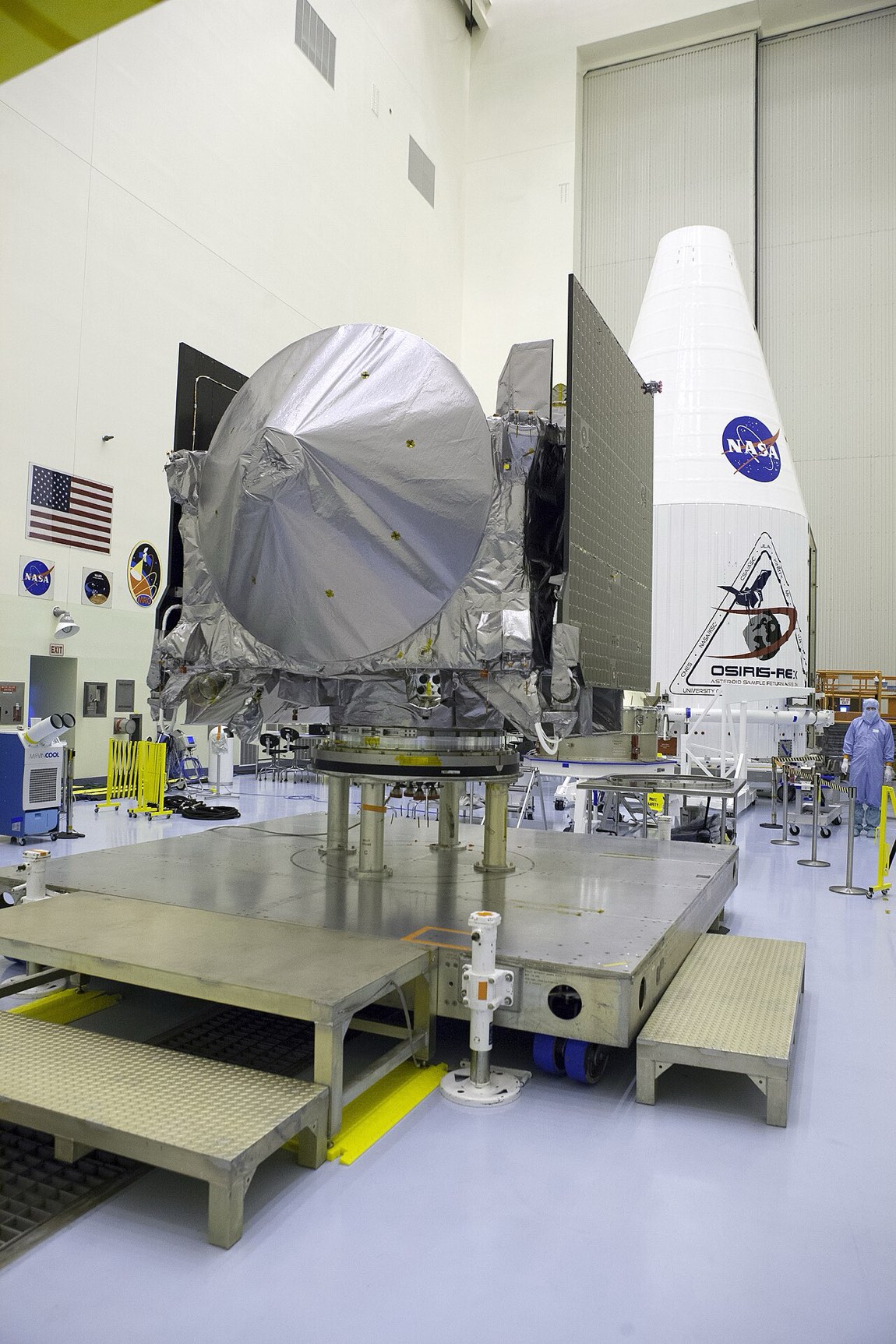
 Photograph · NASA Kennedy from United States NASA/Glenn Benson · Public domain
Spacecraft · Deep guide
OSIRIS-REx
America's asteroid courier delivered 121 grams of Bennu by parachute.
What is it?
OSIRIS-REx flew to asteroid Bennu, mapped it for two years, survived a sampling touchdown that nearly swallowed the spacecraft in fluffy rubble, and on September 24, 2023 dropped a capsule holding 121.6 grams of asteroid into the Utah desert — the largest asteroid sample ever returned. Inside: water-bearing clays, amino acids, all five genetic-code bases, and ancient salts. The spacecraft, renamed OSIRIS-APEX, is now en route to asteroid Apophis for its 2029 Earth flyby.
The deep dive
Researched for the Atlas from Wikipedia — OSIRIS-REx (31,323 characters read) · updated Sep 20, 2026
01 A Seven-Year Journey Across the Solar System
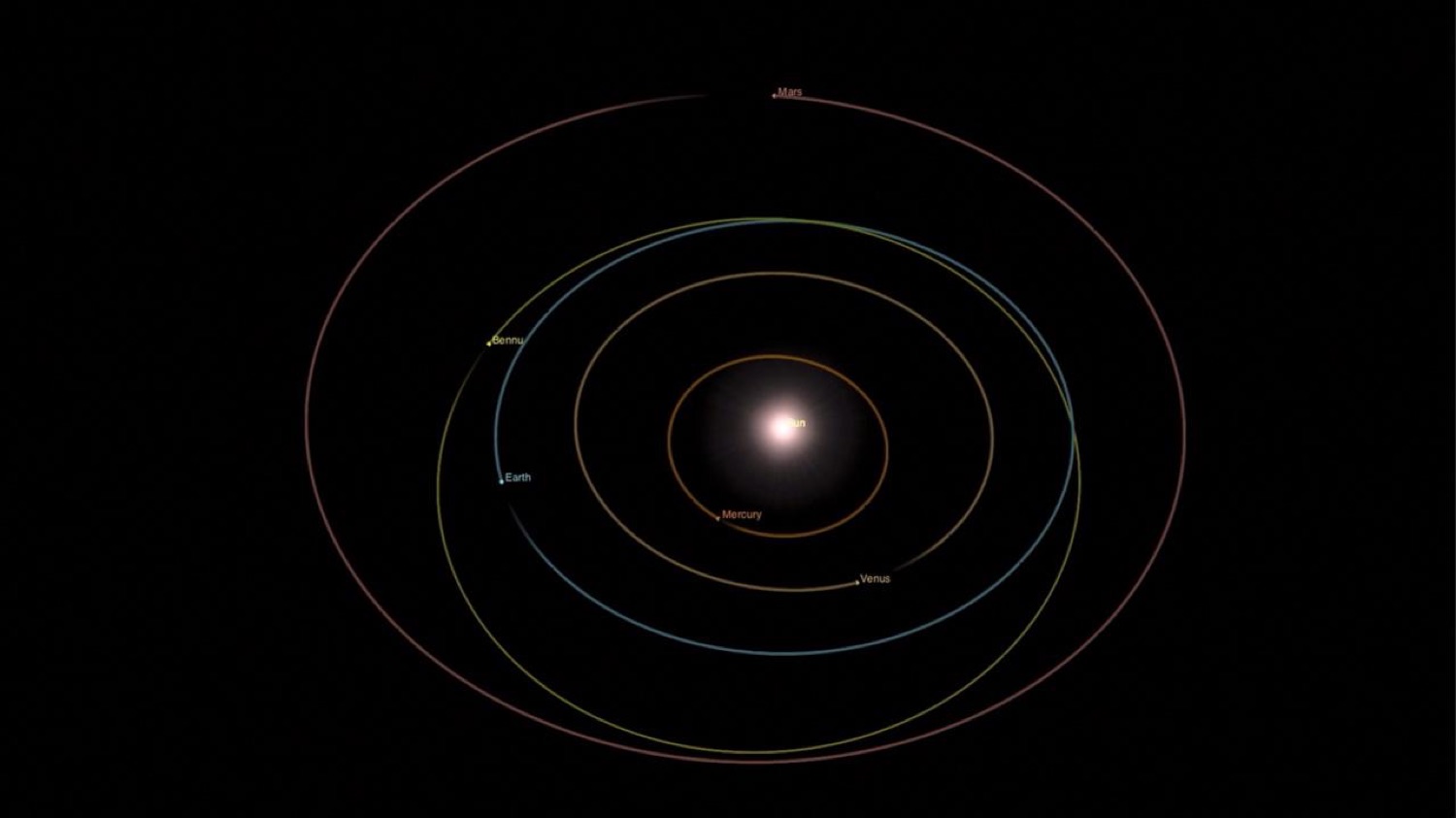
From launch to sample delivery, OSIRIS-REx spent roughly seven years in space threading a precise gravitational needle. It lifted off on 8 September 2016 at 23:05 UTC aboard a United Launch Alliance Atlas V 411 rocket from Cape Canaveral's Space Launch Complex 41. The rocket's first stage was powered by an RD-180 engine assisted by a single AJ-60A solid-fuel booster, with a Centaur upper stage finishing the job. The spacecraft separated 55 minutes after ignition, leaving Earth at a hyperbolic escape speed of about 5.41 km/s. Rather than flying straight to Bennu, it looped back past Earth on 22 September 2017 to steal a gravitational boost, a classic trick that saves fuel. A deep space maneuver on 28 December 2016 changed velocity by 431 m/s using 354 kg of fuel, with a smaller trim burn following on 18 January 2017. The principal investigator called the launch "exactly perfect," with no anomalies detected before or during the event.
02 Mapping an Asteroid at Arm's Length
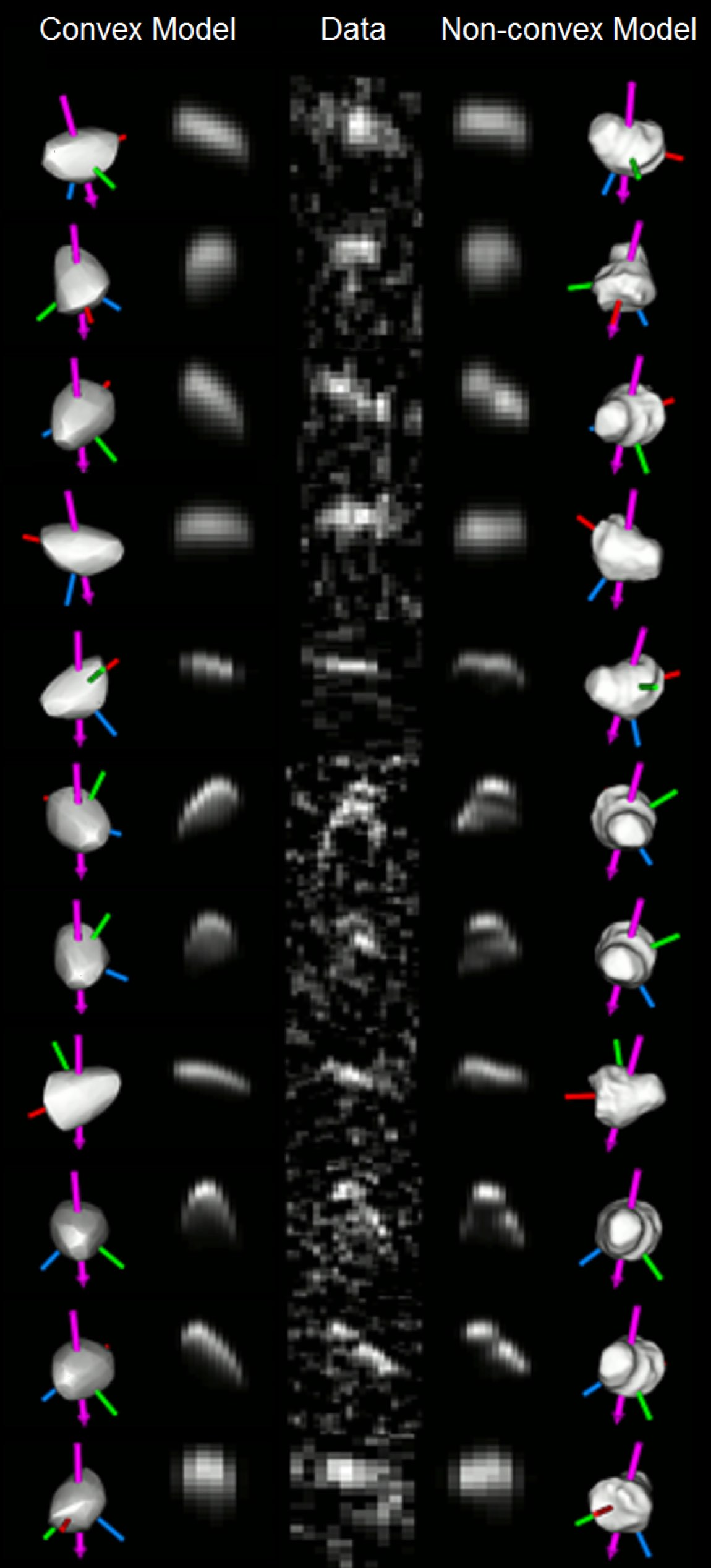
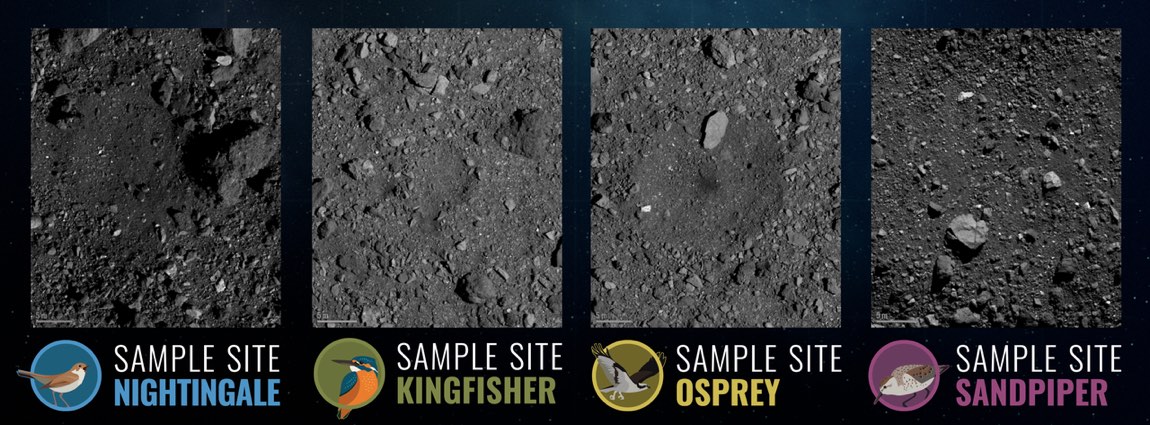
Arriving at Bennu on 3 December 2018, OSIRIS-REx didn't simply land — it entered a 505-day campaign of meticulous mapping at a distance of roughly 5 km, closer to the asteroid than most people's daily commute to work. On 31 December 2018 it slipped into orbit around Bennu at only 1.75 km altitude, the closest any spacecraft has ever orbited a celestial body, beating even the Rosetta probe's 7 km orbit around comet 67P/Churyumov-Gerasimenko. At that altitude one orbit took 62 hours. Spectroscopic surveys detected hydrated minerals in the form of clay, suggesting hydroxyl groups that may have come from water once present in Bennu's parent body before it broke apart. The spacecraft eventually tightened its orbit further to a radius of 1 km. Four candidate sample sites were named Nightingale, Kingfisher, Osprey, and Sandpiper in August 2019, with Nightingale near the north pole chosen as the primary target and Osprey near the equator as backup — both located within craters.
03 The Five-Second Touch That Changed Everything
Collecting a sample from a rubble-pile asteroid hundreds of millions of kilometres away required two dress rehearsals before the main event. The first, on 15 April 2020, brought the spacecraft to within 65 m of the surface; the second on 11 August 2020 descended to 40 m. On 20 October 2020 at 22:13 UTC, with the spacecraft 320 million kilometres from Earth, OSIRIS-REx made contact with Bennu's surface. The TAGSAM arm, stretching 3.35 m, fired a burst of nitrogen gas lasting just five seconds to fluidise regolith particles smaller than 2 cm, blowing them into a sampler head. Contact pads made of tiny stainless-steel loops — essentially a Velcro-like material — passively trapped grains smaller than 1 mm. The spacecraft touched down within 92 cm of the intended target, an extraordinary feat of navigation. Solar arrays had been raised into a Y-shape beforehand to minimise dust buildup and to keep the craft stable if it tipped up to 45 degrees. The approach velocity at contact was just 10 cm/s — slower than a leisurely walk.
04 When the Sample Container Wouldn't Close Properly Deeper
Success brought an unexpected crisis. Images taken after contact revealed rocks wedged in the mylar flap designed to seal the sample inside, and material was slowly leaking out into space. Mission controllers cancelled both a planned spin manoeuvre — intended to measure sample mass by change in momentum — and a navigational braking burn, and moved up sample stowage from 2 November to 27 October 2020 to prevent further loss. On 28 October the collector head was secured inside the Sample-Return Capsule. Engineers commanded the spacecraft to sever two mechanical connections: the nitrogen gas tube and the TAGSAM arm itself, and the capsule lid was closed and latched with two internal latches. Inspection images showed a few particles had escaped during stowage, but the team was confident that more than the required 60 g remained. Final accounting confirmed 121.6 g — more than double the mission minimum — had been safely sealed inside a 46 kg return capsule similar in design to the one that returned comet 81P/Wild samples on the Stardust mission.
05 A Parachute Problem on the Way Home
The return capsule's ride back to Earth on 24 September 2023 was not entirely smooth. At 4:42 a.m. MDT, at a distance of 101,000 km from Earth, the spacecraft released the capsule, which slammed into the atmosphere at 44,500 km/h. A wiring mistake meant the drogue parachute failed to deploy as planned at 30,400 m altitude. The main parachute opened instead at around 2,700 m — lower and faster than designed — but survived the higher-than-anticipated deployment stresses. The capsule touched down at 18 km/h at 8:52 a.m. MDT at the Utah Test and Training Range, one minute ahead of schedule. A helicopter retrieved it by 10:15 a.m. The capsule then travelled to NASA's Johnson Space Center and was opened on 11 October 2023, revealing the first glimpse of Bennu's interior. Damaged fasteners slowed full access, but after three months of work the container was completely opened on 13 January 2024.
06 Amino Acids, Nucleobases, and a Left-Right Puzzle Deeper
The scientific revelations from Bennu's sample arrived in stages. A first look in October 2023 noted organic molecules and unknown materials. By December 2023 the picture sharpened, and in January 2025 NASA reported a sweeping inventory: a wide range of carbon- and nitrogen-rich organic compounds, including 14 of the 20 amino acids that build proteins in living organisms on Earth, along with all four nucleobases — adenine, thymine, cytosine, and guanine — the chemical letters of DNA and RNA. Crucially, the samples contained a nearly equal mix of left-handed and right-handed amino acids. Life on Earth uses almost exclusively left-handed amino acids, so the roughly 50-50 split raises genuine questions about whether asteroidal delivery helped tip Earth's biochemistry toward one handedness, or whether that tipping happened elsewhere. The amount of ammonia detected indicates Bennu originated in the colder outer regions of the Solar System, not the warmer inner disk. Samples were made available to scientists worldwide on 1 April 2024.
07 Measuring the Subtle Yarkovsky Effect Deeper
One of the mission's most consequential goals was pinning down the Yarkovsky effect on Bennu — a tiny but cumulative thermal force caused when a rotating asteroid absorbs sunlight and re-emits it as heat, nudging the object onto a slightly different trajectory over thousands of years. The effect is too small to measure from Earth with precision on an object the size of Bennu, which has a mean diameter of 480 to 511 m. Understanding it matters enormously for planetary defence: calculations give Bennu a cumulative probability of 1 in 1,410, or 0.071%, of striking Earth between 2169 and 2199. Even a small uncertainty in the Yarkovsky drift translates to significant uncertainty in that probability over centuries. The spacecraft's instruments were specifically designed to characterise the physical properties — composition, texture, thermal inertia — that feed into Yarkovsky models. OTES measured thermal emission globally in the 4–50 µm range, while OVIRS mapped minerals across 400–4300 nm, together providing the data needed to refine the force estimates and better predict whether Bennu's orbit will converge on Earth.
08 An Accidental Black Hole Discovery
Not every finding from OSIRIS-REx was about Bennu. On 11 November 2019, while university students and researchers were using the REXIS instrument to observe the asteroid, they unexpectedly caught an X-ray burst from a black hole named MAXI J0637-430, located roughly 30,000 light-years away. REXIS is a coded-aperture soft X-ray telescope covering 0.3 to 7.5 keV, designed to map element abundances on Bennu's surface by detecting X-ray fluorescence produced when solar X-rays excite atoms in the regolith. The instrument was sensitive enough — imaging with 21-arcminute resolution corresponding to about 4.3 m on the surface at an orbital altitude of 700 m — that a transient cosmic X-ray source halfway across the galaxy appeared in its data. It was an entirely serendipitous catch, illustrating how scientific instruments pointed at a small nearby asteroid can still serve as windows on the far universe.
09 Five Instruments, One Comprehensive Portrait Deeper
OSIRIS-REx carried a carefully coordinated instrument suite rather than a single sensor. OCAMS, the camera system, contained three cameras: PolyCam, a 20 cm telescope for high-resolution approach and surface imaging; MapCam, which searched for satellites and outgassing plumes while mapping in four colour channels; and SamCam, which continuously documented sampling. OVIRS mapped minerals and organics from 400 to 4300 nm with a spectral resolution of 7.5 to 22 nm at 20 m spatial resolution. OTES, the thermal spectrometer, covered 4 to 50 µm and was built to be resilient against dust contamination, a lesson learned from the dusty Mars environment experienced by its predecessor Mini-TES. OLA, the laser altimeter funded by the Canadian Space Agency and built by MDA in Brampton, Ontario, used two complementary laser transmitters — a high-energy beam for 1 to 7.5 km ranging and a low-energy beam for 0.5 to 1 km — to produce detailed topographic maps. Together, all five instruments cross-checked each other, with OVIRS and OTES spectra jointly guiding the selection of the final sample site.
10 Egyptian Mythology Woven into Every Name
The mission's name is not incidental decoration — it is a deliberate mythological argument. Dante Lauretta, then deputy PI, realised while sketching that the principal themes of the mission (life origins, resource identification, planetary security, regolith study) spelled out OSIRIS, the ancient Egyptian god often credited with teaching agriculture to humanity, bringing civilisation and life to Egypt. Similarly, OSIRIS-REx aims to return material that may contain the organic precursors to life on Earth. Rex is Latin for "king," reinforcing the Egyptian royal connection since Osiris was a mythical pharaoh. The target asteroid Bennu is named after the mythological Egyptian bird associated with the Sun and cosmic creation. The extended mission's destination, Apophis, is named after the Egyptian god of chaos and destruction — an apt label for an asteroid that, while posing no real impact risk in the near future, will pass extremely close to Earth. All four names — OSIRIS, REx, Bennu, and Apophis — trace directly to ancient Egyptian tradition.
11 OSIRIS-APEX: From Sample Return to Apophis
With the sample safely on the ground, the spacecraft was renamed OSIRIS-APEX and given a new target: the near-Earth asteroid 99942 Apophis, a potentially hazardous object. Apophis will make an extraordinarily close pass of Earth on 13 April 2029 — no impact risk, but close enough that the spacecraft can rendezvous with it during the flyby. Observations are planned to begin on 8 April 2029, with arrival set for 21 April 2029. OSIRIS-APEX will orbit Apophis for about 18 months, operating in a regime similar to its time at Bennu. Rather than touching down to collect a sample, it will fire its thrusters to disturb the surface and expose subsurface material, which will then be studied spectrally. The extended mission carries an additional cost of US$200 million. Its funding was initially threatened when it was proposed for shutdown in the FY2026 budget, but legislators secured continued funding in the final appropriations bill, and the House Appropriations Committee advanced FY2027 funding on 13 May 2026.
12 International Collaboration and Shared Samples
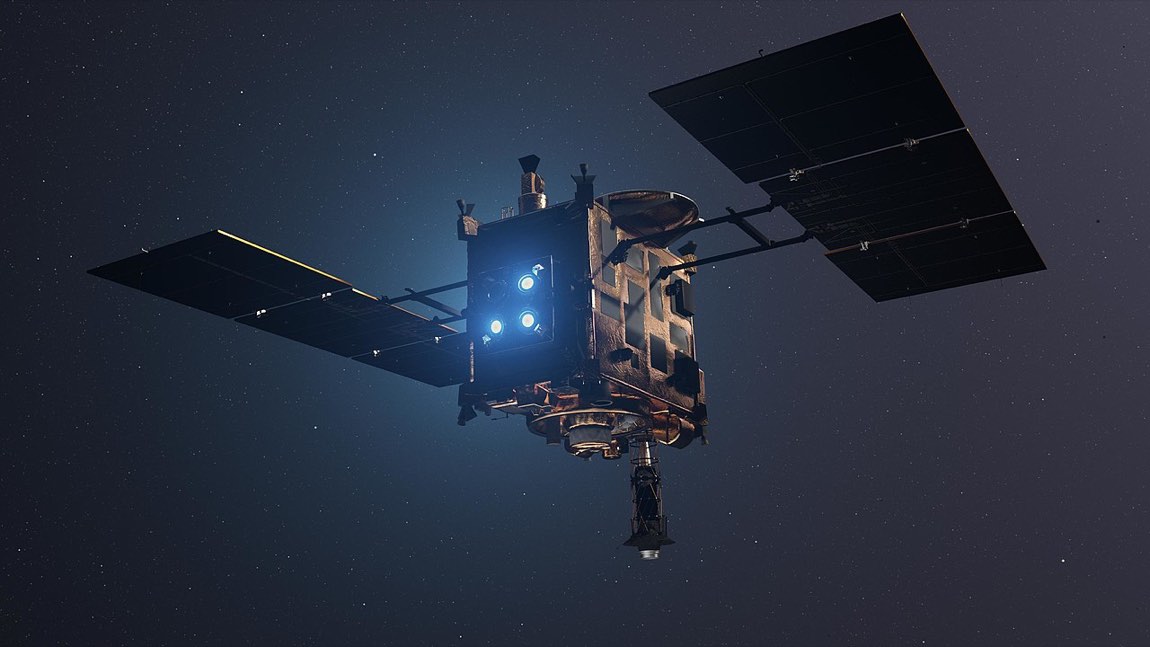
OSIRIS-REx was international from the start, with science team members from the United States, Canada, France, Germany, the United Kingdom, and Italy. Canada's contribution was particularly tangible: the Canadian Space Agency funded OLA, the laser altimeter, built by MDA in Brampton, Ontario, and delivered to the spacecraft on 17 November 2015. The mission also built deep ties with JAXA's parallel Hayabusa2 mission, which visited the carbonaceous asteroid 162173 Ryugu, arriving in June 2018 and returning to Earth in December 2020. Because the two missions were studying similar asteroid types on overlapping timelines, NASA and JAXA signed a formal agreement to collaborate on sample exchange and research. Teams visited each other's facilities — JAXA representatives came to the University of Arizona's science operations centre and OSIRIS-REx members travelled to Japan — sharing software, data, and analytical techniques. Ultimately, portions of the Bennu and Ryugu samples will be exchanged, giving each team access to material from both asteroids and enabling direct comparisons between two primitive carbonaceous bodies.
 ⤢
⤢