 Diagram · Marina Brozović, Lance A.M. Benner, Joseph G .McMichael, Jon D. Giorgini, Petr P · CC BY 4.0
Asteroid · Deep guide
Apophis
Also called: 99942 Apophis
In 2029 this asteroid will shave past Earth, closer than our TV satellites.
What is it?
Apophis is a 340-meter asteroid that will pass astonishingly close to Earth on Friday, April 13, 2029 — about 32,000 km, closer than geostationary satellites. It will NOT hit: the orbit is precisely measured, and impact has been ruled out for at least a century. Instead, an estimated two billion people across Europe, Africa and western Asia will watch a naked-eye asteroid glide across the evening sky — a once-per-thousand-years event, on a Friday the 13th.
Go deeper
Discovered in 2004, Apophis briefly held the record Torino-scale rating (level 4, ~2.7% computed impact chance for 2029) before further data collapsed the risk — the textbook demonstration of how impact probabilities evolve. Radar ranging through the 2021 apparition eliminated all keyholes through at least 2116. The 2029 pass is itself an experiment: Earth's tides will torque this S-type contact-binary-shaped body, possibly triggering measurable quakes and resurfacing — which OSIRIS-APEX (the re-tasked OSIRIS-REx) will arrive to watch.
01 How close is 32,000 km?
About one-tenth of the way to the Moon — and closer than the satellites that broadcast television. Apophis will cross the sky in hours, moving visibly against the stars, like a slow bright satellite. Nothing this large has passed this close in recorded history with humans able to predict it — and we know to the minute when it will happen.
02 Planetary defense's field day Deeper
The 2029 flyby is a free experiment: Earth's gravity will stretch Apophis, possibly triggering landslides and exposing fresh material — telling us how rubble asteroids respond to tides, which feeds directly into deflection planning. After DART's 2022 demonstration that a kinetic impactor can change an asteroid's orbit, Apophis is the reconnaissance half of humanity's asteroid-insurance policy.
The deep dive
Researched for the Atlas from Wikipedia — 99942 Apophis (26,449 characters read) · updated Sep 20, 2026
03 The night a 2.7% chance shook the world
For a few extraordinary days in late December 2004, astronomers watched a probability number tick upward in a way that had never happened before. When Apophis was first spotted on 19 June 2004 by Roy Tucker, David Tholen, and Fabrizio Bernardi at Kitt Peak National Observatory, it received the dull provisional label 2004 MN4. The discovery was unusual from the start — the team found it at a very low solar elongation of only 56° and at a long range of 1.1 AU, conditions that make asteroid hunting difficult. By 27 December 2004, after precovery images from 15 March 2004 were folded into the orbital calculations, the uncertainty region had shrunk to 83,000 km and the chance of an Earth impact on 13 April 2029 peaked at 2.7%, or 1 in 37. That figure pushed Apophis to Level 4 on the Torino scale and 1.10 on the Palermo scale — representing an impact hazard more than 12 times the background level — the highest ratings ever recorded for any object on either scale. Then, later the same day, the precovery data eliminated the 2029 impact entirely. The entire crisis, from peak alarm to relief, lasted mere hours.
04 An Egyptian chaos-serpent gets a Greek name
The discoverers named the asteroid on 19 July 2005, after it received its permanent number 99942 on 24 June of that year. They chose Apophis, which is the Greek rendering of Apep — an enemy of the Ancient Egyptian sun-god Ra. In mythology, Apep was the uncreator, an evil serpent dwelling in the eternal darkness of the Duat who tried to swallow Ra during his nightly passage. Apep was held at bay by Set and Horus, and Ra himself once beheaded Apep while taking the form of a great feline in the shade of the persea tree at the Heliopolis sun temple. The name carries a secondary astronomical logic: the asteroid was an Aten-type at discovery, and Aten asteroids are conventionally named after Egyptian deities. After the 2029 flyby it will become an Apollo-type, and Apollo asteroids are named after Greek deities. Apophis — the Greek name of an Egyptian god — elegantly straddles both categories. Two of the discoverers, Tholen and Tucker, are fans of the television series Stargate SG-1, where Apophis is a recurring villain posing as an ancient god. Tholen denied the naming was inspired by the show, calling the connection coincidental.
05 A tumbling, wobbling, bilobed boulder Deeper
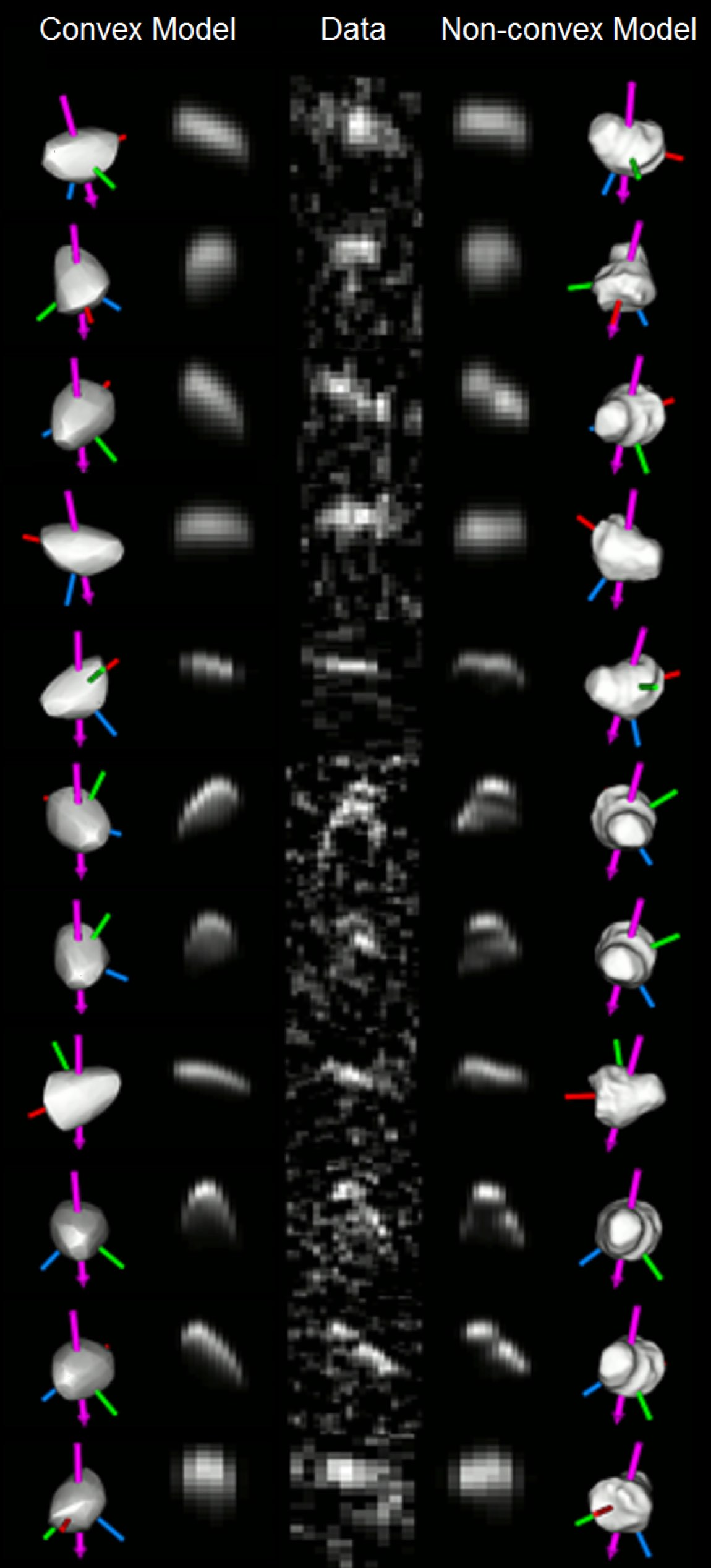
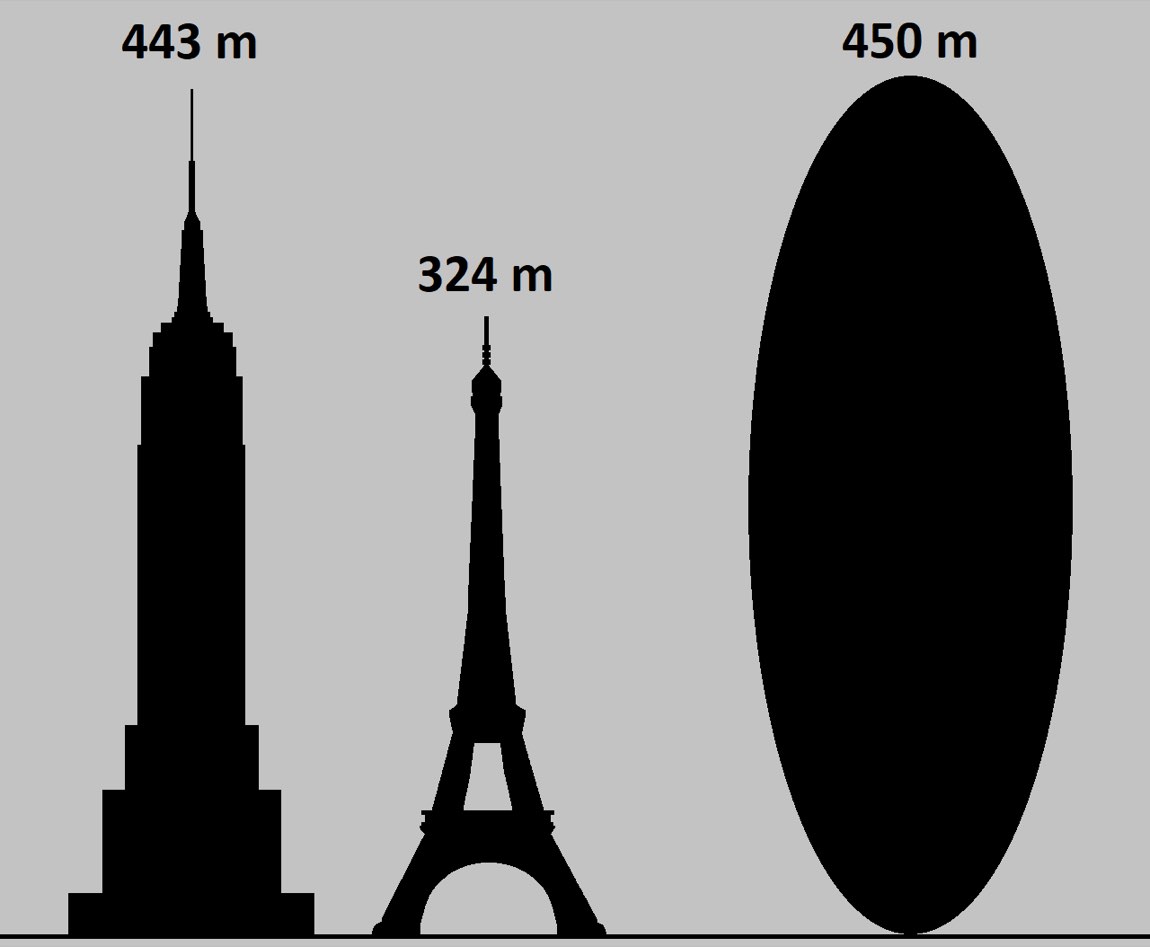
Apophis does not spin cleanly around a fixed axis the way a top does. It is a tumbler, meaning its rotation axis itself wanders through the body of the asteroid. Radar images taken by Goldstone and Arecibo in 2012–2013 showed it is elongated at 450 metres by 170 metres and is likely bilobed — possibly a contact binary, two objects resting against each other — with a relatively bright surface albedo of 0.35±0.10. The tumbling motion has a period of about 263 hours, during which the angle between the long axis of Apophis and the angular momentum vector swings between roughly 78° and 102°. Superimposed on this slow wobble is a much faster precession: the principal axis of highest moment of inertia and the rotation axis both sweep around the fixed angular momentum vector with a time-averaged period of 27.38 hours. The net visual effect is that Apophis appears to flip, completing one apparent revolution on average every 30.56 hours. The angular momentum vector itself points 59° south of the ecliptic, making Apophis a retrograde rotator. Its surface composition is thought to match that of LL chondrites, a class of stony meteorites relatively common in collections.
06 How its orbit works — and will change Deeper
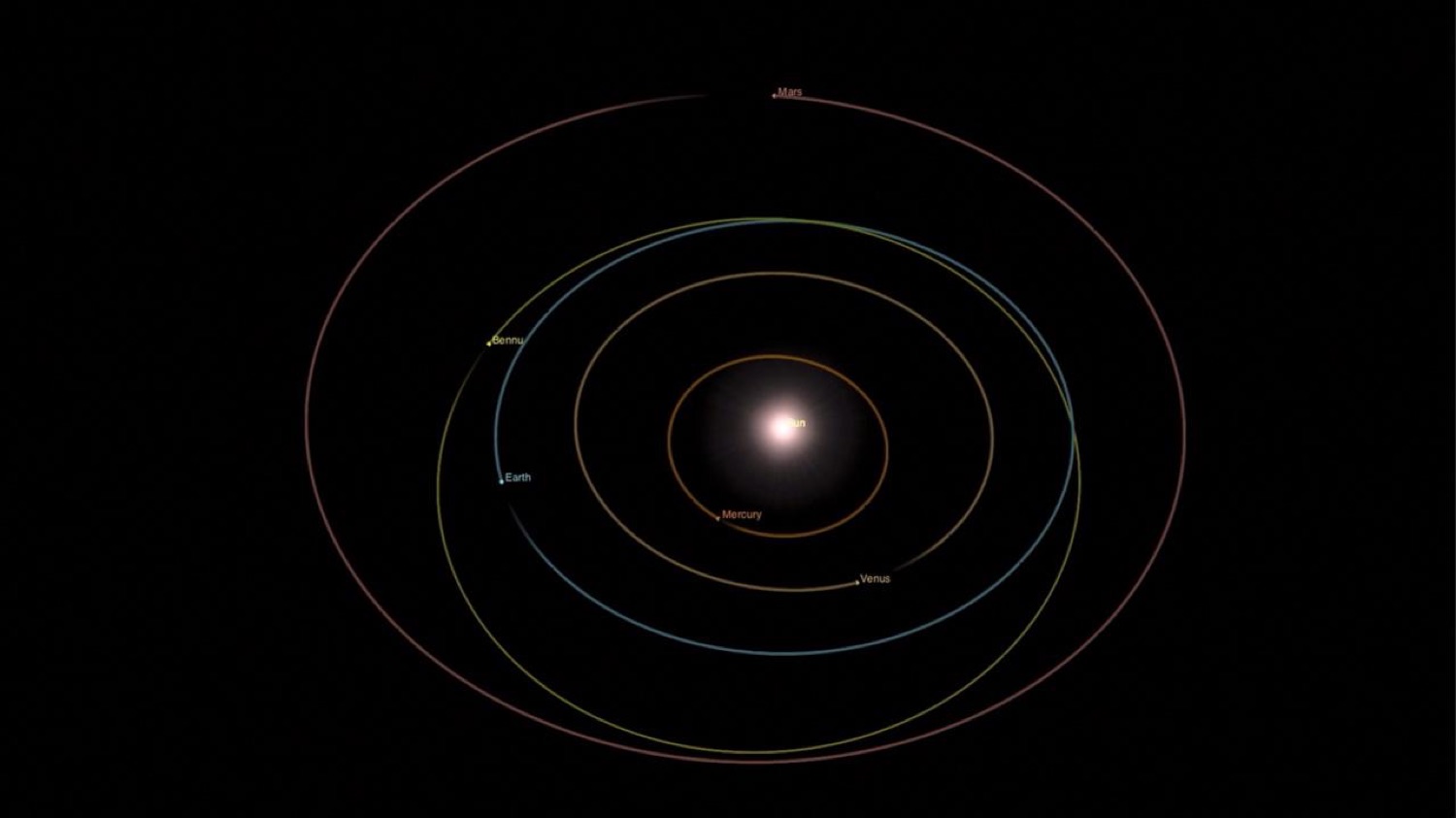
Apophis follows a low-inclination orbit tilted just 3.3° from the ecliptic, swinging from 0.746 AU at perihelion — just outside Venus's aphelion of 0.728 AU — to 1.099 AU at aphelion, just outside Earth's orbit. Before 2029 it approaches Earth roughly every 7.75 years, with encounters tending to cluster between December and April. The geometry is specific: at its ascending node, where it crosses Earth's orbital plane from south to north, Apophis arrives very close to where Earth is around 13 April each year, which is why 13 April recurs so ominously in its history. The 2029 flyby will permanently reshape this pattern. Earth's gravity will push the semi-major axis from 0.92 AU to 1.1 AU, lift perihelion from 0.746 AU to 0.895 AU, and raise aphelion from 1.10 AU to 1.31 AU, converting it from an Aten-class to an Apollo-class asteroid. Apophis will lose its December close-approach geometry and gain a new one near mid-September, setting up a notable close encounter on 11 September 2102. By April 2116, predictions from different databases already diverge substantially — Apophis might pass anywhere from 0.001 AU to 0.1 AU from Earth.
07 The Yarkovsky effect: sunlight changes everything Deeper
A thermal force so subtle it was long ignored turned out to be crucial for predicting Apophis's path. The Yarkovsky effect arises because a rotating asteroid absorbs sunlight and re-radiates heat in a slightly different direction as it turns, producing a tiny but persistent push on the orbit. No observations of Apophis were possible between January 2015 and February 2019 because the asteroid spent years within 60° of the Sun from Earth's perspective. When observations resumed, astronomers David Tholen and Davide Farnocchia measured the Yarkovsky acceleration on Apophis for the first time in March 2020. They found the effect causes the semi-major axis to decrease by about 170 metres per year, producing a cumulative shift in ecliptic longitude that grows quadratically over time. This shift matters enormously for 2029: incorporating it moved the predicted miss parameter — how far behind Earth Apophis would pass absent Earth's gravity — from a nominal 47,659 km to about 47,363 km, a change of 296 km. That shift placed Apophis 212.14 km away from a gravitational keyhole that would have led to a 2068 collision, confirming safety for the next century. By 2021, the uncertainty in the 2029 approach distance had been reduced to just a couple of kilometres.
 ⤢
⤢
08 Watching it pass: a spectacle across three continents
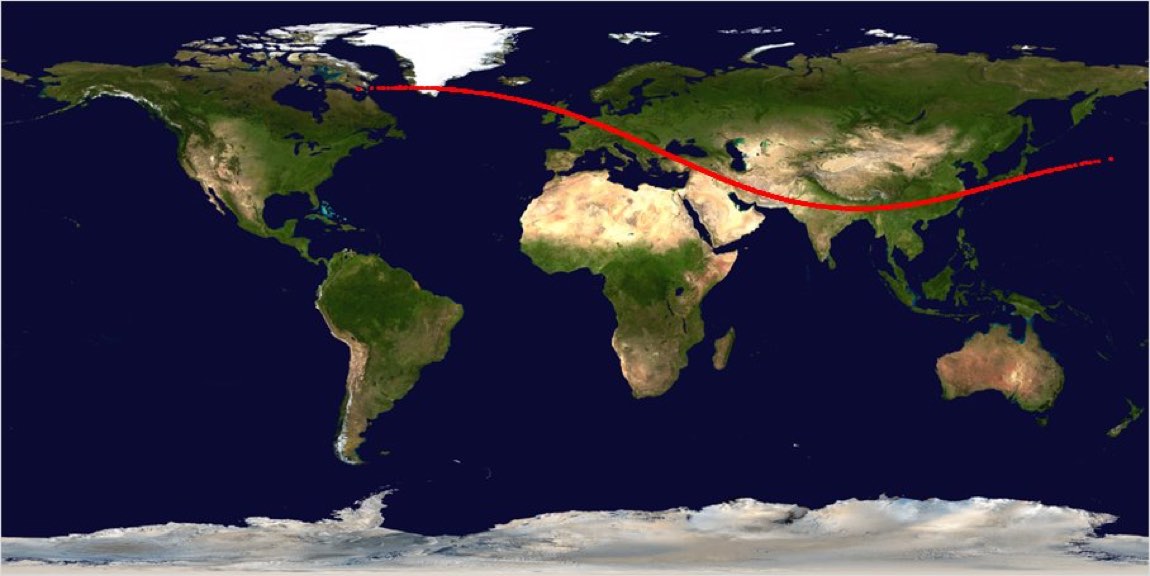
The 2029 flyby will be one of the most dramatic naked-eye asteroid events in recorded history. At closest approach on 13 April 2029 at 21:46 UT, Apophis will be just 31,600 kilometres above Earth's surface, closer than the ring of geostationary satellites. It will brighten to magnitude 3.1 — easily visible without a telescope from rural and darker suburban areas, and through binoculars from most locations. The close approach will be observable from Europe, Africa, and western Asia. Over roughly a day Apophis will sweep an arc of 205° across the sky, moving northwest from Centaurus through Perseus and then southwest to Pisces. Its maximum angular speed will reach 42° per hour — fast enough to see it move against the stars in real time. Even its apparent disk will be measurable: a maximum angular diameter of about 2 arcseconds, roughly the same as Neptune seen from Earth, meaning large ground-based telescopes with adaptive optics will resolve its surface features. Sixteen hours after its Earth encounter, Apophis will also pass within 89,600 km of the lunar surface. Tidal forces during the flyby are expected to alter the asteroid's rotation axis, and a partial resurfacing is possible, potentially shifting its spectral class from a weathered Sq-type to an unweathered Q-type.
09 What a hit would actually do
Apophis will not strike Earth in the foreseeable future, but scientists calculated its destructive potential carefully. As of 2021, the estimated impact kinetic energy was equivalent to 1,200 megatons of TNT — six times the energy released by the eruption of Krakatoa (200 MT) and comparable to the entire global nuclear arsenal (1,460 MT), though vastly smaller than the Chicxulub extinction event (100,000,000 MT). Assuming a 370-metre stony body with a density of 3,000 kg per cubic metre striking sedimentary rock, the impact would excavate a crater about 5.1 kilometres wide. Any impact would devastate thousands of square kilometres but would be unlikely to trigger a global impact winter. The effects would depend heavily on composition and impact angle. An ocean impact posed its own hazard: the now-expired 2036 path of risk crossed the north Pacific and Atlantic, and simulations suggested a deep-water strike could generate a destructive tsunami reaching inundation heights above 2 metres out to roughly 1,000 km for much of North America, Brazil, and Africa, 3,000 km for Japan, and 4,500 km for parts of Hawaii.
10 OSIRIS-APEX: a spacecraft already en route
One spacecraft will not just watch the 2029 flyby — it will accompany Apophis up close. After returning a sample of asteroid Bennu to Earth on 24 September 2023, the OSIRIS-REx spacecraft still had fuel remaining. Engineers determined that Apophis was the only asteroid the probe could reach for a long-duration rendezvous rather than a quick flyby. The extension was approved in April 2022, and the spacecraft was renamed OSIRIS-APEX — short for OSIRIS-Apophis Explorer. It will rendezvous with Apophis a few days after the Earth close approach in April 2029 and spend 18 months studying the asteroid in detail. One planned maneuver mirrors a technique already tested at Bennu: the spacecraft will descend close to the surface and fire its thrusters downward, blasting away loose material to expose the subsurface layer beneath. This will give scientists a direct look at Apophis's internal composition and material properties, information that is otherwise almost impossible to obtain without landing. Alongside OSIRIS-APEX, the European Space Agency's Ramses mission — approved with a planned launch in April or May 2028 — is scheduled to rendezvous with Apophis in February 2029, arriving before the Earth flyby to observe changes in real time.
11 Stellar occultations: a record-breaking technique Deeper
In early 2021, Apophis achieved a distinction that had nothing to do with impact hazard. Between March and April of that year, five separate occultations — moments when the asteroid passed in front of a background star of apparent magnitude 8 to 11 — were successfully observed, making Apophis the smallest asteroid ever characterized by this method. The previous record holder was asteroid 3200 Phaethon, which is more than ten times larger. The first event on 7 March was captured from multiple sites across the United States. A second on 11 March was predicted to be visible from central Europe but was lost mainly to bad weather, with only two negative observations recorded from Greece. On 22 March, a single observer — amateur astronomer Roger Venable from the United States — recorded the event alone, after larger-than-expected residuals from the 7 March data had sent most other observers to the wrong location. That single data point was precise enough to predict several additional events, including one on 4 April observed from New Mexico again by Venable and others, and two more on 10 and 11 April observed from Japan and New Mexico respectively. Together, these occultation measurements helped refine both the asteroid's size and its orbital trajectory.
12 The gravitational keyhole nobody wants to hit Deeper
Even after the 2029 impact was ruled out, astronomers faced a subtler worry: a gravitational keyhole. A keyhole is a region of space so precisely defined that if an asteroid passes through it during one close approach, gravitational timing guarantees a collision years later. For Apophis, the relevant keyhole was estimated to be less than 1 kilometre wide in the 2029 approach corridor. Passing through it would have set up an impact exactly seven years later on Easter Sunday, 13 April 2036. This possibility kept Apophis at Level 1 on the Torino scale until August 2006, when analysis showed the probability of threading that keyhole was negligible, dropping the rating to Level 0. A separate keyhole 212.14 km below the nominal 2029 miss distance would have led to a 2068 collision; the 2021 Yarkovsky measurements confirmed Apophis would miss that one too. The 2036 close approaches, when they actually occur, will be distant: on 27 March 2036 Apophis will pass no closer than 0.3089 AU — about 46.21 million km — farther from Earth than Venus will be on 30 May of that same year.
13 How rare is a pass this close?
Context matters when assessing the 2029 flyby. An asteroid as large as Apophis passing as close to Earth as 31,600 km is estimated to happen only once in 800 years on average. An asteroid of that size actually striking Earth is expected once in about 80,000 years. Those numbers frame why the event is both scientifically remarkable and, in the long sweep of time, not unprecedented. The 2029 encounter will be the closest a known asteroid of this size has come to Earth in recorded history. For comparison, geostationary satellites orbit at roughly 35,786 km — Apophis will slip inside that ring. At closest approach, Earth's gravity will have accelerated Apophis from its approach speed of 6.0 km/s to 7.4 km/s, before it decelerates back to 6.0 km/s as it departs. The cumulative Palermo scale rating for Apophis as of 2021 stood at −3.22, meaning the impact risk is less than one thousandth of the background hazard level — but the asteroid will remain a potentially hazardous object for possibly thousands of years, until some future close encounter with Venus or Mars permanently shifts its orbit away from Earth's neighborhood.
14 Deflection ideas that were seriously studied
Even before the impact threat was fully retired, engineers and scientists around the world began sketching deflection strategies, treating Apophis as a live test case for planetary defense planning. NASA, ESA, and numerous research groups examined gravitational tractors — hovering spacecraft that nudge an asteroid with their own gravity over years — as well as kinetic impactors and nuclear devices. In 2011, researchers at China's Tsinghua University proposed a more novel approach: an impactor spacecraft in a retrograde orbit, guided and powered by a solar sail, aimed not at moving the asteroid dramatically but at preventing it from threading the gravitational keyhole in the first place. In October 2022, a separate method was proposed to map Apophis's interior structure before any impact attempt, so that a kinetic strike could be aimed at the optimal location. Russia's space agency Roscosmos announced in December 2009 that it would study deflection mission designs. The European Space Agency also considered Apophis as one of two candidate targets for its Don Quijote mission concept, which was designed to study the real effects of deliberately impacting an asteroid. The 2007 Planetary Society contest drew 37 entries from 20 countries on six continents, with the winning commercial design — called Foresight — proposing a simple orbiter costing approximately US$140 million.
 ⤢
⤢
Could life exist here?
A dry stony fragment.
Our labels: Confirmed · Strong Evidence · Estimated · Hypothesis · Theoretical · Speculative (see Methodology).
How would we get there?
OSIRIS-APEX is en route by recycling a spacecraft that was already flying — the cheapest ticket in planetary science.
| Technology | Status | Travel time (one way, straight line) |
|---|---|---|
| Apollo-style spacecraft, about 39,000 km/h | Flown technology | 107 days |
| Ion-propulsion probe, about 90,000 km/h | Flown technology | 46 days |
| Voyager 1, about 61,000 km/h | Flown technology | 68 days |
| Parker Solar Probe, about 690,000 km/h | Flown technology | 6 days |
| Nuclear-thermal rocket, about 120,000 km/h cruise | In development | 35 days |
| Laser light-sail at 20% of light speed | Proposed concept | 28 minutes |
| Light itself, 299,792 km/s | Physical limit | 6 minutes |
Simplified straight-line times at cruise speed. Real missions fly curved orbital paths and take longer. Full travel calculator →
Weird & wonderful
- April 13, 2029 is a Friday the 13th — the universe has a sense of humor.
- Earth's gravity will measurably shake Apophis during the pass — asteroid-quakes.
- Apophis's threat rating once broke records; today its rating is a firm zero for a century out.