 Photograph · NASA/Johns Hopkins APL · Public domain
Spacecraft · Deep guide
DART
The day humanity moved an asteroid. Planetary defense, demonstrated.
What is it?
On September 26, 2022, NASA's DART spacecraft deliberately smashed into Dimorphos, the small moon of asteroid Didymos, at 22,500 km/h — and shortened its orbit by 32 minutes, far exceeding predictions. It was the first time our species purposefully changed the motion of a celestial body: proof that, with enough warning, a dangerous asteroid can be nudged off course. ESA's Hera arrives in 2026 to inspect the crater.
The deep dive
Researched for the Atlas from Wikipedia — Double Asteroid Redirection Test (22,708 characters read) · updated Sep 20, 2026
01 Why a Binary Asteroid Was the Perfect Target
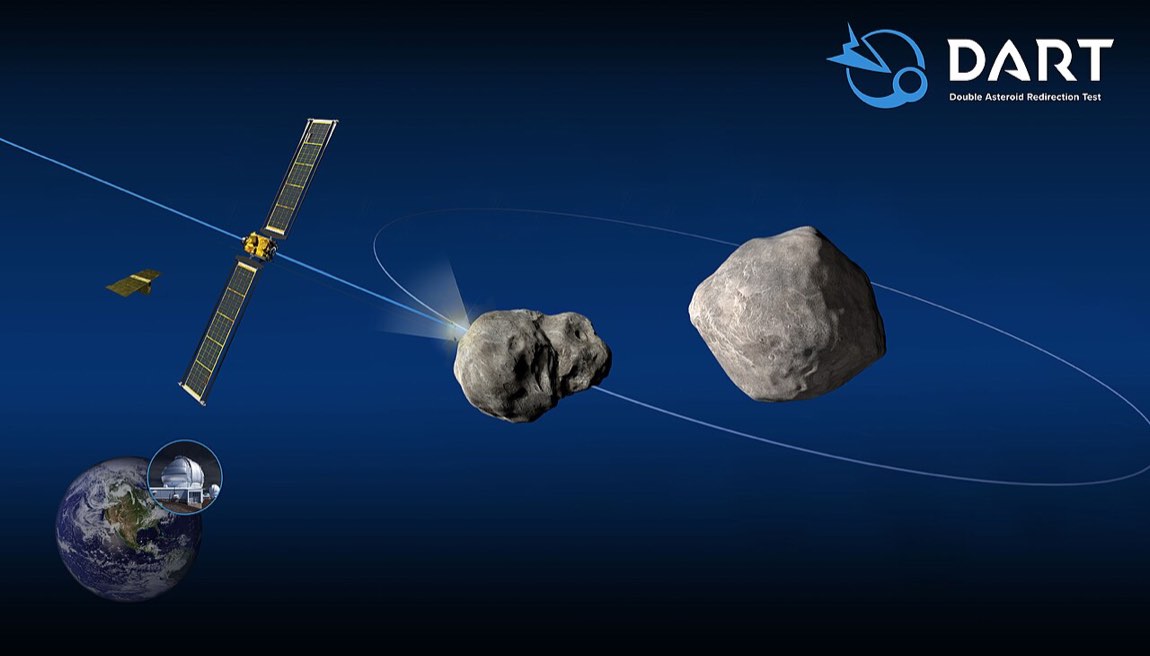
Picking the right asteroid to hit was as important as the hit itself. NASA chose the Didymos system — a binary pair in which a 780-metre primary is orbited by a 160-metre moonlet called Dimorphos — because the geometry offered a natural measuring tool. Dimorphos transits in front of Didymos once per orbit and disappears behind it half an orbit later, causing the combined brightness seen from Earth to dip and recover in a regular rhythm. Any change in that rhythm directly reveals a change in orbital period. This made it possible to measure the deflection effect from the ground without sending a separate observer spacecraft. The size of Dimorphos also mattered: at 160 metres across, it sits squarely in the range of asteroids considered genuinely dangerous to Earth — large enough to cause regional devastation, small enough that a single kinetic impactor might realistically divert it. Crucially, the Didymos system is not an Earth-crossing asteroid, so there was no risk that a miscalculation could accidentally send either body toward us.
02 The Spacecraft Itself: Simple by Design
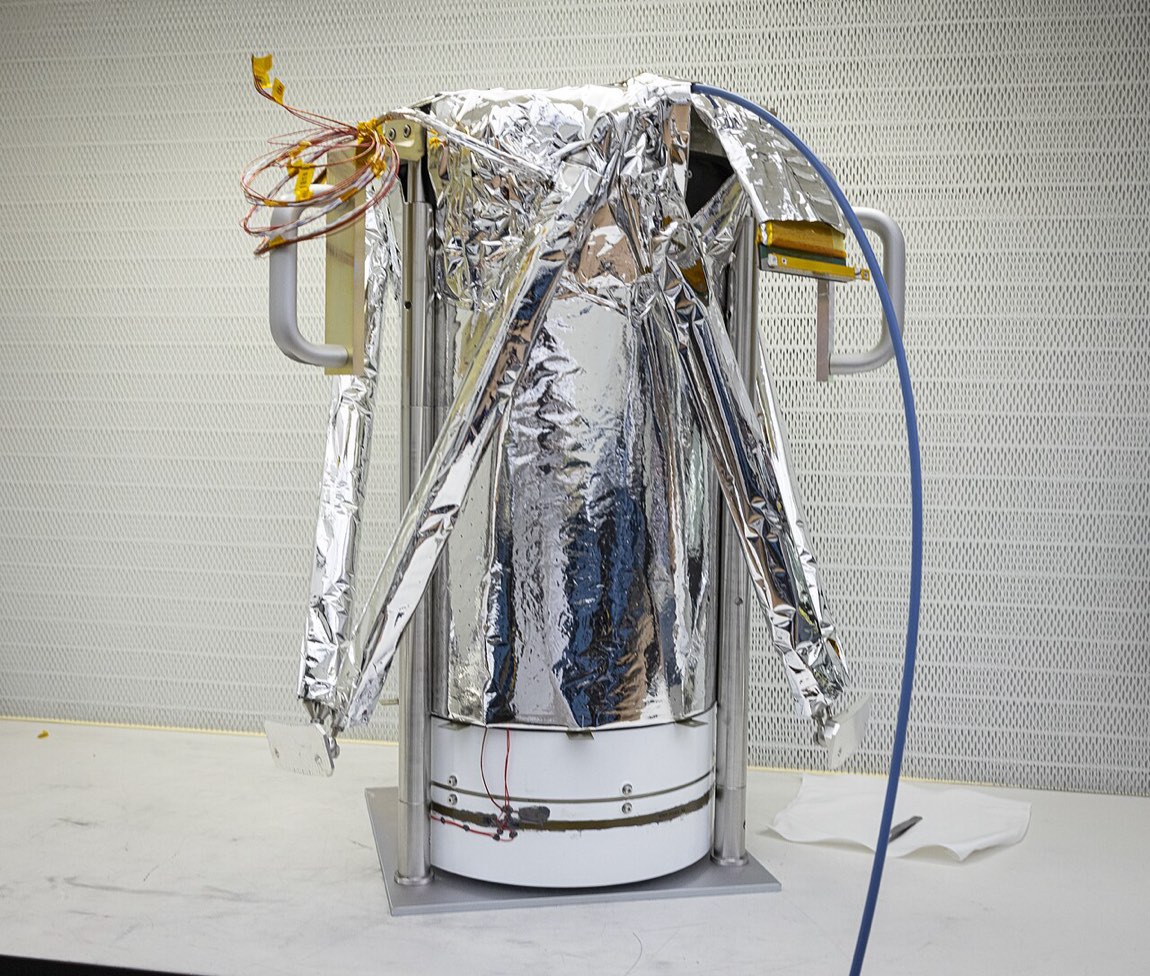
DART was deliberately stripped down. The spacecraft had a mass of 610 kilograms and carried no scientific payload in the traditional sense — its sensors existed purely to navigate. The total mission cost reached US$330 million by the time of impact. Its most important instrument was DRACO, a 20-centimetre aperture Ritchey-Chrétien telescope with a focal length of 2.6208 metres and a field of view of just 0.29 degrees. DRACO's 2,560 × 2,160 pixel CMOS sensor recorded wavelengths from 0.4 to 1 micron, covering visible and near-infrared light, and achieved a spatial resolution of roughly 20 centimetres per pixel in the final approach. The camera was derived from the Long Range Reconnaissance Imager on New Horizons but used a commercial off-the-shelf CMOS detector rather than a custom charge-coupled device — a choice that actually improved performance because sensor technology had advanced so much in the decade between the two designs. DRACO's images were fed into onboard software descended from anti-missile guidance technology, allowing DART to steer itself to impact autonomously.
03 An Ion Engine That Rode Along but Stayed Quiet Deeper
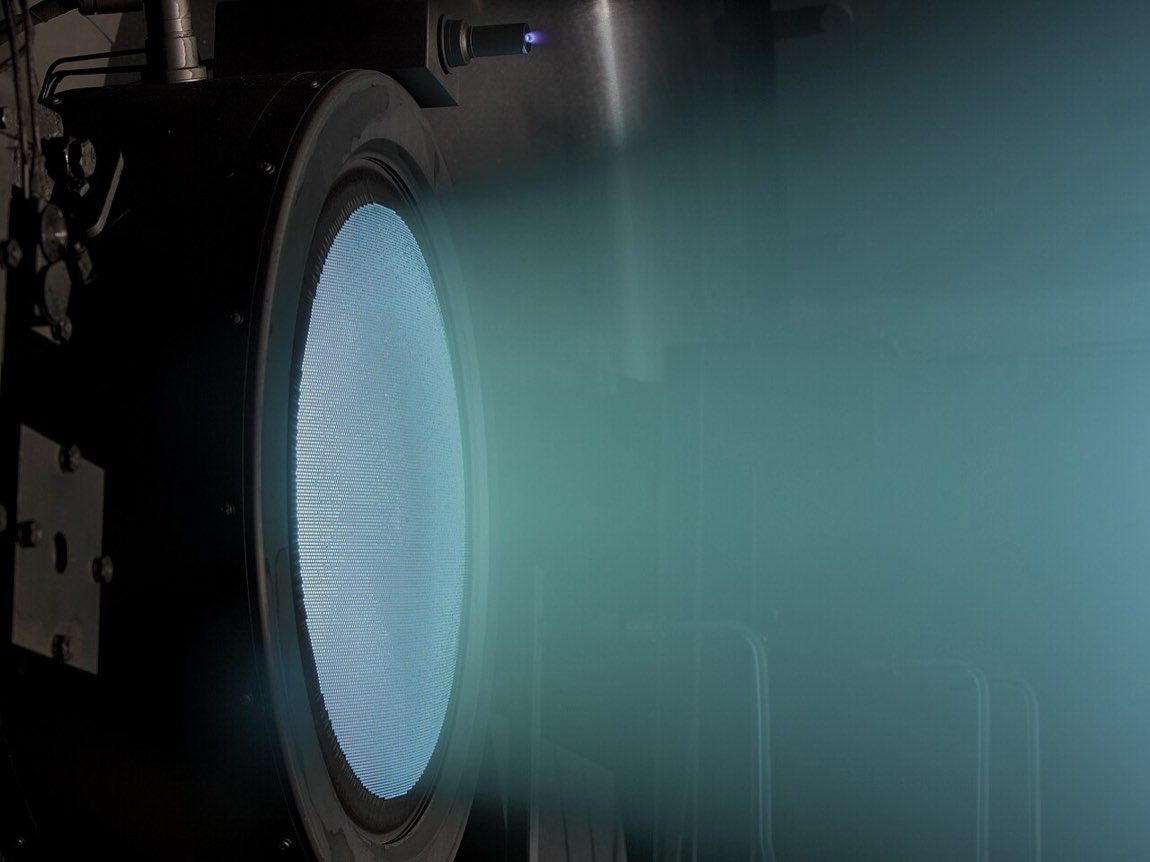
DART carried a NEXT-C gridded ion thruster — the NASA Evolutionary Xenon Thruster–Commercial — powered by 22-square-metre solar arrays that generated approximately 3.5 kilowatts. It also carried about 60 kilograms of xenon as fuel for that engine. Early testing revealed a problem: a reset mode caused current spikes of 100 amperes through the spacecraft structure, four times the expected 25 amperes. Engineers decided not to rely on it for the mission, using instead 50 kilograms of conventional hydrazine propellant for attitude control and course corrections. The Falcon 9 upper stage did the heavy lifting anyway, injecting DART directly into a heliocentric escape trajectory so that only minor chemical-thruster burns were needed to home in on Dimorphos. The ion engine was kept available as a contingency; had DART missed its target entirely, the NEXT-C system could have maneuvered the spacecraft back to Dimorphos for a second attempt two years later. Despite its passive role, the demonstration of the thruster in space was itself a technology objective of the mission.
04 The Final Four Hours: Going It Alone
Four hours before impact, with Dimorphos still about 90,000 kilometres away, DART handed control entirely to its SMART Nav autonomous guidance system. Three hours out, the spacecraft catalogued objects near the target to make sure it was tracking the right body. Ninety minutes before collision, at a distance of 38,000 kilometres, the final trajectory was locked in. It was only when DART closed to 24,000 kilometres that Dimorphos finally appeared in DRACO's images — just 1.4 pixels across. To guarantee sharp final images, the last thruster correction was fired four minutes before impact and then the engines were shut off completely, eliminating the vibrations that had been blurring photographs. The last full image, transmitted two seconds before the spacecraft ceased to exist, captured Dimorphos's surface at a resolution of about 3 centimetres per pixel — roughly the width of a human fist. The impact occurred on 26 September 2022 at 23:14 UTC, about 6.8 million miles from Earth.
 ⤢
⤢
05 What Actually Moved the Asteroid: Ejecta, Not the Hit Deeper
The counterintuitive headline from DART is that the spacecraft itself was not the main driver of deflection. The impact at 6.6 kilometres per second delivered roughly 11 gigajoules of energy — equivalent to about three tonnes of TNT — and the direct momentum transfer was real. But the measured momentum enhancement factor, called beta, came in at 3.6. That means the total momentum transferred to Dimorphos was approximately 3.6 times greater than it would have been if the asteroid had simply swallowed the spacecraft with no material escaping. The difference came from recoil: over 1,000,000 kilograms of dusty debris blasted off the surface and streamed into space, and the reaction pushed Dimorphos in the opposite direction like exhaust from a rocket. Scientists estimate the ejecta tail stretched at least 30,000 kilometres and carried a mass of at least 1,000 tonnes, possibly up to ten times that. The practical implication is significant — a planetary defense mission could use a smaller impactor, or act with less warning time, and still achieve a given deflection if ejecta production is high.
06 Measuring 32 Minutes from the Ground
Before impact, Dimorphos completed one orbit around Didymos every 11 hours and 52 minutes. The pre-defined success threshold for the mission was a shortening of that period by at least 73 seconds. The actual result — confirmed by optical telescopes watching mutual eclipses through photometry — was a reduction of 33 plus or minus 1 minutes, more than 26 times the minimum required. Radar observations corroborated the optical data. The method worked because Dimorphos was too small and too close to Didymos for any telescope to see directly; instead, astronomers tracked how the combined light of the pair dimmed when one body passed in front of the other. Amateur astronomers in several countries contributed precise measurements by recording occultations of background stars. The orbital period reduction brought Dimorphos slightly closer to Didymos, where stronger gravity means a faster, shorter orbit — the same principle that keeps the Moon in a fixed relationship with the periods predicted by Kepler's laws.
07 A New Kind of Active Asteroid, Observed Live Deeper
By striking Dimorphos, DART did something science had theorized but never witnessed: it activated a previously inert asteroid. Active asteroids — bodies that display comet-like tails or comae — are known to exist in the solar system, and some researchers had argued that past collisions could explain how they formed. DART confirmed this hypothesis under controlled, well-documented conditions for the first time. Dimorphos lost approximately 1 million kilograms of mass as a direct result of the collision, material that spread into the observed ejecta plume and tail. The Hubble Space Telescope, the James Webb Space Telescope, the SOAR observatory, and the ATLAS observatory all independently detected the plume. SOAR recorded the visible ejecta trail extending more than 10,000 kilometres on 26 September alone. Scientists must now account for a subtlety: if the energy delivered was large enough, it may also have reshaped Dimorphos without significant mass loss, or even triggered reshaping of Didymos given its near-rotational-breakup spin rate. Reshaping would alter the mutual gravitational field of the pair and independently change the orbital period — a factor that must be separated from the pure deflection signal.
08 Humanity's First Measurable Nudge to a Solar Orbit
The DART impact did something beyond deflecting Dimorphos around Didymos: it measurably changed where the entire Didymos pair travels around the Sun. Scientists determined that the orbital speed of the asteroid pair increased by about two inches per hour from its pre-impact speed of 76,000 miles per hour. This marked the first time in recorded history that a deliberate human action measurably altered the orbit of a natural body around the Sun. The change is imperceptibly small by everyday standards — two inches per hour is slower than a snail — but the significance is scientific and philosophical in equal measure. Researchers used radio telescope data gathered before and after impact alongside ground-based stellar occultation measurements to confirm the result. As one study author noted, even such a tiny orbital change, applied early enough to a hypothetical Earth-threatening asteroid, might be sufficient to prevent a catastrophic impact, because small velocity differences accumulate into large positional separations over years and decades.
 ⤢
⤢
09 LICIACube: Italy's Front-Row Seat
Riding piggyback with DART all the way to the Didymos system was LICIACube — the Light Italian CubeSat for Imaging of Asteroids — contributed by the Italian Space Agency. The small CubeSat separated from DART on 11 September 2022, fifteen days before impact, and drifted on its own trajectory so that it would pass the asteroid just after the collision rather than being destroyed in it. LICIACube carried two optical cameras nicknamed LUKE and LEIA, and captured images of the impact flash and the expanding ejecta cloud as it flew past Dimorphos. Because LICIACube communicated directly with Earth rather than through DART, it was able to transmit its imagery independently after the flyby. This was especially valuable because once DART ceased to transmit upon impact, LICIACube became the only spacecraft in the vicinity with working cameras, providing a close-up perspective that no Earth-based or orbital telescope could replicate.
10 How a Velocity Whisper Becomes a Canyon of Space Deeper
The orbital period change sounds modest — 33 minutes out of nearly 12 hours — but translating it into practical planetary defense numbers reveals why it matters so much. Researchers determined that DART caused an instantaneous slowing of Dimorphos's speed along its orbit of about 2.7 millimetres per second. The momentum change was amplified by a factor of between 2.2 and 4.9 depending on assumptions about the mass of Dimorphos, with ejecta recoil responsible for the difference above the spacecraft's direct contribution. For a hypothetical Earth-threatening asteroid, scientists calculate that Earth's diameter of roughly 13,000 kilometres means that shifting an incoming body by as little as 6,500 kilometres — half Earth's width — would turn a hit into a miss. A velocity change of 2 centimetres per second accumulates to that separation in approximately 10 years of travel. The key word is 'early': the same technology that nudged Dimorphos by a few millimetres per second would need to be applied years or decades before a predicted impact to be effective at planetary scale.
11 The DART Antenna: A First in Deep Space Radio Deeper
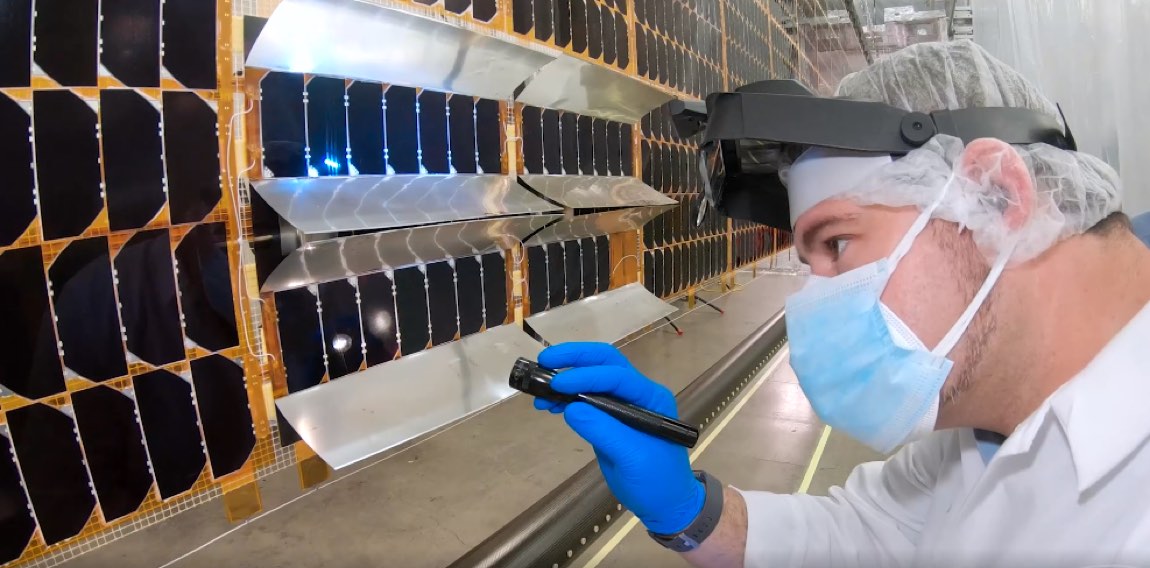
Among the hardware firsts aboard DART was a new type of high-gain communication antenna called a Spiral Radial Line Slot Array, or RLSA. It was the first spacecraft to fly this antenna design. The circularly polarized antenna operated at X-band frequencies of 7.2 and 8.4 gigahertz, interfacing with the NASA Deep Space Network. Its downlink gain was 29.8 dBi and its uplink gain was 23.6 dBi. The antenna was fabricated in a flat, compact shape and passed testing that certified it to a Technology Readiness Level of 6, meaning it had been demonstrated in a relevant environment before flight. The solar arrays also carried a demonstration payload: a section configured to test Transformational Solar Array technology using SolAero Inverted Metamorphic solar cells combined with reflective concentrators, a combination claimed to provide three times more power than other available solar array technology at the time.
12 From Launch Pad to Impact: The Journey in Numbers
DART launched from Vandenberg Space Force Base on 24 November 2021 at 06:21:02 UTC aboard a SpaceX Falcon 9. The Falcon 9 upper stage burned a second time to place the spacecraft directly onto an Earth-escape trajectory, sparing DART's ion engine for contingency use. During the roughly nine-month transit, the spacecraft made a distant flyby of the near-Earth asteroid 2001 CB21 — a 578-metre body — passing within 0.117 astronomical units on 2 March 2022. DRACO took its first light image on 7 December 2021, when DART was 2 million miles from Earth, imaging stars for camera calibration. It later imaged the open cluster Messier 38, the bright star Vega, and then Jupiter with its moon Europa emerging from behind the planet as a rehearsal for the autonomous tracking system. On 27 July 2022, the DRACO camera detected the Didymos system from 32 million kilometres away, beginning the final trajectory refinement that would end, ten weeks later, in a head-on collision at 6.6 kilometres per second.
 ⤢
⤢
13 Hera: The Mission That Will Inspect the Crime Scene
DART deliberately had no companion spacecraft capable of closely orbiting Dimorphos at the moment of impact — the original plan for a European orbiter called AIM was canceled. Its replacement, the European Space Agency's Hera spacecraft, launched in October 2024 and is planned to arrive at Didymos in 2026, four years after the DART impact. Hera's job is forensic: it will conduct a detailed reconnaissance of both Dimorphos and Didymos, measuring the crater DART left, assessing how much the shape of Dimorphos changed, determining the physical properties of the surface and interior, and providing the ground-truth data needed to fully interpret the momentum enhancement factor beta. Hera carries two CubeSats of its own, named Milani and Juventas, which will conduct close-up observations. The combined DART and Hera effort forms the AIDA mission architecture — Asteroid Impact and Deflection Assessment — a concept developed jointly by NASA and ESA beginning around 2015.