 Photograph · NASA · Public domain
Spacecraft · Deep guide
Chandra X-ray Observatory
For 25 years, NASA's X-ray flagship has been seeing the violent universe.
What is it?
Chandra, launched by shuttle in 1999, is to X-rays what Hubble is to visible light: an observatory sharp enough to image the million-degree universe — gas swirling into black holes, supernova shockwaves, galaxy clusters glowing across millions of light-years. Named for astrophysicist Subrahmanyan Chandrasekhar, it remains irreplaceable: no sharper X-ray telescope has ever flown.
The deep dive
Researched for the Atlas from Wikipedia — Chandra X-ray Observatory (13,101 characters read) · updated Sep 20, 2026
01 From Proposal to Launch: A 23-Year Journey
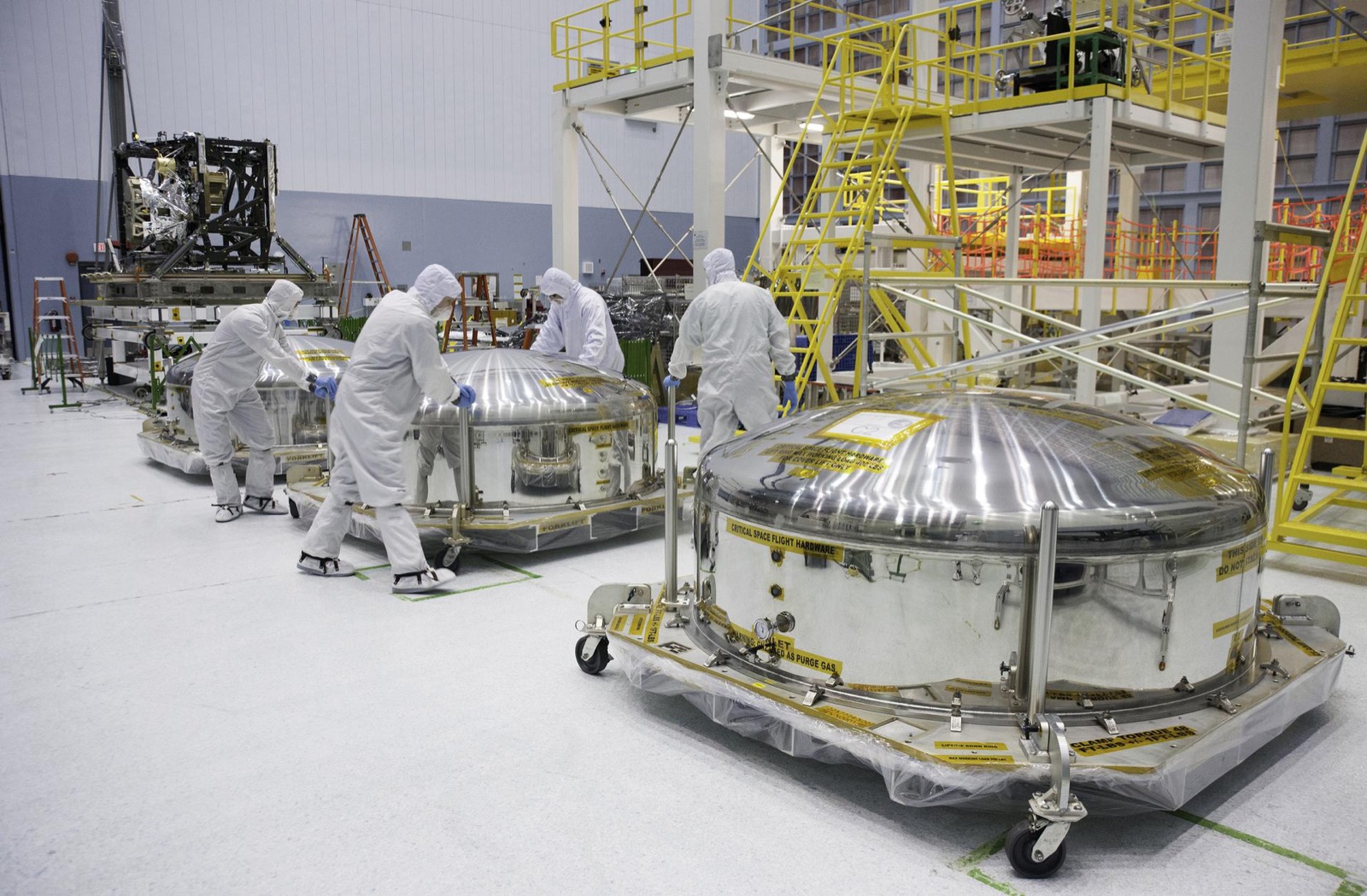
Chandra's path from idea to orbit was anything but swift. In 1976, astrophysicists Riccardo Giacconi and Harvey Tananbaum proposed the observatory to NASA — then calling it the Advanced X-ray Astrophysics Facility, or AXAF. Preliminary work began the very next year at Marshall Space Flight Center and the Smithsonian Astrophysical Observatory. The project survived the full sweep of the 1980s and early 1990s before a 1992 redesign stripped it down to control costs: four of twelve planned mirrors were cut, two of six instruments were removed, and the orbit was changed from a simple circular path to a stretched ellipse reaching one-third of the way to the Moon. That ellipse made shuttle servicing impossible but kept the telescope above Earth's radiation belts for most of each orbit. Assembly and testing fell to TRW (now Northrop Grumman) in Redondo Beach, California. Originally scheduled for December 1998, the launch slipped by several months. Chandra finally lifted off aboard Space Shuttle Columbia on July 23, 1999, at 04:31 UTC — 23 years after that first proposal.
02 The Heaviest Shuttle Payload Ever Flown
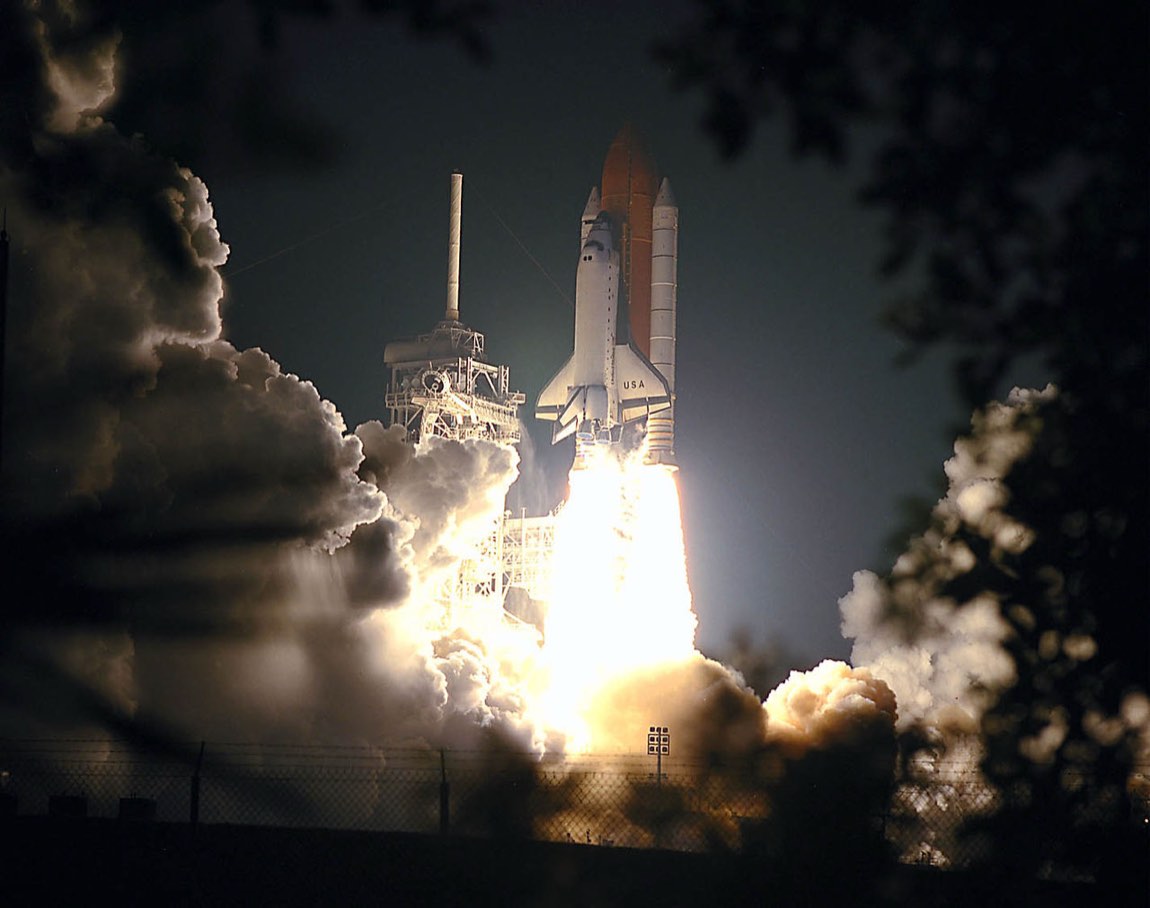
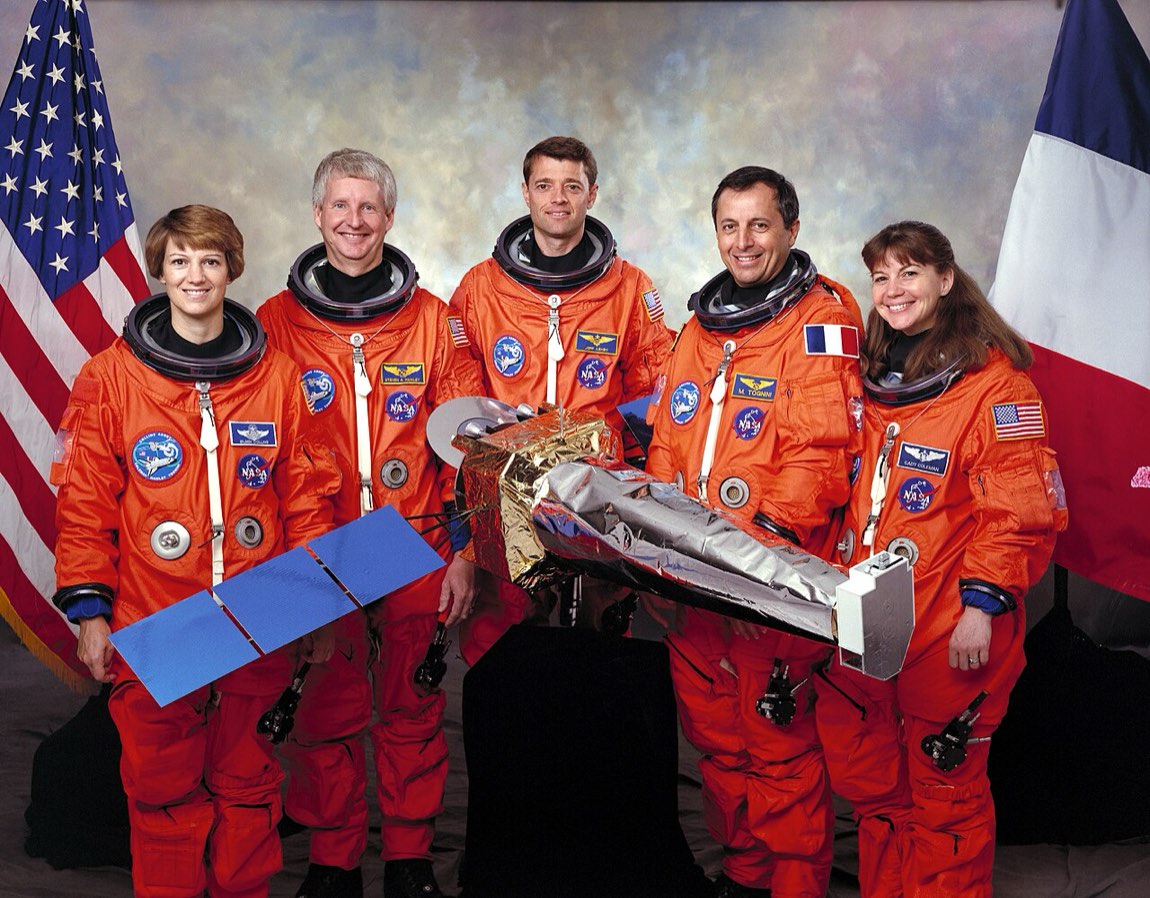
When Space Shuttle Columbia climbed away from the launch pad during STS-93, it was carrying the single heaviest payload in shuttle history: Chandra and its booster system together massed 22,753 kilograms — about 50,162 pounds, roughly the weight of four adult African elephants. That bulk existed because Chandra needed a two-stage Inertial Upper Stage rocket to push it from the shuttle's low orbit up to its final high elliptical orbit. Astronaut Cady Coleman deployed the observatory from Columbia at 11:47 UTC. The first stage motor ignited at 12:48 UTC and burned for 125 seconds before separating; the second stage then ignited at 12:51 UTC and burned for 117 seconds. Together, the two burns delivered Chandra to an orbit that swings out beyond geostationary satellites and past the outer Van Allen radiation belt — a region unreachable by any previous science satellite intended for long-term continuous observation.
03 Why X-rays Demand a Space-Based Telescope
Earth's atmosphere is a near-perfect shield against X-rays — it absorbs the vast majority before they can reach the ground. That is excellent news for life on the surface, but it means that any telescope hoping to catch X-ray light from the cosmos must operate above the atmosphere entirely. Chandra orbits as a satellite, completing one loop every 64 hours on a highly elliptical path. Within that orbit, it can observe continuously for up to 55 hours — nearly the entire period — because the elongated geometry keeps it above the planet's radiation belts for most of the time. The practical payoff of escaping the atmosphere is dramatic: Chandra can detect X-ray sources 100 times fainter than any previous X-ray telescope could. That sensitivity leap is comparable to the difference between seeing a candle across a crowded room and seeing it across a city block on a foggy night.
04 Mirrors That Barely Graze the Light Deeper
Conventional optical telescopes bounce light off mirrors head-on, but X-ray photons are so energetic that a normal mirror simply absorbs them rather than reflecting them. Chandra instead uses a Wolter telescope design: nested cylindrical surfaces shaped as paraboloids and hyperboloids set at very low grazing angles, so X-rays skim across the surface and are redirected toward a focus. The observatory carries four pairs of these nested mirrors, together forming the High Resolution Mirror Assembly. Each mirror substrate is 2 cm-thick glass, and the reflecting surface is a coating of iridium just 33 nanometers thick. The four mirror pairs have diameters of 65 cm, 87 cm, 99 cm, and 123 cm. Because the glass substrates are thick — deliberately so, to allow the extremely careful polishing that produces a precise optical surface — the mirrors do not fill as large a fraction of the aperture as thinner alternatives would. That trade-off limits Chandra's light-collecting area compared with XMM-Newton, but it produces angular resolution that concentrates between 80 and 95 percent of incoming X-ray energy into a circle just one arcsecond across.
05 Resolution Over 1,000 Times Better Than the First Deeper
The first orbiting X-ray telescope was NASA's Einstein Observatory, launched in 1978 — itself a landmark instrument that Giacconi and Tananbaum had helped pioneer. Chandra's angular resolution of 0.5 arcsecond (equivalent to 2.4 microradians) exceeds Einstein's capability by a factor of more than 1,000. To put that figure in tangible terms, 0.5 arcsecond is about the angle subtended by a dime viewed from roughly 4 kilometers away. That sharpness allows Chandra to separate closely packed X-ray sources, trace the fine structure inside supernova remnants, and image jets and rings around pulsars that blurred into featureless blobs for earlier telescopes. The resolution is not merely impressive on paper: it was directly responsible for the very first image Chandra returned — a sharply resolved view of the compact object buried at the heart of the supernova remnant Cassiopeia A, an object no previous X-ray telescope could isolate.
06 Four Instruments, Two Ways to See X-rays Deeper
Chandra's Science Instrument Module holds two focal-plane detectors and two transmission grating spectrometers. The Advanced CCD Imaging Spectrometer, or ACIS, is built from 10 CCD chips and records both images and spectral information across a photon energy range of 0.2 to 10 keV. The High Resolution Camera, or HRC, uses two micro-channel plate components to image sources from 0.1 to 10 keV and achieves a time resolution of 16 microseconds — fast enough to track rapid brightness changes in pulsars and other energetic objects. Either detector can be used alone or paired with one of the two transmission gratings. The High Energy Transmission Grating Spectrometer covers 0.4 to 10 keV with a spectral resolution of 60 to 1000, while the Low Energy Transmission Grating Spectrometer reaches down to 0.09 keV with a resolution of 40 to 2000. The gratings swing into the optical path behind the mirrors when needed, spreading X-ray light into a spectrum the way a prism spreads sunlight into a rainbow. Early in the mission, the ACIS CCDs suffered particle damage during radiation belt passages, and the instrument is now routinely moved out of the focal plane during those passages to prevent further harm.
07 A Name Won by a Teacher and a Student
The name Chandra did not come from a NASA committee — it came from a public contest held in 1998 that drew more than 6,000 submissions from around the world. The winners were Jatila van der Veen, then a high school teacher, and Tyrel Johnson, then a high school student, who together suggested honoring Nobel Prize-winning Indian-American astrophysicist Subrahmanyan Chandrasekhar. Chandrasekhar is celebrated for determining the maximum mass that a white dwarf star can sustain before collapsing — work that deepened understanding of neutron stars and black holes, precisely the kinds of extreme objects Chandra was built to study. The name carries an extra layer of resonance: Chandra means "moon" in Sanskrit, and the observatory's elongated orbit carries it out to roughly one-third of the distance to the actual Moon at its farthest point. The pairing of a lunar meaning with an orbit that reaches toward the Moon is, by any measure, a satisfying coincidence.
08 Landmark Discoveries Across the Universe
The volume of new science Chandra has produced is extraordinary. It captured the first X-ray emission ever detected from Sagittarius A*, the supermassive black hole at the Milky Way's center, and on January 5, 2015, recorded an X-ray flare from that same black hole that was 400 times brighter than usual — possibly caused by an asteroid breaking apart as it fell inward, or by tangled magnetic field lines in infalling gas. In the Perseus Cluster, Chandra detected sound waves rippling outward from a supermassive black hole in 2003, a discovery that turned galaxy clusters into cosmic concert halls. A 2006 observation of a supercluster collision provided strong evidence for the existence of dark matter, and separate observations of the Bullet Cluster placed limits on how strongly dark matter particles interact with each other. Chandra also found a new class of intermediate-mass black holes in galaxy M82, detected X-ray emissions from Pluto in 2014 and 2015 — the first such detection from any Kuiper Belt object — and in September 2020 reported a possible exoplanet candidate in the Whirlpool Galaxy, which would be the first planet identified beyond our galaxy.
09 When Chandra Listened to a Black Hole Roar
In 2003, Chandra observations of the Perseus Cluster revealed something unexpected: pressure waves, or sound waves, propagating through the hot gas surrounding a supermassive black hole. The violent activity of the black hole was sending ripples outward through the intracluster medium much as a speaker cone pushes waves through air. A related discovery came from Messier 87, where in 2006 Chandra found X-ray emitting loops, rings, and filaments that implied the simultaneous presence of pressure waves, shock waves, and sound waves together. Astronomers concluded that this activity may have dramatically shaped the evolution of Messier 87 over cosmic time — essentially, the black hole was not just consuming material but sculpting its entire galactic environment through mechanical energy. These observations helped establish a field of research now called AGN feedback, the study of how supermassive black holes regulate star formation across whole galaxy clusters by injecting energy into surrounding gas.
10 Dark Matter's Smoking Gun in a Cluster Collision
One of Chandra's most celebrated contributions to fundamental physics came from observing galaxy clusters in the act of colliding. In 2006, observations of a supercluster collision provided strong evidence that dark matter genuinely exists as a distinct component of the universe, separate from ordinary gas and stars. The logic rested on comparing where the X-ray-emitting hot gas ended up after the collision versus where the gravitational mass was concentrated: the gas, slowed by electromagnetic interactions, lagged behind, while the bulk of the mass streaked ahead — behaving exactly as a largely non-interacting dark matter component would. Separate Chandra observations of the famous Bullet Cluster went further, placing measurable limits on the self-interaction cross-section of dark matter particles. Both results were powerful because they used X-ray observations as a probe of a phenomenon that produces no X-rays itself, showing how Chandra's view of hot gas can illuminate physics far beyond astrophysics.
11 Gyroscope Glitch and Safe Mode in 2018
On October 10, 2018, Chandra unexpectedly entered safe mode — a protective state in which the spacecraft suspends science operations and orients its solar panels toward the Sun while engineers diagnose a problem. The trigger was a glitch in one of the mechanical gyroscopes that help determine which direction the telescope is pointing. NASA confirmed that all science instruments remained safe throughout the event. Engineers quickly traced the issue: one gyroscope was producing data with a 3-second error, a timing offset that could corrupt pointing information. Within days of identifying the problem, mission controllers had developed a plan to return Chandra to full operation. The affected gyroscope was placed in reserve rather than being decommissioned — it remained otherwise healthy and could be returned to service if needed. The episode illustrated the complexity of operating a spacecraft in a high radiation environment with no possibility of a hands-on repair visit, since Chandra's distant elliptical orbit is entirely beyond the reach of any crewed vehicle.
12 A Mission Fighting for Its Future
Chandra was originally designed for a 5-year mission, but NASA extended that to 10 years in September 2001 after the observatory's outstanding early results. A 2004 study by the Chandra X-ray Center suggested the hardware could physically survive at least 15 years, and the telescope remains operational as of 2026 with a published schedule of upcoming observations. Despite that longevity, the mission's future is uncertain. In March 2024, Congress reduced NASA's funding in ways that threatened premature termination of Chandra — a prospect that astronomers sardonically described as an "extinction-level" event for X-ray astronomy in the United States. A coalition of astronomers launched a public outreach campaign urging American citizens to contact Congress in support of the mission. In June 2024, senators urged NASA to reconsider the cuts, and NASA accepted those representations. The episode underscores a recurring tension in big-science programs: spacecraft that physically could operate for decades are vulnerable to budget decisions made on annual political cycles.
13 Chandra's Place Among the Great Observatories
NASA deliberately built Chandra as one of four Great Observatories, a suite designed to survey the universe across complementary wavelengths. The Hubble Space Telescope covers ultraviolet through near-infrared light; the Compton Gamma Ray Observatory, which operated from 1991 to 2000, covered gamma rays; the Spitzer Space Telescope, active from 2003 to 2020, covered infrared; and Chandra covers X-rays. Together, the four could observe the same object or class of objects and build a picture spanning a vast stretch of the electromagnetic spectrum. Chandra's closest international counterpart is ESA's XMM-Newton, also launched in 1999, but the two telescopes are deliberately complementary rather than redundant: Chandra's design prioritizes angular resolution, while XMM-Newton's design prioritizes spectroscopic throughput — the ability to collect a large number of X-ray photons efficiently. Looking ahead, ESA has been developing the Advanced Telescope for High Energy Astrophysics, ATHENA, as a next-generation successor with a proposed launch in 2028, though that project itself represents a downsized revival of the earlier International X-ray Observatory concept that was canceled after being proposed in 2008.
 ⤢
⤢