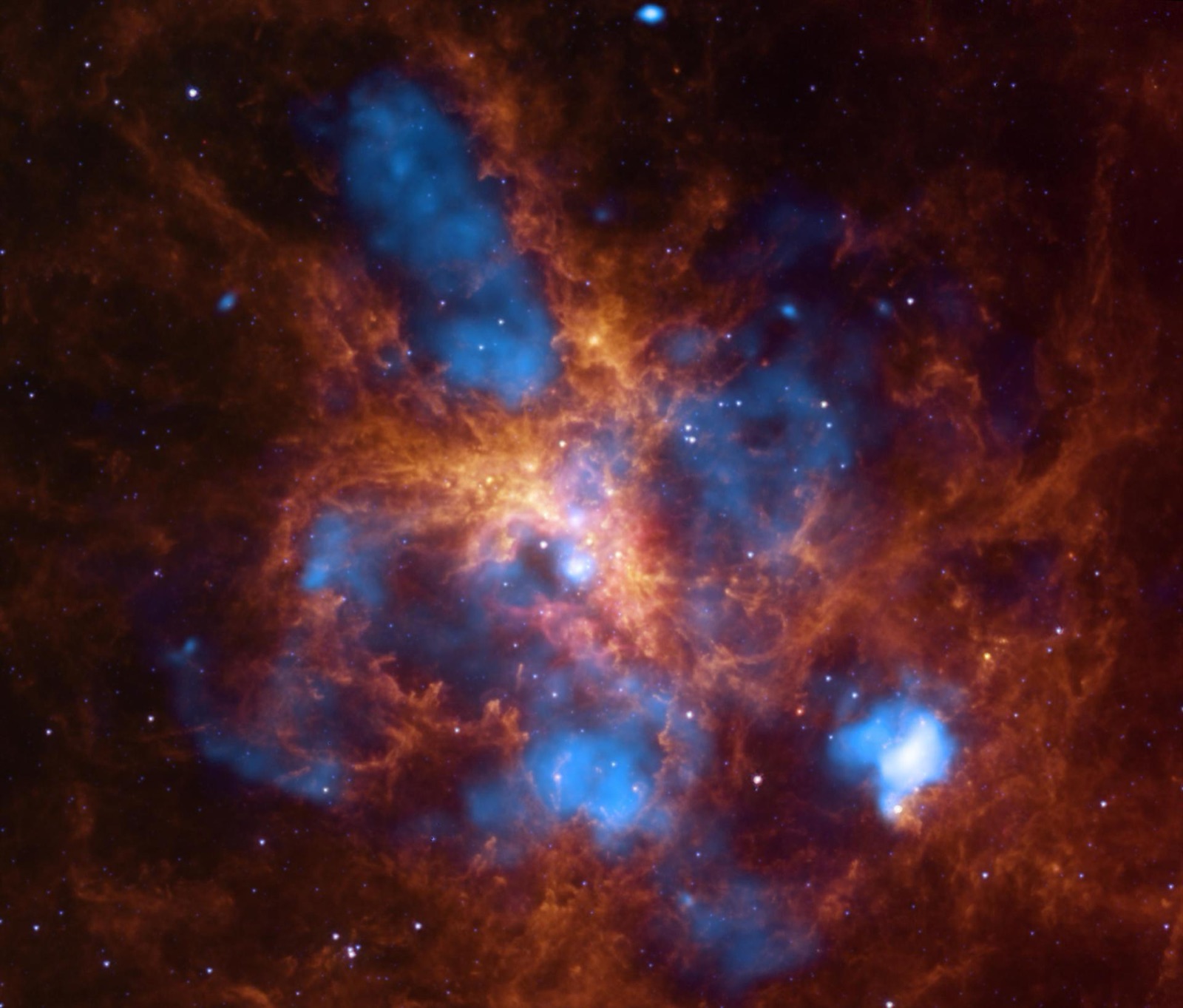
 Photograph · X-ray: NASA/CXC/PSU/L. Townsley et al.; Infrared: NASA/JPL/PSU/L. Townsley et al.
Nebula · Deep guide
The Tarantula Nebula
The Local Group's monster nursery is home to the most massive stars known.
What is it?
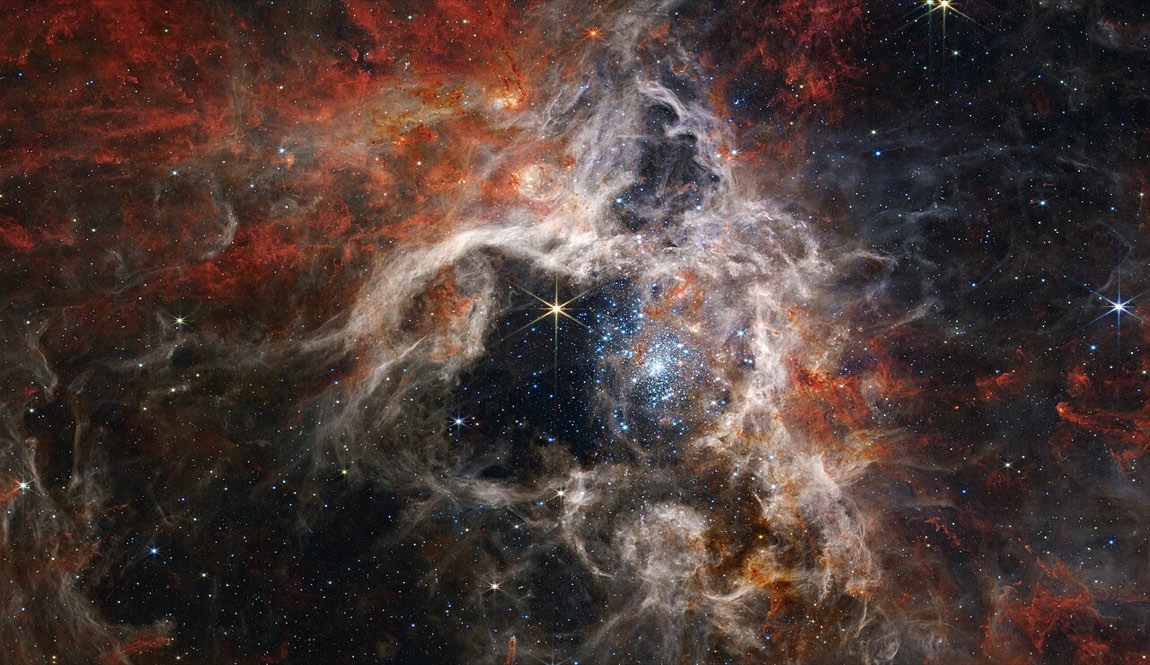
The Tarantula (30 Doradus) in the Large Magellanic Cloud is the most violent star factory in our galactic neighborhood — so luminous that at the Orion Nebula's distance it would cast shadows at night. Its core cluster R136 packs stars up to roughly 200 solar masses, the heaviest known, and supernova 1987A exploded on its outskirts. JWST uses it as a window onto how stars formed in the early universe.
The deep dive
Researched for the Atlas from Wikipedia — Tarantula Nebula (3,332 characters read) · updated Sep 20, 2026
01 How the Tarantula got its name
The nebula's arachnid identity is a surprisingly recent invention. When Nicolas-Louis de Lacaille observed it from the Cape of Good Hope between 1751 and 1753, he simply cataloged it as a diffuse nebula about 20 arcminutes across — no creature, no drama. Johann Bode gave it a catalog number, listing it as object 30 in the constellation Dorado in his 1801 Uranographia atlas, which is why the designation 30 Doradus stuck. The evocative name Tarantula Nebula only emerged in the mid-20th century, when long-exposure photographic plates revealed glowing filaments of gas stretching outward from the bright core in a pattern that genuinely resembles the sprawling legs of a large spider. Before photography made those tendrils visible, there was simply nothing spider-like to see. The name caught on quickly, and today "Tarantula" is far better known than the older designation 30 Doradus — though astronomers still use both, treating 30 Doradus as referring to the entire nebula region rather than just its central star cluster.
02 Lacaille's first look and Bode's catalog Deeper
Nicolas-Louis de Lacaille's expedition to the Cape of Good Hope ran from 1751 to 1753, and during that time he systematically cataloged southern sky objects invisible from European observatories. He placed the Tarantula Nebula second in his class of "Nebulae of the First Class," which he defined as nebulosities not accompanied by any star visible in his two-foot telescope — meaning the glow appeared truly diffuse, with no obvious stellar point at its heart. Half a century later, Johann Bode incorporated it into his landmark Uranographia star atlas of 1801 and listed it in the accompanying Allgemeine Beschreibung und Nachweisung der Gestirne catalog. Rather than assigning a stellar magnitude, Bode simply noted it as nebulous — a sensible admission given that it behaves nothing like a star. The designation 30 Doradus that survives today comes directly from Bode's numbering system for the constellation then called Xiphias or Dorado, anchoring this extraordinary object in the history of systematic sky surveys long before anyone understood what H II regions were.
03 Why its brightness is genuinely shocking
The Tarantula Nebula shines at an apparent magnitude of 8, which sounds modest — just beyond the naked-eye limit — but that number becomes staggering once you factor in the distance. The nebula sits about 49 kiloparsecs away, roughly 160,000 light-years from Earth. At that enormous remove, anything glowing at magnitude 8 must be radiating energy on a barely imaginable scale. Astronomers have calculated that if the Tarantula Nebula were relocated to the same distance as the Orion Nebula — our well-known nearby stellar nursery — it would cast visible shadows on the ground at night. That single comparison captures how disproportionately luminous it is. The driving engine behind all that output is the compact central star cluster R136, which generates most of the ultraviolet radiation that ionizes the surrounding hydrogen gas and makes the entire structure glow. The nebula holds the title of the most active starburst region known anywhere in the Local Group of galaxies, a neighborhood that includes the Milky Way, Andromeda, and dozens of smaller companions.
 ⤢
⤢
04 Just how big is 570 parsecs of nebula?
Size estimates for the Tarantula Nebula span a wide range: somewhere between about 200 and 570 parsecs in diameter, which translates to roughly 650 to 1,860 light-years. The uncertainty is real and reflects genuine difficulty in drawing a firm boundary around a structure made of gas that fades gradually into its surroundings rather than ending with a clean edge. At the upper end of that range, 570 parsecs is about 18 times the distance from the Sun to the center of the Orion Nebula. The nebula's enormous scale means it is sometimes described simply as the largest H II region in the Local Group, though astronomers note that this claim is contested. NGC 604, a star-forming cloud in the Triangulum Galaxy, could rival or exceed it in size. What is not in dispute is that the Tarantula sits on the leading edge of the Large Magellanic Cloud — the side that plows through surrounding gas as the LMC moves through space — where a process called ram pressure stripping compresses the interstellar medium and likely helps drive the exceptional star formation activity.
05 NGC 2070 and the cluster inside a cluster Deeper
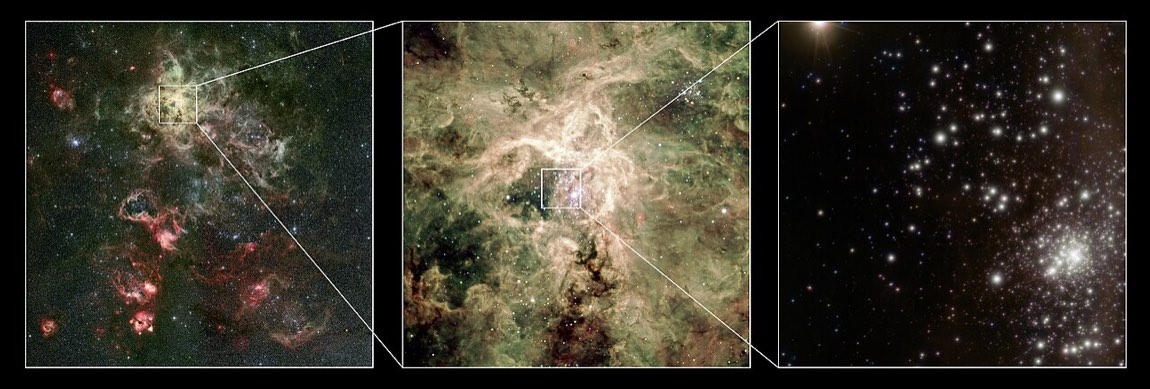
At the geometric and energetic heart of the Tarantula Nebula lies NGC 2070, a dense young star cluster that itself contains a remarkable inner concentration called R136. This nested architecture means energy production is highly centralized: R136 is responsible for the bulk of the ionizing radiation that keeps the surrounding hundreds of light-years of hydrogen glowing. The total estimated mass of NGC 2070 is 450,000 solar masses — a figure large enough that astronomers think the cluster may eventually evolve into a globular cluster, the ancient, tightly bound stellar cities that orbit mature galaxies. The Tarantula is not just one generation of stars, however. It also contains Hodge 301, a significantly older cluster embedded in the same nebula. Hodge 301 is old enough that its most massive stars have already exhausted their fuel and detonated as supernovae, seeding the surrounding gas with heavy elements and shock waves. The coexistence of extremely young star-forming regions alongside a cluster whose giant stars have already lived and died illustrates the Tarantula as a place of overlapping, multigenerational stellar activity rather than a single burst event.
06 Supernova 1987A: history's closest modern blast
On the outskirts of the Tarantula Nebula, something extraordinary happened in 1987: a star exploded close enough to Earth that it became the nearest supernova observed since the invention of the telescope. Designated Supernova 1987A, it was visible to the naked eye from the Southern Hemisphere and gave astronomers their first opportunity to study a supernova up close with modern instruments, including neutrino detectors that caught the pulse of particles released at the moment of core collapse. The explosion left behind a supernova remnant that continues to expand and brighten as its blast wave slams into surrounding material. That remnant encloses the open cluster NGC 2060. The Tarantula's complex, tangled nebulosity creates a challenge, though: while 1987A's remnant is prominent and well-studied, the remains of many other supernovae that have gone off in the region are difficult to pick out against the glowing background gas. The nebula is dense with stellar history, but much of that history is obscured by its own brilliance.
 ⤢
⤢
07 A silent black hole hiding in plain sight
In 2022 astronomers announced the discovery of a black hole inside the Tarantula Nebula with a mass of at least nine solar masses — significant not just for its size but for what it is not doing. Most known stellar-mass black holes have been detected because they are actively pulling material from a companion star and radiating X-rays as that gas heats up and spirals inward. VFTS 243, as the system is called, is different: the black hole is X-ray quiet, meaning it radiates little or nothing detectable in X-rays. It was identified instead through the motion of its companion, a blue giant star with a mass of about 25 solar masses, which traces a circular orbit betraying the gravitational influence of an unseen massive partner. This made it the first black hole discovered outside the Milky Way that does not radiate strongly. Its quietness hints that the black hole formed without a dramatic asymmetric explosion that would have disrupted the orbit — a finding that carries implications for understanding how black holes are born from dying massive stars.
08 Ram pressure and why location matters Deeper
The Tarantula Nebula does not sit just anywhere inside the Large Magellanic Cloud. It occupies the leading edge — the front face of the LMC as that small galaxy moves through the diffuse gas of the Local Group and the halo of the Milky Way. As the LMC travels, it encounters resistance from this surrounding medium, a phenomenon called ram pressure stripping. Think of it like the wind you feel when you put your hand out of a moving car: the galaxy's motion through external gas creates a pressure on the gas inside and around the LMC. At the leading edge where the Tarantula sits, this compression of the interstellar medium is at its maximum. Astronomers believe this ram pressure likely plays a role in triggering and sustaining the extraordinary star formation happening there, essentially squeezing gas clouds past the density threshold needed to collapse and ignite new stars. It is a reminder that the Tarantula's furious activity is not purely internal to the nebula — the large-scale dynamics of the LMC's orbit around the Milky Way may be directly feeding the most productive stellar nursery in the Local Group.
09 What the future holds for NGC 2070
The central star cluster NGC 2070 already weighs in at an estimated 450,000 solar masses, and astronomers think this puts it on a long-term evolutionary path toward becoming a globular cluster. Globular clusters are among the oldest objects in any galaxy — ancient, spherical swarms of hundreds of thousands to millions of stars, tightly gravitationally bound, still orbiting galaxies like the Milky Way billions of years after their formation. If NGC 2070 follows that trajectory, the brilliant, chaotic stellar nursery at the heart of the Tarantula today would eventually settle into one of those ancient, stable communities. That future is enormously distant — globular clusters take billions of years to reach their mature form — but the mass estimate gives astronomers confidence that the gravitational conditions are at least plausible. Meanwhile, the older cluster Hodge 301 in the same nebula offers a preview of what happens as massive stars age out: its heaviest members have already gone supernova, leaving behind a population of lower-mass stars and enriched surrounding gas that feeds the next generation of star formation.
 ⤢
⤢
10 The Local Group's star-formation champion Deeper
Calling the Tarantula Nebula the most active starburst region in the Local Group is not casual hyperbole — it is a statement that holds up against every other H II region across roughly three dozen galaxies within about 3 million light-years of the Milky Way. Starburst regions are defined by star formation rates dramatically elevated above the galactic average, sustained by large reservoirs of dense molecular gas and sufficient triggering mechanisms to keep clouds collapsing. The Tarantula's nearest large competitor for the title of biggest H II region in the Local Group is NGC 604 in the Triangulum Galaxy, and astronomers genuinely debate which is physically larger given the difficulty of precisely bounding diffuse gas structures. But in terms of overall activity and luminosity, the Tarantula appears to be unrivaled locally. This makes it an invaluable laboratory: because it is only 160,000 light-years away, astronomers can resolve individual stars within it, something completely impossible in comparable starburst regions in distant galaxies, giving unparalleled insight into how intense star formation actually works.