 Photograph · GSFC / NASA Image Library
Nebula · Deep guide
The Ring Nebula
Also called: M57
A dying star's smoke ring, and a preview of our Sun's own farewell.
What is it?
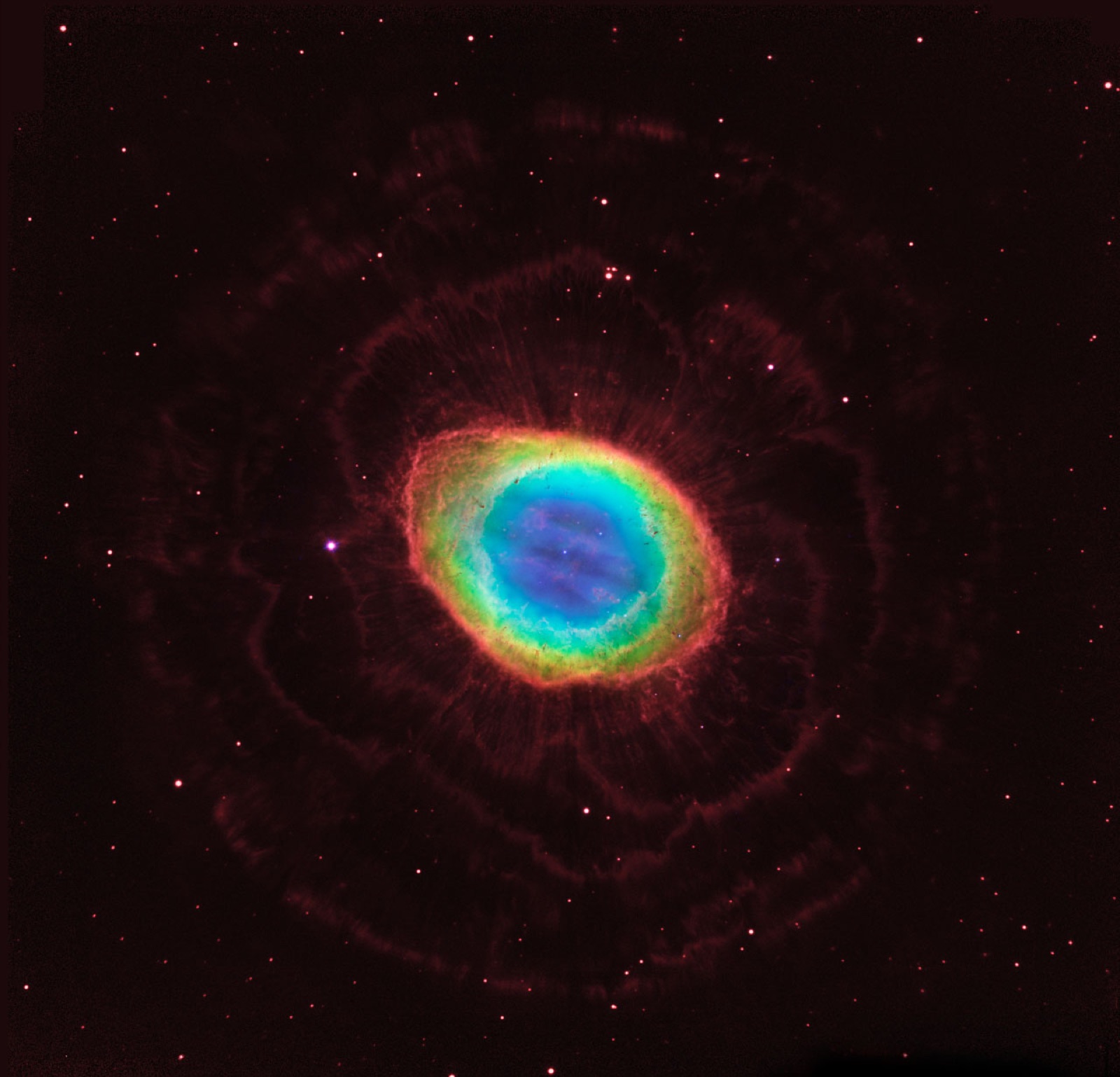
The Ring Nebula is the sky's most famous planetary nebula: a luminous doughnut of glowing gas 2,300 light-years away in Lyra, puffed off by a dying Sun-like star. The star's exposed core — a newborn white dwarf — sits at the center like a period in a colored ring. In about 5 billion years, the Sun will make one of these.
Go deeper
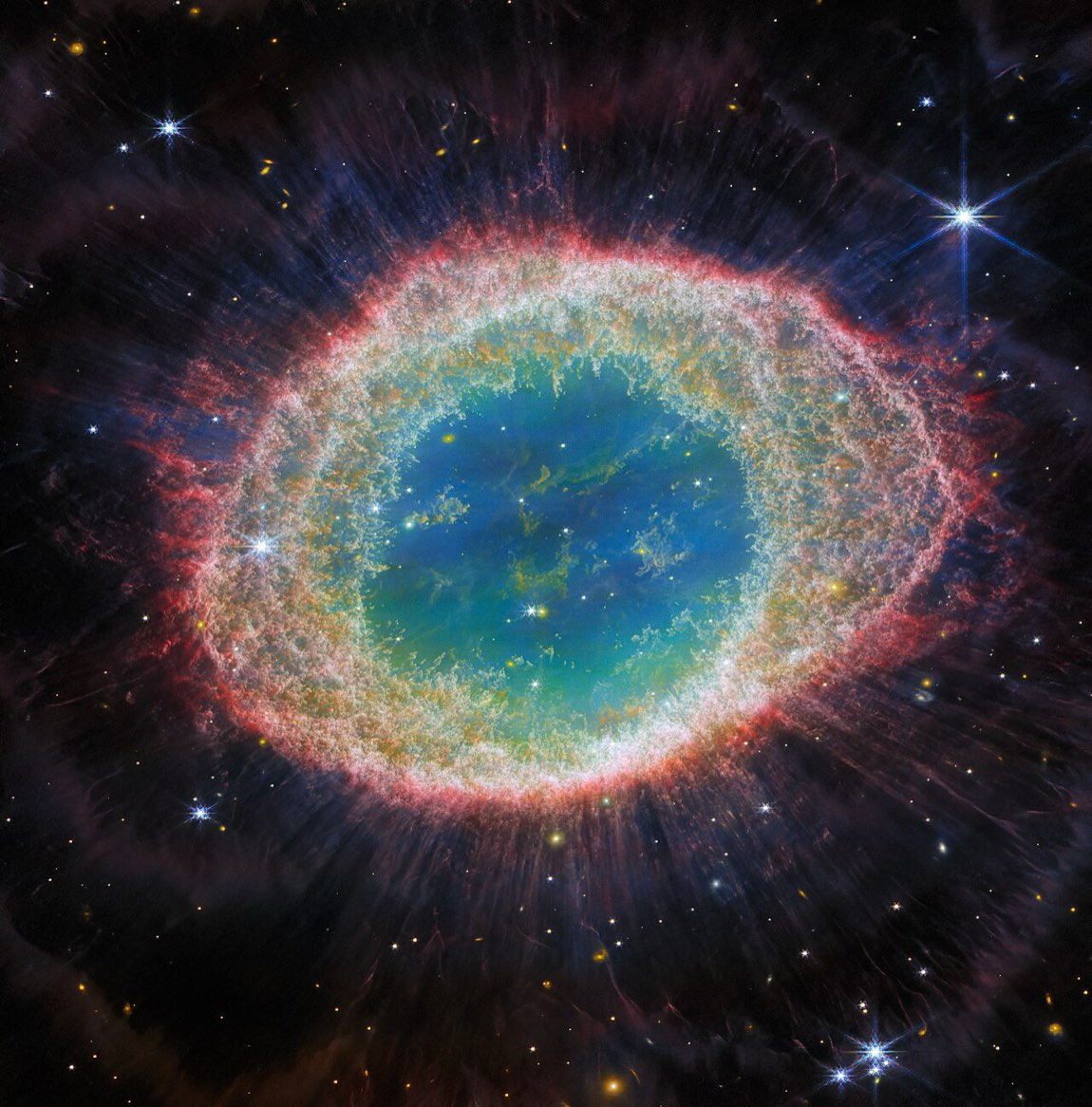
'Planetary nebulae' (a historical misnomer — small telescopes showed planet-like disks) are the ejected envelopes of 1–8 M☉ stars, ionized by the ~120,000 K core left behind. JWST's 2023 images of M57 resolve ~20,000 dense globules and outer halo arcs hinting at an unseen binary companion shaping the geometry; the 'ring' is actually a barrel viewed down its axis. The phase is fleeting — ~20,000 years of glow before the gas disperses into the next generation's raw material.
01 The Sun's future, on display
Stars like ours don't explode — they exhale. When the Sun's fuel runs low it will swell, pulse, and gently shrug off its outer half into space; ultraviolet light from the exposed core will make those shells glow in exactly these colors — oxygen teal, hydrogen red. M57 is a postcard from 5 billion years in our future.
02 Rings that are really barrels Deeper
Most 'rings' are projection effects: M57 is a barrel of gas we happen to view end-on. Why dying single stars should eject barrels, spirals, and butterflies rather than simple spheres is an active puzzle — hidden companions and magnetic fields are the leading sculptors, and JWST's globule-level detail is the current evidence trove.
The deep dive
Researched for the Atlas from Wikipedia — Ring Nebula (5,364 characters read) · updated Sep 20, 2026
03 How the Ring was found — twice
The Ring Nebula has a slightly awkward origin story: it was discovered twice within weeks, and neither discoverer was even looking for it. Charles Messier, the French comet-hunter, spotted it in late January 1779 while sweeping for comets. When word of his independent sighting of Comet Bode reached fellow Frenchman Antoine Darquier de Pellepoix about two weeks later, Darquier turned his own telescope to follow the comet and stumbled upon the nebula independently. His description is historically memorable: he wrote that it was 'as large as Jupiter and resembles a planet which is fading.' That casual comparison may be partly responsible for the term 'planetary nebula' sticking around in astronomy long after astronomers understood that the objects have nothing whatsoever to do with planets. Messier logged the object as the 57th entry in his famous catalogue, giving it the designation M57 that astronomers still use today alongside NGC 6720.
04 The hidden central star's long detective story
Locating the faint star buried inside the Ring turned out to be surprisingly difficult. In 1800, German Count Friedrich von Hahn announced that he had found the central star a few years earlier — but he also reported that the nebula's interior appeared to have changed, and he could no longer locate the star at all. Whether that reflected genuine variability, atmospheric conditions, or observational uncertainty is unclear, but the report hinted at how elusive the star would prove. The definitive photographic discovery came on September 1, 1886, when Hungarian astronomer Jenő Gothard captured it on images taken at his private observatory in Herény, near Szombathely. Even today, visually spotting the central star is considered a serious challenge: it shines at only magnitude 14.8, requiring a large, well-collimated telescope and steady skies. Its apparent visual magnitude is listed in the article as +15.75, reflecting how little light reaches us across 2,570 light-years.
 ⤢
⤢
05 Huggins and the great nebula debate Deeper
For much of the early nineteenth century, astronomers assumed that fuzzy nebulae were simply distant star clusters too densely packed to resolve individually — a perfectly reasonable guess given the technology of the era. The debate shifted decisively in 1864, when English amateur astronomer William Huggins turned a spectroscope on a series of nebulae. The results were startling: instead of the rainbow of overlapping stellar spectra one would expect from an unresolved cluster, M57 and similar objects showed bright, narrow emission lines. Huggins recognized these as the signature of fluorescing glowing gases, not stars. He concluded that most planetary nebulae were genuine clouds of gas — nebulosities, as he put it — rather than unresolved stellar populations. This single observational campaign effectively launched the spectroscopic study of nebulae and settled a question that telescopic imaging alone could not answer. The same emission-line physics that Huggins identified is still what gives the Ring its vivid colors today.
06 What gives the Ring its colors
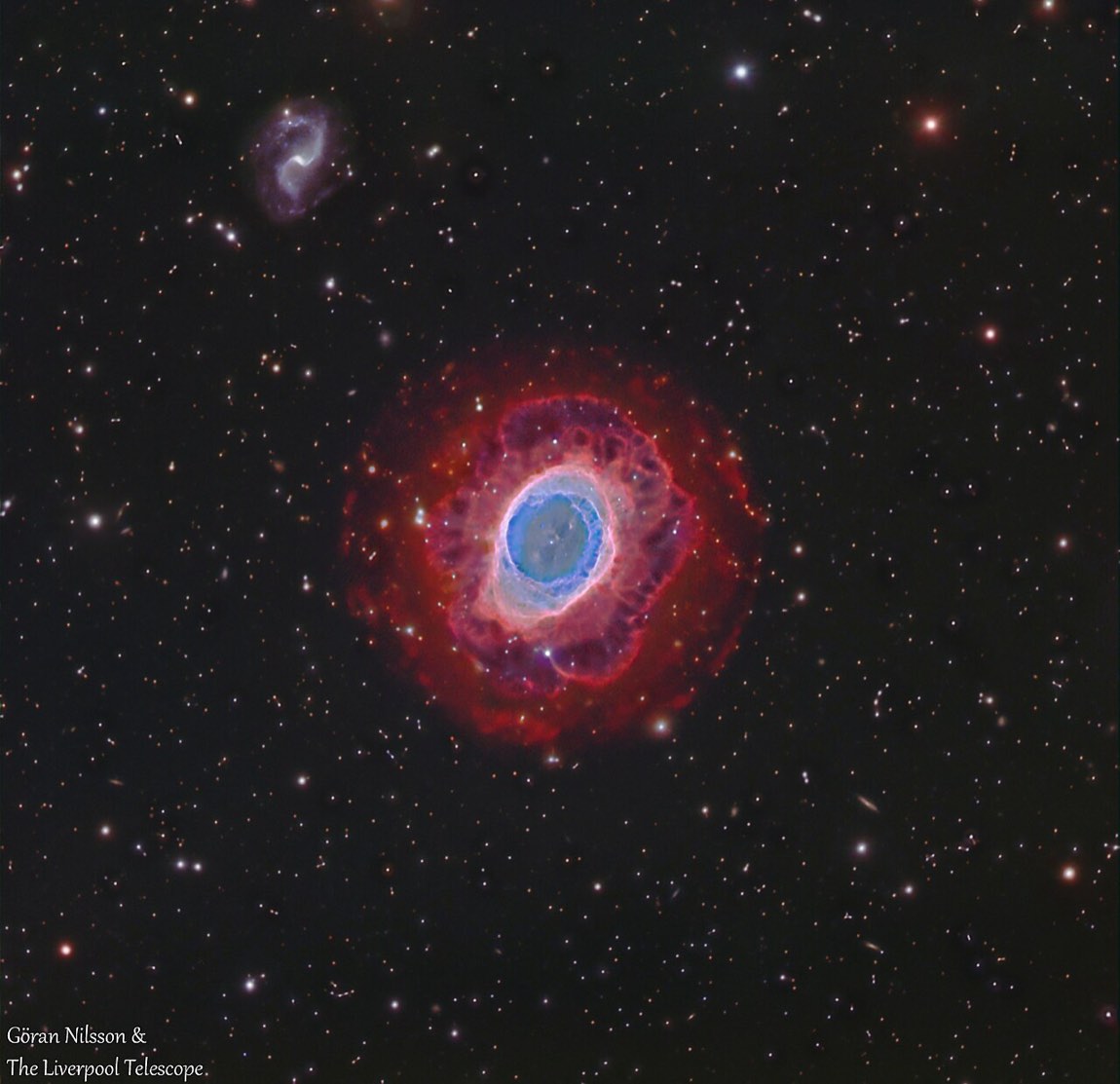
The Ring Nebula's distinctive palette is not decorative — each color is a precise chemical fingerprint. The blue-green glow that fills the interior comes from doubly ionized oxygen, which produces emission lines at 495.7 and 500.7 nanometers. These are so-called forbidden lines, a counterintuitive term that means the transitions are forbidden under normal laboratory conditions and can only occur in environments of extremely low density — containing no more than a few thousand atoms per cubic centimeter. In everyday terms, that is far emptier than any vacuum achievable on Earth. Toward the outer ring, the color shifts toward reddish hues. Part of that redness comes from hydrogen emitting at 656.3 nm, a line belonging to the Balmer series. Forbidden lines from ionized nitrogen, or N II, add further reddish tones at 654.8 and 658.3 nm. The result is a natural color gradient that maps, from inside to outside, the ionization structure driven by the intensely hot central star.
07 The white dwarf at the center: a star transformed Deeper
The star now sitting at the heart of M57 has undergone one of the most dramatic transformations a star can experience. Within the last two thousand years it left the asymptotic giant branch — the red-giant phase during which it shed the gas that became the nebula. It no longer generates energy through nuclear fusion. Instead it is a compact, cooling body consisting primarily of carbon and oxygen with only a thin outer envelope of lighter elements. Its mass is estimated at about 0.61–0.62 solar masses, comparable to a sphere of material roughly the size of Earth packed with the mass of more than half a Sun. Its surface temperature is a remarkable 125,000 ± 5,000 K — roughly twenty times hotter than the Sun's surface. Despite that ferocious heat, its tiny size means its apparent magnitude is only +15.75 as seen from Earth. In 2025 the James Webb Space Telescope observed a dust disk around this central star, adding a new layer of complexity to our picture of the system.
08 Luminosity versus visibility: a paradox explained
There is something initially confusing about the Ring Nebula's central white dwarf: the article states it is currently about 300 times more luminous than the Sun, yet it is almost impossible to see even in a large amateur telescope. How can something 300 times brighter than our Sun be so dim? The answer lies in distance and size together. At 2,570 light-years away — roughly 24 quadrillion kilometers — even the entire nebula has an apparent visual magnitude of only 8.8, just beyond naked-eye reach. The white dwarf, despite its enormous luminosity relative to the Sun, radiates predominantly in the extreme ultraviolet and soft X-ray portions of the spectrum rather than visible light, and its physical surface area is tiny. The combined effect pushes its visual magnitude to +15.75, making it roughly 50 times fainter than the faintest stars the unaided eye can detect under perfect skies. It is a reminder that apparent brightness depends on wavelength, area, and distance simultaneously.
 ⤢
⤢
09 Shape: not a ring at all, strictly speaking Deeper
Despite the name, M57 is not a flat ring like a wedding band. Astronomers describe its true three-dimensional form as a prolate spheroid — an elongated shape somewhat like a rugby ball — with strong concentrations of material gathered along its equatorial plane. What we see as a ring is essentially the thickened walls of this barrel-like structure viewed from an angle. Specifically, our line of sight meets the symmetrical axis of the nebula at an angle of about 30 degrees. That oblique viewing geometry means the edges of the barrel appear brighter because we are looking through more material there, while the thinner polar regions appear more transparent, creating the illusion of a hollow ring. Larger telescopes reveal subtleties consistent with this picture: a few darker zones become visible on the eastern and western edges, and faint nebulosity can be detected inside the disk, exactly where a barrel-shaped shell would allow a partial view through to the far interior.
10 How fast is the nebula growing?
The Ring Nebula is not sitting still — it has been expanding outward from its central star for an estimated 1,610 ± 240 years, and the expansion continues today. Astronomers can measure this growth in two complementary ways. By comparing photographs taken over a span of 50 years, the angular expansion rate works out to roughly 1 arcsecond per century — almost imperceptibly slow on a human timescale, but detectable across decades with careful astrometry. Spectroscopic observations add a second dimension: by measuring the Doppler shift of the nebula's emission lines, astronomers find that the gas along the line of sight is rushing outward at 20–30 km/s. That is about 72,000–108,000 km/h, fast enough to circle Earth roughly 1,800 times in an hour. The nebula has already grown to a diameter of 1 light-year. Combining angular and velocity measurements allows astronomers to independently estimate the distance to M57, providing a useful cross-check against parallax measurements.
11 Finding M57 in the summer sky
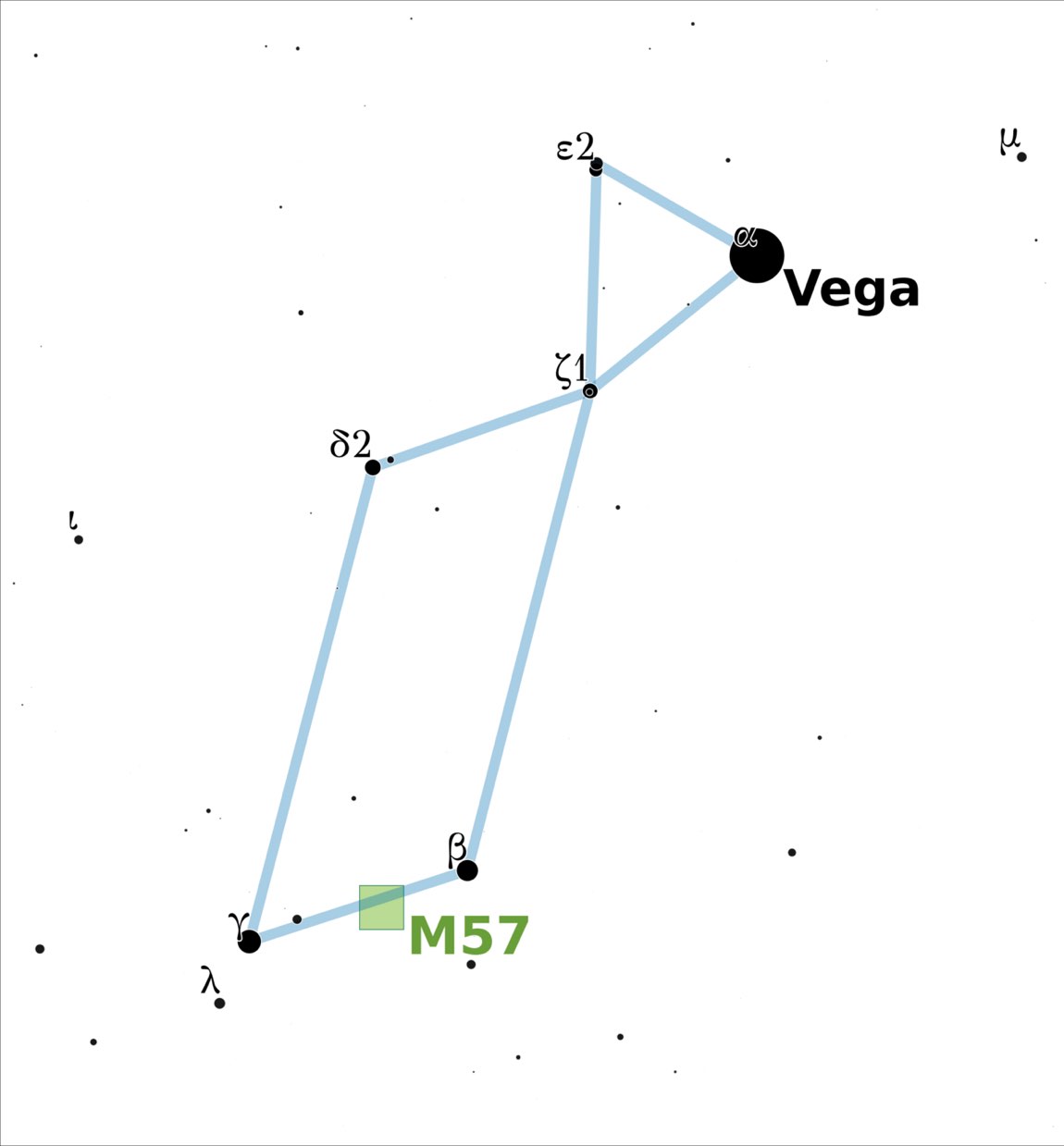
Locating the Ring Nebula begins with finding one of the brightest stars in the northern summer sky. Vega, the dazzling white star that anchors the northwestern corner of the Summer Triangle, acts as the starting beacon. From Vega, a short hop south brings you into the small constellation of Lyra. The nebula lies about 40 percent of the angular distance along the line from Beta Lyrae to Gamma Lyrae, making star-hopping to it straightforward. At an apparent visual magnitude of 8.8, M57 is too faint for the naked eye but well within reach of even a 7.5 cm (3 inch) telescope, which will already reveal its characteristic elliptical ring shape. A 10 cm (4 inch) instrument at 100× magnification can resolve the central hole. For observers in light-polluted areas, a UHC or OIII narrowband filter substantially improves contrast by blocking the wavelengths of artificial lighting while transmitting the nebula's own forbidden-line emission. The nebula's angular size of 1.5 × 1 arcminutes means it appears as a tiny but recognizable smoke ring, not just a fuzzy dot.
12 The first photograph and who took it
Astronomical photography was still in its pioneering infancy when the Ring Nebula was first successfully captured on a photographic plate. The achievement belongs to Hungarian astronomer Eugene von Gothard, who photographed M57 in 1886. This is the same Gothard family name attached to the photographic discovery of the central star: the article credits Jenő Gothard with that discovery on September 1, 1886, at his observatory in Herény, near Szombathely. Whether these refer to the same individual or to related figures at the same observatory, the Herény observatory in Hungary clearly played an outsized role in the early photographic study of this nebula. The 1886 photographs marked a turning point in how nebulae could be studied, allowing researchers to capture fainter detail than the eye could hold at the eyepiece and to compare images taken at different epochs — a technique that would later be used to measure the nebula's angular expansion rate across 50-year baselines.
 ⤢
⤢
13 Open questions the JWST is helping to answer Deeper
Even a well-studied object like M57 still holds genuine surprises. In 2025 the James Webb Space Telescope detected a dust disk around the Ring Nebula's central white dwarf — a finding not previously confirmed and one that raises new questions about how material is distributed in the innermost regions of the system long after the main ejection event. Dust surviving in such close proximity to a star with a surface temperature of 125,000 K is not trivially explained; it may have been shielded, replenished, or represent a disk that formed through a different process than the nebula itself. More broadly, the nebula's structure — a prolate spheroid with equatorial density concentrations, viewed at roughly 30 degrees from its symmetry axis — is still being refined. The mechanisms that shape planetary nebulae into non-spherical forms, including the possible influence of binary companions, magnetic fields, and rotation, remain active areas of research across the field, and M57 continues to serve as a nearby, well-resolved test case for these models.
Could life exist here?
Any planets that survived the red-giant phase now orbit a fading ember in an ionized fog. Planetary nebulae recycle: their carbon and oxygen seed future living worlds.
Our labels: Confirmed · Strong Evidence · Estimated · Hypothesis · Theoretical · Speculative (see Methodology).
Weird & wonderful
- Everything that glows in M57 used to be INSIDE a star.
- The central white dwarf is roughly Earth-sized but ~60% of the Sun's mass.
- The carbon in your body took this exact exit route from some earlier star.