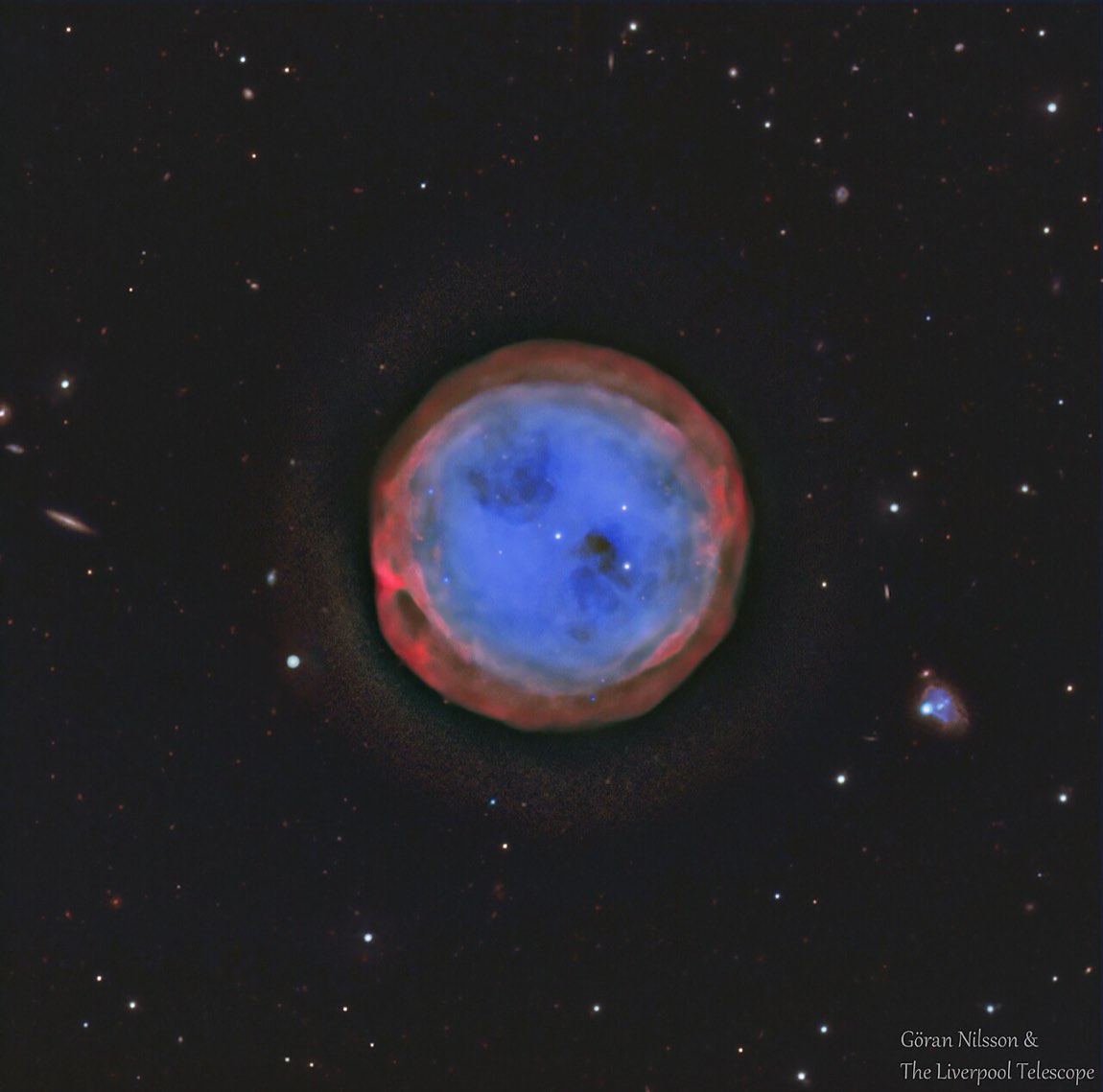
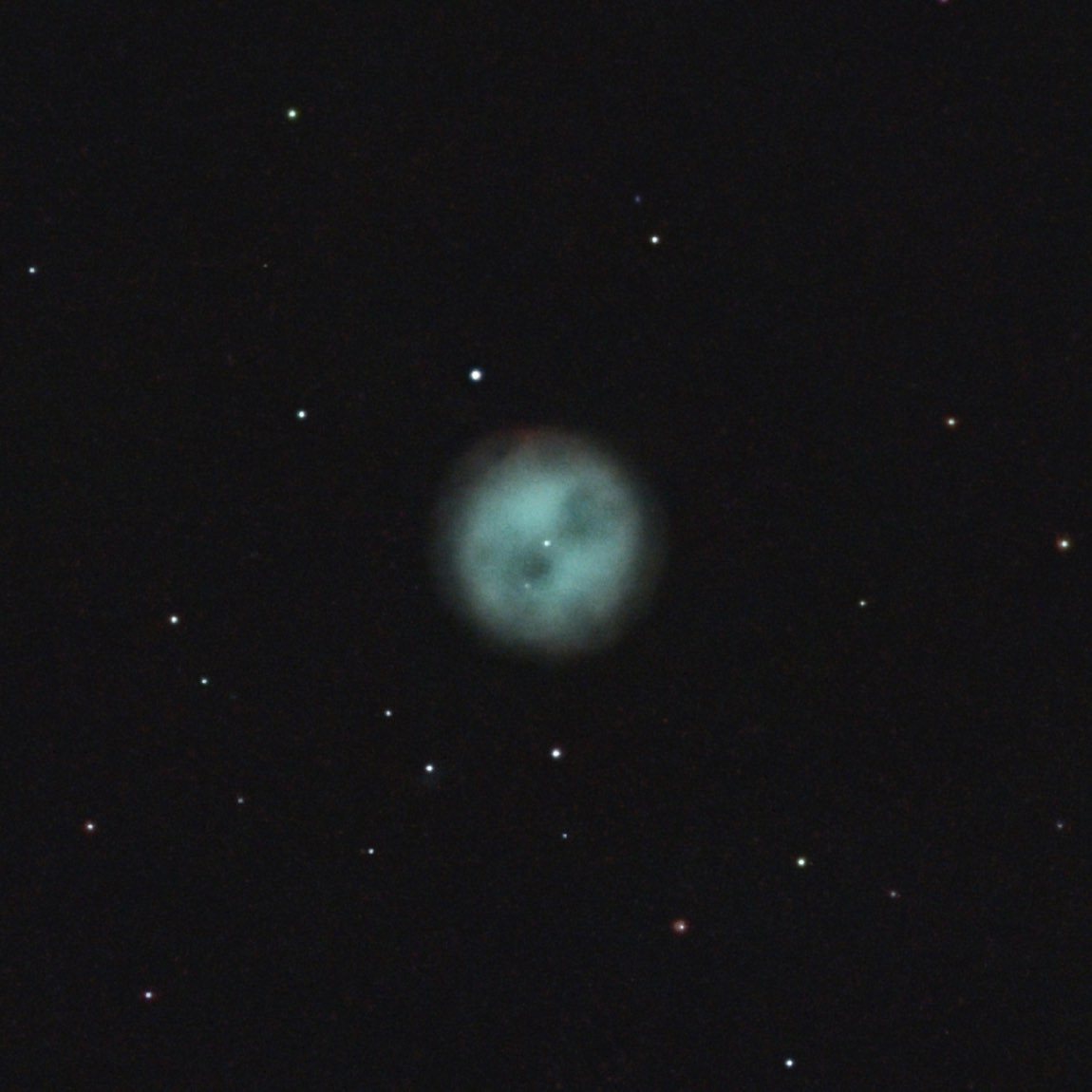
 Photograph · Göran Nilsson & The Liverpool Telescope · CC BY-SA 4.0
Nebula · Deep guide
Messier 97 (Owl Nebula)
Also called: M97 · NGC 3587 · Owl Nebula
A round shell of glowing gas in Ursa Major whose two dark patches look like an owl's eyes.
What is it?
Messier 97, the Owl Nebula, is a planetary nebula in Ursa Major, made of gas puffed off by a dying star over the last 8,000 years or so. The nebula is built of three nested shells. The inner shell is shaped like a tilted barrel, and seen from Earth that creates two darker patches that resemble an owl's eyes in larger telescopes. It holds about 0.13 solar masses of thin gas and is still expanding. Its central star, at about 123,000 K, is turning into a white dwarf.
The deep dive
Researched for the Atlas from Wikipedia — Owl Nebula (3,703 characters read) · updated Nov 15, 2026
01 How Pierre Méchain and Messier logged it
The Owl Nebula entered the historical record on February 16, 1781, when French astronomer Pierre Méchain — Charles Messier's close observing colleague — first spotted it near Beta Ursae Majoris. Messier himself followed up a few weeks later and formally added the object to his famous catalog on March 24, 1781, designating it Messier 97. In his catalog notes, Messier described it as a faint nebula without a star, remarking that it was especially difficult to see when the micrometer wires were illuminated. He also noted that Méchain had glimpsed two additional nebulae in the same region of sky — objects we now call Messier 108 and Messier 109 — meaning a single sweep of that patch of Ursa Major yielded three catalog entries. It was not until 1844 that Admiral William H. Smyth formally classified M97 as a planetary nebula, and it was William Parsons, the 3rd Earl of Rosse, who gave it its lasting nickname in 1848 after his hand-drawn sketch, made from his observatory in Ireland, resembled an owl's head.
02 Why Lord Rosse saw owls in the eyepiece
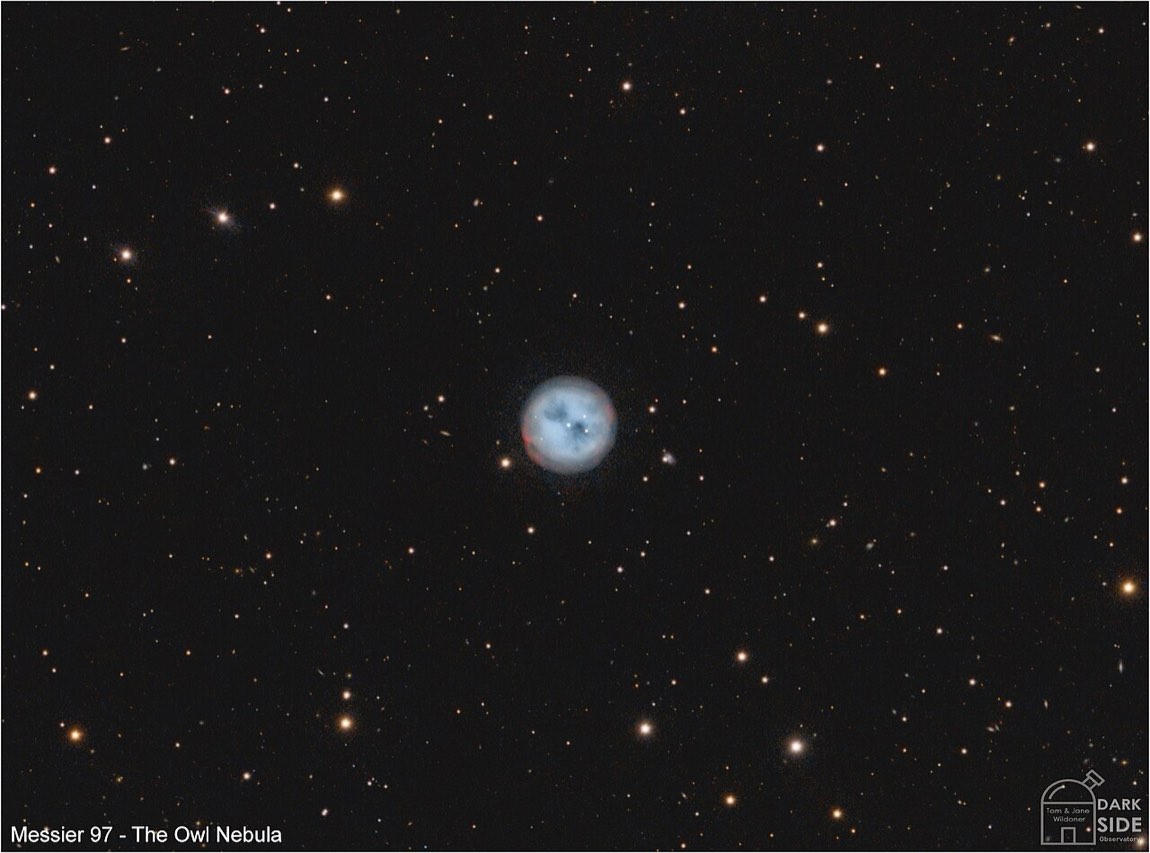
When William Parsons, the 3rd Earl of Rosse, turned his telescope on M97 in 1848, he described a nebula with two stars set considerably apart in its central region, each surrounded by a dark penumbra with a spiral arrangement of fainter stars appearing to orbit them like centers of attraction. His hand-drawn illustration captured two dark, circular voids against the nebula's glow, unmistakably evoking an owl's wide-set eyes. That impression is not purely artistic fancy — it has a real physical explanation. The nebula's inner shell is not circularly symmetric. Instead it forms a barrel-like structure tilted at a 45-degree angle to our line of sight, so we see two roughly cylindrical tunnels of lower-density gas oriented toward us at that angle, creating the dark eye patches. The surrounding brighter material frames them like a facial disc. Parsons's description has been the object's common name ever since, making it one of the rare cases where a 19th-century visual impression accurately anticipated a structural feature later confirmed by modern astrophysics.
03 Three nested shells and a tilted barrel Deeper
M97 is not a simple spherical bubble of gas. Its structure is arranged in three concentric shells, and the relationship between them is key to its appearance. The outermost shell is roughly 20 to 30 percent larger in radius than the inner shell, so the nebula has a layered architecture built up over time as the progenitor star shed material at different rates. The nebula's outer radius stands at around 0.91 light-years — roughly 57,000 times the Earth–Sun distance — giving it substantial physical size despite appearing small in the sky. The most distinctive structural element is the inner shell, which is not a sphere but a barrel-shaped region, and that barrel is tipped at 45 degrees to our line of sight. This tilt is what produces the two dark, eye-like voids that define the owl appearance: we are looking slightly down both ends of the barrel simultaneously, seeing lower-density zones against the brighter surrounding gas. The asymmetry is a reminder that most planetary nebulae, despite looking round in simple images, have complex three-dimensional geometries that only careful mapping can fully reveal.
04 The gas inside: composition and density Deeper
The Owl Nebula contains approximately 0.13 solar masses of gas and dust spread across its volume — a relatively modest amount of material that was once part of the outer layers of the progenitor star. The nebula's composition includes hydrogen, helium, nitrogen, oxygen, and sulfur, a mixture broadly representative of the processed material a star sheds as it climbs the asymptotic giant branch. Despite holding all that mass, the nebula is extraordinarily rarefied: its density is less than 100 particles per cubic centimeter, which is far emptier than the best vacuum achievable in an Earth laboratory. That low density is why planetary nebulae are essentially transparent at many wavelengths and glow only because energetic ultraviolet radiation from the central star ionizes the gas, causing it to fluoresce. The combination of multi-element composition and extreme thinness makes M97 a useful natural laboratory for measuring the abundances of light elements and understanding how stars redistribute the products of nuclear burning back into the interstellar medium.
 ⤢
05 An expanding shell moving at tens of km/s
The Owl Nebula is not static. Its gas is actively expanding outward into the surrounding interstellar medium at velocities in the range of 27 to 39 kilometers per second. To put that in everyday terms, at the lower end of that range the nebula's edge is moving about 97,000 kilometers per hour — roughly 80 times faster than the International Space Station orbits Earth. This expansion is a direct continuation of the stellar wind that blew material off the dying star thousands of years ago, and it has been going on for the nebula's estimated lifetime of about 8,000 years. The range of measured velocities, rather than a single value, reflects the fact that different parts of the nebula — the barrel interior, the intermediate shell, the outer envelope — are not all expanding at exactly the same rate. Eventually, over tens of thousands of additional years, the nebula's gas will thin out and merge with the general interstellar medium, becoming undetectable, as happens to all planetary nebulae.
06 How the stellar wind sculpted the nebula Deeper
The Owl Nebula formed from material driven outward by the stellar wind of its central star during the asymptotic giant branch phase of stellar evolution. The asymptotic giant branch is a late stage in which a star of roughly solar mass swells enormously, its outer layers becoming loosely bound and subject to powerful stellar winds that eject mass at high rates over thousands of years. The nebula's three concentric shells are a record of that mass-loss history: different shells likely correspond to episodes of stronger or weaker outflow, or to interactions between a fast late wind overtaking slower earlier material. In the late 1900s, researchers discovered an additional feature surrounding the main nebula — a giant red halo of wind material extended around the inner shells, adding another layer to the picture and suggesting the mass-loss history was even more prolonged and complex than the three main shells alone would indicate. Mapping these structures in detail has been an ongoing scientific effort that has clarified how asymptotic giant branch stars return processed material to the galaxy.
07 The white dwarf being born at the center
At the heart of the Owl Nebula sits a 14th-magnitude star that is in the process of becoming a white dwarf. It has already passed the turning point in its evolutionary journey, meaning it has finished its giant-branch expansion and is now contracting and heating. Its effective temperature has reached an extraordinary 123,000 Kelvin — roughly 20 times hotter than the surface of our own Sun — and yet it carries only 55 to 60 percent of the Sun's mass. Its luminosity is estimated between 41 and 148 times that of the Sun, a wide range reflecting genuine measurement uncertainty. As it continues to condense, it will eventually cool and fade over billions of years into a cold, dark stellar remnant. The Spitzer Space Telescope successfully resolved this central star as a distinct point source, and importantly found no infrared excess that would indicate a circumstellar disk of dust surrounding it — the star appears to be a relatively clean remnant without significant leftover orbiting material.
08 What Spitzer revealed about the central star Deeper
One specific scientific question planetary nebula researchers investigate is whether the central star retains a disk of circumstellar material — either a surviving portion of a planetary system or dust condensed from the ejected nebular gas. Such a disk would reveal itself as an excess of infrared emission beyond what a bare hot star produces, since dust absorbs starlight and re-radiates it at longer infrared wavelengths. The Spitzer Space Telescope, with its sensitivity at infrared wavelengths, was used to observe M97's central star specifically to test this question. Spitzer successfully resolved the star as a point source — meaning it was detected cleanly and separately from the surrounding nebula — and the measurement showed no infrared excess characteristic of a circumstellar disk. This result indicates that whatever planetary or dust system may have orbited the progenitor star, none of it survived the asymptotic giant branch mass-loss phase in a form detectable by Spitzer, or no substantial disk was ever present to begin with.
 ⤢
09 Locating the Owl in Ursa Major's bowl
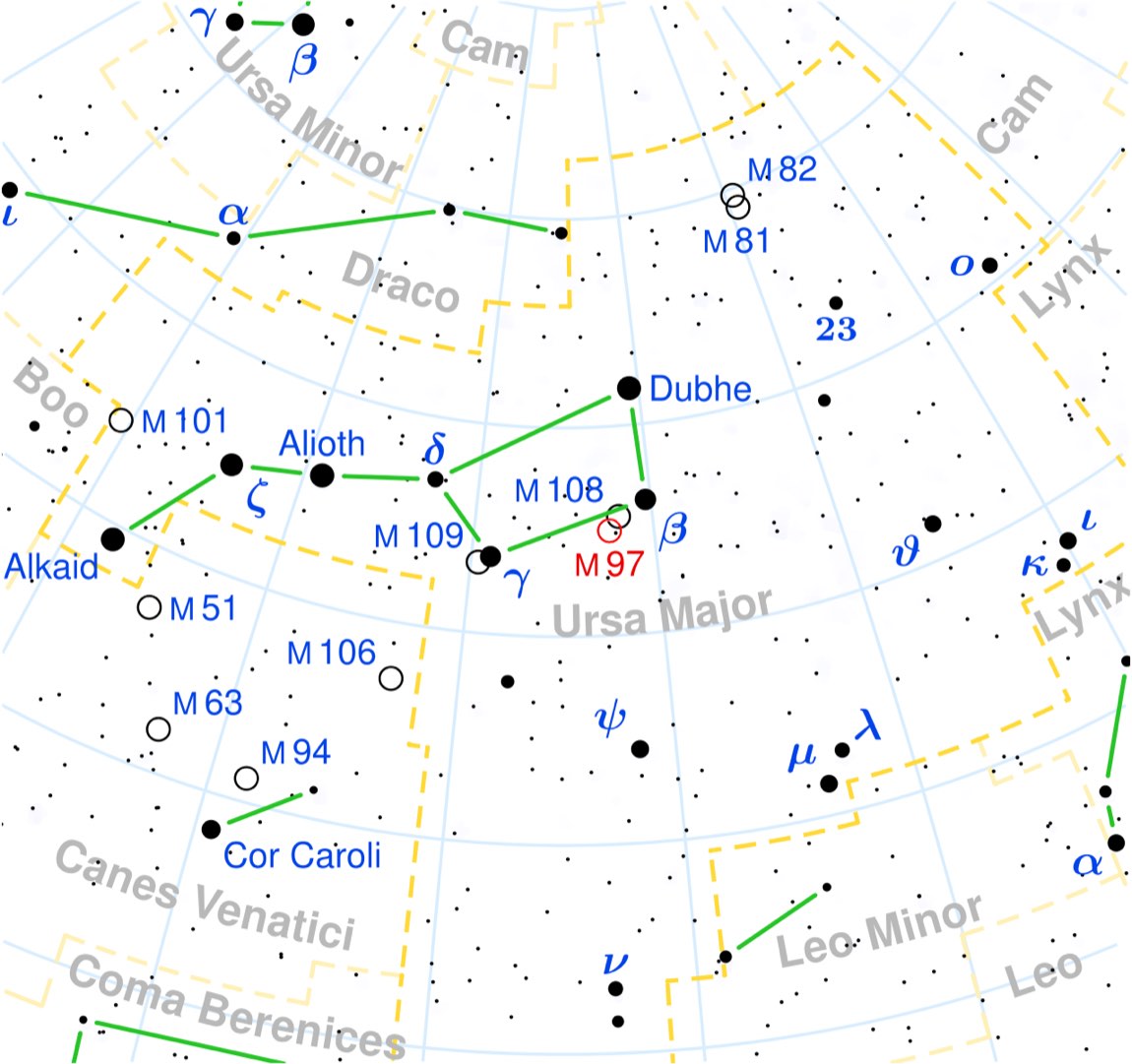
Finding the Owl Nebula in the night sky is straightforward once you can identify the Big Dipper. Look to the southwest corner of the Dipper's bowl, which is marked by the star Beta Ursae Majoris, also known as Merak. From there, M97 lies just over 2.5 degrees to the southeast, in the direction of Gamma Ursae Majoris — the star at the opposite bottom corner of the bowl. That 2.5-degree hop is roughly five times the apparent diameter of the full Moon, small enough to keep both reference stars and the target in a low-power eyepiece field. As a bonus navigational note, M97 together with Alpha Ursae Majoris point the way toward Polaris, the North Star. At apparent magnitude 9.9, the nebula cannot be seen with the naked eye, but under exceptionally good conditions a faint impression can be caught with 20×80 binoculars or a small telescope. To actually perceive the distinctive owl-eye structure — the two dark patches that give the nebula its name — a telescope with an aperture of 10 inches or greater is recommended.
10 Neighbors in the sky: M108 and M109
The Owl Nebula is not alone in its patch of Ursa Major sky. When Méchain first spotted M97 in February 1781, he also noticed two additional nebulae nearby in the same field, objects whose positions he had not yet precisely determined. These turned out to be Messier 108 and Messier 109. Messier recorded this proximity in his own catalog notes, making the original sighting of M97 also the moment of discovery for two other Messier objects. This clustering in the sky is a line-of-sight coincidence rather than a physical grouping — M97 is a planetary nebula roughly 2,030 light-years away, while M108 and M109 are galaxies at vastly greater distances. Nevertheless, the tight angular proximity makes this small region of Ursa Major unusually rich for observers, and the apparent association in the catalog gives M97 an interesting historical footnote: a single night's observing in 1781 contributed three entries to one of astronomy's most enduring reference lists.
11 Open questions the nebula still poses Deeper
Despite more than two centuries of observation, M97 retains genuine scientific uncertainties. The luminosity of its central star is pinned down only within a broad range — 41 to 148 times solar luminosity — a factor-of-three uncertainty that reflects the difficulty of precisely modeling a 123,000-Kelvin stellar atmosphere and accounting for the overlying nebular emission. The exact physical origin of the barrel-shaped inner shell and why it is tilted at 45 degrees to the line of sight remain topics of active modeling: proposed explanations involve asymmetries in the original stellar wind, possible binary star interactions, or the influence of the star's magnetic field during the mass-loss phase. The late-1900s discovery of an extended red halo of wind material beyond the main shells also raised questions about the full duration and history of mass loss from the progenitor — how many distinct ejection episodes occurred and over what timescales. These open questions make M97 more than a pretty showpiece; it is a test case for theories of how sun-like stars die.
 ⤢