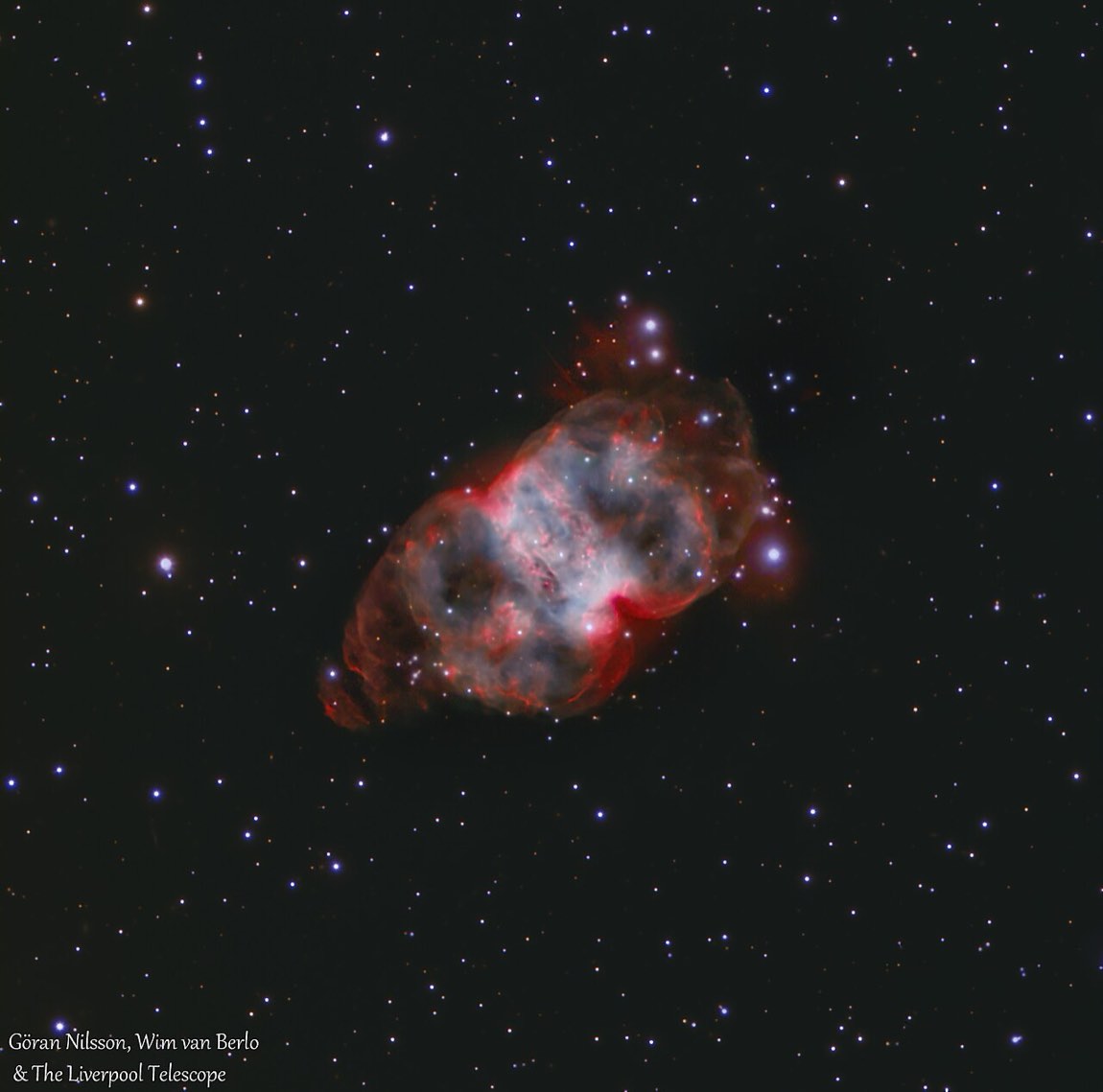
 Photograph · Göran Nilsson, Wim van Berlo & The Liverpool Telescope · CC BY-SA 4.0
Nebula · Deep guide
Messier 76 (Little Dumbbell Nebula)
Also called: M76 · NGC 650 · NGC 651 · Little Dumbbell Nebula · Barbell Nebula · Cork Nebula
A dying star's ring and twin lobes in Perseus, one of the faintest objects in Messier's list.
What is it?
Messier 76, the Little Dumbbell Nebula, is a planetary nebula in Perseus. Pierre Méchain discovered it in 1780, and it was recognised as a planetary nebula in 1918. It is bipolar: a ring of gas, seen edge-on as a bright bar, with a lobe flaring out from each side. The ring was thrown off while the central star was a swollen red giant; later it shed its remaining outer layers into the lobes, leaving a white dwarf behind. At magnitude 10.1 it is one of the fainter Messier objects.
The deep dive
Researched for the Atlas from Wikipedia — Little Dumbbell Nebula (1,815 characters read) · updated Nov 15, 2026
01 A Nebula That Fooled Early Catalogers
When Pierre Méchain spotted this faint smudge in 1780 and passed the observation to Charles Messier, neither man could resolve it into anything clearly recognizable. Messier logged it as number 76 in his famous catalog of comet-like nuisances — objects that could fool astronomers into thinking they had found a new comet. The confusion ran even deeper: early observers using modest telescopes perceived what looked like two distinct glowing patches side by side, which is why the object ended up with two separate New General Catalogue numbers, NGC 650 and NGC 651. It took more than a century of improving instrumentation before astronomers understood they were looking at a single structure. William Huggins made an important leap when he analyzed the object's spectrum and confirmed it was a true nebula rather than a distant galaxy or a star cluster. Then in 1891, Isaac Roberts proposed something remarkably prescient: he suggested that M76 might resemble the Ring Nebula (M57) in Lyra, only viewed from the side rather than face-on. That intuition proved essentially correct, though the formal classification as a planetary nebula did not come until 1918, when Heber Doust Curtis officially placed it in that category.
02 The Bipolar Shape Explained
Modern astronomers classify the Little Dumbbell Nebula as a bipolar planetary nebula, a designation that unlocks its three-dimensional geometry. Picture a ring — like a cosmic barrel hoop — oriented so that we on Earth see it edge-on. That edge-on ring appears as the bright central bar that gives the nebula its dumbbell or barbell silhouette. Extending outward from each open end of that ring are two lobes of glowing gas, puffed out in opposite directions like sleeves on either side of a cuff. The result is a symmetrical, double-ended structure whose nickname — the Cork Nebula — evokes the compressed waist between the two lobes. The ring and the lobes were not created simultaneously. The dying star first shed the ring material during an earlier evolutionary phase, and only afterward blasted out the lobes in a separate expulsion event. Understanding this two-stage ejection is central to understanding how bipolar planetary nebulae form, and M76 serves as one of the more accessible examples of this class because its edge-on orientation lets astronomers study the ring's geometry directly rather than inferring it from a face-on view.
03 How the Dying Star Built the Nebula Deeper
The star that produced M76 passed through what astronomers call the asymptotic giant branch, a late evolutionary stage in which a star has exhausted the hydrogen and helium fuel in its core and swells into a cool, luminous giant. During this phase, the star's outer layers become loosely bound and are gradually expelled into surrounding space. It was during this asymptotic giant branch phase that the progenitor of M76 ejected the material that now forms the central ring structure we see edge-on. What drove the gas preferentially into a ring rather than a uniform sphere is not entirely settled science, but interactions with a companion star or the star's own rotation are commonly invoked explanations in the broader study of bipolar nebulae. After the ring was established, the dying star expelled the remainder of its outer layers in a subsequent event, and that later outflow inflated the two lobes extending from the ring's openings. Once the outer layers were gone, what remained was the dense, exposed core of the original star: a white dwarf, now shining as the nebula's central point of light and providing much of the ultraviolet radiation that keeps the surrounding gas glowing.
04 The Fierce White Dwarf at the Center
Buried at the heart of M76 is the stellar remnant responsible for the entire spectacle: a white dwarf cataloged as the planetary nebula nucleus, or PNN. Despite being the collapsed core of what was once a much larger star, this object shines at an apparent visual magnitude of +15.9, making it far too faint to see without a substantial telescope. Its blue magnitude is recorded at 16.1. What makes the white dwarf remarkable is its temperature. The surface of this stellar cinder reaches approximately 88,400 Kelvin — roughly fifteen times hotter than the surface of our own Sun. That extreme heat floods the surrounding gas cloud with energetic ultraviolet photons, ionizing the atoms in the nebula and causing them to re-emit light at visible wavelengths — the glow we detect from Earth. The total nebula, integrated across its full extent, reaches an apparent magnitude of +10.1, which puts it within reach of a small telescope under good dark-sky conditions even though it remains invisible to the naked eye. The contrast between the faint nucleus and the brighter surrounding gas cloud is a vivid reminder that what we see is reflected and re-emitted energy, not just the white dwarf itself.
05 Size, Distance, and What Those Numbers Mean
Current estimates place M76 at a distance of 780 parsecs, equivalent to roughly 2,500 light years from Earth. To put that in perspective, light traveling at nearly 300,000 kilometers per second takes two and a half millennia to cover that gap — meaning the glow we observe tonight left the nebula around the time ancient Greek philosophers were debating the nature of the cosmos. At that distance, the nebula's average physical extent works out to about 0.378 parsecs, or 1.23 light years, across. That is a substantial volume of space — more than a light year in diameter — yet viewed from Earth the entire structure is compressed into a small apparent patch, which is part of why a reasonably large amateur telescope is needed to appreciate its shape. The distance figure itself carries some uncertainty, as is typical for planetary nebulae; measuring precise distances to these objects remains one of the ongoing challenges of observational astronomy, and different methods have historically produced somewhat different results for M76.
06 The Nebula's Motion Through Space Deeper
M76 is not stationary relative to Earth. Measurements of its radial velocity — the component of motion directly toward or away from us — give a value of −19.1 kilometers per second. The negative sign indicates that the nebula is approaching us, closing the distance at nearly 19 kilometers every second, or roughly 68,000 kilometers per hour. For comparison, that is about twice the speed at which the International Space Station orbits Earth, yet across the vast interstellar distances involved, this motion is barely perceptible on human timescales. Radial velocity measurements like this one are obtained by analyzing the Doppler shift of spectral lines in the nebula's light: when a source moves toward an observer, the wavelengths of its emitted light are compressed slightly toward the blue end of the spectrum. Such measurements are valuable not only for understanding M76's motion through the Milky Way but also for studying the internal dynamics of the nebula itself, since gas expanding outward from the central white dwarf will show systematically different velocity signatures from the bulk motion of the entire system through space.
07 Heber Curtis and the 1918 Classification
The person who formally placed M76 into the category of planetary nebulae was Heber Doust Curtis, an American astronomer who made the classification in 1918. Curtis is perhaps more widely remembered for his role in the Great Debate of 1920, in which he argued — correctly, as it turned out — that the spiral nebulae were distant galaxies rather than structures within the Milky Way. His work on planetary nebulae, including M76, was part of a broader effort during the early twentieth century to systematically sort the bewildering variety of nebulous objects in the sky into coherent physical categories. The planetary nebula classification itself is a historical misnomer: these objects have nothing to do with planets. Early telescopes gave them a rounded, planet-like appearance, and the name stuck. By classifying M76 as a planetary nebula, Curtis was asserting that it was a shell of gas expelled by a dying star rather than an unresolved galaxy or a reflection nebula illuminated by starlight — a physically meaningful distinction that pointed toward the correct understanding of its origin.
08 Its Many Names and What They Reveal
Few objects in Messier's catalog have accumulated as many informal names as M76. The Little Dumbbell Nebula is the most common, drawing an explicit comparison to the larger and brighter Dumbbell Nebula, Messier 27, which resides in the constellation Vulpecula. Both objects share a similar hour-glass or double-lobed silhouette, though M27 is significantly easier to observe because it is closer and more extended on the sky. The Barbell Nebula is another descriptor applied to M76, emphasizing the same elongated, weighted-ends appearance. The Cork Nebula highlights a different aspect of the shape — the pinched central waist between the two lobes, reminiscent of a wine cork viewed from the side. Each nickname reflects the observer's eye catching a different feature of the same structure. The formal designations NGC 650 and NGC 651, assigned because early observers thought the two apparent lobes were separate objects, serve as a historical record of how difficult it can be to interpret faint, complex structures through the limited instruments of earlier centuries. Even the Messier number, 76, anchors the object in the history of comet-hunting astronomy.
09 Observing M76 with Amateur Telescopes
M76 sits in the northern constellation of Perseus, which makes it a rewarding autumn and winter target for observers in the Northern Hemisphere. With a total apparent magnitude of +10.1, the nebula itself is accessible through a small telescope under dark skies, though a larger aperture — typically 150 millimeters or more — is needed to begin resolving its distinctive dumbbell shape rather than perceiving it as a simple faint smudge. The central white dwarf, shining at magnitude +15.9, is well beyond the reach of any typical amateur instrument and requires professional-grade equipment to detect. The nebula benefits from the use of a narrowband or oxygen-III filter, which suppresses background sky glow and enhances the contrast of the ionized gas. Because M76 is relatively compact on the sky, higher magnification helps tease apart the bar structure from the surrounding lobes. It is often cited as one of the more challenging Messier objects to observe satisfactorily, sitting near the faint end of what the catalog contains, but patient observers under good conditions are rewarded with one of the sky's finest examples of a bipolar planetary nebula seen edge-on.
10 M76 as a Window Into Stellar Endings Deeper
Beyond its visual appeal, M76 holds scientific value as a relatively nearby and geometrically well-oriented example of how Sun-like stars end their lives. Because we see the central ring structure edge-on, astronomers can measure the ring's physical extent and study the density and composition of the bar region with less projection ambiguity than nebulae seen face-on or at intermediate angles. The two-stage formation history encoded in M76 — first the ring ejection during the asymptotic giant branch phase, then the lobe inflation after subsequent mass loss — gives researchers a snapshot of processes that the Sun itself will undergo billions of years from now. The white dwarf's surface temperature of 88,400 K is also a data point for models of post-asymptotic-giant-branch stellar evolution, since the temperature of the central star influences how rapidly the surrounding nebula is ionized and how long it will remain visible before dispersing into the interstellar medium. In this sense, M76 is not merely a beautiful remnant but an active laboratory for stellar astrophysics, offering constraints on models of mass loss, nebula shaping, and white dwarf cooling.
11 Open Questions About This Nebula Deeper
Despite more than two centuries of observation, M76 retains genuine scientific uncertainties. The distance estimate of 780 parsecs (2,500 light years) is a current best figure, but distance determination for planetary nebulae is notoriously difficult and historically contentious; different measurement techniques have yielded different values, and the true distance anchors calculations of the nebula's physical size, luminosity, and age. The mechanism that shapes bipolar planetary nebulae — why some dying stars produce symmetric double-lobed structures while others produce roughly spherical or elliptical shells — remains an active area of debate. Proposed explanations include the influence of a binary companion star, rapid stellar rotation, and magnetic fields, but no single mechanism has been universally confirmed across all bipolar nebulae. For M76 specifically, the question of whether the progenitor had a companion star that helped sculpt the ring and lobes is not definitively answered by the article's available data. As with many planetary nebulae, the eventual fate of M76 is straightforward in outline — the gas will continue expanding and thinning until it merges invisibly with the interstellar medium — but the precise timescale and the current expansion rate involve measurements that carry their own uncertainties.