 Photograph · Sloan Digital Sky Survey · CC BY 4.0
Galaxy · Deep guide
Messier 108 (Surfboard Galaxy)
Also called: M108 · NGC 3556 · Surfboard Galaxy · UGC 6225 · PGC 34030
A barred spiral seen nearly edge-on in Ursa Major, laced with bubbles of expanding gas.
What is it?
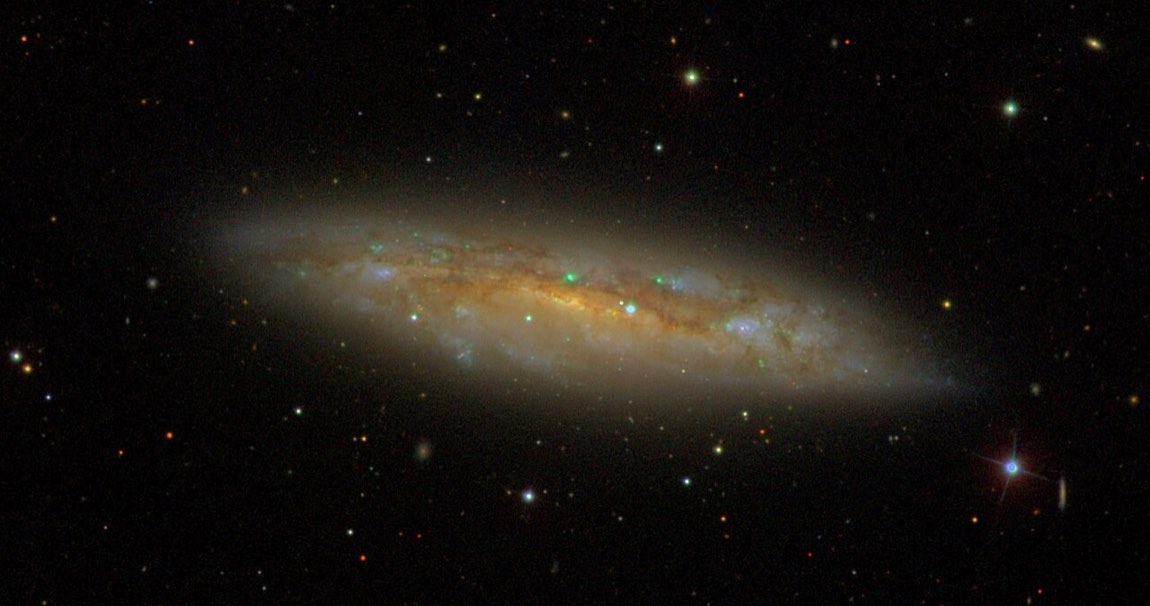
Messier 108, the Surfboard Galaxy, is a barred spiral galaxy in Ursa Major about 46 million light-years away. Pierre Méchain discovered it in 1781 or 1782. We see it almost edge-on, tilted about 75° from face-on. It is an isolated member of the Ursa Major Cloud of galaxies and has an estimated mass of about 125 billion Suns, with roughly 290 globular clusters. Its hydrogen gas forms expanding shells several thousand light-years across, possibly blown by supernovae. Chandra has detected 83 X-ray sources in it.
The deep dive
Researched for the Atlas from Wikipedia — Messier 108 (2,869 characters read) · updated Nov 15, 2026
01 An Island Galaxy, Strikingly Alone
Most large galaxies belong to tight gravitational families, but Messier 108 is an isolated member of the Ursa Major Cloud within the local supercluster — meaning it has no close companion pulling at its stars and gas. That solitude makes it a valuable laboratory: whatever is happening inside M108 is driven by its own internal physics rather than by a neighbor's tidal forces. Its classification in the de Vaucouleurs system is SBbc, which tells astronomers it is a barred spiral whose arms wind only loosely around the central bar, giving it a somewhat ragged, open appearance. The galaxy is tilted 75° to our line of sight, so we see it almost perfectly edge-on — like a surfboard lying flat before us — which is exactly how it earned its nickname. That steep viewing angle is a double-edged gift: we get a clear cross-section of the disk, but the overlapping arms make it harder to map individual star-forming regions from above.
02 Méchain's Discovery and the Messier Catalogue
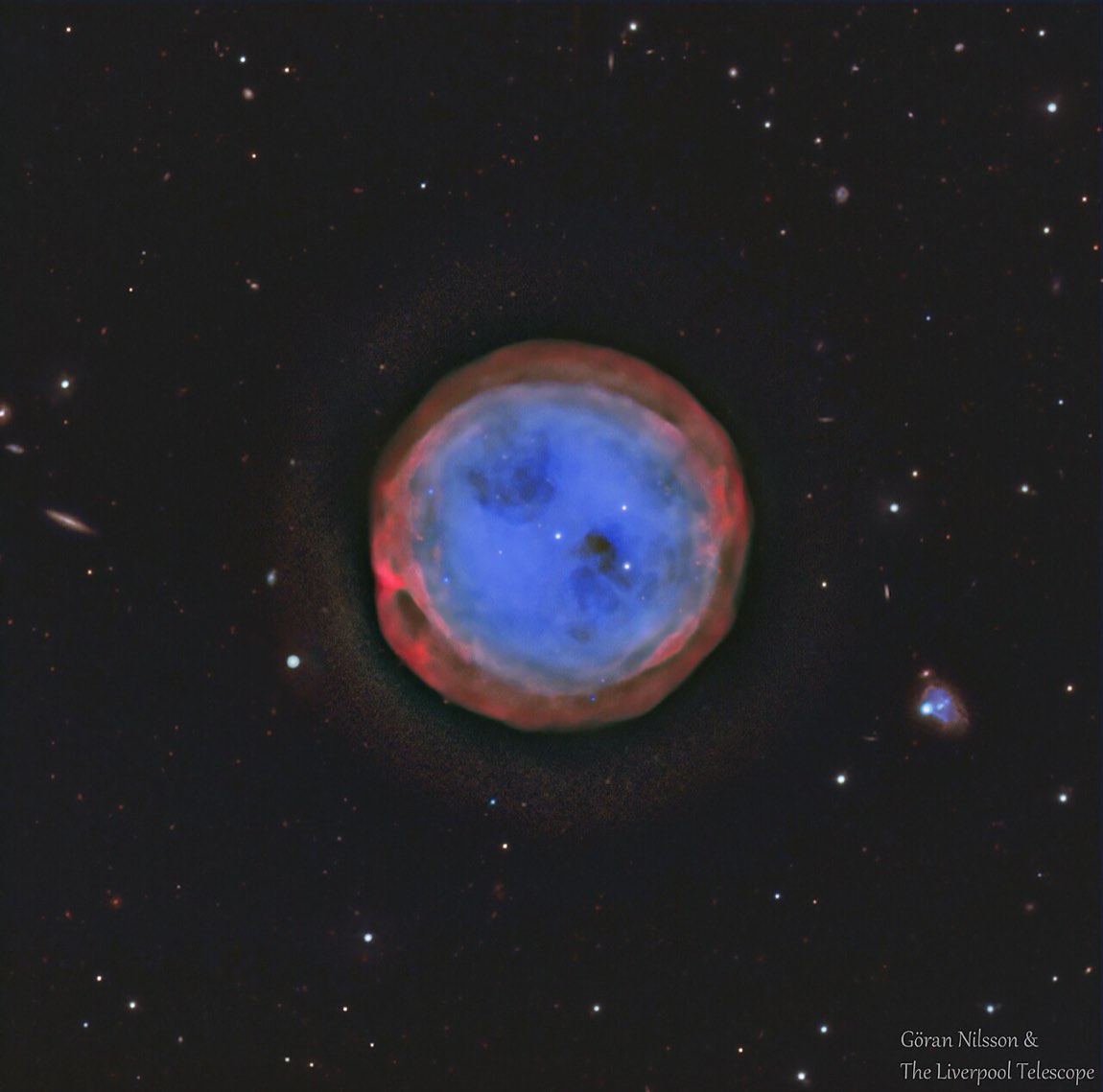
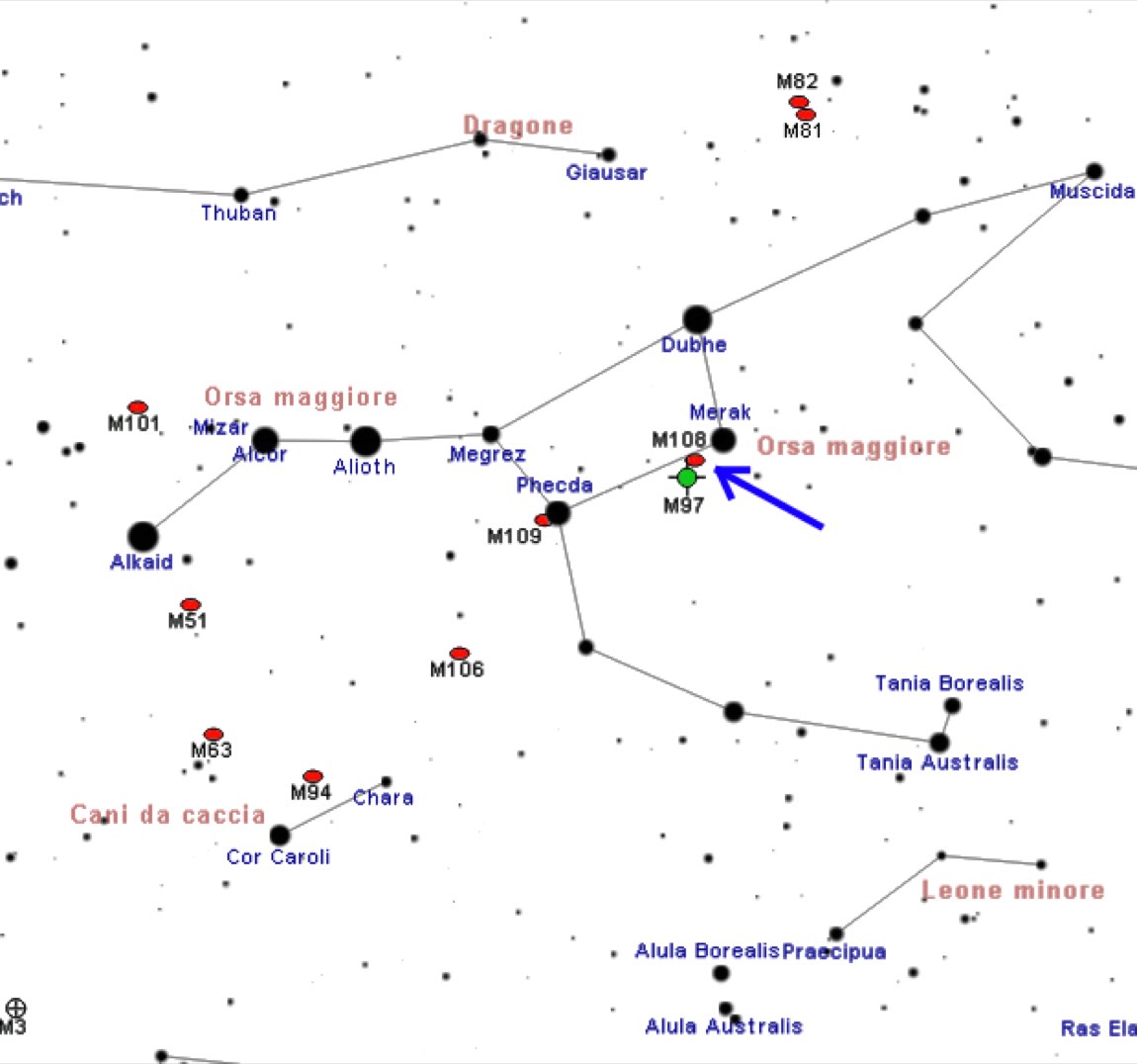
Messier 108 was discovered by the French astronomer Pierre Méchain, a close colleague of Charles Messier, in either 1781 or 1782 — the historical record is imprecise about the exact year. Méchain reported it to Messier, who added it to his famous catalogue of nebulae and star clusters, the list that astronomers still reach for first when scanning the northern sky. The galaxy is also catalogued as NGC 3556, the designation it carries in John Dreyer's New General Catalogue compiled a century later. Sitting in the constellation Ursa Major — the Great Bear — M108 shares the sky with several other Messier objects in the same region, most famously the Owl Nebula, M97, which lies only about 48 arcminutes away. That proximity on the sky is a coincidence of projection; the two objects are physically unrelated. The galaxy's maximum angular size in the optical band is 11.1 × 4.6 arcminutes, large enough to show structure through a modest telescope under dark skies.
03 Shells of Exploding Gas Across the Disk Deeper
One of the most striking structural features revealed by radio observations of M108 is the presence of discrete shells of expanding neutral hydrogen gas — called H I supershells — that stretch for several kiloparsecs across the galaxy's disk. A kiloparsec is roughly 3,260 light-years, so these shells are genuinely enormous bubbles carved into the interstellar medium. Their origin is debated. One hypothesis is that streams of dark matter, dust, and gas funnel material into star-forming regions, triggering bursts of massive-star birth; those massive stars then explode as supernovae and collectively blow out the surrounding gas into the shell structures we observe. A second possibility is that gas falling inward from the intergalactic medium — material between galaxies that rains onto the disk — creates the same expanding morphology. A third candidate explanation involves radio jets from the galaxy's active core blasting outward into the surrounding medium. No single explanation has been confirmed, and M108's supershells remain an open question that future radio surveys may resolve.
04 An X-ray Zoo: 83 Sources in One Galaxy Deeper
When the Chandra X-ray Observatory turned its mirrors toward M108, it catalogued 83 distinct X-ray point sources embedded in the galaxy. That number alone hints at a rich population of compact objects — neutron stars, stellar-mass black holes, and X-ray binaries — scattered through the disk. The brightest of these point sources does not fit the profile of a typical stellar-mass black hole; instead, its luminosity is consistent with an intermediate-mass black hole actively pulling in matter. Intermediate-mass black holes, with masses between roughly a hundred and a hundred thousand solar masses, are a population that astronomers have long sought to confirm, because they would bridge the gap between stellar remnants and the supermassive black holes that anchor most large galaxies. Beyond the point sources, Chandra also detected a diffuse soft X-ray glow extending within 2.6 arcminutes of the optical galaxy — a haze of hot plasma permeating the space around the disk, likely heated by supernovae and stellar winds over billions of years.
05 A Quiet Giant at the Core
At the very center of M108 sits a supermassive black hole with an estimated mass of 24 million solar masses. For comparison, the black hole at the center of our own Milky Way, Sagittarius A*, has a mass of roughly 4 million solar masses, making M108's central engine about six times heavier. The X-ray spectrum measured at the nucleus is consistent with an active galactic nucleus — a core where infalling material releases enormous amounts of energy as it spirals in. Yet when astronomers pointed the Spitzer Space Telescope at the same location and examined the infrared light, they found no detectable sign of that activity. This discrepancy is unresolved: either the nucleus is in a very low-activity state that only faint X-ray emission betrays, or the classification as an active galactic nucleus needs to be revisited. M108's core is a reminder that galactic nuclei can be deceptive, appearing different depending entirely on which wavelength of light you choose to observe.
06 Four Supernovae and What They Reveal
M108 has hosted four observed supernovae, each telling a different story about how massive stars die. The first, SN 1969B, was spotted on 6 February 1969 by Paul Wild and independently confirmed by Balázs just four days later; it ultimately brightened to magnitude 13.9, though its type was never firmly classified. Decades later in August 2016, the Spitzer Space Telescope found SPIRITS 16tn, a supernova invisible in ordinary light because dust smothered it with 8 to 9 magnitudes of extinction — placing it among the most heavily obscured supernovae ever recorded. Then in March 2023, the Zwicky Transient Facility caught SN 2023dbc, a Type Ic stripped-envelope supernova showing no hydrogen signature beyond narrow emission from surrounding gas; it ranks among the nearest Type Ic events found to date. Most recently, the same facility discovered SN 2025ahqr on 23 November 2025, a highly reddened Type Iax event of a subclass sometimes called 02cx-like — and at the time of discovery it was the closest known low-luminosity Type Iax supernova, a category that challenges standard supernova theory.
07 What Makes a Type Iax Supernova Special Deeper
The discovery of SN 2025ahqr in M108 draws attention to an unusual class of stellar explosion. Standard Type Ia supernovae are thought to result from a white dwarf that accumulates enough mass to trigger runaway nuclear fusion, destroying itself completely. Type Iax events, however, appear to be weaker cousins of that process — lower in luminosity, slower in their spectral evolution, and possibly leaving a surviving remnant white dwarf rather than obliterating the star entirely. The 02cx-like designation for SN 2025ahqr refers to SN 2002cx, the prototype of this subclass. Its strong reddening in M108 means dust absorption is significantly dimming and reddening the light we receive, which is consistent with M108's generally dusty interstellar environment evidenced also by SPIRITS 16tn years earlier. The fact that M108 has now yielded two heavily dust-obscured supernovae underscores how much star formation — and therefore how many massive and intermediate-mass stars — the galaxy has been producing, since dust is a byproduct of that activity.
08 Globular Clusters: M108's Ancient Retinue
Surrounding M108 like a swarm of old watchmen are approximately 290 globular clusters, though the uncertainty in that count is substantial — the article gives the figure as 290 ± 80. Globular clusters are dense, gravitationally bound balls of tens of thousands to millions of ancient stars, typically among the oldest objects in any galaxy, often 10 to 13 billion years old. Their number scales roughly with a galaxy's total mass, so M108's count of around 290 is consistent with its estimated mass of 125 billion solar masses. For comparison, the Milky Way hosts somewhere around 150 known globular clusters, suggesting M108 carries a somewhat richer retinue. These clusters orbit in the extended halo around the galactic disk, preserving a fossil record of the galaxy's earliest epochs of star formation. Mapping their spatial distribution and velocities can, in principle, reveal the shape of M108's dark-matter halo — though that work was not detailed further in current observations reported here.
09 Seeing M108 Through Your Own Telescope
With an apparent magnitude in the range that makes it accessible under reasonably dark skies, M108 sits in Ursa Major, a constellation visible from most of the northern hemisphere throughout much of the year and circumpolar from northern latitudes. Because the galaxy's maximum angular extent reaches 11.1 arcminutes in its long axis, a telescope with moderate aperture and low magnification will reveal an elongated smear of light — the edge-on disk — rather than the face-on spiral structure seen in galaxies like M51. The nearly edge-on 75° inclination means that the central brightness concentration of the bar stands out against the thinner outer disk, giving experienced observers a sense of depth even in a two-dimensional image. The nearby Owl Nebula, M97, provides a convenient navigational anchor in the same field. Under exceptional transparency, glimpses of the galaxy's mottled texture — caused by dust lanes crossing the disk — can reward patient observers with large amateur instruments. The combination of its isolation, its edge-on geometry, and its proximity at 46 million light-years makes M108 one of the northern sky's most instructive edge-on spirals.
10 Open Questions That Still Surround M108 Deeper
Despite decades of observation, M108 leaves astronomers with several genuinely unresolved puzzles. The nature of the H I supershells — whether they are powered by supernova feedback, dark-matter streams, intergalactic infall, or radio jets — remains contested, and no single mechanism has been ruled in or out. The status of the galactic nucleus is similarly ambiguous: X-ray data suggest an active galactic nucleus, yet Spitzer infrared observations showed no corresponding activity, a tension that could reflect a truly quiescent nucleus masquerading as active, or variability in accretion over time. The intermediate-mass black hole candidate among the 83 Chandra X-ray sources has not been confirmed beyond the consistency argument based on luminosity; definitive proof would require more detailed spectral and temporal studies. And the full population of globular clusters, known only to within ±80 objects, invites deeper imaging surveys. Each of these threads is a reminder that M108, though catalogued for over two centuries, continues to generate more questions than answers.
 ⤢