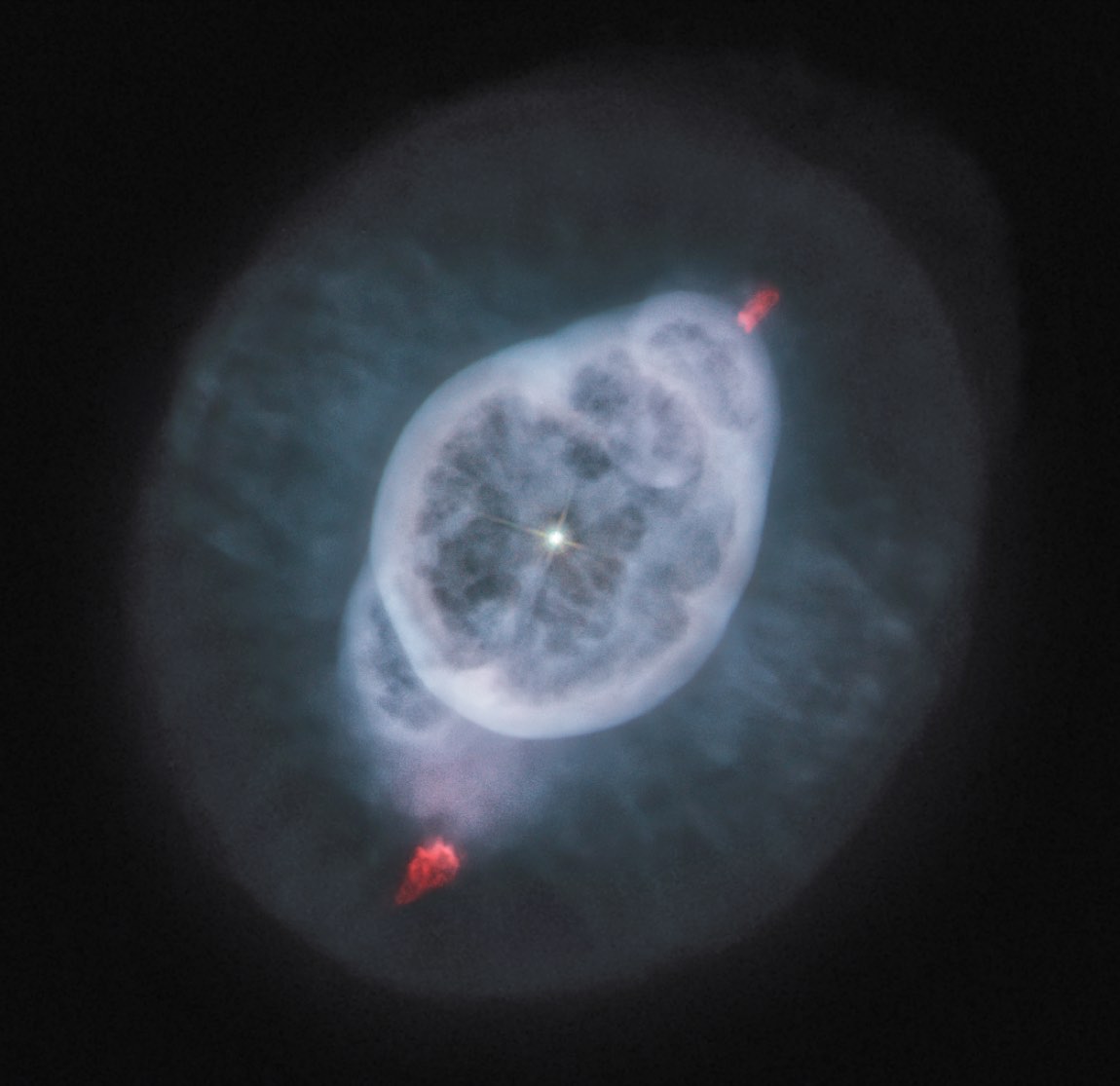
 Photograph · Judy Schmidt · CC BY 2.0
Nebula · Deep guide
Ghost of Jupiter (NGC 3242)
Also called: Caldwell 59 · NGC 3242 · Jupiter's Ghost · Eye Nebula
A bluish-green planetary nebula that looks like a pale twin of Jupiter in a small telescope.
What is it?
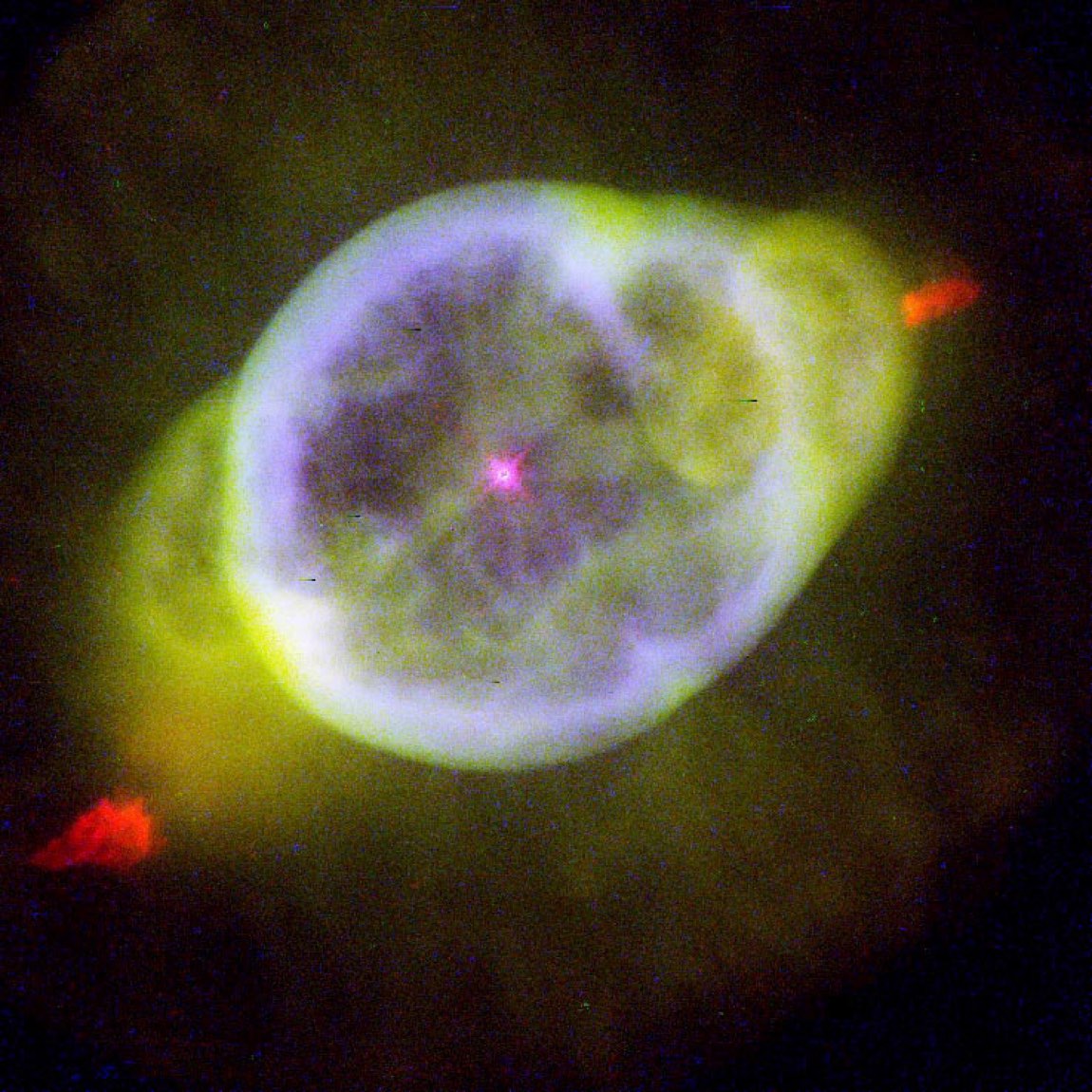
NGC 3242 is a planetary nebula in Hydra, nicknamed the Ghost of Jupiter because through a telescope its round, softly glowing disc resembles the giant planet. William Herschel discovered it in 1785. The nebula is about two light-years across and surrounds a hot white dwarf of about 11th magnitude; its inner shells were shed around 1,500 years ago. At each end sit FLIERs, knots of fast-moving gas that often appear red in false-colour images.
The deep dive
Researched for the Atlas from Wikipedia — NGC 3242 (1,227 characters read) · updated Nov 15, 2026
01 Two names, one striking resemblance
NGC 3242 carries at least three popular nicknames, but the one that has stuck most firmly is the Ghost of Jupiter. The comparison is apt: seen through a small telescope, the nebula presents a pale, rounded disc that uncannily mimics the visual disk of Jupiter in size and color. The alternative name, the Eye Nebula, captures a different impression — the layered shells and bright central star can read as a giant iris staring back at the observer. A third designation, Caldwell 59, places it in Patrick Caldwell-Moore's catalogue of showpiece deep-sky objects. None of these popular names appear in the formal record, which knows it only as NGC 3242, a designation it received in J. L. E. Dreyer's New General Catalogue of 1888. That catalogue number itself descended through a chain of earlier listings: H IV.27 from William Herschel, h 3248 from his son John, and GC 2102 from the 1864 General Catalogue. Each renaming reflects a generation of astronomers refining and inheriting the same object.
02 A discovery 240 years in the making
William Herschel first recorded NGC 3242 on February 7, 1785, adding it to his growing catalogue of nebulae under the designation H IV.27. Decades later, his son John Herschel made his own observations of the object from the Cape of Good Hope in South Africa during the 1830s — a deliberate southern-sky survey that extended the family's systematic sweep of the heavens. John assigned it the number h 3248. That observation was later folded into the 1864 General Catalogue as GC 2102, a compilation that aimed to unify earlier lists. It was Dreyer who gave the object its modern identity in 1888 when he published the New General Catalogue, renumbering it NGC 3242. The lineage of observations spanning father to son to Dreyer spans more than a century of careful telescopic work, and the nebula's position in Hydra — a sprawling southern constellation — explains why John Herschel's southern expedition was necessary to study it properly from the ground.
03 How big is two light years, really?
The Ghost of Jupiter measures around two light years from end to end. To put that in perspective, the distance from our Sun to the nearest star system, Alpha Centauri, is about 4.2 light years — meaning this entire nebula would fit inside that gap roughly twice over. Despite that physical scale, the nebula appears small in the sky because it lies far from Earth, within the constellation Hydra. The structure is not uniform across those two light years: distinct inner and outer regions exist, and the two opposing ends of the elongated nebula are marked by special features called FLIERs. The inner layers, which are the brightest and most compact part of the nebula, formed relatively recently in astronomical terms — roughly 1,500 years ago. The outer halo is older and fainter, detectable only with larger telescopes. Together these layers record different episodes in the dying star's mass-loss history, written across two full light years of glowing gas.
04 The white dwarf at the heart of it all
At the geometric center of NGC 3242 sits the stellar remnant responsible for the entire spectacle: a white dwarf with an apparent magnitude of 11. That brightness puts it just beyond naked-eye visibility, but well within reach of a modest amateur telescope. The star is classified as an O-type star with a spectral type of O(H), making it one of the hottest categories of stellar objects known. White dwarfs are the exposed cores of stars that have shed their outer envelopes; the ultraviolet radiation pouring from this intensely hot remnant is precisely what ionizes the surrounding gas and makes the nebula glow. Without that flood of energetic photons, the shells of expelled material would be invisible cold gas drifting silently into space. The O(H) spectral designation carries specific information about the star's atmosphere, though the article does not elaborate further on its chemical composition. What is clear is that this compact, searingly hot object is the engine driving everything visible in the Ghost of Jupiter.
 ⤢
05 FLIERs: the nebula's mysterious fast jets Deeper
The two ends of NGC 3242 are each marked by a FLIER — a Fast Low-Ionization Emission Region. FLIERs are compact knots or lobes of gas moving outward at speeds faster than the main expanding shell of the nebula, yet paradoxically they show lower ionization than the surrounding material. In false-color images, FLIERs are often tinted red, which makes them visually distinctive against the blue-green glow of the main nebula body. Their origin remains a subject of genuine scientific discussion; they appear in a number of planetary nebulae and are not unique to NGC 3242, but no single formation mechanism has been universally accepted. Some researchers have linked them to episodes of asymmetric mass loss from the progenitor star, while others invoke interactions with a companion star or magnetic field effects. What is observationally clear is that in NGC 3242 these features bracket the nebula symmetrically at its two opposing ends, suggesting that whatever process created them acted along a preferred axis of the dying stellar system.
06 Layers of time frozen in glowing gas Deeper
The Ghost of Jupiter is not a single uniform shell but a layered structure that encodes multiple phases of stellar mass loss. The inner layers are the younger and brighter component, having formed approximately 1,500 years ago — meaning the gas that makes up the nebula's bright core was expelled from the dying star while medieval civilizations on Earth were flourishing. The outer halo is an older structure, representing an earlier episode of mass loss when the progenitor star was still on the asymptotic giant branch, puffing away material at a slower rate before the dramatic end stages arrived. The transition between these two regions marks a change in conditions: the inner shell is more energetically excited by the central white dwarf's radiation, while the outer halo requires a larger telescope to detect because it is more diffuse and less intensely illuminated. This two-zone architecture is common among planetary nebulae and helps astronomers reconstruct the life history of the star that created the nebula.
07 Its color and what causes it
Most observers who look at NGC 3242 through a telescope describe it as bluish-green. This color is not an artifact of instrument optics but a genuine property of the nebula's light. The characteristic hue of many planetary nebulae, including this one, arises largely from doubly ionized oxygen atoms — often written as O III — which emit strongly in the blue-green part of the visible spectrum. The intensely hot central O-type white dwarf provides the ultraviolet photons that strip electrons from oxygen atoms in the surrounding gas; when those electrons recombine and cascade back to lower energy states, they release light at specific wavelengths that the human eye perceives as that signature teal color. Because different elements emit at different wavelengths, astronomers can read a nebula's chemical composition from its spectrum. The false-color images that show the FLIERs as red are using color-coding to represent data beyond what the eye would naturally see, but the blue-green appearance in normal visual observation is genuine, making the Ghost of Jupiter one of the more colorful objects accessible to amateur telescopes.
08 Observing the Ghost with your own telescope
NGC 3242 sits in the constellation Hydra, the water snake, which stretches across a large swath of the southern sky. The nebula can be observed easily with amateur telescopes, making it a popular target for backyard astronomers. At an apparent magnitude of 11 for the central star alone, and with the nebula itself bright enough to be a rewarding target, it falls within reach of modest instruments. Through the eyepiece it presents that distinctive bluish-green disc that evokes its Jupiter comparison. Smaller telescopes will show the compact inner disk, while larger instruments bring out the fainter outer halo surrounding it, revealing the two-zone structure discussed by researchers. The FLIERs at the nebula's ends appear as subtle extensions in the right conditions. Because of Hydra's position in the sky, the best views from mid-northern latitudes come during late winter and spring evenings. Its listing as Caldwell 59 means it appears on many amateur astronomers' target lists as a showcase object worth returning to as aperture and observing conditions improve.
 ⤢
09 An O-type star: the hottest stellar class Deeper
The central star of NGC 3242 carries the spectral classification O(H), which places it among the hottest known categories of stars. Standard O-type stars on the main sequence are already extreme objects, with surface temperatures typically exceeding 30,000 kelvin, but the central stars of planetary nebulae that earn this classification can be far hotter still — sometimes exceeding 100,000 kelvin. The parenthetical H in the O(H) designation carries specific spectroscopic meaning related to the star's atmospheric absorption features, though the article does not expand on this detail. What matters observationally is that such extreme temperatures generate a torrent of ultraviolet radiation. This radiation performs the work of ionizing the surrounding nebula across two full light years of expelled gas, maintaining the ghostly glow that makes the object visible at all. As the white dwarf cools over geological timescales — a process that takes billions of years — that ionizing radiation will diminish, the gas will recombine, and the nebula will gradually fade from view, dispersing into the interstellar medium.
10 From dying star to planetary nebula: the process
The Ghost of Jupiter is the product of a star that ended its life not in an explosion but in a slow, majestic exhalation. Stars with masses similar to or somewhat greater than the Sun eventually exhaust the hydrogen and helium fuel in their cores, expand into giant stars, and then begin shedding their outer layers through increasingly intense stellar winds. The ejected material expands outward and, once the hot core is exposed, the ultraviolet radiation from that core ionizes the surrounding gas cloud, making it glow — this glowing shell is the planetary nebula. The name planetary nebula is a historical misnomer dating to early telescopic observations when the rounded discs resembled planets; they have nothing to do with planets. In NGC 3242, the inner layers of this ejected envelope formed around 1,500 years ago, suggesting that the most dramatic mass-loss phases happened within that time window. The result is the two-light-year-wide glowing shell we see today, with a white dwarf cooling at its center — the compressed remnant of the star's core.
11 The Herschel family's southern sky campaign Deeper
John Herschel's observations of NGC 3242 from the Cape of Good Hope in the 1830s were part of one of the most ambitious astronomical projects of the nineteenth century. Following the extensive northern-sky surveys his father William had conducted from Britain, John traveled to South Africa specifically to extend that systematic survey to the southern celestial hemisphere, which is not accessible from European latitudes. Hydra, the constellation in which NGC 3242 resides, dips deep enough south that observations from the Cape were particularly valuable for objects in this region of the sky. John Herschel's southern catalogue became foundational material for later comprehensive listings, including the 1864 General Catalogue compiled from multiple observers' records, and ultimately Dreyer's New General Catalogue of 1888 that assigned the number NGC 3242. The fact that both a father and his son independently observed and catalogued this single object — separated by decades and thousands of miles — speaks to its prominence among nebulae visible through the instruments of that era and to the sustained, multigenerational ambition of the Herschel astronomical project.
 ⤢