 Photograph · NASA/ESA/STScI
Nebula · Deep guide
The Cat's Eye Nebula
Shells within shells of impossible symmetry make this a dying star's masterpiece.
What is it?
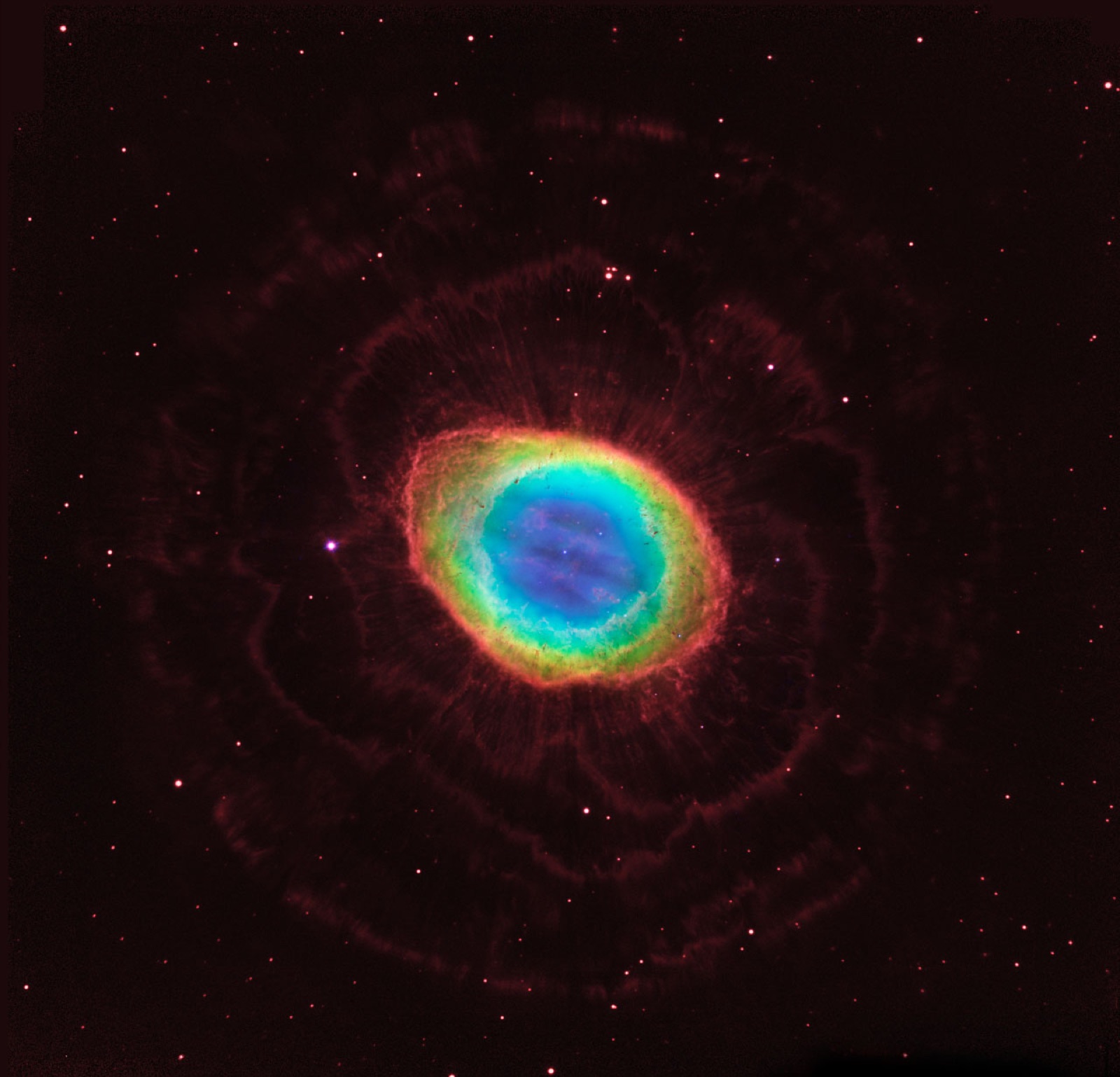
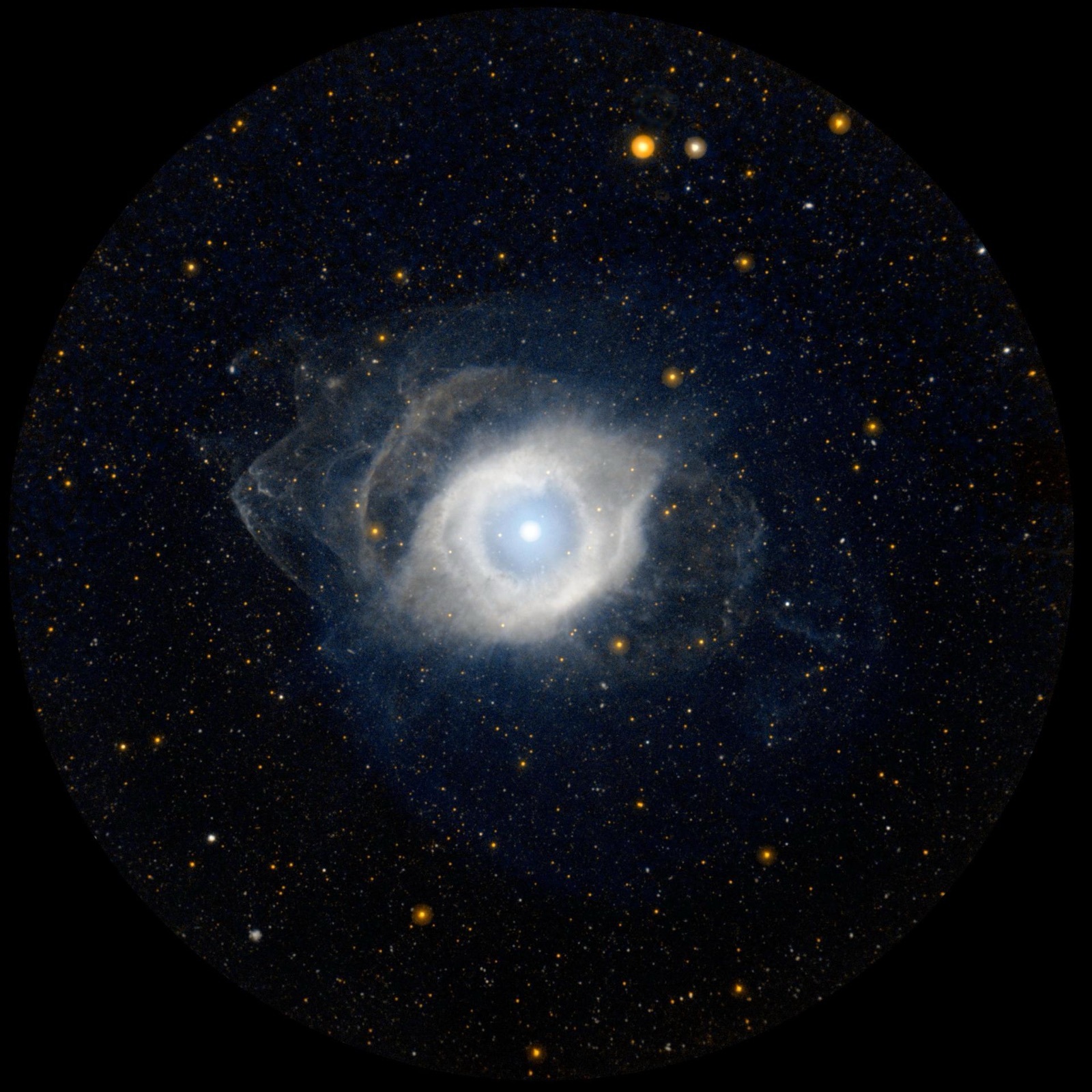
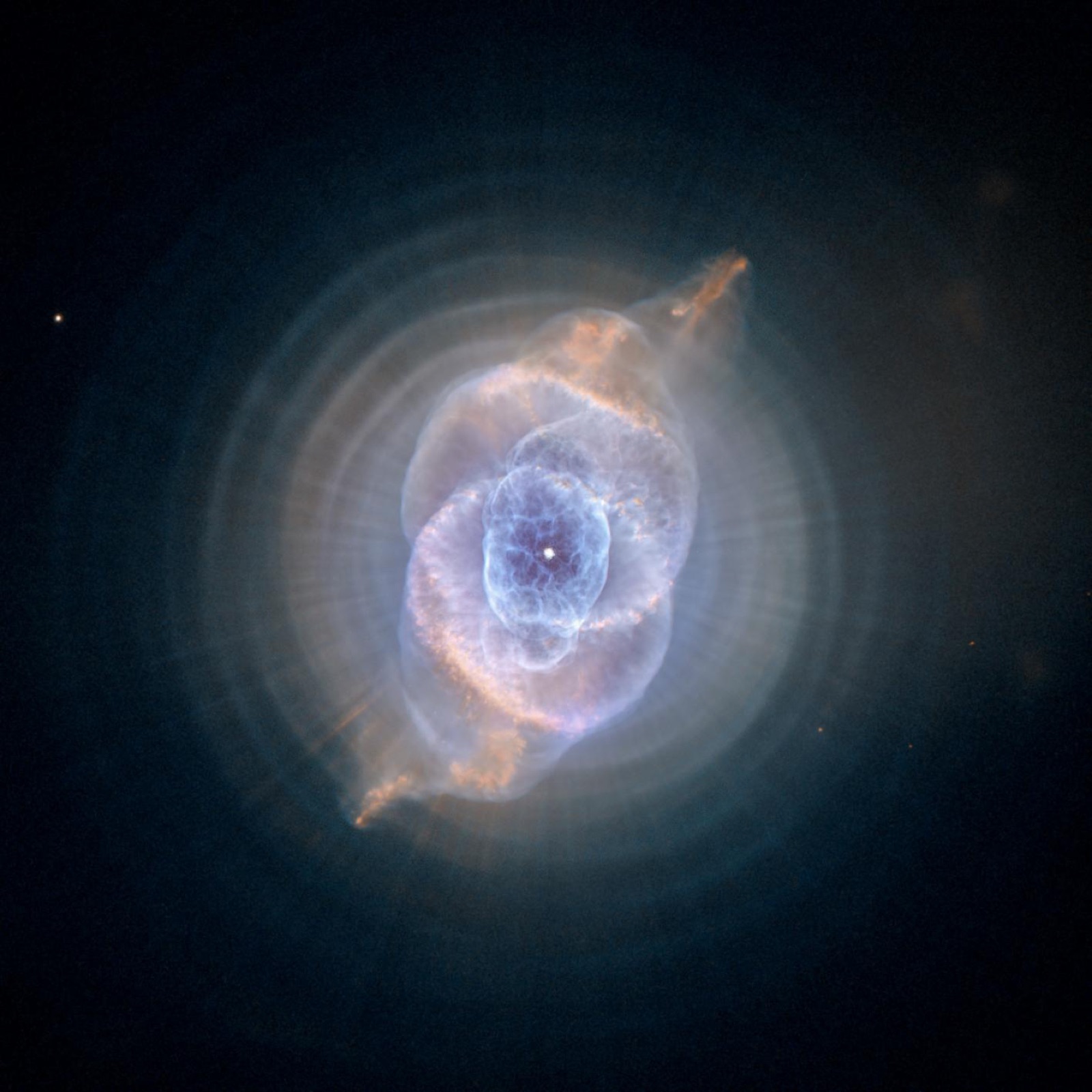
The Cat's Eye (NGC 6543) in Draco is the planetary nebula that made astronomers rethink how stars die: Hubble's images revealed at least eleven concentric shells — the star apparently pulsed off a layer every 1,500 years — wrapped around a knotted, jet-pierced core of eerie symmetry. Whether a hidden companion star choreographs the pattern remains an open question.
The deep dive
Researched for the Atlas from Wikipedia — Cat's Eye Nebula (11,097 characters read) · updated Sep 20, 2026
01 William Huggins and the spectrum that changed astronomy
On August 29, 1864, English amateur astronomer William Huggins pointed a spectroscope at the Cat's Eye Nebula and made a discovery that rewrote textbooks. Instead of the continuous rainbow of colors a star produces, the nebula's light broke into just a few bright emission lines — a non-continuous spectrum. This was the first direct evidence that planetary nebulae are made of tenuous ionized gas rather than unresolved swarms of stars. Before that night, nobody knew what these ghostly glowing objects actually were. Huggins essentially invented a new branch of astronomy — the spectroscopic study of nebulae — with a single observation of NGC 6543. The Cat's Eye was not just an early target of convenience; it became the founding specimen of an entirely new scientific understanding of how stars end their lives and return their material to space.
02 A perfect marker for Earth's ecliptic pole Deeper
NGC 6543 sits only 4.4 arcminutes from the north ecliptic pole — the point in the sky around which Earth's rotational axis slowly traces a circle due to precession. To put that closeness in perspective, the gap between Polaris and the current true north celestial pole is 45 arcminutes, meaning the Cat's Eye is more than ten times closer to the ecliptic pole than Polaris is to the rotational pole. Because the ecliptic pole moves through the sky extraordinarily slowly compared to the precessing celestial pole, NGC 6543's value as a fixed reference point is essentially permanent on the timescale of all recorded human history — unlike the pole star, which shifts to a new star every few thousand years. It also marks the nearby "invariable" axis of the Solar System, around which every planet's north pole and every planetary orbital pole traces its own small circle. Astronomers and navigators rarely need such a marker, but its geometric precision is genuinely remarkable.
03 Layers upon layers: the nebula's nested structure
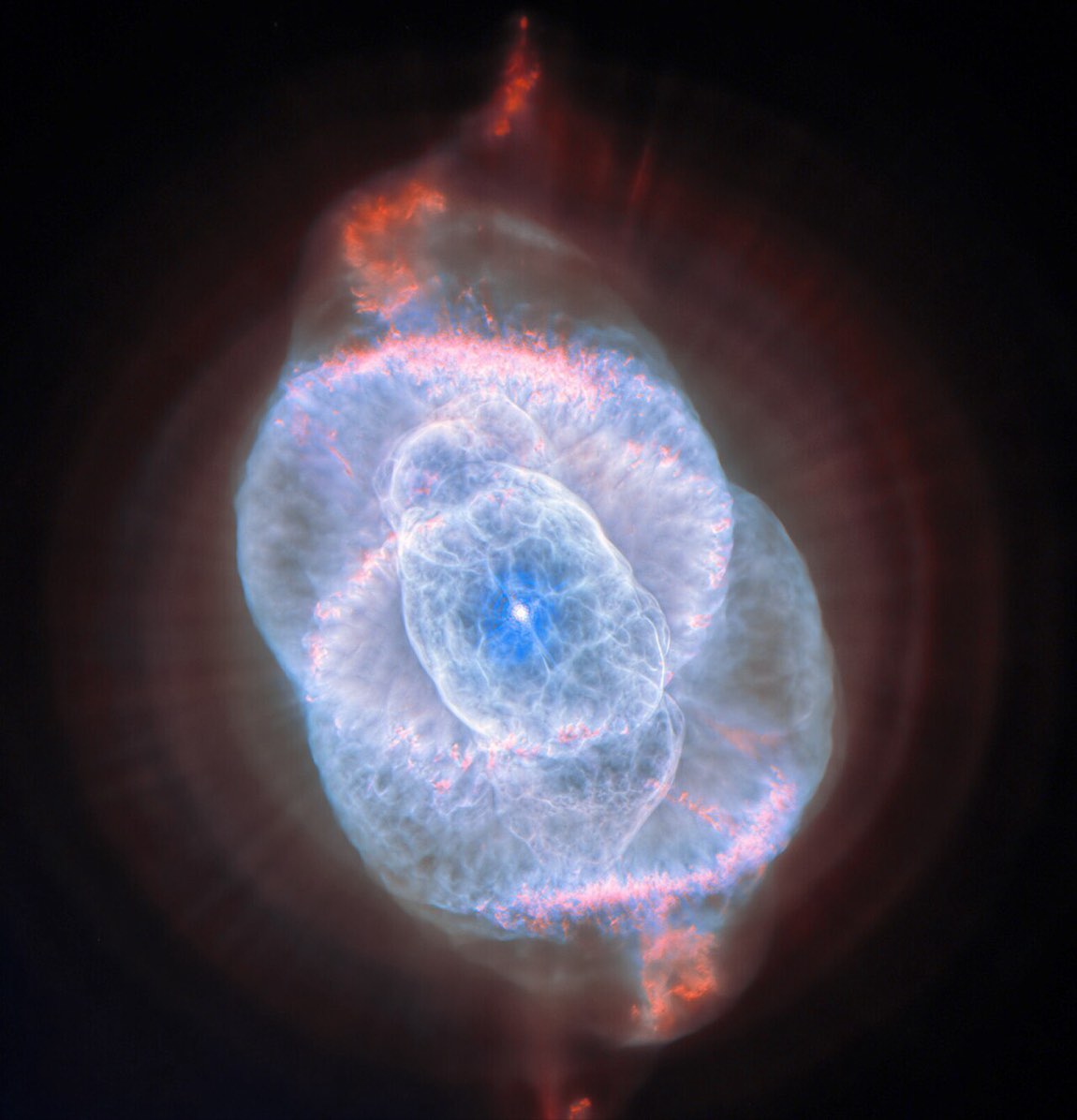
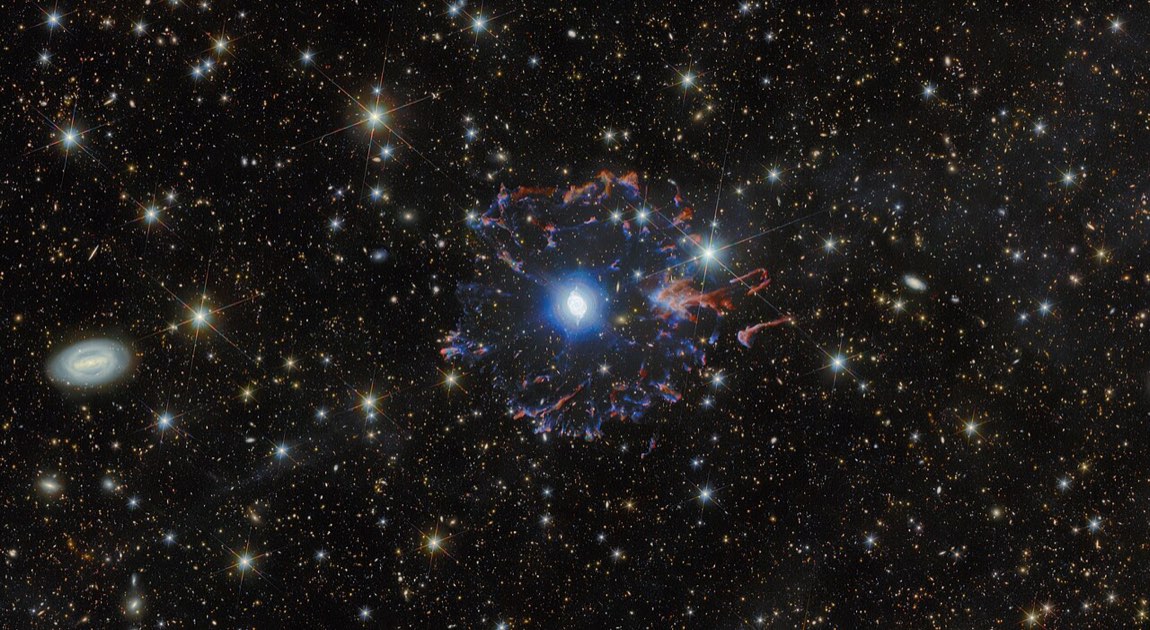
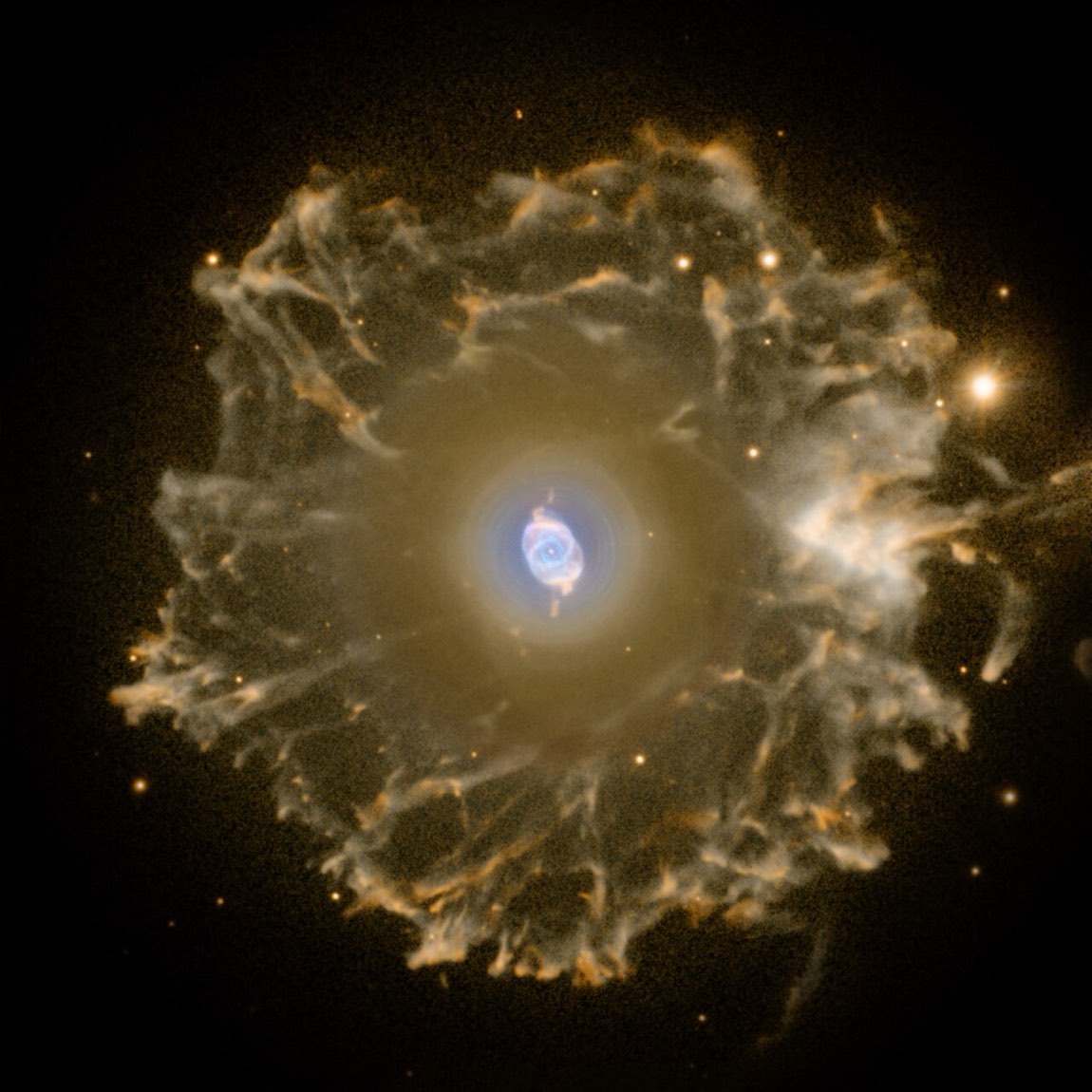
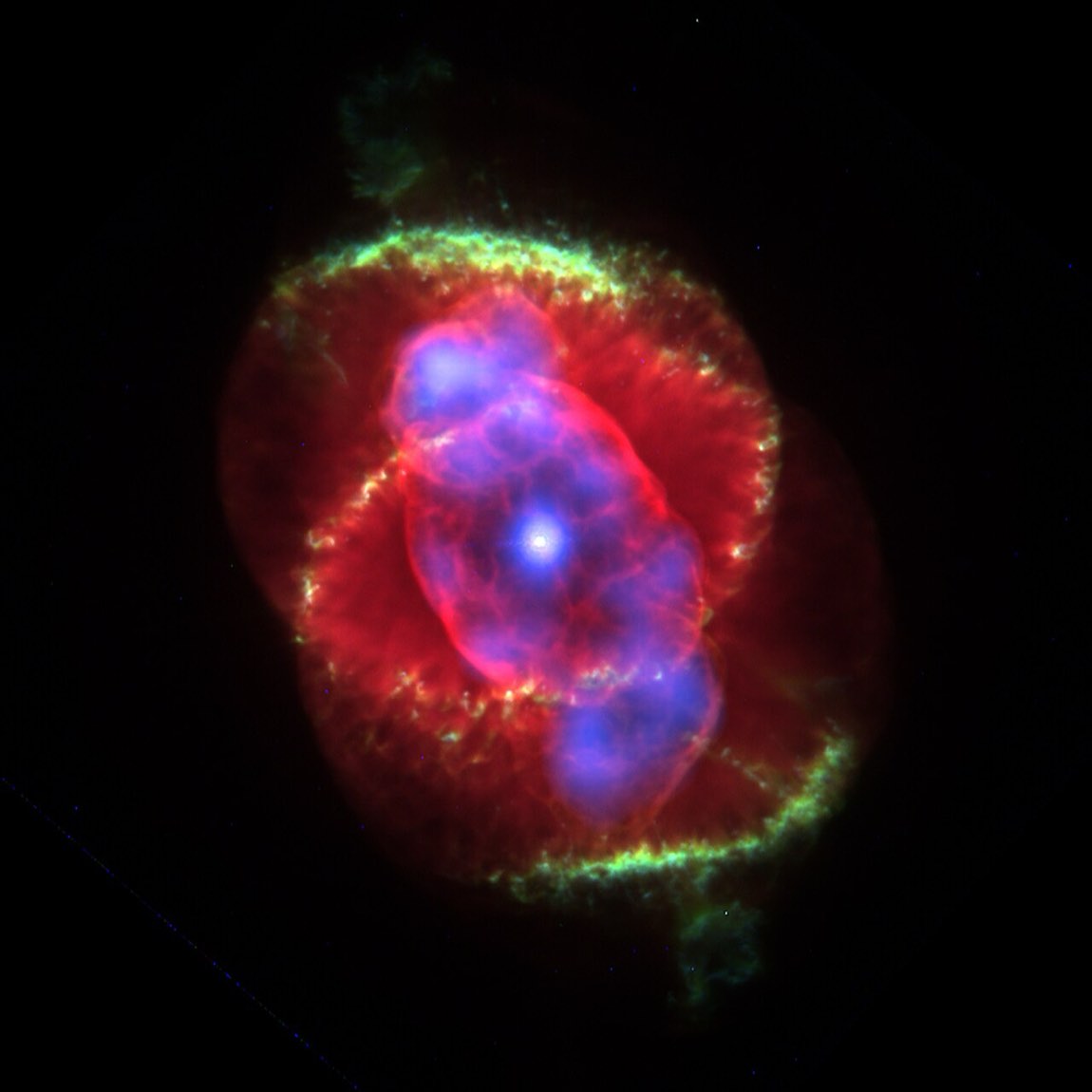
The Cat's Eye is not a single simple shell of gas — it is a Russian nesting doll of structures built up over thousands of years. At the very center sits an elongated inner bubble filled with searingly hot gas, blown hollow by the central star's fast wind. That bubble is itself nestled inside a pair of larger conjoined spherical bubbles, their waists appearing as a second ellipse oriented perpendicular to the inner one. Surrounding both is a series of remarkably evenly spaced concentric rings — visible in Hubble images as a dartboard pattern — that were ejected while the progenitor star was still on the asymptotic giant branch. Those pulsations probably began 15,000 years ago and stopped around 1,000 years ago when the bright central nebula began forming. Farther out still lies a vast faint halo, a relic of the star's even earlier red giant phase, stretching roughly 300 arcseconds — about 5 arcminutes — across the sky.
 ⤢
⤢
04 The wind that hollowed out a bubble
The central dying star drives a ferocious fast stellar wind outward at approximately 1,900 km/s — fast enough to cross the distance from Earth to the Moon in about 3.5 minutes. This wind rams into the slower material the star shed during earlier stages of its life, and the violent collision is what sculpts the inner bubble. The impact is energetic enough to heat gas to 1.7 million kelvin, producing the X-ray glow detected by the Chandra X-ray Observatory in 2001. At the same time, the wind appears to have literally burst the inner bubble at both ends, carving openings that may channel outflowing material into jets. The current rate of mass loss from the central star averages 3.2×10⁻⁷ solar masses per year — equivalent to twenty trillion tons every second — so the wind is constantly replenishing the energy and material that drive this ongoing internal sculpting.
05 Mysterious hard X-rays and a possible hidden companion Deeper
When the Chandra X-ray Observatory imaged the Cat's Eye in 2001, it found not only diffuse X-ray emission from the hot shocked gas but also a compact point source right at the position of the central star. What makes that source puzzling is that its X-ray spectrum extends into the hard band, reaching 0.5–1.0 keV. A star with a photospheric temperature of around 100,000 K should not produce significant hard X-rays, so something extra is going on. One compelling explanation is that the central object is actually a binary system, and mass flowing from one star onto the other creates a high-temperature accretion disk that generates the hard emission. This idea gained broader context in a 2012 Chandra survey of 21 central stars of planetary nebulae in the solar neighborhood, which found that nearly all of the detected X-ray point sources were harder than a single hot star could explain. The survey's authors suggested a high frequency of binary companions as the most likely culprit, though self-shocking winds and mass fallback onto the star were also listed as possibilities. The Cat's Eye remains a key exhibit in this unresolved debate.
06 Dust in the cold outskirts
Far from the blazing hot center, the outer reaches of the Cat's Eye harbor cold stellar dust sitting at about 85 K — roughly the temperature of liquid nitrogen and colder than anywhere on the surface of Mars. This dust is thought to have formed during the final phases of the progenitor star's life, before the planetary nebula phase began. It absorbs ultraviolet and optical light from the central star and re-radiates that energy at far-infrared wavelengths around 60 micrometers. The total mass of this dust has been estimated at 6.4×10⁻⁴ solar masses. Infrared observations have also revealed un-ionized material mixed in with the dust, including molecular hydrogen and argon. Curiously, the molecular hydrogen emission in NGC 6543 appears brightest not at the outermost edges, as in many planetary nebulae, but at the inner edge of the outer halo — possibly because colliding gas streams create shock waves that excite the molecules in that zone.
 ⤢
⤢
07 The baffling regularity of the concentric rings Deeper
One of the most visually striking and scientifically puzzling features of the Cat's Eye is the series of concentric rings surrounding its bright core. Hubble images show these rings spaced with remarkable evenness, implying that whatever process produced them repeated at very regular intervals and at nearly identical ejection speeds, time after time. The pulsations that created the rings apparently began roughly 15,000 years ago and switched off about 1,000 years ago. The total mass locked up in the rings adds up to about 0.1 solar masses — a substantial fraction of stellar material. What drove such metronomic precision remains unclear. Some researchers point to periodic thermal pulses deep inside the dying star; others invoke binary-star interactions. The mechanism responsible has not been conclusively identified, and the Cat's Eye rings represent one of the cleaner natural laboratories for studying whatever process causes a dying star to shed material in such a disciplined, rhythmic fashion.
08 Chemical enrichment written in light
Like the rest of the universe, NGC 6543 is dominated by hydrogen and helium, but its exact recipe carries the fingerprints of the nuclear burning that happened inside the progenitor star. Spectroscopic studies find that, relative to hydrogen, the helium abundance is about 0.12, while carbon and nitrogen each come in around 3×10⁻⁴ and oxygen around 7×10⁻⁴. All of these are higher than the values measured in the Sun, reflecting the fact that the progenitor star spent millions of years fusing lighter elements into heavier ones in its core and then dredging those products up into its outer layers before expelling them. There is also a hint, from deep spectroscopic analysis, that a small amount of material in the nebula is exceptionally enriched in heavy elements. Because different telescope apertures sample different physical regions, various studies disagree on exact numbers — a persistent challenge in measuring the chemistry of extended objects like this one.
09 The shrinking star at the center Deeper
The central planetary nebula nucleus of the Cat's Eye — catalogued as HD 164963 — is an extraordinary object in its own right. Its surface temperature is around 80,000 K, making it roughly fourteen times hotter than the Sun's surface, and it radiates about 10,000 times the Sun's total luminosity from a body with a radius of only 0.65 solar radii, or about 452,000 km. Its spectral classification combines two exotic types: O7 and Wolf-Rayet. Calculations suggest this remnant core now exceeds one solar mass, whittled down from a theoretical initial stellar mass of around 5 solar masses — meaning the star shed roughly 80 percent of its birth mass during its giant phases and planetary nebula ejection. The central star shines at magnitude +11.4, faint enough to require a moderate telescope but detectable. Its photospheric temperature has separately been estimated at around 100,000 K in the context of the hard X-ray observations, illustrating that different measurement techniques can yield somewhat different values.
 ⤢
⤢
10 Knowing how far away it really is Deeper
Distance measurement in astronomy is notoriously difficult, and the Cat's Eye illustrates the problem vividly. The most geometrically direct modern estimate uses Hubble Space Telescope images taken years apart to measure how fast the nebula's outer edge appears to expand on the sky — 3.457 milliarcseconds per year. Combining that angular expansion rate with an assumed line-of-sight expansion velocity of 16.4 km/s gives a distance of 1,001 ± 269 parsecs, roughly 3,300 light-years. But another widely cited figure, drawn from a 2008 study by Stanghellini and collaborators and quoted in the SIMBAD database as recently as 2014, places the nebula at 1,623 parsecs — about 5,300 light-years. That is a factor of roughly 1.6 difference between two reputable estimates, reflecting how even the best modern techniques leave substantial uncertainty for planetary nebulae. The age estimate from angular expansion carries a parallel uncertainty: assuming a constant expansion rate of 10 milliarcseconds per year, the nebula is at most 1,000 ± 260 years old, though real deceleration by surrounding material could make it somewhat older.
11 Observing the Cat's Eye from your backyard
With a combined magnitude of 8.1 and high surface brightness, the Cat's Eye Nebula is within reach of a modest amateur telescope from a reasonably dark site. It sits in the northern constellation Draco at a high northern declination, making it circumpolar — never setting — for observers at mid-northern latitudes. The small bright inner nebula spans only about 16.1 arcseconds on average, roughly the size of Saturn's disk at certain oppositions, so it will look stellar or barely resolved in small instruments. A medium aperture telescope reveals the compact, bright disk. The outer condensations stretch to about 25 arcseconds, and deep long-exposure photography can capture the full extended halo reaching roughly 300 arcseconds — but that faint halo demands dark skies and significant exposure time. Because of its proximity to the north ecliptic pole, it is accessible on nearly any clear night throughout the year for northern observers, making it a popular target for both visual observers and astrophotographers.
12 Gas temperatures across a 200-million-degree range Deeper
The Cat's Eye Nebula contains gas spanning one of the widest temperature ranges of any single object commonly observed by amateur astronomers. The bright visible nebulosity — the part captured in most photographs — sits at temperatures between 7,000 and 9,000 K, with particle densities averaging around 5,000 particles per cubic centimetre. Moving outward, the fainter outer halo is actually hotter at around 15,000 K, even though it is far less dense. Then, deep inside the inner bubble where the fast stellar wind has collided with older ejecta, the Chandra X-ray Observatory measured gas at 1.7 million K — about 200 times hotter than the outer halo and roughly 130 times hotter than the surface of the Sun. Finally, the cold dust in the outer nebula sits at just 85 K. This layered thermal structure — from near absolute coldness through millions of degrees — within a single object a few light-years across makes the Cat's Eye one of the most thermally complex environments that astronomers have been able to map in detail.
 ⤢
⤢