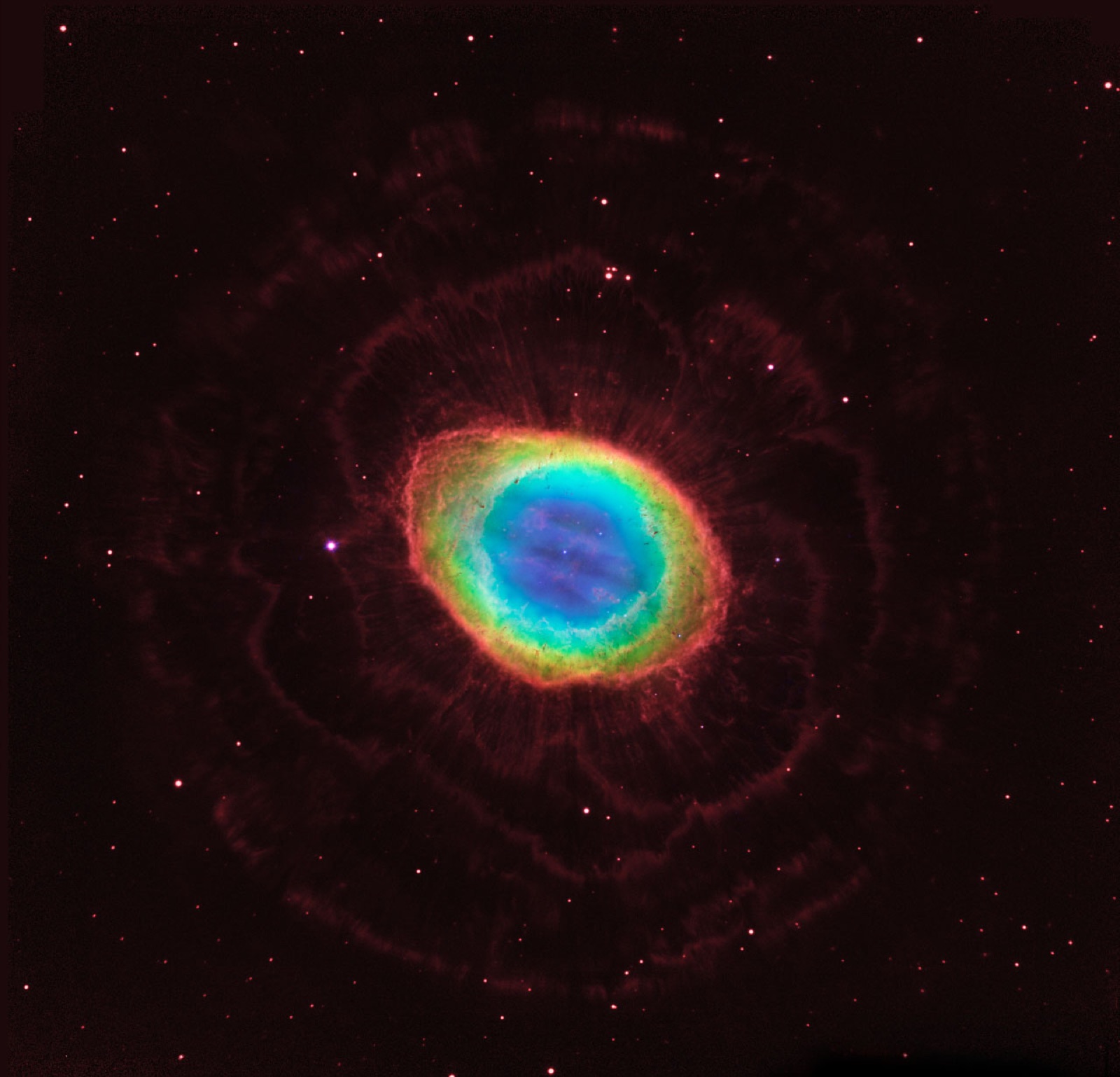
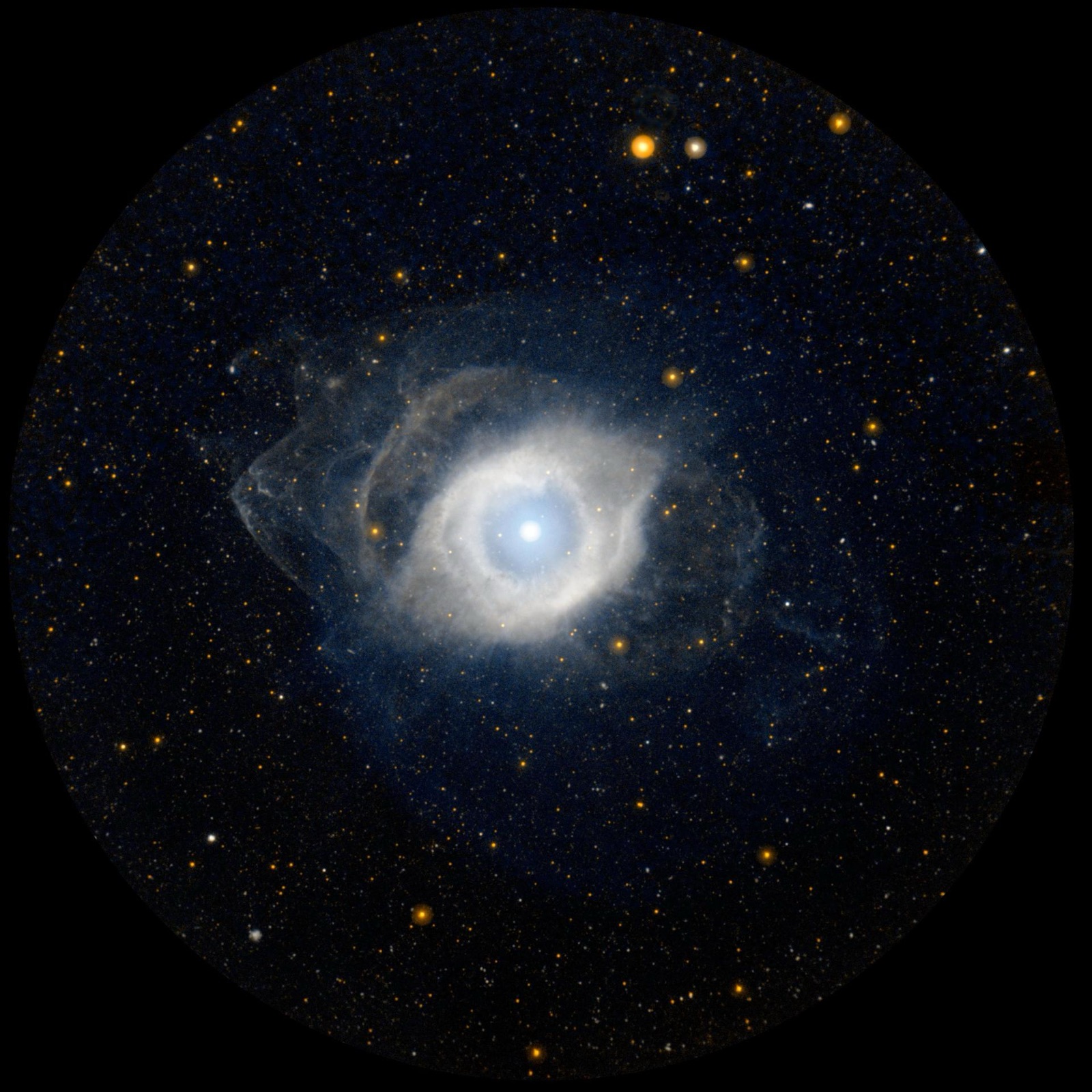
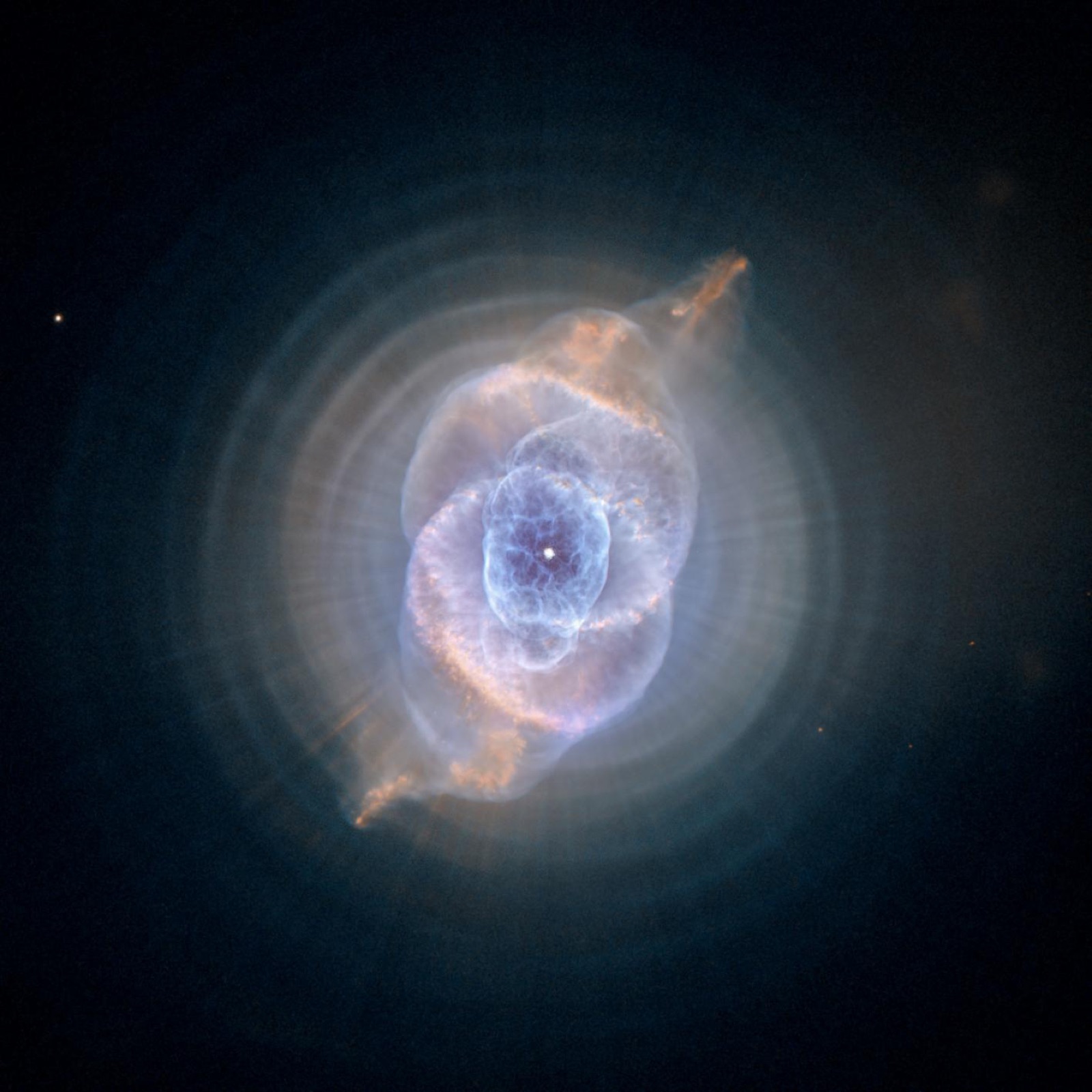
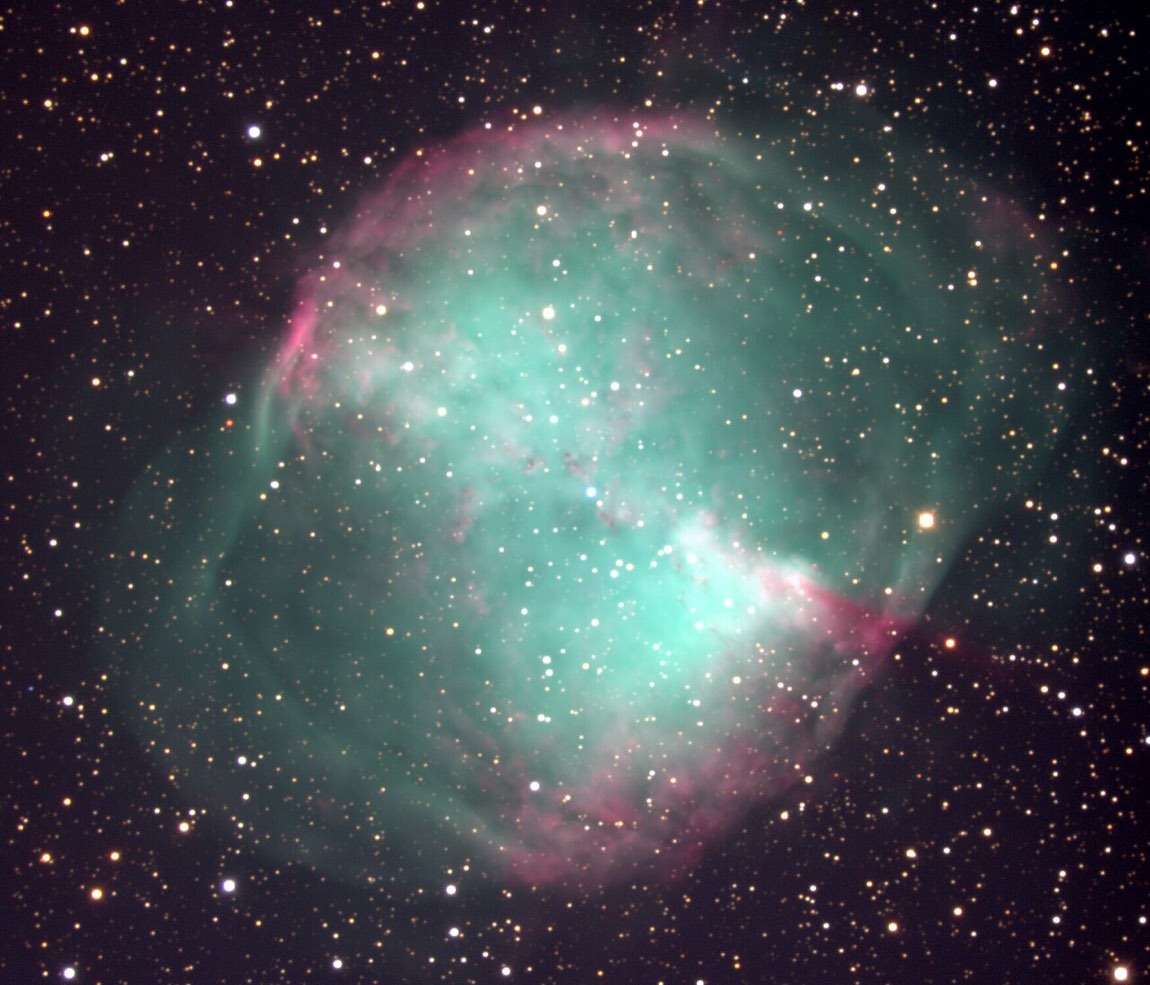
 Photograph · Credit: REU program/NOIRLab/NSF/AURA · CC BY 4.0
Nebula · Deep guide
The Dumbbell Nebula (Messier 27)
Also called: M27 · Messier 27 · NGC 6853 · Apple Core Nebula · Diabolo Nebula
The first planetary nebula ever discovered: a dying star's glowing shell shaped like an apple core.
What is it?
The Dumbbell Nebula is a planetary nebula in Vulpecula, a shell of gas thrown off by a Sun-like star near the end of its life. Charles Messier discovered it in 1764, making it the first object of its kind ever found. It lies about 1,360 light-years away and is bright enough to see in binoculars. Measurements of how fast it is expanding suggest it is roughly 10,000 years old. Its centre is dotted with dark, comet-like knots of gas, similar to those in the Helix Nebula.
The deep dive
Researched for the Atlas from Wikipedia — Dumbbell Nebula (1,941 characters read) · updated Nov 15, 2026
01 The First Planetary Nebula Ever Found
When Charles Messier swept his telescope across the sky on July 12, 1764, he stumbled onto something that had no name and no category yet. What he recorded as the 27th entry in his famous catalog became the very first planetary nebula ever discovered by humanity. The term "planetary nebula" came later — these glowing shells of gas have nothing to do with planets, but through early telescopes their round, softly lit appearance reminded observers of the disk of a distant planet. The Dumbbell was the object that started that entire classification. Every other planetary nebula known today was identified in relation to this one pioneering example, making Messier 27 not just a beautiful object but a cornerstone of stellar astrophysics. That a backyard-scale instrument from the eighteenth century could reveal something so scientifically fundamental is a reminder of how much the sky rewards patient, systematic looking.
02 A Shape That Tricks the Eye
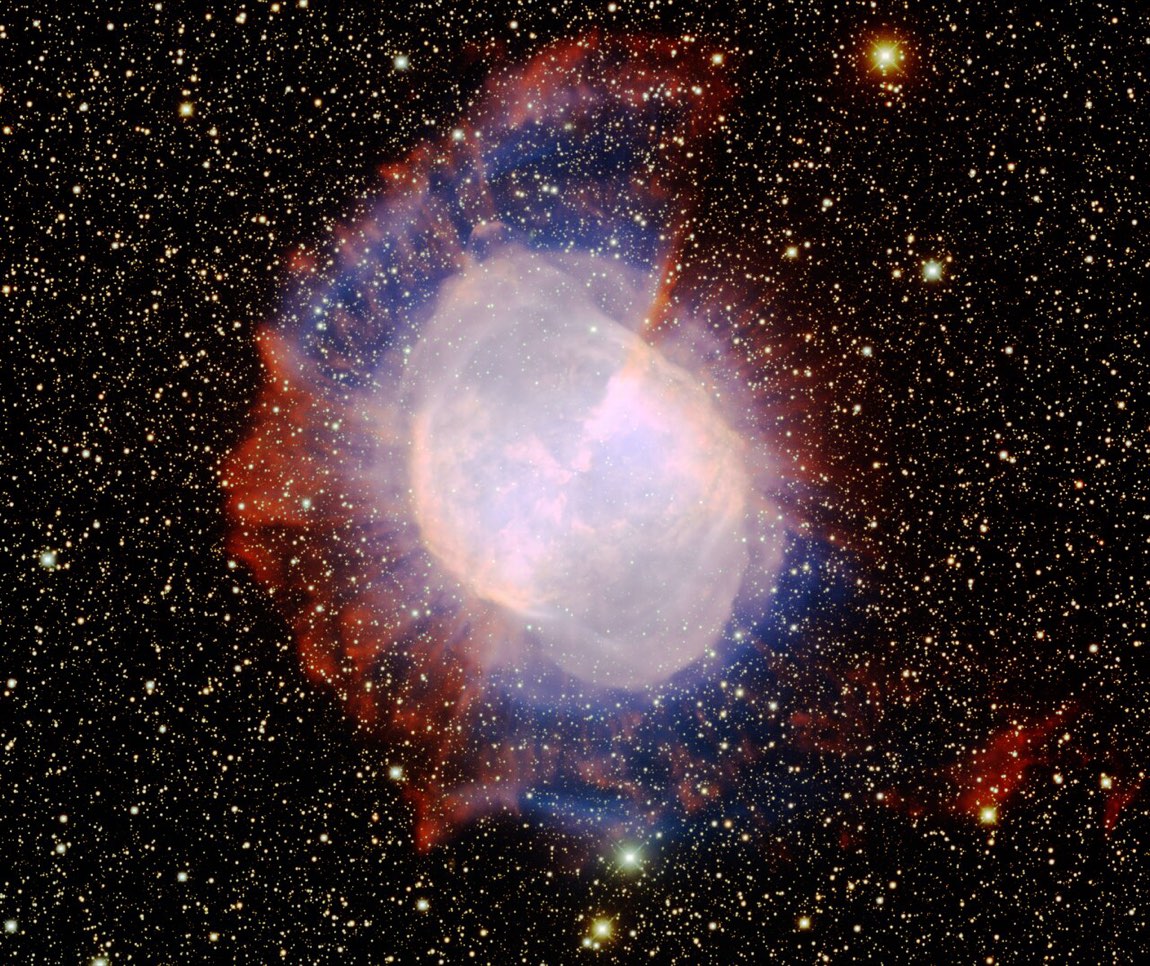
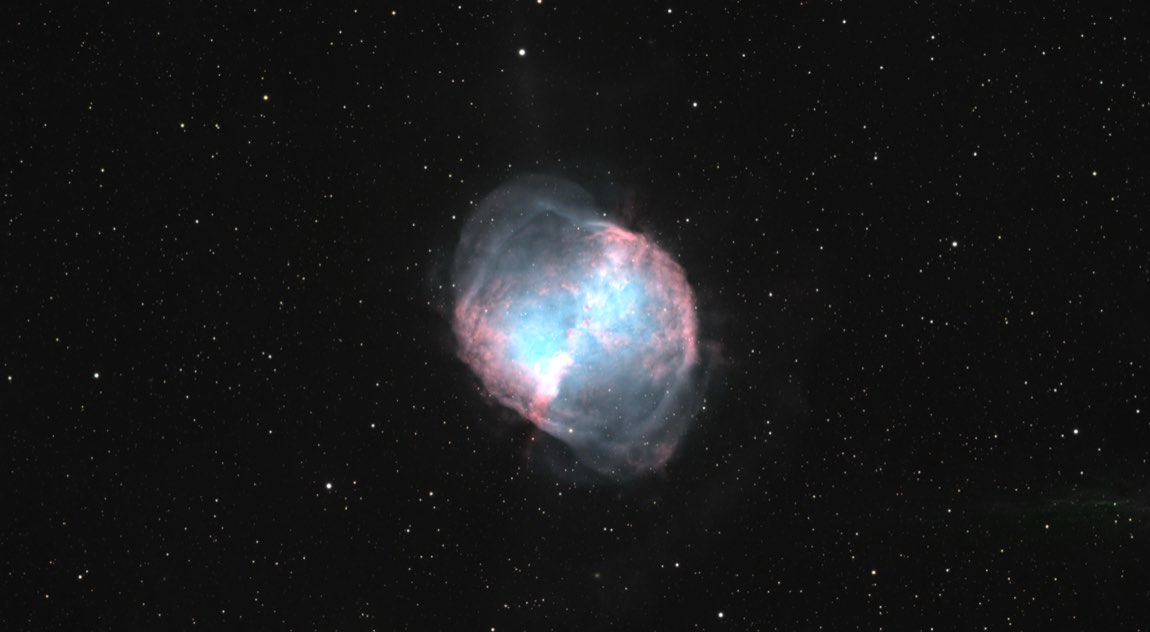
The name "Dumbbell" describes what we see from Earth, but the true three-dimensional form is more subtle. The nebula is shaped like a prolate spheroid — imagine a rugby ball or an American football — and we happen to be looking at it from a vantage point aligned almost exactly with its equatorial plane. That geometry compresses what would otherwise appear as a fuller, more rounded glow into the distinctive two-lobed silhouette that inspired both the "Dumbbell" nickname and the alternate name "Apple Core Nebula." Had we been positioned above one of its poles, we would see something closer to a simple circle of light. This viewing-angle effect is a constant challenge in nebula astronomy: the apparent shape on the sky is a projection of a three-dimensional structure, and reconstructing the real form requires careful modeling of how light, velocity, and symmetry fit together across the image.
03 Knots, Cusps, and Shadowy Tails Deeper
Look closely at the Dumbbell's central region and the smooth glow breaks down into a remarkable texture: a pattern of dark and bright cusped knots, each one trailed by a dark tail streaming away from the central star. These knots vary considerably among themselves — some are symmetric with well-defined tails while others are irregular and tail-less. The same kind of structures appear in two other famous planetary nebulae, the Helix Nebula and the Eskimo Nebula, suggesting a common physical process at work. The bright cusps at the heads of the knots are identified as local photoionization fronts, meaning they mark the precise boundary where intense ultraviolet radiation from the central white dwarf is currently stripping electrons from atoms in the surrounding gas. The dark tails behind each knot are shadowed zones where that radiation cannot reach directly. These knots are essentially tiny battles between radiation pressure and dense clumps of gas, frozen in a moment that has already lasted thousands of years.
04 How Old Is This Glowing Shell? Deeper
Pinning down the age of a planetary nebula requires measuring how fast it is expanding and how big it has grown — but different methods give different answers, and the Dumbbell illustrates that tension clearly. In 1992, Moreno-Corral and colleagues measured the nebula's angular rate of expansion as seen from Earth at no more than 2.3 arcseconds per century. Scaled to the nebula's known distance, that angular motion sets an upper limit of 14,600 years on how long it has been expanding. A second approach uses the actual velocity of the gas directly: in 1970, Bohuski, Smith, and Weedman measured the expansion velocity at 31 km/s. Combined with the nebula's semi-minor axis radius of 1.01 light-years, that velocity implies a kinematic age of 9,800 years. The gap between 9,800 and 14,600 years reflects real uncertainties in both methods and shows that even well-studied objects hold unresolved questions about their own histories.
 ⤢
05 The Unusual White Dwarf at Its Heart Deeper
At the center of all that glowing gas sits a white dwarf — the collapsed remnant of a sun-like star that shed its outer layers to create the nebula we see. This particular white dwarf stands out because of its size. Its radius has been estimated at 0.055 ± 0.02 solar radii, which translates to roughly 0.13 light-seconds, or about 38,000 kilometers — a sphere smaller than Jupiter yet containing more than half the mass of the Sun. What makes it unusual is that this radius is larger than most other known white dwarfs, placing it at the bigger end of a class of objects already famous for packing stellar masses into planetary-scale volumes. Its mass was pinned down more precisely in 1999 by Napiwotzki, who estimated it at 0.56 ± 0.01 solar masses. That figure sits close to the typical white dwarf mass, suggesting the original star was broadly similar in mass to our own Sun before it aged off the main sequence.
06 How Fast Is the Nebula Growing?
The Dumbbell Nebula is not static — it is a living, expanding shell of gas still rushing outward from its central star. The measured expansion velocity is 31 km/s, a speed that sounds dramatic but is ordinary by stellar standards. For comparison, the fastest commercial aircraft travel at roughly 0.3 km/s, so the nebula's edge is moving about 100 times faster than a jet. Yet on astronomical timescales even this pace is leisurely: at 31 km/s, the nebula has taken close to ten thousand years to reach its current semi-minor radius of 1.01 light-years. As the shell continues to expand, it will grow thinner and fainter, eventually dissolving into the surrounding interstellar medium over tens of thousands of years. What we see today is a brief, luminous episode in the long afterlife of a star.
07 Finding It in the Night Sky
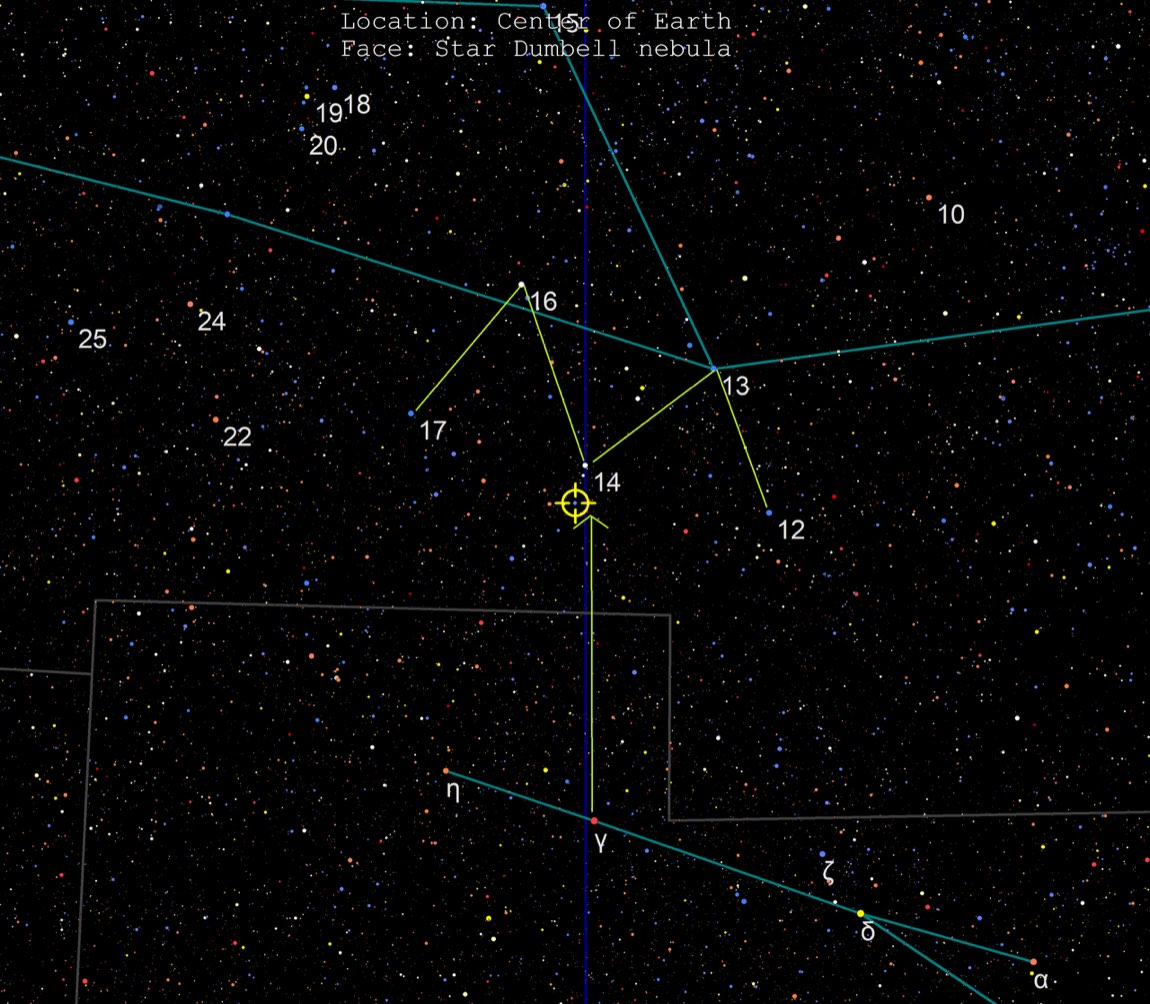
Despite lying in Vulpecula, one of the faintest and least-recognizable constellations in the northern sky, the Dumbbell Nebula is remarkably easy to find once you know where to look. The key landmark is the Summer Triangle, the prominent asterism formed by the bright stars Vega, Deneb, and Altair that dominates summer and early-autumn skies in the northern hemisphere. Vulpecula sits inside the Triangle, and the Dumbbell lies a few degrees north of gamma Sagittae, close to the star 14 Vulpeculae. At an apparent visual magnitude of 7.5 and a diameter of about 8 arcminutes — roughly a quarter of the full Moon's width — it glows brightly enough to be seen in ordinary binoculars under reasonably dark skies. In an amateur telescope it becomes one of the showpiece objects of the warm-weather observing season, its two-lobed form unmistakable even at modest magnification.
08 Why "Planetary" Nebula Is a Misnomer
The Dumbbell Nebula belongs to a class of objects with a genuinely misleading name. Planetary nebulae have no connection to planets whatsoever — they are formed when a dying star similar in mass to our Sun sheds its outer atmosphere late in life, leaving behind a hot white dwarf that then illuminates the expelled gas with intense ultraviolet radiation. The "planetary" label comes purely from visual resemblance: through the small telescopes of the eighteenth and nineteenth centuries, these nebulae appeared as smooth, roundish disks that looked superficially like the planets Uranus or Neptune. Because the Dumbbell was the first of its kind identified, every later object added to the category was compared back to it, and the name stuck even after astronomers fully understood what these objects actually are. Today a planetary nebula is understood as a snapshot of stellar death, an event our own Sun is expected to undergo billions of years from now.
 ⤢
09 Its Place in Messier's Famous Catalog
Charles Messier compiled his celebrated catalog not to celebrate beautiful objects but to avoid them. As a comet hunter, he was repeatedly frustrated by fuzzy, stationary patches of light that could be mistaken for new comets at first glance. His solution was to systematically record these imposters so that he and other observers could immediately rule them out. The Dumbbell Nebula became Messier 27, the 27th entry in that list of things-that-are-not-comets. The irony is rich: a catalog built out of astronomical annoyance became one of the most treasured observing lists in amateur astronomy, and its entries — galaxies, nebulae, star clusters — are now sought out precisely because they are so rewarding to look at. The Dumbbell holds the distinction of being not only the catalog's first planetary nebula but also the original reason that class of object has a name at all.
10 Open Questions That Remain Unsettled Deeper
Even a well-observed and relatively nearby object like the Dumbbell Nebula leaves significant questions unanswered. The discrepancy between its upper-limit age of 14,600 years based on angular expansion and its kinematic age of 9,800 years based on measured gas velocity points to unresolved uncertainties in one or both measurement approaches — possibly reflecting changes in expansion speed over time, projection effects, or limitations in distance estimates. The knot structures in the nebula's central region are a subject of ongoing interest: understanding exactly how dense clumps form within an expanding shell, survive the radiation field of the white dwarf, and produce their characteristic cusp-and-tail morphology is not yet fully solved. The white dwarf itself, with its notably large radius compared to other known white dwarfs, may also carry information about the mass-loss history of its progenitor star that has not been entirely extracted. These are the kinds of open problems that keep the Dumbbell scientifically relevant long after its discovery.
11 Connections to Other Famous Nebulae Deeper
The Dumbbell does not stand alone as a scientific object — it belongs to an informal family of nearby planetary nebulae that share structural features and have been studied comparatively to understand what drives those features. The knots in the Dumbbell's interior, with their bright photoionized cusps and shadowy tails, appear in strikingly similar forms in the Helix Nebula and the Eskimo Nebula. This recurrence across three different objects suggests that knot formation is a standard feature of the planetary nebula lifecycle rather than an oddity unique to any one system. Comparative studies across these nebulae allow astronomers to separate properties that depend on specific local conditions — the mass of the progenitor star, the density of the surrounding gas — from those that reflect universal physics. The Dumbbell, as the oldest-known member of this class, anchors those comparisons historically and observationally.
 ⤢