 Photograph · NASA/JPL-Caltech
Nebula · Deep guide
The Helix Nebula
The Eye of God offers the nearest glimpse of the Sun's own future.
What is it?
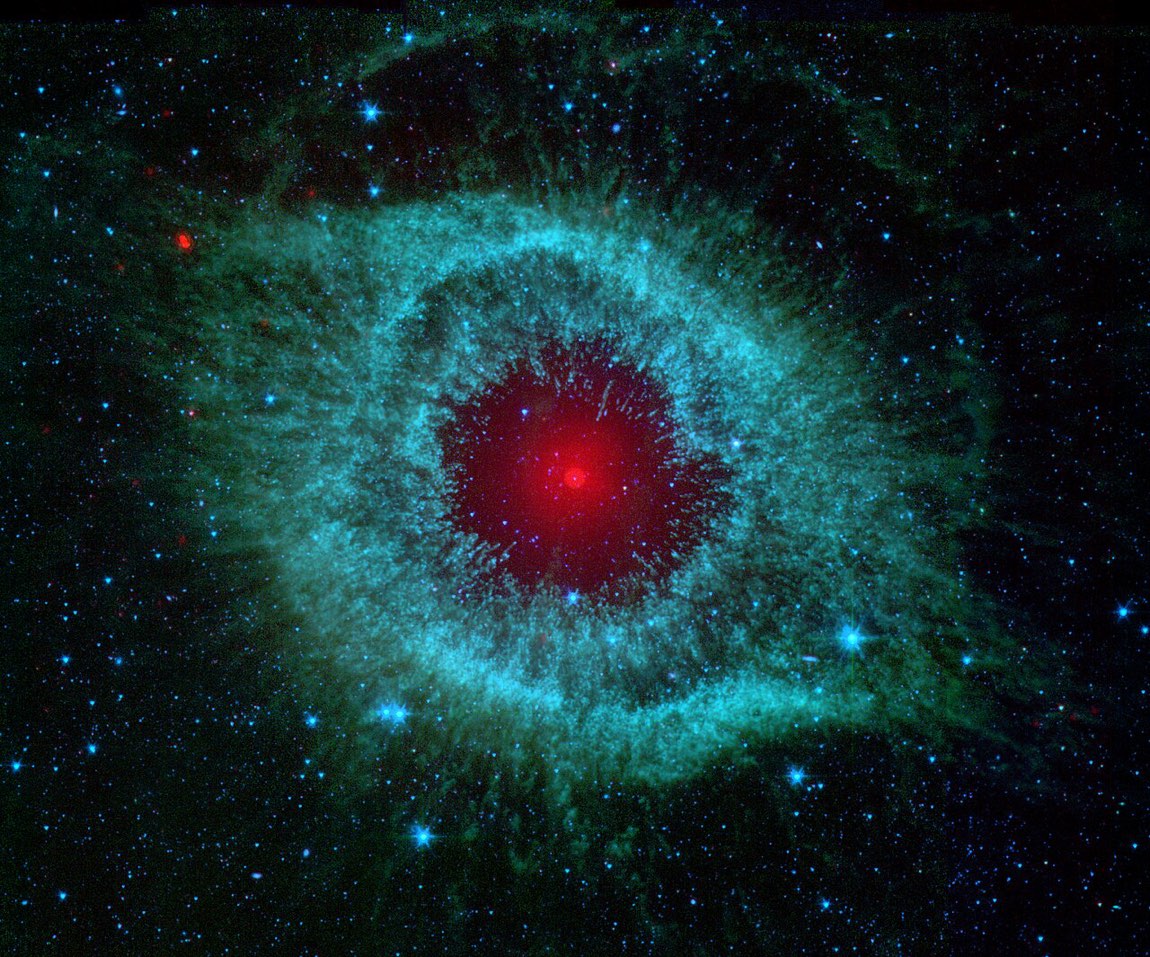
The Helix, only 650 light-years away in Aquarius, is the closest bright planetary nebula: the unwrapped outer layers of a dying Sun-like star, staring back at us like a vast iris. Its central white dwarf lights up a barrel of gas over two light-years wide, laced with thousands of comet-like knots, each the size of a solar system. In about 5 billion years, this is us.
The deep dive
Researched for the Atlas from Wikipedia — Helix Nebula (5,077 characters read) · updated Sep 20, 2026
01 Who discovered the Helix Nebula
The Helix Nebula was discovered by the German astronomer Karl Ludwig Harding, most likely before 1824. Beyond that date, the historical record is thin — the article offers no further detail about the circumstances of the discovery, whether Harding was sweeping for comets or conducting a systematic survey, or how the object was initially catalogued. What we do know is that it eventually received three separate designations: NGC 7293 in the New General Catalogue, Caldwell 63 in Patrick Caldwell-Moore's observer's list, and the informal nickname the "Eye of God" — and occasionally the "Eye of Sauron" — in popular culture. Despite sitting relatively close to Earth at 655 light-years (as measured precisely by the Gaia space mission, with an uncertainty of just 13 light-years), the nebula's large angular spread across the sky and low surface brightness made it a surprisingly easy object to overlook for visual observers in the centuries after Harding first logged it.
02 The star that made the nebula
The Helix Nebula was not born from an explosion. Instead, it came from a slow, graceful shedding. An intermediate to low-mass star — the kind that makes up the vast majority of stars in our galaxy — reached the end of its nuclear-burning life and swelled into what astronomers call an Asymptotic Giant Branch star. In that phase it shed its outer layers into surrounding space. Those expelled gases, when seen from Earth, form the helix structure we observe today. The remnant core left behind is now the central star of the nebula, on its way to becoming a white dwarf. That core is so intensely hot — 120,000 Kelvin, roughly twenty times hotter than the surface of our own Sun — that its radiation floods the surrounding gas with energetic photons, causing the nebula to brightly fluoresce. Without that fierce ultraviolet glare from the central star, the Helix Nebula would be invisible.
03 A prolate shell, tilted toward us Deeper
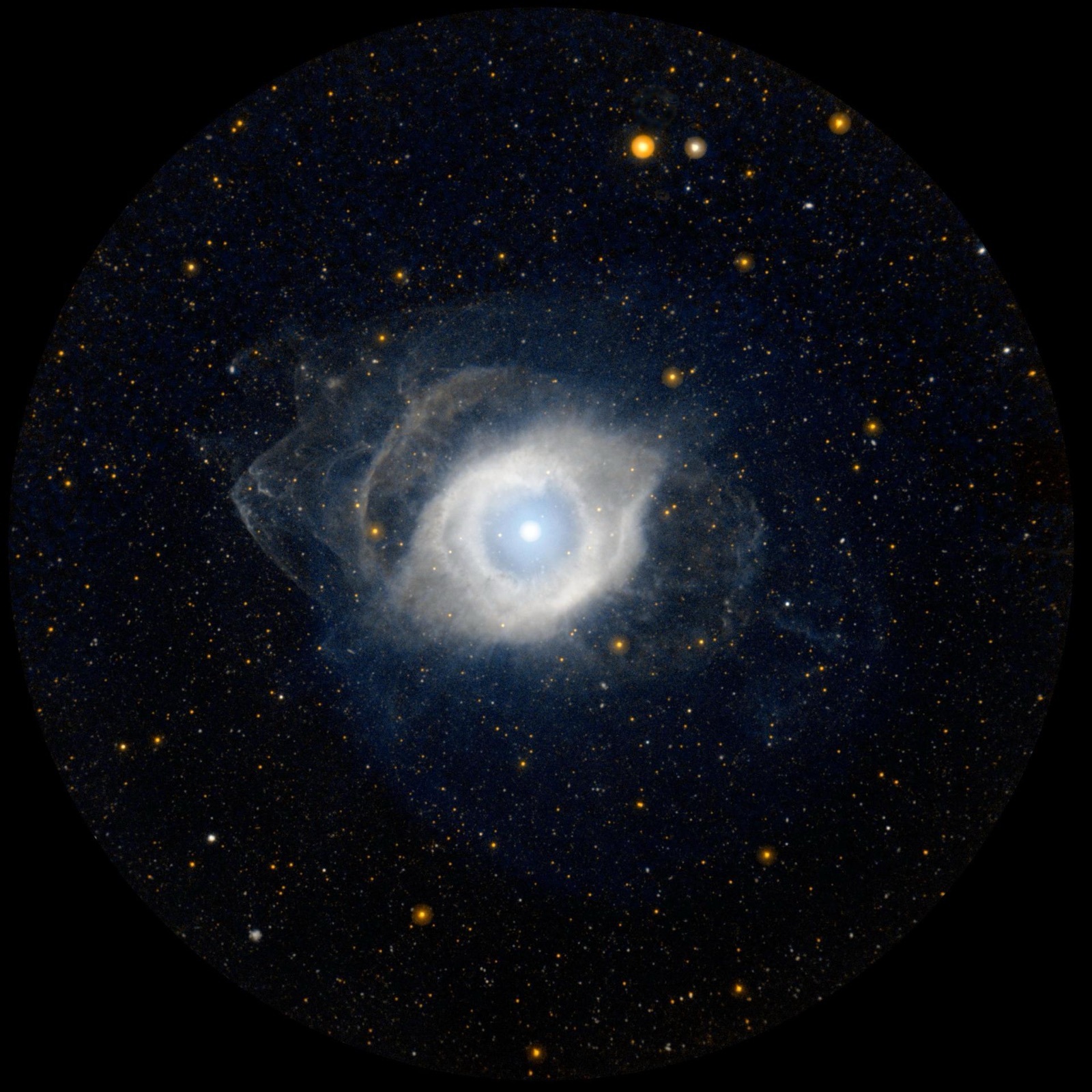
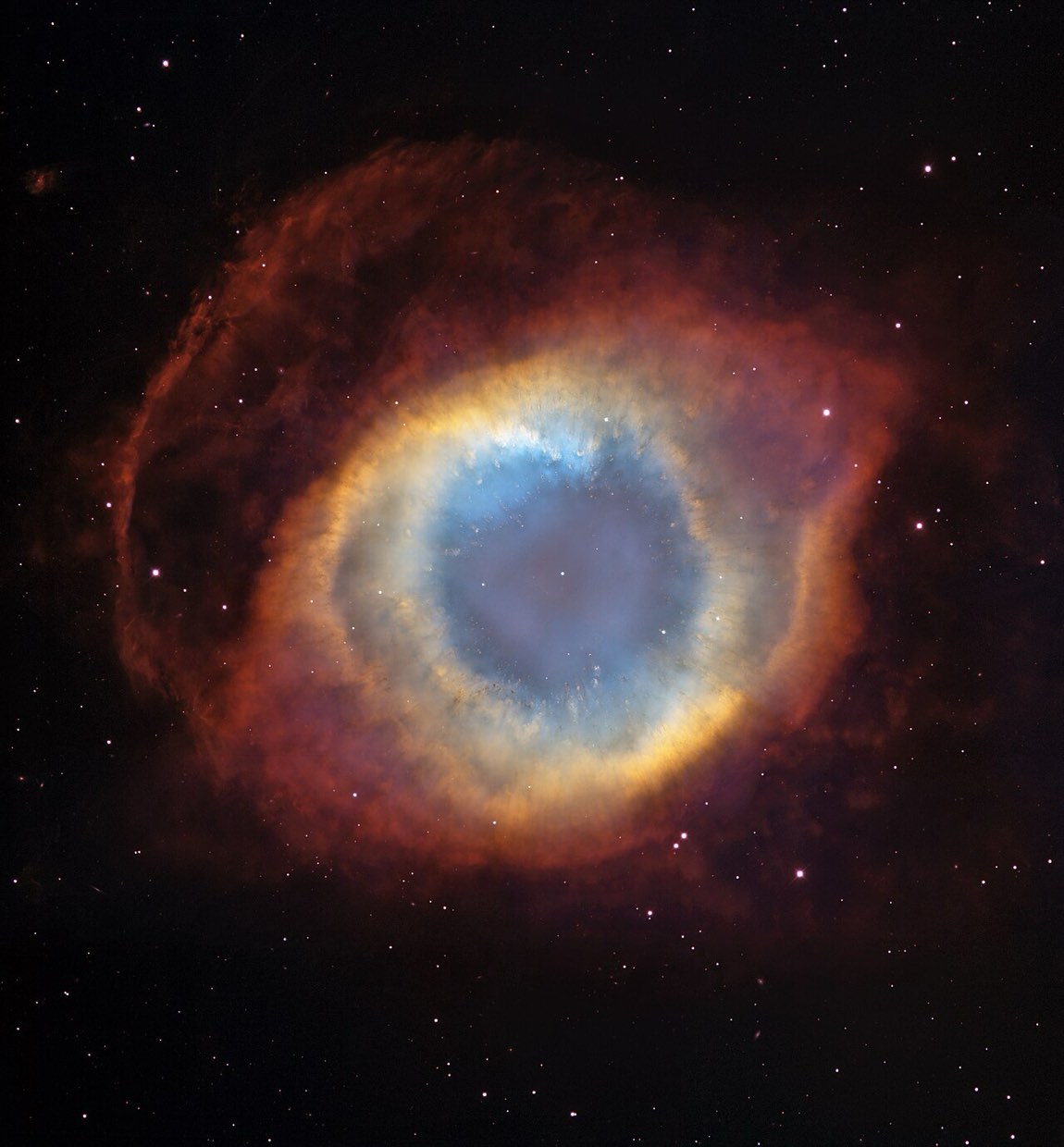
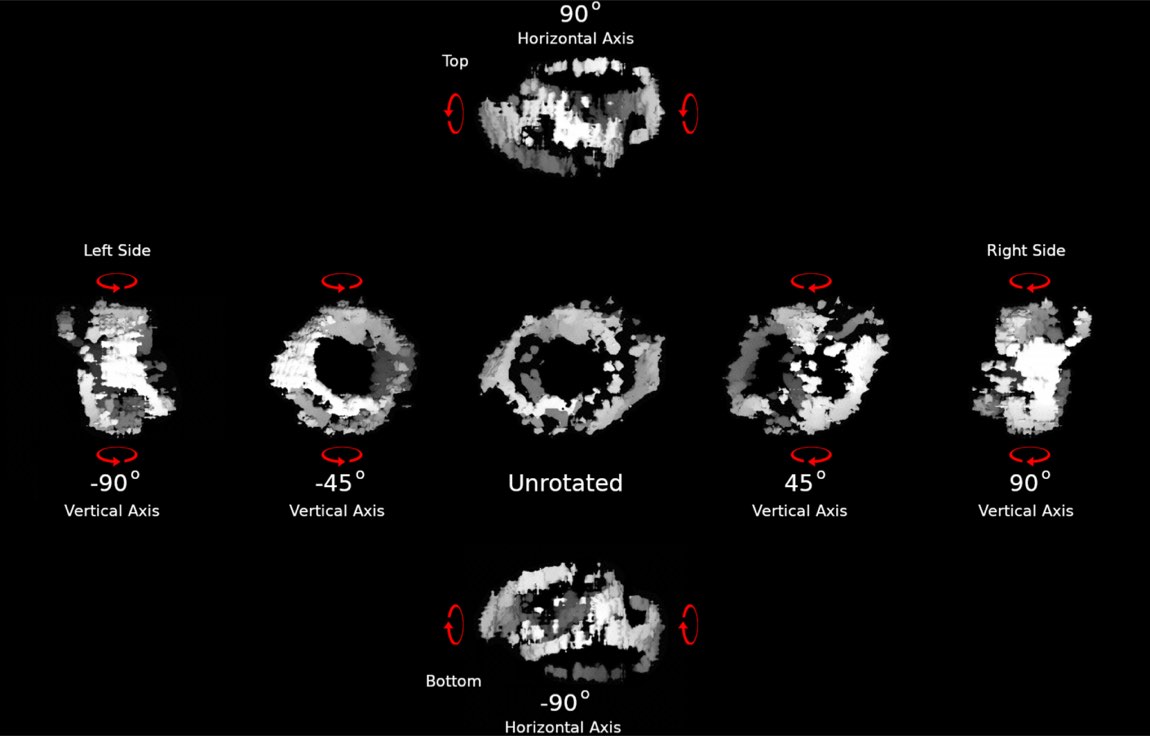
The Helix Nebula is not the flat ring it appears to be in photographs. Astronomers believe it is shaped like a prolate spheroid — think of a slightly elongated football — with its densest material concentrated in a disk along the equatorial plane. Crucially, the major axis of that structure is tilted between 21° and 37° relative to our line of sight, which is what gives us our relatively face-on view. The nebula has at least three distinct structural layers. The inner disk measures 8 by 19 arcminutes in diameter, corresponding to 0.52 parsecs. Outside that sits an outer torus 12 by 22 arcminutes across (0.77 parsecs). Beyond both is a faint outermost ring about 25 arcminutes in diameter — roughly 1.76 parsecs, or about 5.7 light-years across. That outermost ring is visibly flattened on one side, a detail explained by the ring physically colliding with the ambient interstellar medium surrounding the nebula.
 ⤢
⤢
04 How old is the Helix Nebula
Estimating a nebula's age sounds straightforward — measure how big it is and how fast it is expanding, then divide — but the Helix Nebula's layered structure means there is no single clean answer. The overall nebula structure is estimated to be about 10,600 years old, with an uncertainty range extending from roughly 9,400 to 12,900 years. That estimate comes from the ratio of the nebula's total size to its measured expansion rate of 31 kilometres per second. The inner disk, however, tells a different story: it is thought to have formed more recently, roughly 6,560 years ago, and its expansion rate is faster at 40 kilometres per second. The outer ring expands more slowly at about 32 kilometres per second. The implication is that the star did not simply switch on its mass-loss all at once; it shed material in distinct episodes separated by thousands of years, each episode creating another structural layer we can identify today.
05 Cometary knots: the nebula's strange lumps Deeper
The Helix Nebula holds a significant place in astronomical history as the first planetary nebula ever found to contain cometary knots. These are clumps of nebulosity that look superficially like comets — each has a bright cusp pointing toward the central star and a long tail streaming away from it in a radial direction. Despite the visual similarity to comets, they have nothing to do with them. Each knot is centred on a core of neutral molecular gas, and the bright cusp arises from a local photoionization front where the central star's radiation slams into the dense clump. Excluding their tails, every individual knot is roughly the size of our entire Solar System — yet there are approximately 40,000 of them packed into the main ring. Astronomers believe they form through Rayleigh-Taylor instability, the same physical process that makes the boundary between two fluids of different densities go unstable and clump up, here driven by fast, tenuous ionized gas pushing against slower, denser neutral material shed earlier in the star's life.
06 Temperature gradients inside the knots Deeper
The cometary knots are not uniformly warm. Spectroscopic measurements reveal a clear temperature gradient running outward from the central star. In the inner region of the nebula, at a distance of about 2.5 arcminutes from the central star, the rotational-vibrational temperature of molecular gas within a knot reaches approximately 1,800 Kelvin. Farther out at 5.6 arcminutes from the central star, that same measurement drops to around 900 Kelvin — roughly half as hot. This gradient makes physical sense: the knots closer to the intensely hot central star absorb far more ionizing radiation and are heated more aggressively. The measurement technique used here — rotational-vibrational temperature from spectroscopy — probes the molecular gas at the heart of each knot, the neutral material that has not yet been ionized by the star's ultraviolet output. Tracking this gradient helps astronomers understand how energy transfers from the central star outward through the layered, complex structure of the nebula.
 ⤢
⤢
07 The white dwarf at the center
The central star of the Helix Nebula is catalogued as WD 2226-210 (also known as PHL 287 and GJ 9785) and is classified as a spectral type DAO white dwarf. Its vital statistics are striking. The star has a radius of just 0.025 solar radii — about 17,000 kilometres, not much larger than Earth's diameter of roughly 12,700 kilometres. Despite that tiny size, it packs a mass of 0.678 solar masses into that compact volume. Its surface temperature of 120,000 Kelvin makes it one of the hotter white dwarfs known, and its apparent magnitude is 13.5, meaning it requires a telescope to see but is not unreasonably faint for a moderately sized instrument. All of that heat crammed into a body barely larger than our planet is what powers the spectacular fluorescence of the surrounding nebula.
08 Dusty debris orbiting a dead star Deeper
Infrared observations of the central white dwarf reveal a puzzling excess of mid-infrared light — more than the bare star alone should produce. The leading explanation is a disk of warm dust circling the white dwarf somewhere between 30 and 100 AU from the star, a range revised downward from an earlier estimate of 35 to 150 AU. The dust is not thought to be a remnant of the star's original planetary disk; that material would have been destroyed long ago. Instead, researchers favour a picture in which the dust is constantly replenished by thousands of exocomets on highly eccentric orbits plunging close to the white dwarf and vaporising. Those exocomets are thought to originate from a reservoir analogous to our own Oort Cloud, disturbed into high-eccentricity trajectories as the star evolved. Longer-wavelength observations that showed no detectable emission allowed the team to rule out several alternative explanations, lending support to this exocomet replenishment scenario.
09 Could a planet still orbit the dead star
A 2024 study added another layer of intrigue to the central white dwarf. Researchers noticed periodic variations in the star's light curve and hypothesised that they could be caused by an orbiting planet — a world that survived, at least partially, the dramatic death of its host star. If that planet exists and if its orbital plane is inclined at roughly 25° (consistent with the orientation of the nebula itself), then the planet would have a radius of about 0.021 solar radii, or approximately 15,000 kilometres — around 2.3 times the radius of Earth. However, the authors were careful to note that intrinsic stellar variability cannot be ruled out as the cause of the signal. Then, in 2025, a separate study using X-ray observations suggested the white dwarf may be actively accreting the remains of a Jupiter-like planet, an object apparently located even closer to the star than the candidate found via optical variability. Neither detection is confirmed, but together they paint a picture of a dynamic, still-evolving system.
 ⤢
⤢
10 How the Helix compares to its twin nebulae
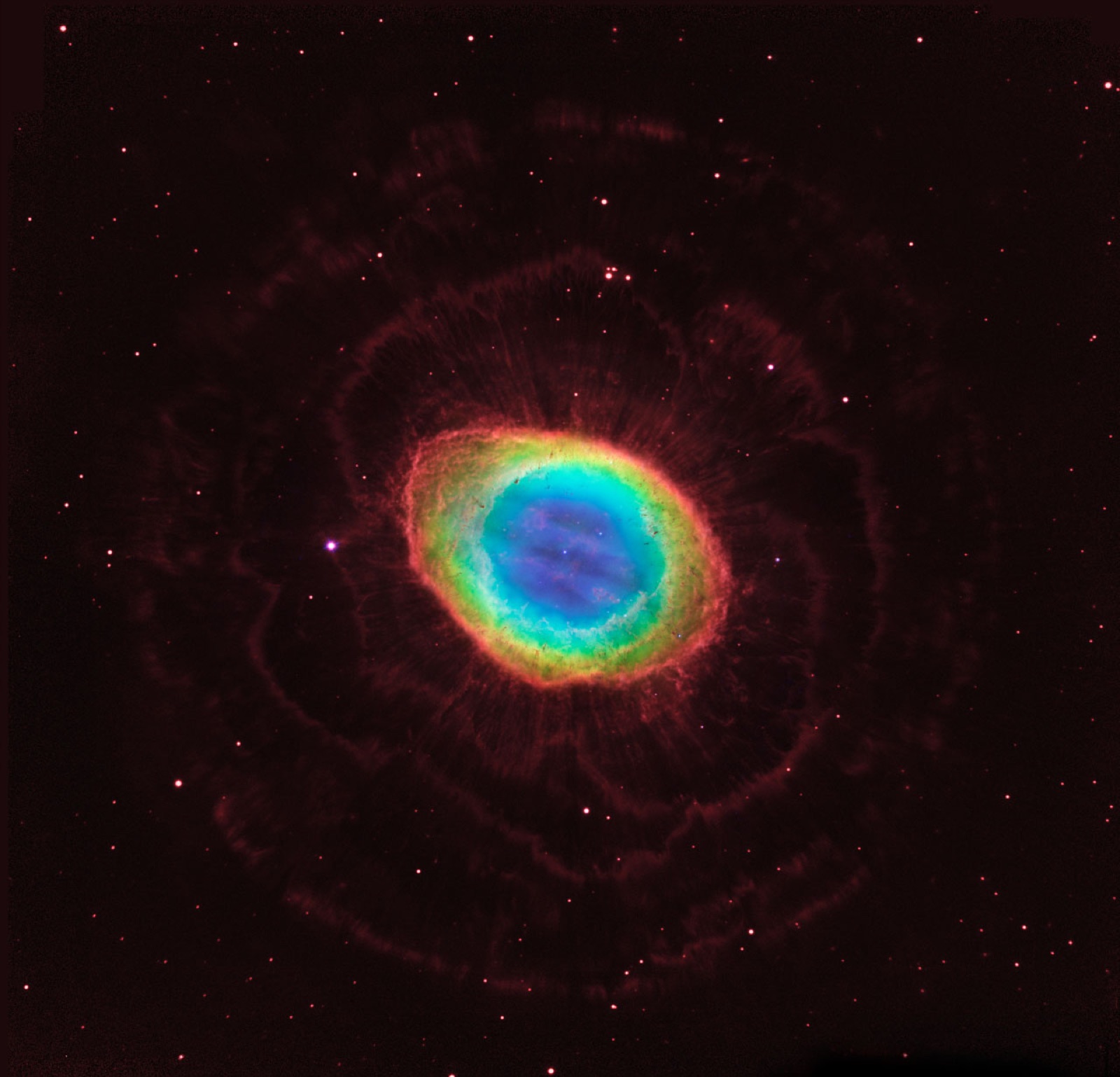
The Helix Nebula is frequently compared to two other celebrated planetary nebulae: the Cat's Eye Nebula and the Ring Nebula. According to the article, all three are similar in appearance, and the Ring Nebula shares comparable size, age, and physical characteristics with the Dumbbell Nebula as well. What sets the Helix apart is primarily proximity — at 655 light-years it is one of the closest bright planetary nebulae to Earth — and viewing angle. We happen to look down nearly along its polar axis, which gives it that striking circular, ring-like appearance in images. Seen from a different vantage point in space, it might look far more elongated and less immediately dramatic. The large apparent size that proximity confers — with the outermost ring stretching about 25 arcminutes across, almost as wide as the full Moon — is what makes the Helix Nebula both a spectacular photographic target and scientifically valuable: detail that would be invisible in more distant nebulae becomes resolvable here.
11 Observing the Helix from your backyard
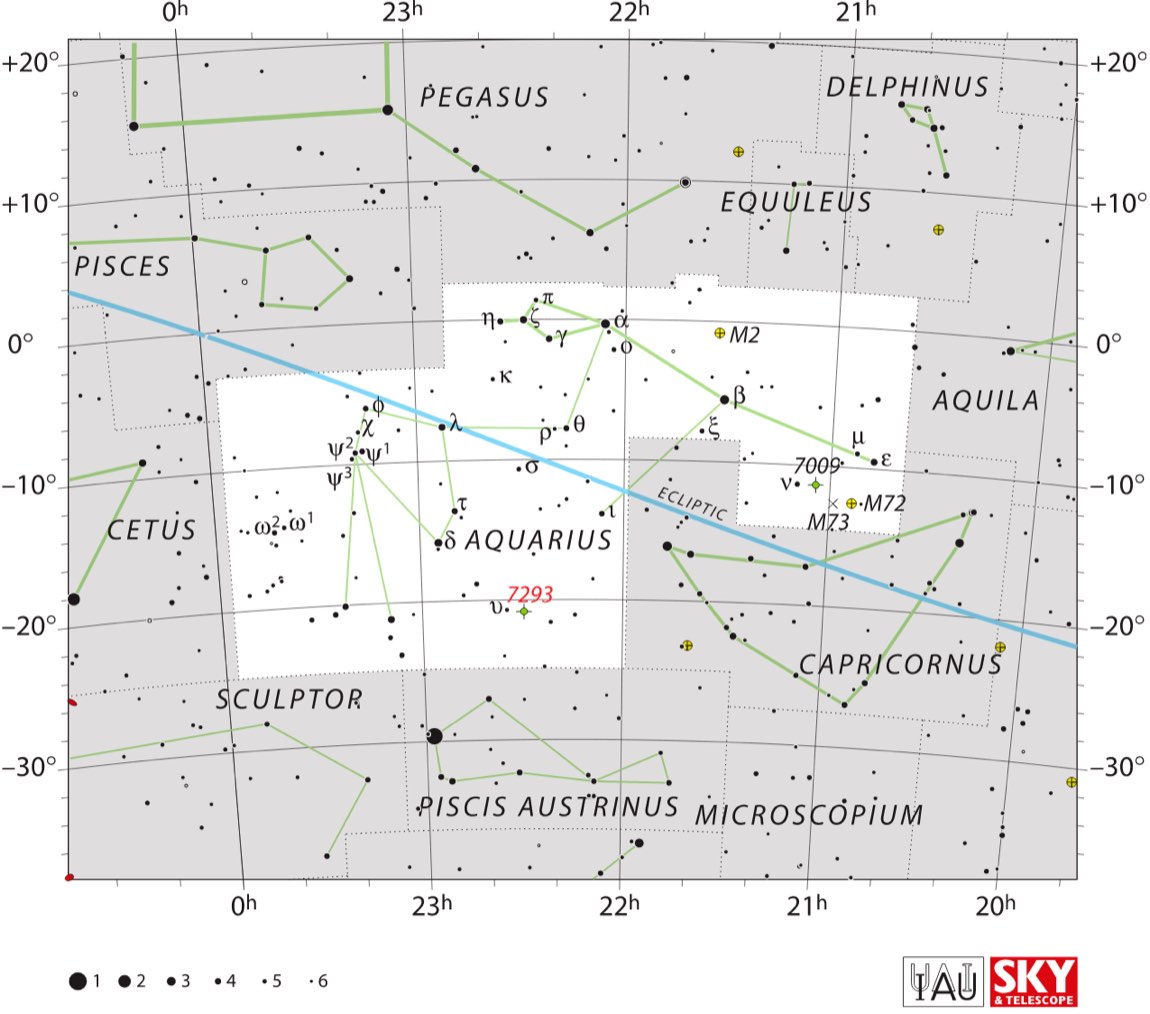
The Helix Nebula lies in the constellation Aquarius, and its proximity to Earth at around 650 light-years makes it one of the intrinsically brightest planetary nebulae in the sky by apparent size. Yet it is famously tricky for visual observers precisely because that large angular diameter — the outermost ring spanning roughly 25 arcminutes — spreads its light thinly across a wide area, giving it a low surface brightness. Binoculars can reveal it as a faint, ghostly patch under dark skies, but a telescope with a narrowband or oxygen-III filter dramatically improves contrast against the background sky glow. The central white dwarf, sitting at apparent magnitude 13.5, requires at least a moderate-sized amateur telescope to glimpse directly. The nebula is best placed for observation from the Southern Hemisphere and low northern latitudes, where Aquarius climbs higher in the sky. The Gaia satellite's precise distance measurement of 655 ± 13 light-years also means that the Helix Nebula serves as a useful calibration benchmark for astronomers measuring the distances of more remote planetary nebulae.
 ⤢
⤢