Moon · Deep guide · orbits Neptune
Naiad
Also called: Neptune III · S/1989 N 6
Neptune's innermost moon, which weaves above and below its neighbour Thalassa.
What is it?
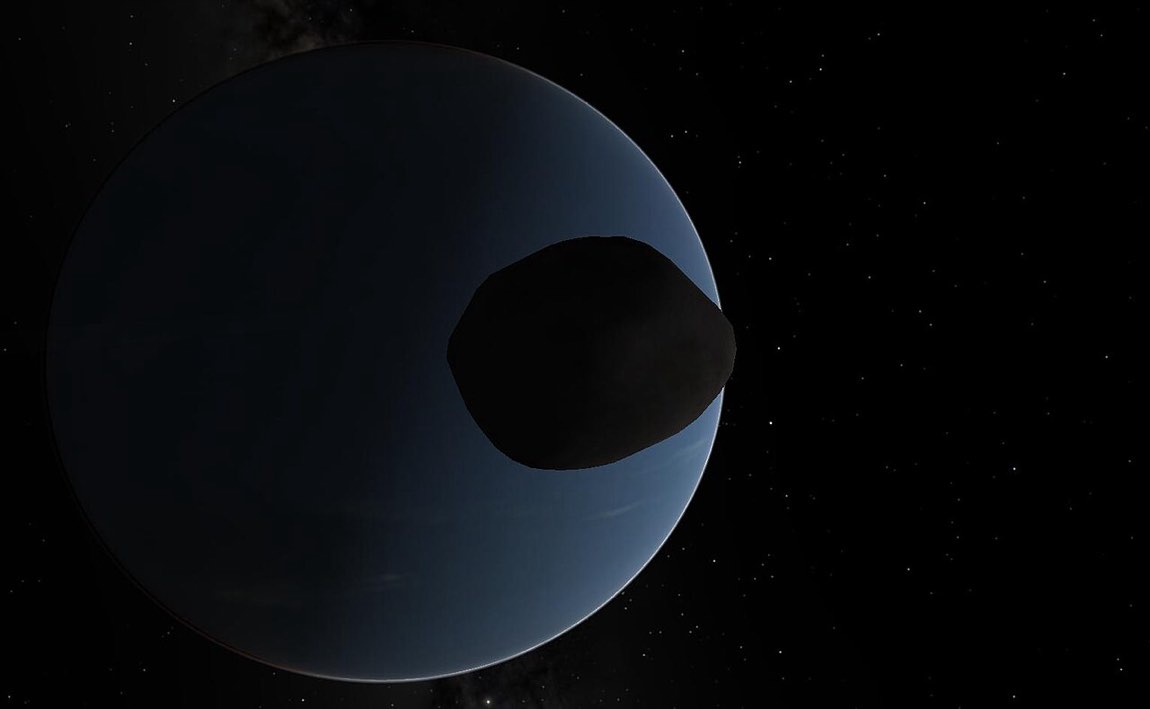
Naiad was discovered in Voyager 2 images in 1989 and is the closest known moon to Neptune, racing around it in about seven hours. It is an irregular body about 96 km long. Naiad's orbit is tilted by almost 5°, and it is locked in a 73:69 resonance with Thalassa: the two pass each other while Naiad is always well above or below, a 'dance of avoidance'. Lost for years after Voyager, it was finally found again in archived Hubble images in 2013.
The deep dive
Researched for the Atlas from Wikipedia — Naiad (moon) (2,712 characters read) · updated Nov 15, 2026
01 The innermost moon of any gas giant
Naiad holds a remarkable distinction: at just 48,224 km from Neptune's center, it is the nearest moon to the center of any gas giant in the solar system. To put that in perspective, Neptune itself has an equatorial radius of about 24,764 km, meaning Naiad skims just roughly 23,000 km above the cloud tops — closer than many artificial satellites orbit Earth relative to Earth's size. Its orbital period is shorter than a Neptunian day, which matters enormously for its long-term fate. When a moon orbits faster than its planet rotates, tidal forces act as a brake, gradually draining energy from the orbit. The result is an inexorable inward spiral. Eventually, Naiad will either plunge into Neptune's upper atmosphere or be torn apart by tidal stresses before it gets that far, scattering debris that could coalesce into a new ring around the planet. Neither outcome is imminent on human timescales, but the clock is running.
02 A rubble pile shaped by catastrophe
Naiad is irregularly shaped — not a smooth sphere, but a lumpy, battered body. Scientists think this form reflects a violent origin. The leading hypothesis is that Naiad is a rubble pile: a loose aggregate of fragments that re-accreted after Neptune's original inner satellites were shattered. The culprit was Triton, Neptune's large moon, which was not born in orbit around Neptune but was captured from elsewhere. When Triton was first caught by Neptune's gravity, it entered a highly eccentric initial orbit, swinging wildly inward and outward. The gravitational perturbations from that chaotic trajectory would have been devastating to any small moons already circling Neptune, smashing them to pieces. What we see today as Naiad — and likely the other small inner Neptunian moons — are the reassembled rubble from that ancient collision cascade, rebuilt from the wreckage Triton's capture left behind.
03 A cosmic dance of avoidance with Thalassa Deeper
Naiad and its outward neighbor Thalassa are locked in a 73:69 orbital resonance, meaning Naiad completes 73 orbits for every 69 Thalassa completes. Astronomers have described this as a "dance of avoidance." Although their orbital radii differ by only 1,850 km — a razor-thin gap in planetary terms — the two moons never come dangerously close. The key is Naiad's orbital inclination. As it circles Neptune, Naiad swings approximately 2,800 km above or below Thalassa's orbital plane at each closest approach, so the two moons pass each other at a safe distance of about 3,540 km rather than nearly colliding. This avoidance pattern repeats on a cycle of roughly 21.5 Earth days, during which Naiad passes Thalassa twice from above and then twice from below. What makes this resonance scientifically interesting is that it is maintained primarily by orbital inclination rather than eccentricity, which is unusual. Most well-known orbital resonances rely on eccentricity to separate bodies at conjunction.
04 How Voyager 2 found the last inner moon
Naiad was discovered from images taken by the Voyager 2 spacecraft during its historic 1989 Neptune flyby, making it the last moon to be found during that encounter. The discovery was formally announced on 29 September 1989 in IAU Circular No. 4867. The circular noted that the detection was based on 25 frames taken over 11 days, which implies the actual discovery occurred sometime before 18 September 1989. At the time of discovery, Naiad received the provisional designation S/1989 N 6. It would be nearly two more years before it got a permanent name: on 16 September 1991, it was officially named Naiad, after the naiads of Greek legend — freshwater nymphs associated with rivers, springs, and streams. The choice fit Neptune's watery theme, as many of the planet's moons carry names drawn from water deities and sea creatures in classical mythology.
05 Lost in space: the missing moon mystery
Even after its discovery, Naiad proved maddeningly difficult to track. In 2002 and 2003, the Keck telescope studied the Neptune system with adaptive optics powerful enough to detect the four largest inner satellites easily, and even managed to find the faint Thalassa with careful image processing. But Naiad was simply not there — it could not be located at all. This disappearance was alarming because it suggested that our predicted position for Naiad had drifted badly from reality, meaning its orbital ephemeris contained significant errors. The mystery persisted for over a decade. Then, on 8 October 2013, the SETI Institute announced that Naiad had finally been recovered — not through new observations, but by scouring archived images from the Hubble Space Telescope taken back in 2004. The suspicion about ephemeris errors proved fully justified: Naiad was found a stunning 80 degrees away from its expected position, an enormous discrepancy that underscores how poorly constrained the orbits of Neptune's small inner moons remain.
06 Hubble's role in keeping tabs on Naiad Deeper
The Hubble Space Telescope has become the primary tool for monitoring Naiad and Neptune's other small inner satellites in the decades since Voyager 2's departure. Hubble is capable of detecting all the known Neptunian satellites and can potentially reveal new ones even fainter than those Voyager 2 originally found, giving it a sensitivity advantage over ground-based facilities for this particular task. The Keck Observatory, despite its large aperture and adaptive optics system, could not recover Naiad in 2002–2003, while Hubble's archival data from 2004 ultimately provided the successful detection in 2013. This contrast highlights how the combination of Hubble's position above Earth's atmosphere and its precise imaging capability makes it uniquely suited for tracking dim, fast-moving objects close to a bright planet like Neptune. The 80-degree positional error that had hidden Naiad from searchers was only resolved once researchers knew which part of the archived imagery to examine more carefully.
07 An orbit destined to end dramatically
Because Naiad orbits Neptune faster than the planet itself rotates, it sits inside what is called the synchronous orbit radius — the distance at which orbital speed matches planetary rotation. Moons outside this boundary are gradually pushed outward by tidal forces; moons inside it, like Naiad, are gradually pulled inward. The mechanism is tidal dissipation: gravitational interactions between Naiad and Neptune's slightly non-spherical mass distribution transfer energy away from the orbit over time. The long-term outcome is binary: either Naiad spirals inward until it enters Neptune's atmosphere, or it crosses the Roche limit — the distance inside which tidal forces exceed the self-gravity holding a body together — and breaks apart. If it breaks apart, the debris could spread into a ring, adding to Neptune's already complex ring system. The article does not specify a timescale for this fate, reflecting genuine scientific uncertainty about the rate of tidal dissipation in Neptune's interior.
08 Open questions science has yet to answer Deeper
Despite decades of observation, Naiad remains poorly understood in fundamental ways. Its exact shape, mass, and density are not well constrained — no spacecraft has imaged it in detail since Voyager 2's brief flyby, and those images showed only an irregularly shaped blob. The rubble-pile interpretation is plausible given its probable formation history, but it has not been directly confirmed. The 80-degree positional error uncovered in 2013 reveals that Naiad's orbital model still needs refinement, raising questions about whether subtle perturbations from other moons or from Neptune's irregular gravity field are being properly accounted for. The exact rate of tidal orbital decay is also uncertain, depending on internal dissipation properties of Neptune that are not independently known. And while the 73:69 resonance with Thalassa is documented, the full story of how that resonance formed and how long it has been stable remains an active area of investigation.
09 The Greek name behind the moon
The name Naiad draws directly from Greek mythology. Naiads were a type of freshwater nymph — divine female spirits believed to inhabit and animate bodies of fresh water such as rivers, streams, springs, wells, and fountains. They were considered minor goddesses in the Greek pantheon, immortal but tied to their specific water source. The naming convention for Neptune's moons follows a consistent mythological theme: because Neptune is the Roman god of the sea, its satellites are named for figures associated with water and the sea in classical tradition. Naiads, though associated with fresh water rather than salt water, fit comfortably within this aquatic framework. The name was formally assigned on 16 September 1991, roughly two years after the moon's discovery, following the standard process by which the International Astronomical Union reviews and approves names for newly found solar system bodies. Prior to that date, the moon was known only by its provisional designation S/1989 N 6, and informally as Neptune III.
10 Why the resonance with Thalassa is unusual Deeper
Orbital resonances between moons are well known throughout the solar system — Jupiter's Galilean moons provide the textbook example — but the Naiad-Thalassa resonance is scientifically notable for a specific structural reason. In most resonances that stabilize two objects by maximizing their separation at conjunction, the separating mechanism involves eccentricity: one or both orbits are elliptical, ensuring that at the moment the bodies are aligned they are at different distances from their planet. The Naiad-Thalassa resonance works differently. The orbital eccentricities of these two moons are minimal, yet the resonance still keeps them safely apart. The key variable instead is orbital inclination: Naiad's orbit is tilted relative to Thalassa's, so at each close pass the two moons are separated vertically rather than radially. This inclination-driven avoidance mechanism in a low-eccentricity system is flagged in the scientific literature as unusual, suggesting that the dynamics of Neptune's inner moon system may have features not fully captured by models developed for other planetary systems.
 ⤢