Moon · Deep guide · orbits Saturn
Skathi
Also called: Saturn XXVII · Skadi · S/2000 S 8
A dim Norse-group moon named for a giantess of skiing and winter.
What is it?
Skathi is a retrograde irregular moon of Saturn, about 8 km across, in the Norse group. Brett Gladman's team found it in September 2000 at Mauna Kea, one of eight Saturn moons announced that December. It orbits about 15.5 million km out, taking just over 725 days per lap. Cassini saw it only as a faint point but estimated a rotation of about 11 hours. It is named after Skaði of Norse myth, part of an effort to move beyond Greek and Roman names.
The deep dive
Researched for the Atlas from Wikipedia — Skathi (moon) (7,777 characters read) · updated Nov 14, 2026
01 The night Skathi was found
Skathi was discovered on September 23, 2000, by a team of eight astronomers: Brett J. Gladman, JJ Kavelaars, Jean-Marc Petit, Hans Scholl, Matthew J. Holman, Brian G. Marsden, Phil Nicholson, and Joseph A. Burns. They worked with images captured by the Canada–France–Hawaii Telescope at the Mauna Kea Observatories in Hawaii. The discovery was not announced immediately — the team held their findings for nearly three months before going public on December 7, 2000, at which point they revealed not just Skathi but seven other Saturn satellites found in the same search: Tarvos, Ijiraq, Thrymr, Siarnaq, Mundilfari, Erriapus, and Suttungr. Announcing so many moons at once was a dramatic moment in planetary science, the product of a systematic survey effort rather than a lucky one-off observation. In the interim, Skathi carried the placeholder designation S/2000 S 8, a name that encoded everything the community officially knew about it: a satellite, found in 2000, orbiting Saturn, and the eighth such object identified that year.
02 A name chosen to break old habits
Most English names for planets trace back to Roman mythology, and scientists naming new satellites had long followed that convention. JJ Kavelaars wanted to push back against what historian Jürgen Blunck called astronomy's "Greco-Romano-Renaissance rut." Kavelaars specifically tried to choose names that were both multicultural and Canadian. For this moon he reached into Norse mythology, selecting Skaði — a giantess who traveled to Asgard to avenge the death of her father. The name was officially announced in 2003, initially spelled "Skadi," using the ordinary Latin letter d as a rough substitute for the Icelandic letter ð (eth). Two years later, in 2005, the IAU Working Group on Planetary System Nomenclature revised the spelling to "Skathi," using the digraph th as a closer transliteration of that Icelandic sound. Alongside its mythological name, the moon was assigned the permanent Roman numeral designation Saturn XXVII. Meanwhile, several of Saturn's other newly found moons received names from Inuit mythology — Ijiraq, Kiviuq, Paaliaq, Siarnaq, and Tarqeq — reflecting the same deliberate push toward broader cultural representation.
03 An orbit that runs against the grain
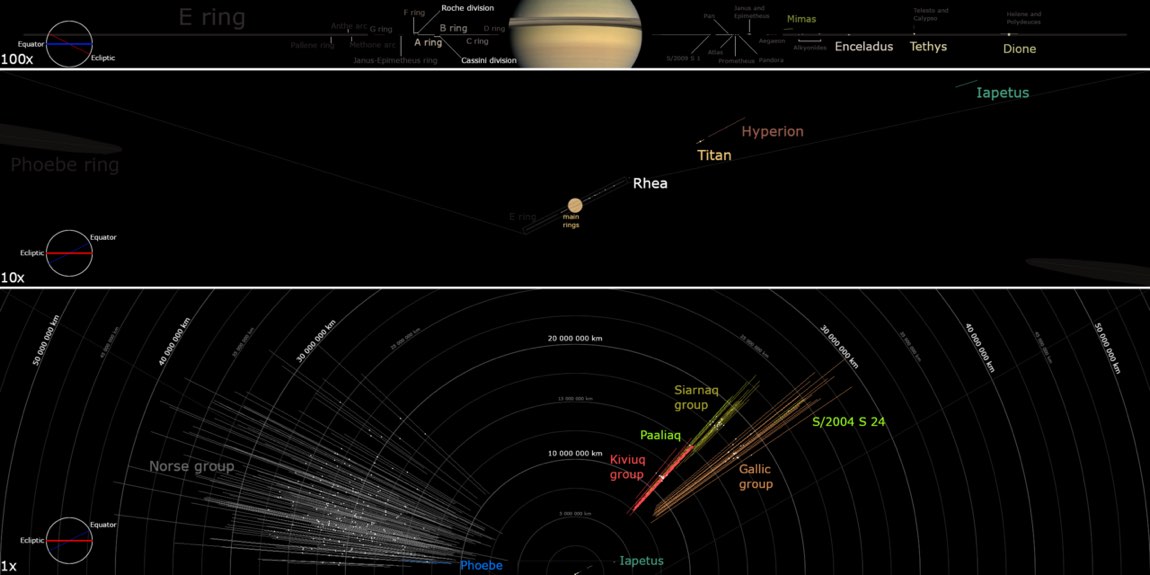
Skathi is a member of Saturn's Norse group, and every moon in that group shares the same defining quirk: a retrograde orbit, meaning it circles Saturn in the direction opposite to Saturn's own rotation. Skathi does this at an average distance of 15,576,000 kilometres from Saturn — far enough out that a single lap takes just over 725 days, slightly more than two Earth years. That is actually fast for an irregular satellite at such a remote distance; among Saturn's named retrograde moons, only Phoebe completes the journey more quickly. The orbit is also tilted steeply, sitting at 149° relative to the ecliptic and 150° relative to Saturn's equator, meaning it loops at a sharp angle compared to the flat plane on which most Solar System objects travel. On top of that, Skathi's orbital eccentricity is 0.246, making it noticeably elliptical — compare that to Earth's nearly circular orbit, which has an eccentricity of just 0.017. The combined effect of retrograde motion, steep inclination, and high eccentricity is what classifies Skathi as an "irregular" satellite.
04 How fast does Skathi spin? Deeper
Early observations could only pin down Skathi's rotation period to somewhere between 11 and 12 hours. The more precise answer came from the Cassini spacecraft, which observed Skathi on eight separate occasions between March 2011 and August 2016. Even so, those observations were conducted from a distance of nearly 9.7 million kilometres — roughly 25 times the distance from Earth to the Moon — which left Skathi as little more than a dim point of light in Cassini's detectors. By measuring how the brightness of that point fluctuated over time as the moon turned, scientists extracted a rotation period of 11.10 ± 0.02 hours as of 2019. That small uncertainty range, plus or minus just 0.02 hours, reflects how carefully the Cassini team analyzed their limited data. The same brightness variations that enabled this measurement also revealed that Skathi is not a sphere — its light curve changes substantially as it rotates, which is the signature of an irregularly shaped body presenting different surface areas toward the observer at different points in its spin.
05 A tiny, dim, oddly shaped world
Skathi is small by any measure — Cassini observations suggest a diameter of about 8 kilometres, roughly the distance across a mid-sized city. Despite orbiting one of the most visually spectacular planets in the Solar System, Skathi is extraordinarily faint: it has an apparent optical magnitude of 23.6 as seen from Earth, and an absolute visual magnitude of about 14, far dimmer than hundreds of thousands of objects outside the Solar System that telescopes can detect more easily. Part of the reason is its assumed surface albedo of about 0.06, meaning it reflects only about 6 percent of the sunlight that hits it — a dark, unreflective surface similar to charcoal. The moon's spectral slope, measured at +5.2 percent per 100 nanometres, indicates a reddish surface coloring. Interestingly, that reddish quality is shared by two moons in a completely different group — the Gallic group members Erriapus and Tarvos — raising questions about whether surface color alone can tell us anything reliable about family relationships among Saturn's irregular satellites.
06 What Skathi might be made of Deeper
Many of Saturn's well-known moons are rich in water ice mixed with rock, but Skathi's chemical composition remains entirely undetermined. No spacecraft has passed close enough to gather spectroscopic data with sufficient resolution to identify surface minerals or ices. What scientists do have are indirect inferences. Saturnian irregular satellites as a class are generally thought to have low densities — typically below 1 gram per cubic centimetre, which is less dense than water — and this is believed to characterize most of these objects. Skathi's density is not known individually, but it likely falls somewhere in that range. The uncertainty about composition is deepened by uncertainty about origin: if Skathi formed somewhere far from Saturn and was later captured, it may never have shared the same chemical environment as Saturn's inner moons and could have a meaningfully different makeup. The moon's small size and dark surface make remote compositional analysis exceptionally difficult, and no dedicated close flyby has been planned.
07 Captured wanderer or shattered fragment?
The question of where Skathi came from is genuinely open, and scientists have debated two main possibilities. The first is gravitational capture: Skathi may have originally been an asteroid or small body that formed elsewhere in the Solar System, traveled through space, and was captured by Saturn's gravity during a close encounter. The second is collisional fragmentation: Skathi could be a piece of one of Saturn's larger moons — Phoebe is specifically mentioned as a candidate — that was broken off during a violent collision with another object and then settled into an independent orbit. The chaotic, elliptical, and steeply inclined nature of its orbit fits poorly with the standard picture of moon formation, in which objects accumulate from a protoplanetary disk and end up in fairly circular, prograde paths near the disk's plane. Crucially, the article notes that highly irregular orbits produced by collisions tend not to be stable over very long timescales, which adds complexity to the fragmentation hypothesis. Neither scenario is confirmed.
08 Why irregular orbits need explaining Deeper
Understanding why Skathi's orbit looks so unusual requires a quick picture of how planetary systems normally form. In the standard model, a disk of gas and dust — the protoplanetary disk — surrounds a young star, and objects within any given region of that disk move in broadly similar directions and at broadly similar speeds. When those objects gradually clump together to form moons, the resulting body inherits the disk's orderly motion: a roughly circular orbit, moving in the prograde direction, sitting close to the disk's plane. Skathi violates all three of those expectations simultaneously. Its orbit is retrograde, steeply tilted at 149° from the ecliptic, and markedly elliptical with an eccentricity of 0.246. The active scientific debate prompted by Skathi and Saturn's other irregular satellites centers on which violent or exotic process — capture from elsewhere, or a shattering collision — can produce orbits this irregular while also being consistent with what we know about orbital stability over the age of the Solar System.
09 Skathi's place among Saturn's outer moons
Skathi belongs to Saturn's Norse group, a collection of retrograde irregular satellites that share broadly similar orbital properties. Within that group Skathi stands out for the relative speed of its orbit: at just over 725 days per revolution, it completes circuits of Saturn faster than any other named retrograde moon except Phoebe. Phoebe, the most famous of Saturn's irregular moons, is far larger and was visited up close by Cassini, making Skathi a much less studied neighbor. The comparison with Phoebe is scientifically interesting because one hypothesis for Skathi's origin is that it was once physically part of Phoebe before a collision split the two apart. The fact that both moons are retrograde and occupy the same general orbital region of Saturn's system is consistent with that idea, but does not confirm it. With a diameter of only about 8 kilometres, Skathi is a minor body even by irregular-moon standards, and its small size is part of what makes definitive answers about its history so difficult to obtain.
10 The limits of what we actually know Deeper
Even with Cassini's eight observational passes between March 2011 and August 2016, Skathi remains poorly characterized. Every one of those observations was conducted from a distance of nearly 9.7 million kilometres, so the probe never resolved Skathi into anything more than a point of light. This means that all physical inferences — the roughly 8-kilometre diameter, the irregular shape implied by the varying light curve, the reddish spectral slope of +5.2 percent per 100 nanometres — are derived indirectly from photometry rather than direct imaging. The moon's density is unknown, its surface geology is entirely unobserved, and its chemical composition is unconfirmed. Its rotation period of 11.10 ± 0.02 hours is the most precisely measured of its properties. Meanwhile, its origin, whether capture or fragmentation, remains an active debate. Skathi is a reminder that even a spacecraft as capable as Cassini, one of the most successful planetary probes ever flown, could only scratch the surface of Saturn's complex retinue of small outer moons from the distances involved.
 ⤢