Moon · Deep guide · orbits Saturn
Mundilfari
Also called: Saturn XXV · S/2000 S 9
The bluest of Saturn's measured irregular moons, and a fast spinner.
What is it?
Mundilfari is a retrograde irregular moon of Saturn, about 7 km across, discovered by Gladman and colleagues in 2000. It orbits about 18.6 million km out, taking about 953 days per lap. It may be debris knocked off Phoebe, though its orbit differs enough to make that hard to reconcile. It is unusually blue — bluer even than Phoebe — and spins in about 6.7 hours.
The deep dive
Researched for the Atlas from Wikipedia — Mundilfari (moon) (1,306 characters read) · updated Nov 14, 2026
01 A Moon That Spins Remarkably Fast
Among the dozens of irregular moons that the Cassini–Huygens mission studied, Mundilfari stands out for how quickly it rotates. Its measured rotation period is just 6.74 ± 0.08 hours — meaning this roughly 7-kilometer chunk of rock completes a full spin in less time than a typical human workday. Only one other irregular moon in the Cassini–Huygens study rotates faster: Hati, which nudged ahead to claim the top spot. That is a striking finding, because small irregular moons are generally expected to have been battered and tumbled by collisions over billions of years, and many end up spinning slowly or chaotically. Mundilfari's brisk rotation hints that something about its history — perhaps the specific geometry of a past impact, or its internal structure — has kept it spinning with unusual vigor. The uncertainty on that figure, just ±0.08 hours, shows the measurement is fairly precise, making Mundilfari's second-place ranking among fast-spinning irregulars a well-supported observational result rather than a tentative guess.
02 The Bluest Moon in Its Neighborhood Deeper
Color in planetary science is measured through spectral slope — how steeply an object's brightness changes across different wavelengths of light. A negative spectral slope means the object reflects more blue light relative to red, while a positive slope means the reverse. Mundilfari's spectral slope was measured at −5.0%/100 nm by Grav and Bauer in 2007, making it the bluest of all the moons included in their study. For comparison, Phoebe — the large and well-known irregular moon of Saturn — has a spectral slope of −2.5%/100 nm, so Mundilfari is noticeably bluer even than Phoebe. On the opposite end, Erriapus shows a slope of +5.1%/100 nm, placing it toward the red end of the spectrum by roughly the same degree that Mundilfari sits toward the blue end. What drives such an unusually blue surface is not definitively explained in current research. Surface composition, the age of exposed material, and the history of space weathering all likely play roles, and Mundilfari's striking color makes it a particularly interesting data point in understanding how irregular moons evolve.
03 An Orbit That Goes the Wrong Way
Mundilfari travels around Saturn in a retrograde direction — that is, opposite to the direction Saturn itself orbits the Sun and opposite to the direction most of Saturn's regular inner moons travel. Its orbital inclination of 168.4° to the ecliptic is what defines this retrograde motion: inclinations above 90° signal an orbit running backward relative to the dominant sense of rotation in the Solar System. Beyond going the wrong way, Mundilfari's orbit is also noticeably elongated, with an averaged eccentricity of 0.210. At its average distance of 18,590.3 Mm from Saturn — roughly 18.6 million kilometers — that eccentricity means its actual distance from Saturn swings considerably between closest and farthest approach over each orbital cycle. One full trip around Saturn takes 952.95 days, nearly two and two-thirds Earth years. This combination of retrograde motion, high inclination, and significant eccentricity is the hallmark of an irregular moon: an object almost certainly captured or produced by collisions rather than formed neatly in place alongside its planet.
04 Shaped More Like a Potato Than a Sphere
Mundilfari is described as very elongated in shape — meaning that if you could see it up close, it would look far more like a stretched or lumpy potato than anything approaching a ball. At only about 7 kilometers in diameter, it is far too small for gravity to have pulled it into a round shape. The threshold for self-gravity to enforce spherical form generally requires bodies hundreds of kilometers across, so small moons and asteroids are almost always irregular in shape. Mundilfari's elongation is notable enough to be specifically flagged in observations, suggesting its long axis is meaningfully longer than its short axis rather than being just slightly oblong. This shape is consistent with an origin as a fragment broken off during a large collision — sharp impacts tend to produce irregularly shaped debris rather than neat spheres. The moon's fast rotation combined with its elongated form also raises interesting questions about its structural integrity, since a rapidly spinning elongated body must be held together firmly enough to avoid flying apart under centrifugal stress.
05 Head of a Family: The Mundilfari Subgroup Deeper
Mundilfari is not just a lone irregular moon — it is classified as the largest remaining fragment of an entire subgroup of small retrograde irregular moons that bears its name: the Mundilfari group. This subgroup itself belongs to the larger Norse group, the broad family of retrograde irregular moons orbiting Saturn that share broadly similar orbital characteristics. The existence of a named subgroup implies that several of these small moons are thought to share a common origin, most likely as debris produced when a larger precursor body was shattered by an ancient impact. As the biggest surviving piece, Mundilfari effectively gives the family its identity. The Norse group as a whole is one of the main dynamical families among Saturn's irregular satellites, and studying how its subgroups relate to one another helps astronomers reconstruct the collision history of the outer Saturn system. Mundilfari's status as the subgroup's largest fragment makes its physical properties — its color, shape, rotation, and composition — especially important as a reference point for understanding the smaller members of the family.
06 Did Phoebe Give Birth to Mundilfari?
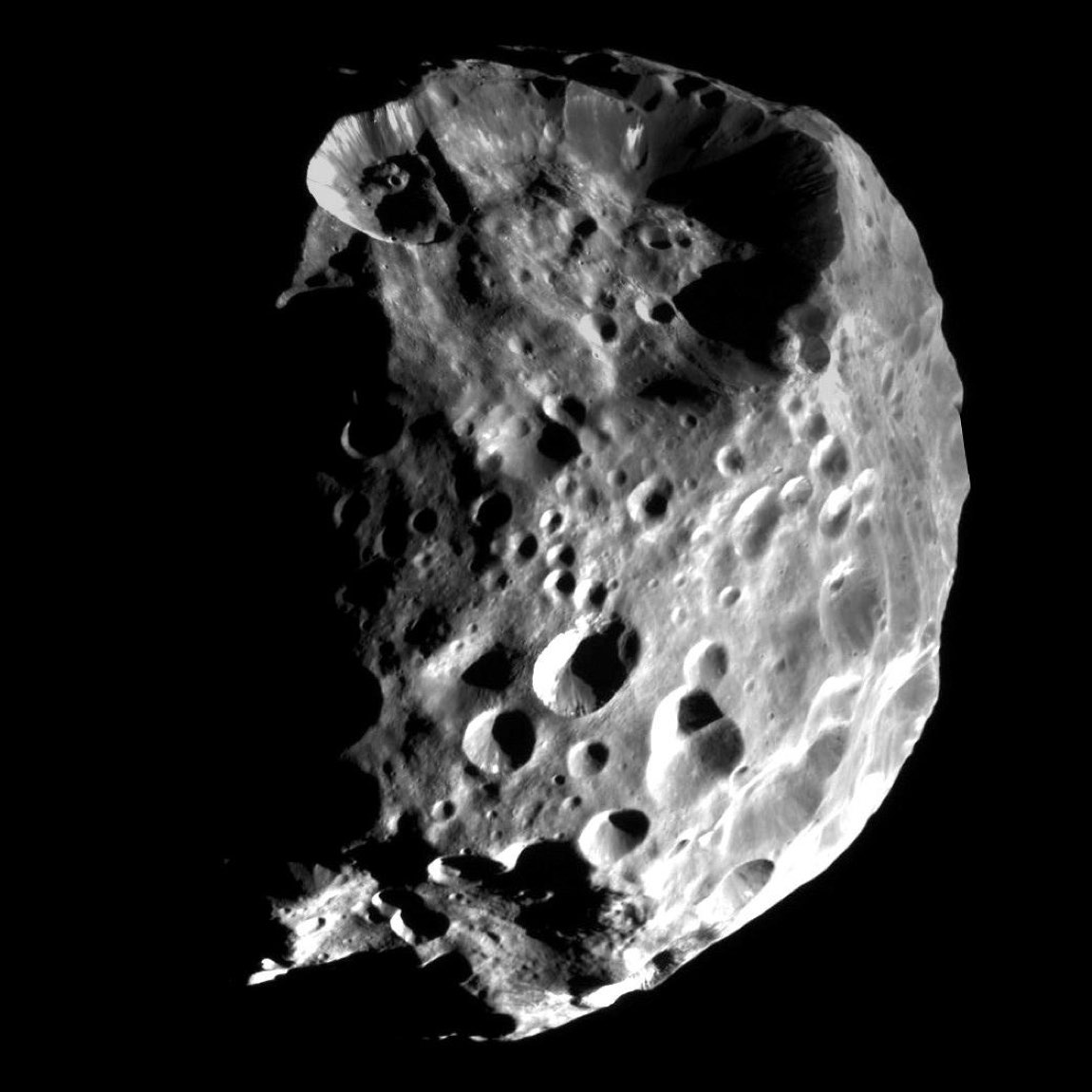
One hypothesis about Mundilfari's origin points to Phoebe, Saturn's largest irregular moon, as a possible parent body. The idea is that large impacts striking Phoebe at some point in Solar System history could have blasted debris into space, and some of that debris eventually settled into orbits that became today's smaller irregular moons. Mundilfari's unusually blue spectral color is actually slightly more extreme than Phoebe's own blue tint, which is at least consistent with both objects sharing similar surface materials. However, the article is careful to note that Mundilfari's orbit is sufficiently different from Phoebe's that reconciling a direct Phoebe-origin story is difficult. Orbits evolve over billions of years under gravitational perturbations, so the difference does not rule out the connection entirely, but it does mean the link remains uncertain rather than established. This unresolved question is part of a broader challenge in planetary science: tracing the genealogy of small irregular moons whose orbits have been nudged and shifted across billions of years of Solar System history.
07 Discovery at the Turn of the Millennium
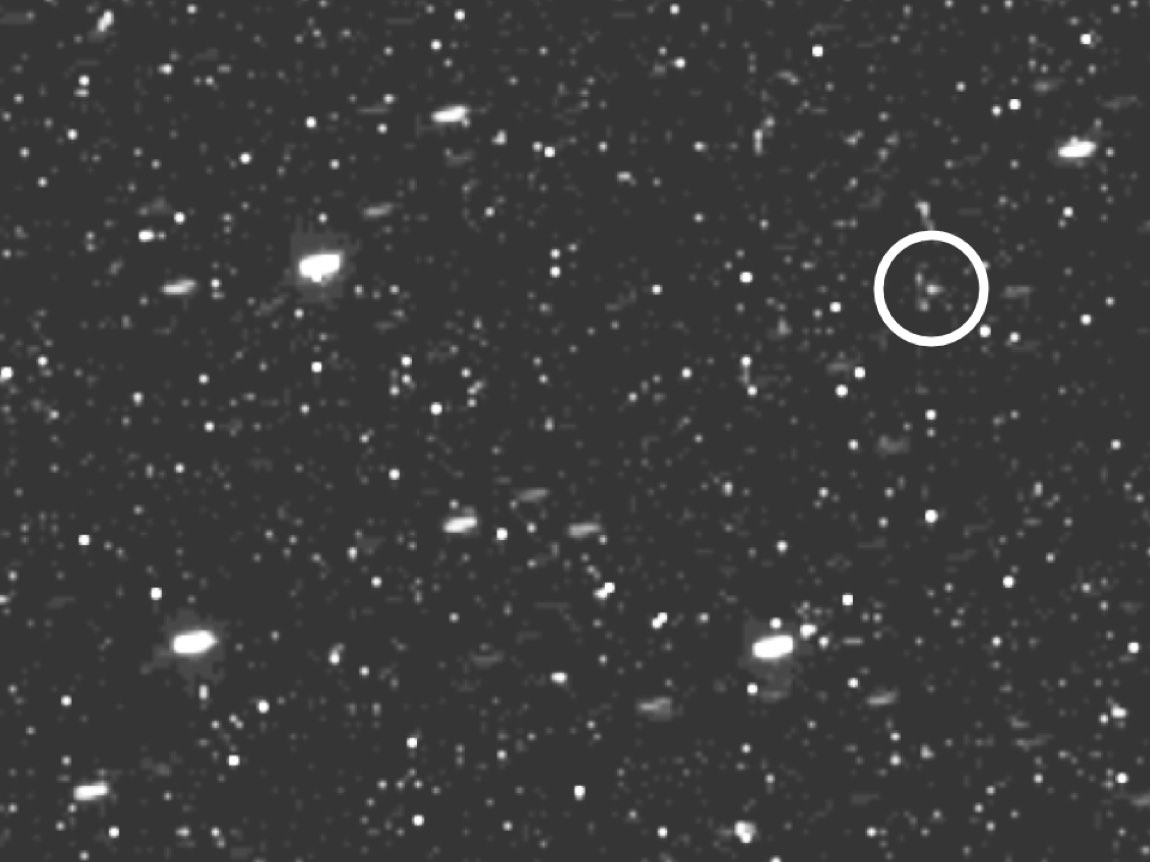
Mundilfari was discovered in the year 2000 by Brett J. Gladman and colleagues, part of a wave of outer Solar System discoveries made possible by increasingly powerful digital imaging surveys. When first found, it received the provisional designation S/2000 S 9, following the standard International Astronomical Union convention for newly spotted Saturn satellites — the S/2000 marks the year of discovery, the first S identifies Saturn as the host planet, and the number 9 indicates it was the ninth such candidate reported that year. It was not until August 2003 that the moon received its official name, Mundilfari, and its catalog number, Saturn XXV. The gap between discovery and naming is typical: the IAU requires that an orbit be confirmed and well-characterized before a permanent name is assigned. Gladman's team was responsible for identifying numerous irregular moons of Saturn and the other outer planets during this period, dramatically expanding the known population of these distant, captured objects in a relatively short span of time.
08 A Name Rooted in Norse Mythology
The name Mundilfari comes from Norse mythology, and its choice for this moon follows a consistent naming convention: Saturn's retrograde irregular moons in the Norse group are all named after figures from Norse myth. In the original mythology, Mundilfari is the father of two radiant children — Sól, the goddess of the Sun, and Máni, the god of the Moon. The name was assigned in August 2003 by the International Astronomical Union. The mythological Mundilfari was said to have named his children so presumptuously after the celestial bodies that the gods, offended by his arrogance, took Sól and Máni away and set them to drive the chariots of the Sun and Moon across the sky. This backstory gives the name a certain irony: a figure whose connection to the Sun and Moon was punished now lends his name to a tiny, dark, cold body in the extreme outer reaches of the Saturn system — about as far from the warmth of the Sun as one can get while still orbiting Saturn.
09 How Its Orbit Was Pinned Down Deeper
The orbital parameters reported for Mundilfari represent averaged values, an important distinction for a moon with significant eccentricity. Its averaged eccentricity of 0.210 means the orbit is not simply a fixed ellipse but one whose shape wobbles slightly over time due to gravitational perturbations from the Sun and other bodies — a phenomenon particularly pronounced for distant irregular moons. The reported average distance of 18,590.3 Mm and orbital period of 952.95 days similarly represent mean values rather than momentary snapshots. Pinning down these parameters requires tracking the moon across many observations spread over months or years, then fitting a dynamical model to the resulting arc of positions. For newly discovered irregular moons, the initial designation is provisional precisely because the orbital solution is not yet stable enough for confident long-term prediction. By the time Mundilfari received its permanent designation as Saturn XXV, its orbit had been characterized well enough to give the values reported today, though ongoing observations continue to refine the picture for all of Saturn's irregular satellites.
10 What Cassini–Huygens Revealed About It Deeper
Although Mundilfari was discovered from Earth-based telescopes, much of what is known about its physical properties — rotation period, shape, and color — came from observations associated with the Cassini–Huygens mission at Saturn. The mission, operated jointly by NASA and ESA, spent over a decade in the Saturn system and was able to monitor many of the planet's irregular moons with far greater sensitivity and over far longer baselines than ground-based telescopes typically allow. Grav and Bauer's 2007 study, which established Mundilfari as the bluest moon in their sample and confirmed its fast rotation of 6.74 ± 0.08 hours, used Cassini data. The determination that Mundilfari is the second-fastest rotator among the studied irregular moons, behind only Hati, also emerged from this body of Cassini-era research. Cassini's long mission duration was essential: measuring a rotation period requires catching multiple brightness cycles of a faint, distant body, something that demands many observations over time. The mission thus transformed Mundilfari from a mere dot with an orbit into an object with measurable physical characteristics, even if many questions remain open.
11 Open Questions That Remain Unanswered Deeper
Despite the data gathered so far, significant uncertainties surround Mundilfari. The question of whether it truly originated from Phoebe-impact debris remains unresolved — the orbital mismatch is a genuine obstacle to that hypothesis, yet no alternative origin story has been confirmed either. The exact shape of Mundilfari, known only to be very elongated, has not been modeled in three dimensions with high confidence given how small and distant it is. The reason for its unusually blue spectral slope — the most extreme in the Grav and Bauer study — is not explained by current data alone; it could reflect surface composition, the degree of space weathering, or some effect of the collision that created it, but distinguishing among these possibilities would require spectroscopic observations at higher resolution than currently available. The internal structure of such a small, fast-rotating, elongated body is also unknown — whether it is a solid fragment or a loosely bound rubble pile has real implications for its long-term stability, but cannot be determined without closer investigation. Future missions targeting Saturn's irregular moon population could address several of these questions directly.