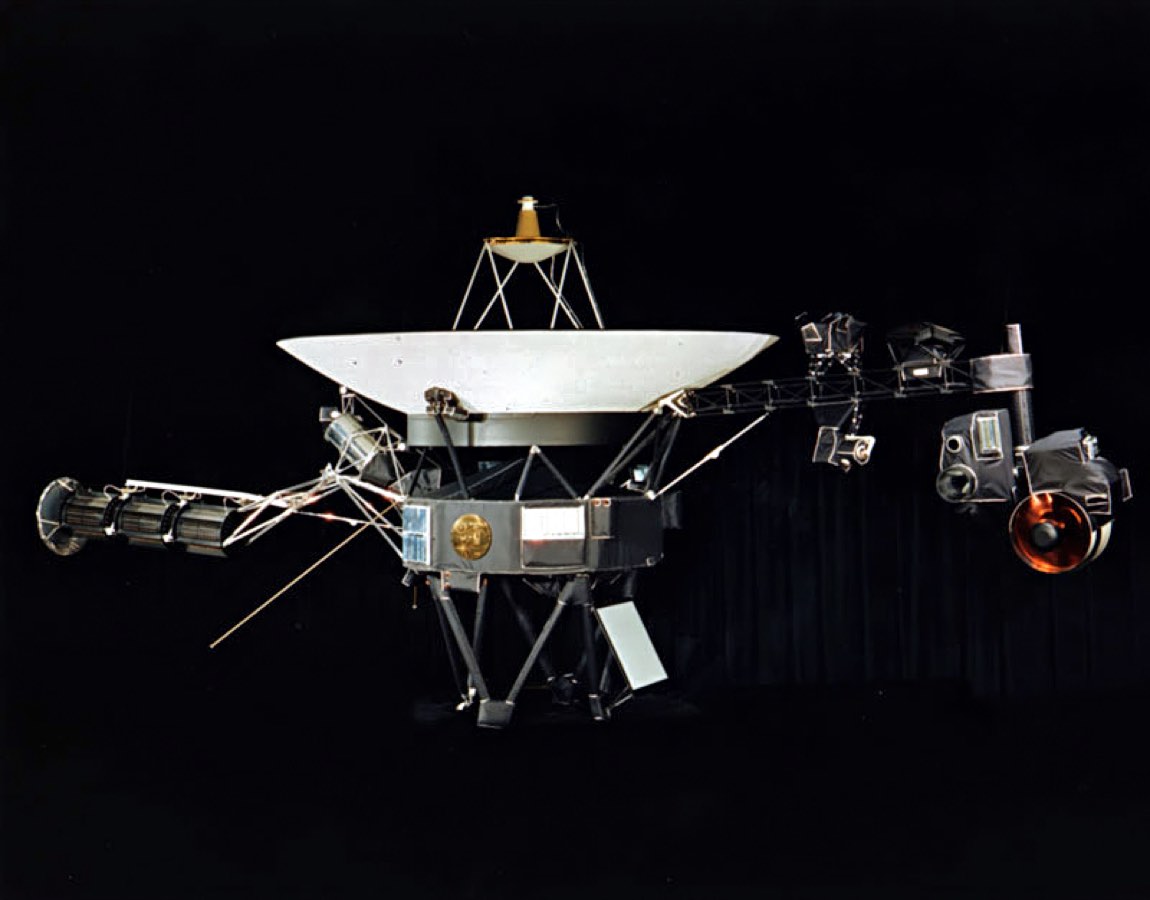
 Photograph · Voyager 2, NASA · Public domain
Moon · Deep guide · orbits Neptune
Proteus
Neptune's lumpy dark moon, as big as a world can be without turning round.
What is it?
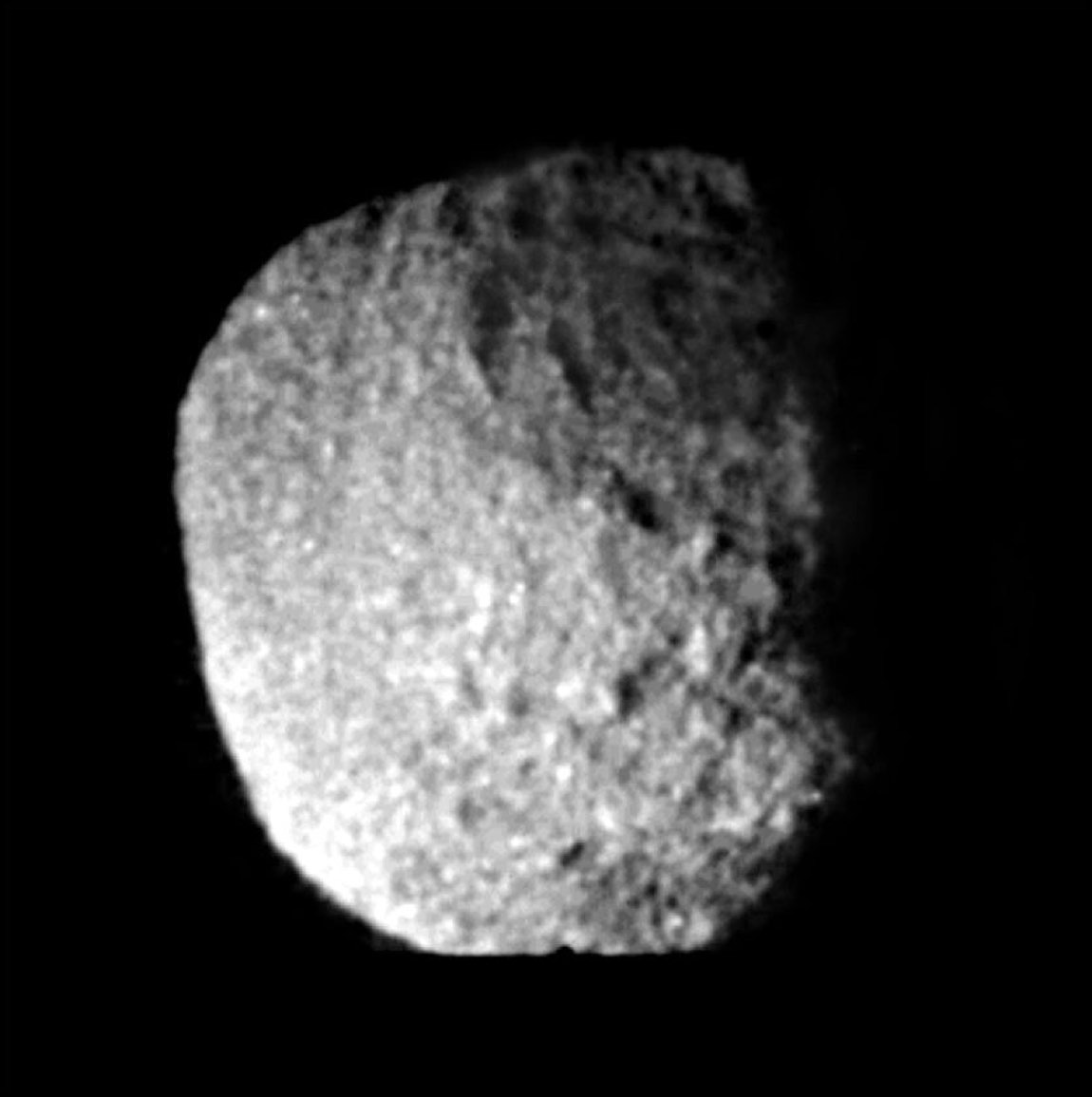
Proteus, about 420 km across, is Neptune's second-largest moon and one of the darkest objects in the Solar System, reflecting only 6% of sunlight. It sits near the theoretical size limit where gravity forces a body into a sphere — and it just barely refused, remaining a boxy lump. Voyager 2 discovered it in 1989; it likely re-formed from debris after Triton's violent capture.
The deep dive
Researched for the Atlas from Wikipedia — Proteus (moon) (6,817 characters read) · updated Sep 20, 2026
01 How Voyager 2 Stumbled Upon Proteus
Proteus was hidden in plain sight for decades. Because it orbits only about 117,647 km (73,102 mi) from Neptune — so close that Neptune's own glare drowns it out — no Earth-based telescope had ever spotted it. It took a spacecraft passing through the neighborhood to reveal it. Voyager 2 picked up Proteus in images taken roughly two months before its closest flyby of Neptune in 1989, and the discovery was announced on July 7, 1989, by Stephen P. Synnott and Bradford A. Smith. They reported that the moon had been identified in 17 frames taken over 21 days, placing the actual detection sometime before June 16. The moon was given the unglamorous provisional designation S/1989 N 1 before receiving its mythological name two years later. Its discovery came a full 40 years after Nereid, Neptune's next-previously-found moon, had been spotted in 1949 — a stark reminder of how much the outer solar system concealed until the Space Age.
02 A Name Borrowed From a Shape-Shifter
On September 16, 1991, S/1989 N 1 was officially christened Proteus, after the shape-shifting sea god of Greek mythology. The choice was deliberate and fitting on two levels. First, it follows the established convention of naming Neptune's moons after sea deities and mythological sea creatures, keeping the whole Neptunian system thematically anchored to the ocean. Second, Proteus the god was famous for refusing to hold a fixed form — and the moon itself stubbornly refuses to settle into a tidy geometric shape, resembling an irregular polyhedron rather than a smooth sphere. The name also threads through to the moon's one officially named surface feature: the giant crater Pharos takes its name from the Lighthouse of Alexandria, a landmark mythologically associated with Proteus himself. Craters on Proteus are formally assigned names from water-related spirits, gods, and goddesses, but figures from Greek and Roman mythology are deliberately excluded from that pool to avoid redundancy with other solar system naming schemes.
03 An Orbit Almost Too Orderly to Be Real
Proteus moves around Neptune in a nearly perfect circle. Its orbital eccentricity is just 0.00047 — vanishingly small — and its orbit tilts by only about 0.04 degrees from Neptune's equatorial plane, making it one of the flattest, most nearly circular orbits among the planet's moons. It completes one full trip around Neptune every 1.1 days. Like our own Moon relative to Earth, Proteus is tidally locked: the same hemisphere perpetually faces Neptune, and the moon rotates exactly once per orbit. Despite this regularity, the history of Proteus's orbit is anything but simple. Tidal interactions with Neptune have gradually pushed the moon outward over billions of years — estimates suggest it originally sat about 8,000 km (5,000 mi) closer to the planet than it does today. That slow outward drift apparently once carried it through a 1:2 orbital resonance with the inner moon Larissa, where Proteus completed one orbit for every two made by Larissa. That resonance was eventually broken, likely several hundred million years ago.
04 A Body Just Barely Holding Its Own Shape Deeper
Proteus sits at a fascinating physical threshold. With a mean radius of about 210 km (130 mi), it is thought to be close to the maximum size a body of its density can reach without gravity pulling it into hydrostatic equilibrium — the state in which an object rounds itself into a sphere or ellipsoid. Just a bit larger and it would have reshaped itself; just a bit smaller and the question would not arise. Instead, Proteus exists in an in-between zone, approximately spherical but deviating from a true sphere by as much as 20 km (12 mi). Its overall shape is better described as an irregular polyhedron, with several flat or slightly concave facets ranging from 150 to 200 km (93 to 124 mi) across. These facets are not thought to be primordial; researchers believe they are the degraded remnants of ancient large impact craters whose rims have been worn down and filled over time. The moon is also slightly elongated in the direction of Neptune, a tidal stretching effect common among close-orbiting satellites.
05 Pharos: A Crater Nearly as Wide as the Moon
The most dramatic feature on Proteus is Pharos, a crater so enormous it strains credibility. Measured precisely, it is 255 ± 12 km across and roughly 10 to 15 km (6.2 to 9.3 mi) deep — nearly as wide as the moon's own mean radius of about 210 km. For comparison, that depth is comparable to stacking two Mount Everests on top of each other. At the crater's floor rises a central dome several kilometers high, a classic feature of large complex impact craters formed when rebounding rock pushes upward after the initial shock. Pharos is currently the only officially named surface feature on Proteus. The name links to the Lighthouse of Alexandria, one of the Seven Wonders of the ancient world, which mythology connects to Proteus the sea god. Beyond Pharos, the surface hosts several craters in the 50 to 100 km (31 to 62 mi) range and many smaller ones under 50 km (31 mi) in diameter. The entire surface shows no evidence of significant geological resurfacing, meaning the cratering record is ancient and largely unaltered.
06 Cliffs, Grooves, and a Battered Landscape
Proteus is not just pitted with craters — its surface is also cut by linear features including cliffs, valleys, and grooves. The most prominent of these runs to the west of Pharos and traces a path roughly parallel to the equator. Scientists have proposed two main explanations for these linear structures. One is that they are directly linked to the massive impacts that produced Pharos and the other large craters, essentially fracture patterns radiating from catastrophic collisions. The other is that tidal stresses from Neptune's gravitational pull have stretched and cracked the surface over geological time. Both processes may have contributed. The overall picture is of a body that has absorbed enormous punishment — large enough to survive major impacts without being shattered, but too small and geologically cold to resurface or heal itself afterward. The surface relief reaches up to 20 km (12 mi) in places, giving Proteus a rugged, battered character quite unlike the smoother small moons found elsewhere in the solar system.
 ⤢
⤢
07 What the Surface Is Actually Made Of Deeper
Proteus is dark, reflecting only about 10 percent of the sunlight that hits it — roughly as dark as fresh asphalt. Its color is nearly neutral across visible wavelengths, meaning it does not strongly favor any particular color of light. In the near-infrared, however, around wavelengths of 2 μm, the reflectivity drops noticeably, a signature that researchers interpret as pointing toward complex organic compounds such as hydrocarbons or cyanides. These materials are thought to contribute to the generally low albedo of Neptune's inner moons as a group. Broader infrared measurements at 1.4, 2.1, 3.0, and 4.6 μm place Proteus in company with other dark small bodies in the solar system, including the Kuiper Belt object 2004 EW95. Spectroscopic observations also reveal hydrated minerals and possibly ammonia-bearing materials, along with weak carbon dioxide absorption that is slightly stronger on the trailing hemisphere. Proteus appears notably poor in phyllosilicates compared to Larissa, Galatea, and Neptune's rings — possibly because impacts have dehydrated those minerals, or because Proteus formed from compositionally different source material. There is also a subtle brightness asymmetry: the leading hemisphere is about 0.1 magnitude brighter than the trailing one.
08 Born From Triton's Violent Arrival Deeper
Proteus almost certainly did not form the way most inner moons do — by quietly accreting from the disk of gas and dust that surrounded Neptune in its youth. Instead, its origin is tied to one of the most disruptive events in the outer solar system: the capture of Triton. When Triton was captured by Neptune, it entered a highly eccentric orbit that would have gravitationally ransacked Neptune's original inner satellite system, triggering collisions that ground those early moons into a debris disk. Once Triton's orbit eventually circularized and the violence settled, material from that disk re-accreted to form the inner moons we see today — including Proteus. This also explains why Proteus probably began its life orbiting about 8,000 km (5,000 mi) closer to Neptune than its current position; tidal migration carried it outward over time. Impacts during that migration likely sculpted its largest craters and flung debris into nearby orbits. One such impact event has even been proposed as the origin of Hippocamp, a tiny moon that orbits close to Proteus — essentially a chip knocked off Proteus by a major collision.
09 Proteus and the Making of Hippocamp
Neptune's moon Hippocamp is one of the smallest known moons in the solar system, and its very existence may be a direct consequence of Proteus's violent past. Hippocamp orbits close to Proteus, and researchers have proposed that it originated as debris ejected during a major impact onto Proteus. The idea is straightforward: as Proteus migrated outward through tidal interactions with Neptune over billions of years, it encountered a period of intense bombardment. One or more of those collisions was energetic enough to blast fragments free from Proteus's gravity, and some of that material coalesced into what we now call Hippocamp. This would make Hippocamp not a moon that formed independently from a primordial disk, but rather a secondary body — a moon of a moon's making, in a sense. The scenario fits the broader picture of Neptune's inner moon system as a second-generation family, rebuilt from the wreckage of Triton's capture rather than inherited cleanly from the planet's formation.
10 Why Proteus Stayed Hidden for So Long
For most of the history of telescopic astronomy, Proteus was simply invisible. Neptune itself was discovered in 1846, and its largest moon Triton was found just 17 days later. But Proteus, despite being Neptune's second-largest moon and larger than Nereid, eluded detection for 143 years after Neptune's discovery. The reason is geometry and brightness: Proteus orbits only about 4.75 Neptune radii from the planet's center, placing it well within the halo of light scattered by Neptune in any ground-based image. Its own geometric albedo of just 10 percent makes it intrinsically dim. Even the most powerful Earth-based telescopes of the twentieth century could not isolate such a faint object so close to a bright planet. Nereid, by contrast, orbits on a wide, highly elongated path that carries it far from Neptune's glare, making it comparatively easy to detect despite being discovered in 1949 — still 40 years before Proteus. Only a spacecraft able to image the area immediately around Neptune with precision, without the blinding effect of the planet's light, could find Proteus, and Voyager 2 was the first to do so.
11 The One Flyby That Taught Us Everything
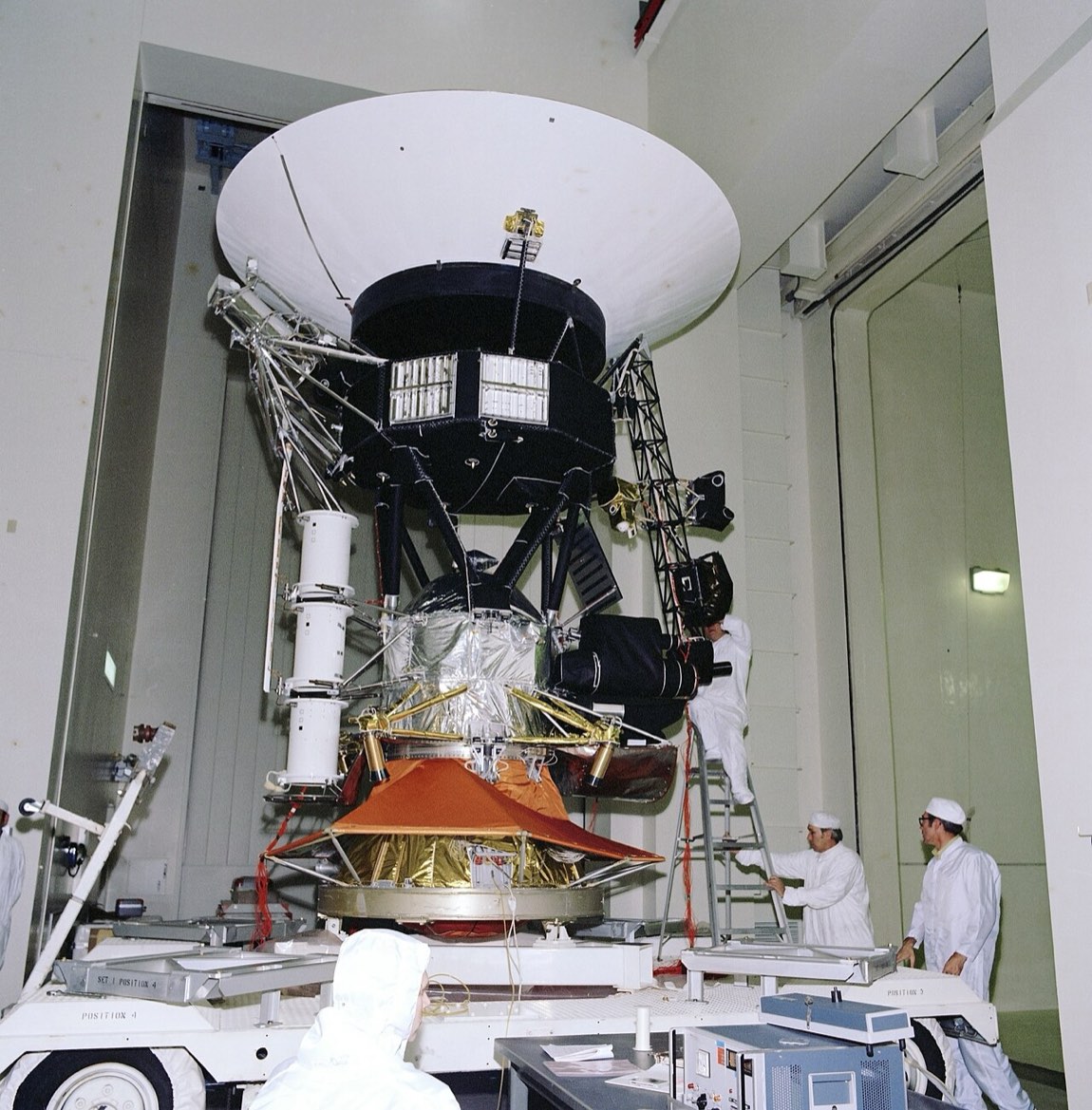
Everything humanity knows about Proteus in any physical detail comes from a single encounter: Voyager 2's flyby of Neptune in 1989. The spacecraft discovered Proteus, imaged its surface, measured its brightness and color, and allowed scientists to determine its size and shape — all during a brief passage through the Neptunian system. No mission has returned since. This means the dataset for Proteus is fundamentally limited: the images have fixed resolution, the viewing geometries are fixed, and there are no follow-up observations from orbit to refine what Voyager 2 saw. Much of what scientists have learned since 1989 has come from reanalyzing Voyager data with better techniques or from ground- and space-based spectroscopy that can measure infrared reflectance without sending a spacecraft. The result is a moon we know exists, have seen in some detail, and have identified major features on — but about whose interior structure, bulk density, and fine-scale geology we remain largely ignorant. Proteus stands as a reminder that one flyby, however historic, leaves enormous questions open.
12 Open Questions Proteus Leaves Unanswered Deeper
Despite what Voyager 2 revealed, Proteus raises more questions than it has settled. Its bulk density is not well constrained, leaving its internal composition genuinely uncertain — researchers know it is probably rocky but cannot pin down the proportions of rock, ice, and organic material. The mechanism behind the low abundance of phyllosilicates compared to neighboring moons like Larissa and Galatea is debated: was it impact-driven dehydration, or a different formation environment? The origin and relative timing of its linear features — whether they trace impact stress or tidal stress — has not been resolved. The proposed resonance history with Larissa, broken several hundred million years ago, is inferred rather than directly observed. The connection between Proteus and Hippocamp is a compelling hypothesis but not yet confirmed. And the broader story of how exactly Triton's capture timing and trajectory produced the specific inner moon system we see today, with Proteus as its largest surviving member, remains an active area of modeling and debate. A future Neptune orbiter would transform understanding of all these questions.
 ⤢
⤢
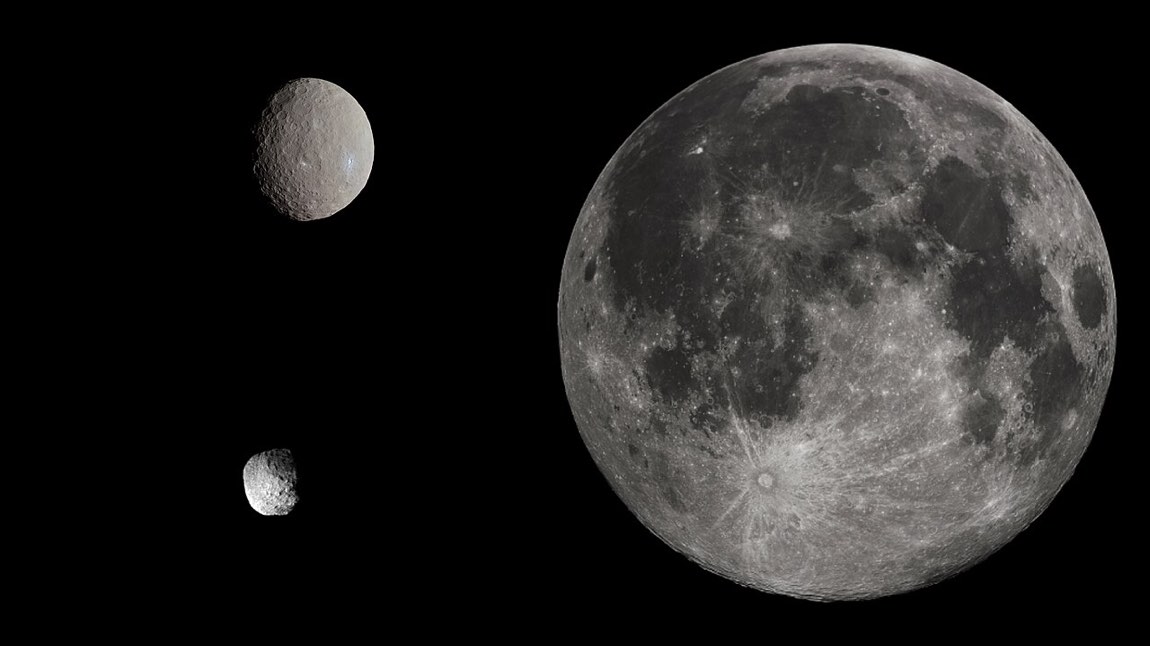
You would weigh…
Surface gravity 0.07 m/s² vs Earth’s 9.81 m/s². Try every world →