 Photograph · NASA · Public domain
Moon · Deep guide · orbits Saturn
Pandora
Also called: Saturn XVII · S/1980 S 26
Once thought to be the F ring's outer shepherd, this cratered moon turns out to be mostly a bystander.
What is it?
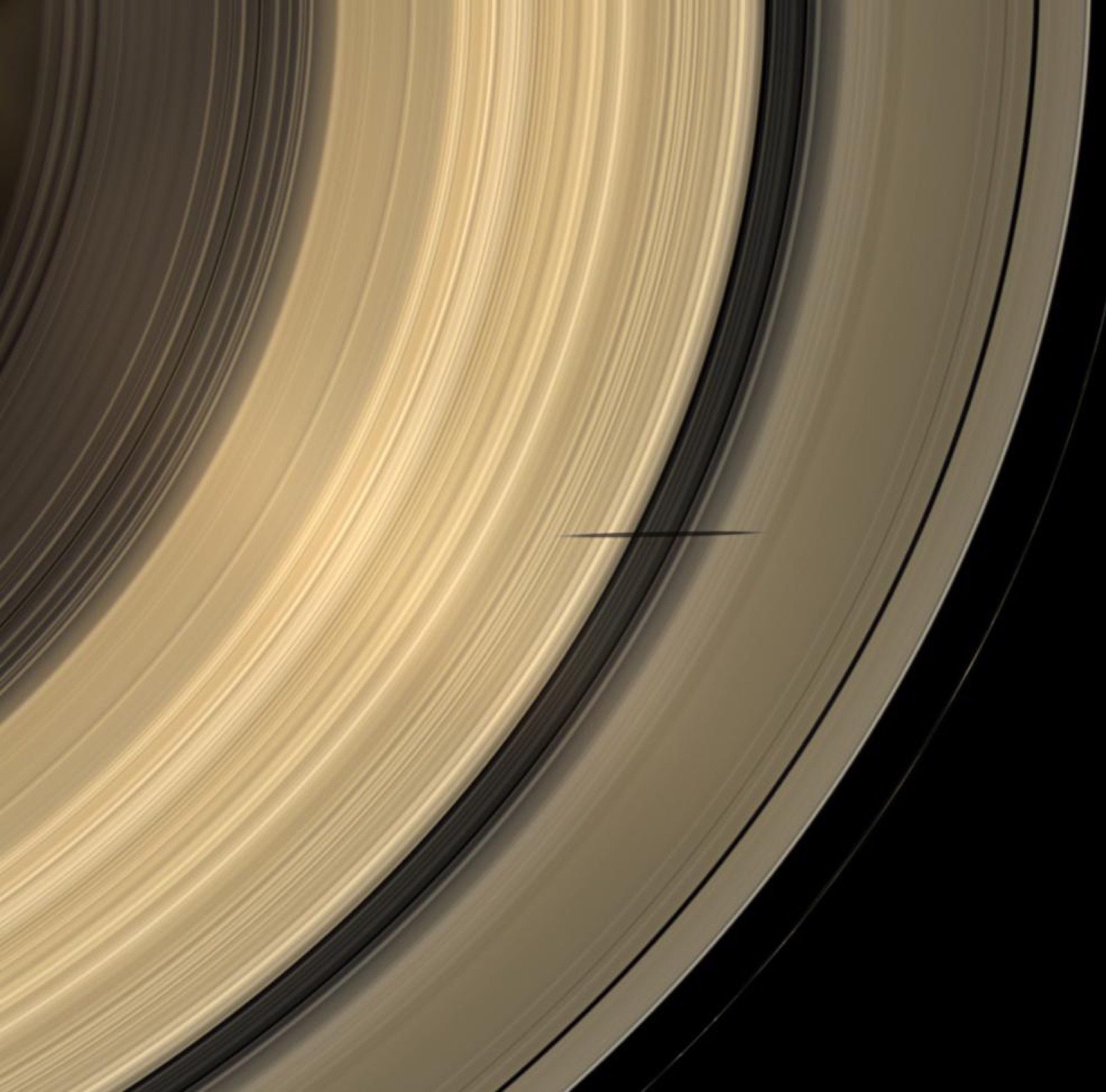
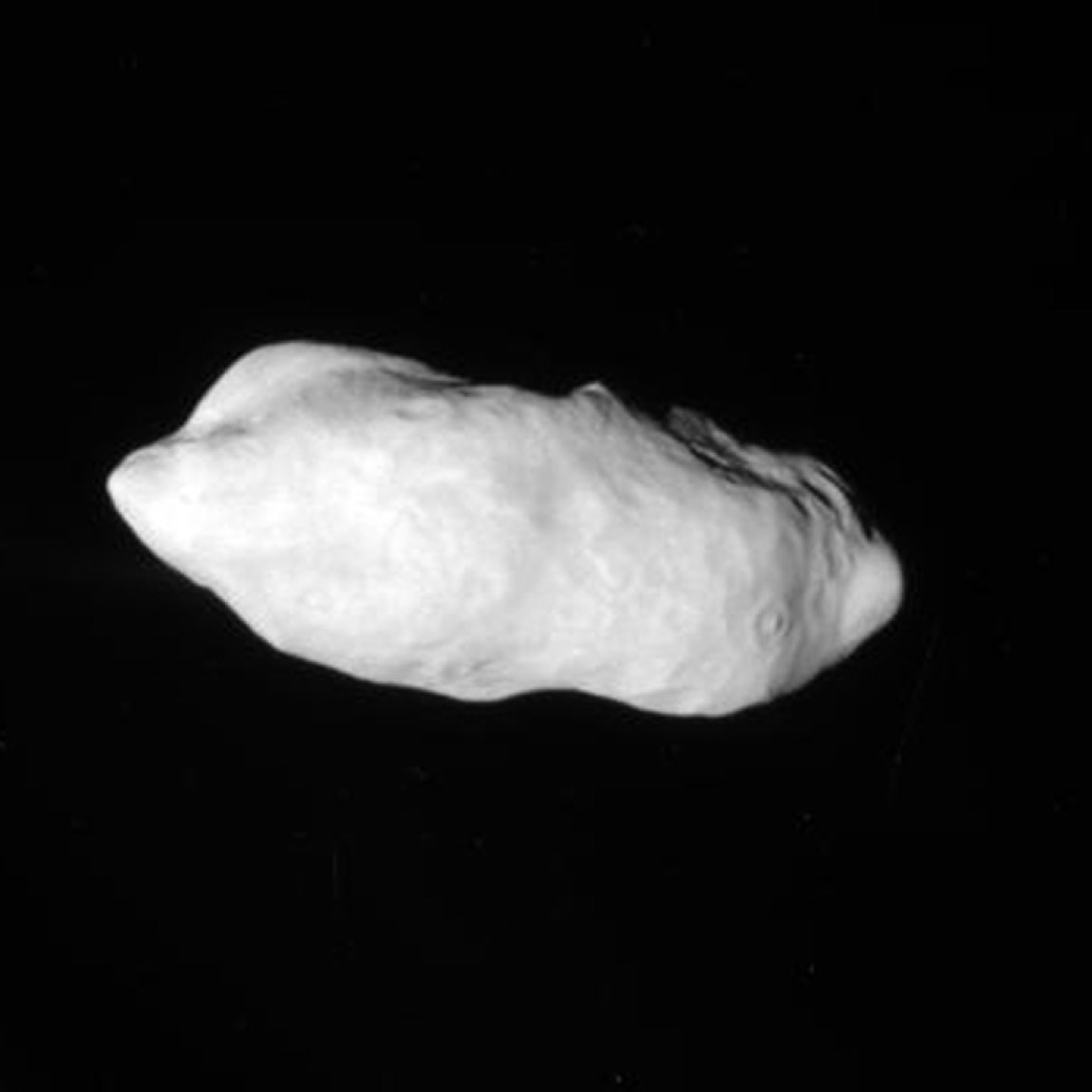
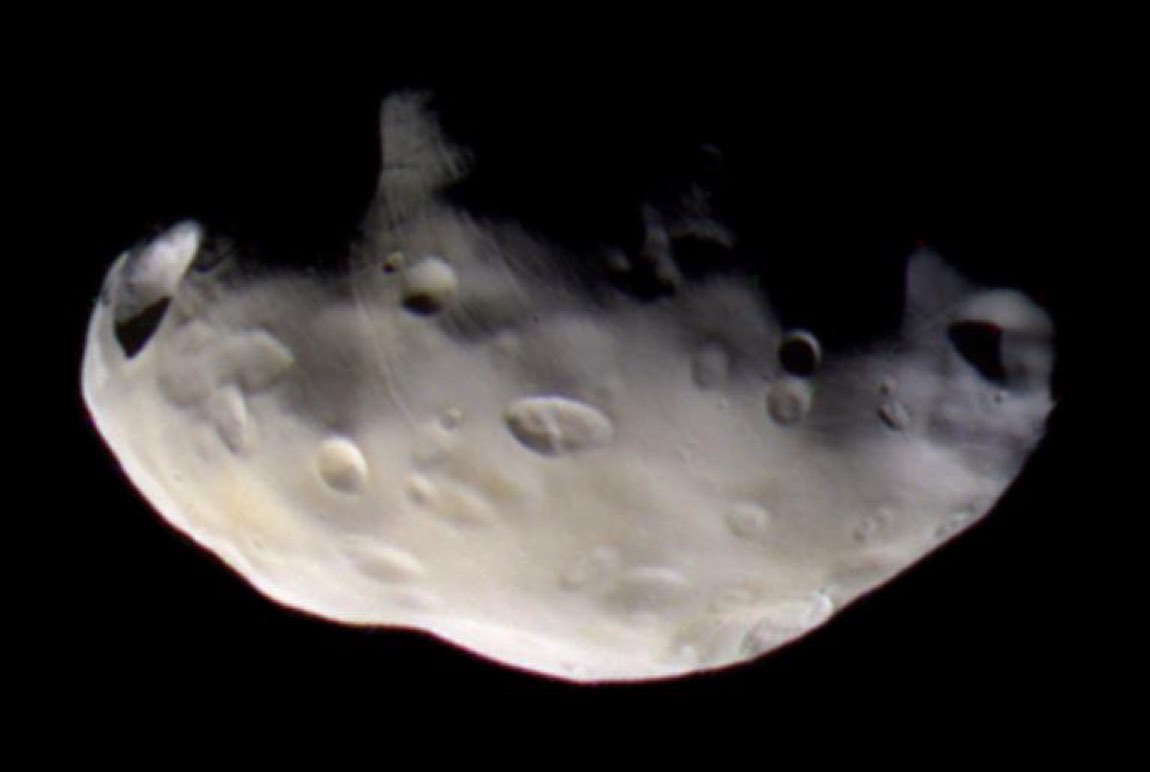
Pandora is an inner moon of Saturn, about 100 km long, orbiting just outside the narrow F ring. It was discovered in Voyager 1 images in 1980. Pandora was long considered the ring's outer shepherd, but newer studies suggest only Prometheus actually confines it. Pandora is more heavily cratered than Prometheus, with at least two craters about 30 km wide, and many shallow craters filled with debris. The two moons' orbits are chaotic, and they may collide with each other or with Mimas within about 20 million years.
The deep dive
Researched for the Atlas from Wikipedia — Pandora (moon) (1,696 characters read) · updated Nov 14, 2026
01 How Pandora was found and named
Pandora's discovery was almost accidental — it turned up in photographs snapped by the Voyager 1 spacecraft during its 1980 flyby of Saturn. Because mission scientists couldn't immediately confirm all the details needed for a formal name, the moon spent several years carrying the unglamorous provisional label S/1980 S 26. It wasn't until late 1985 that it received its official name, borrowed from the figure in Greek mythology who famously opened a jar and released troubles into the world. Saturn's moon catalogue uses Roman numerals to track discovery order, so Pandora also carries the designation Saturn XVII — the seventeenth Saturnian moon to be formally recognized. The name choice is fitting in a quietly ironic way: just as the mythological Pandora was associated with unpredictable consequences, this small moon turns out to have one of the more chaotic orbits in the entire Saturn system, something that wasn't fully appreciated until long after the name was already assigned.
02 A porous, icy body with uncertain innards Deeper
Pandora's interior is poorly understood, but the two clues astronomers have — density and reflectivity — both point in the same direction. The moon's density is very low and its albedo relatively high, which together suggest that Pandora is a highly porous body made predominantly of ice rather than rock. Picture a loosely packed snowball riddled with internal voids rather than a solid chunk of frozen water, and you have roughly the working model scientists use. The porosity would explain why the density comes in so low: a great deal of the moon's volume would simply be empty space. However, the article is careful to flag genuine uncertainty here. The measured values of density and albedo both carry significant error bars, so the porous-icy-body interpretation, while plausible and perhaps even likely, has not yet been confirmed. Nailing down Pandora's true bulk composition would require either a dedicated close flyby with modern instruments or a lander — neither of which has been sent.
03 Craters, ridges, and a debris-filled surface
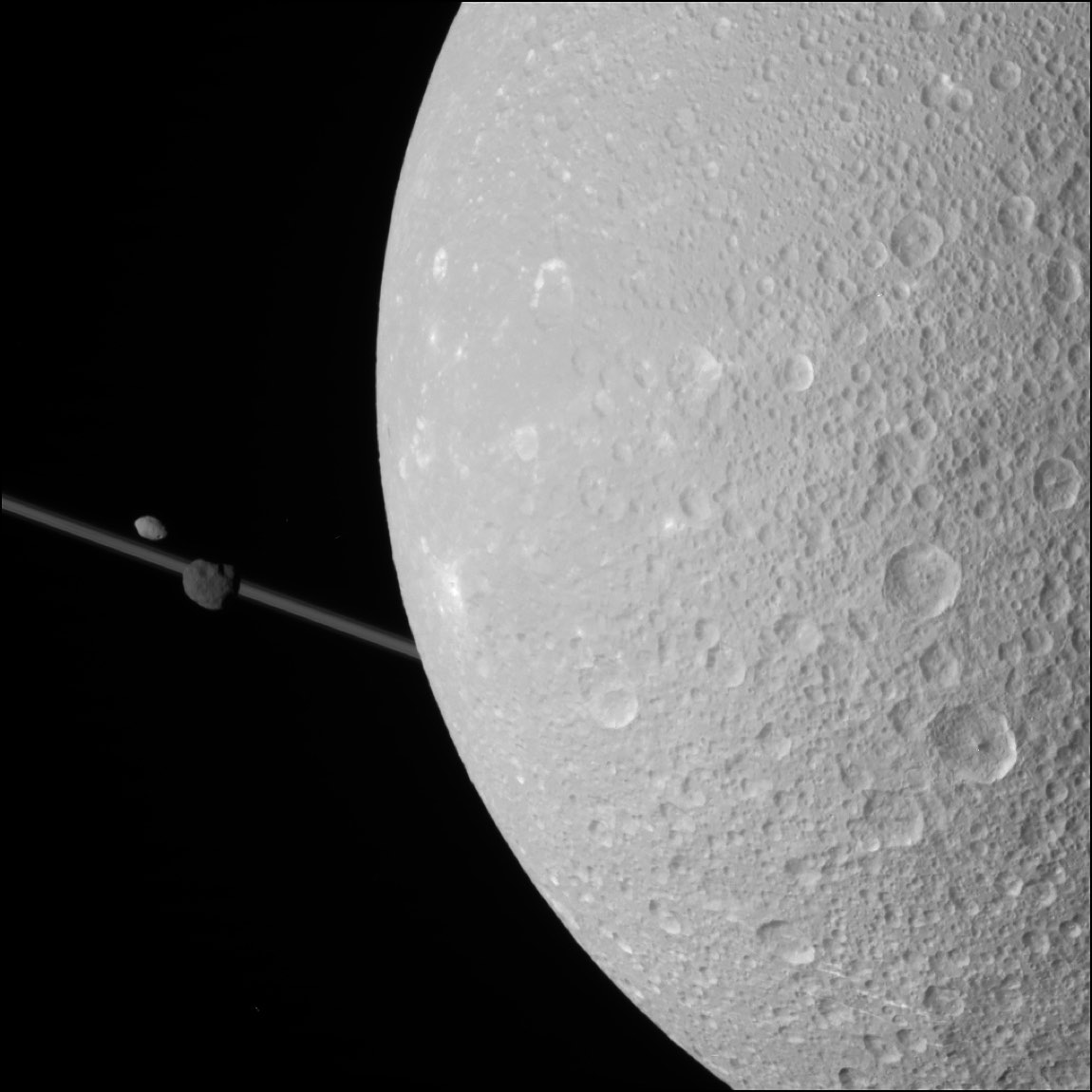
For such a small moon, Pandora wears a surprisingly complex face. Its surface is more heavily cratered than that of its neighbor Prometheus, suggesting it has absorbed a longer or more intense bombardment history — or simply that erosion processes have been less effective at smoothing things over. At least two craters reach 30 kilometres (19 mi) in diameter, which is enormous relative to the moon's overall size. What makes the cratering pattern especially interesting is the character of most individual craters: the majority are shallow rather than deep. Scientists attribute this shallowness to infilling by debris — loose material that has slumped or drifted into the impact bowls over time, blurring their original depth. Beyond craters, Pandora's terrain also features ridges and grooves, hinting at tectonic-style stresses or other internal or external forces that have deformed the surface. This combination of impact scars and structural landforms makes Pandora geologically richer than its modest size might suggest.
 ⤢
04 The chaotic orbital dance with Prometheus Deeper
Pandora's orbit is not the neat, predictable ellipse most people picture when they think of a moon circling a planet. Instead, it is classified as chaotic — a technical term meaning that tiny differences in starting conditions lead to dramatically different long-term trajectories, making precise prediction impossible beyond a certain time horizon. The culprit is a gravitational tug-of-war with Prometheus driven by a series of four separate 118:121 mean-motion resonances. A mean-motion resonance occurs when two bodies complete their orbits in a simple integer ratio, causing repeated gravitational nudges at the same orbital positions. The effects of these resonances accumulate over time, and the most dramatic consequences play out on a cycle of approximately 6.2 years. At that interval, Pandora's closest orbital point (periapsis) aligns with Prometheus's farthest orbital point (apoapsis), and the two moons come within about 1,400 kilometres (870 mi) of each other — close enough for significant mutual gravitational jolts that reshape both orbits noticeably.
05 Three resonances: Mimas and Epimetheus too Deeper
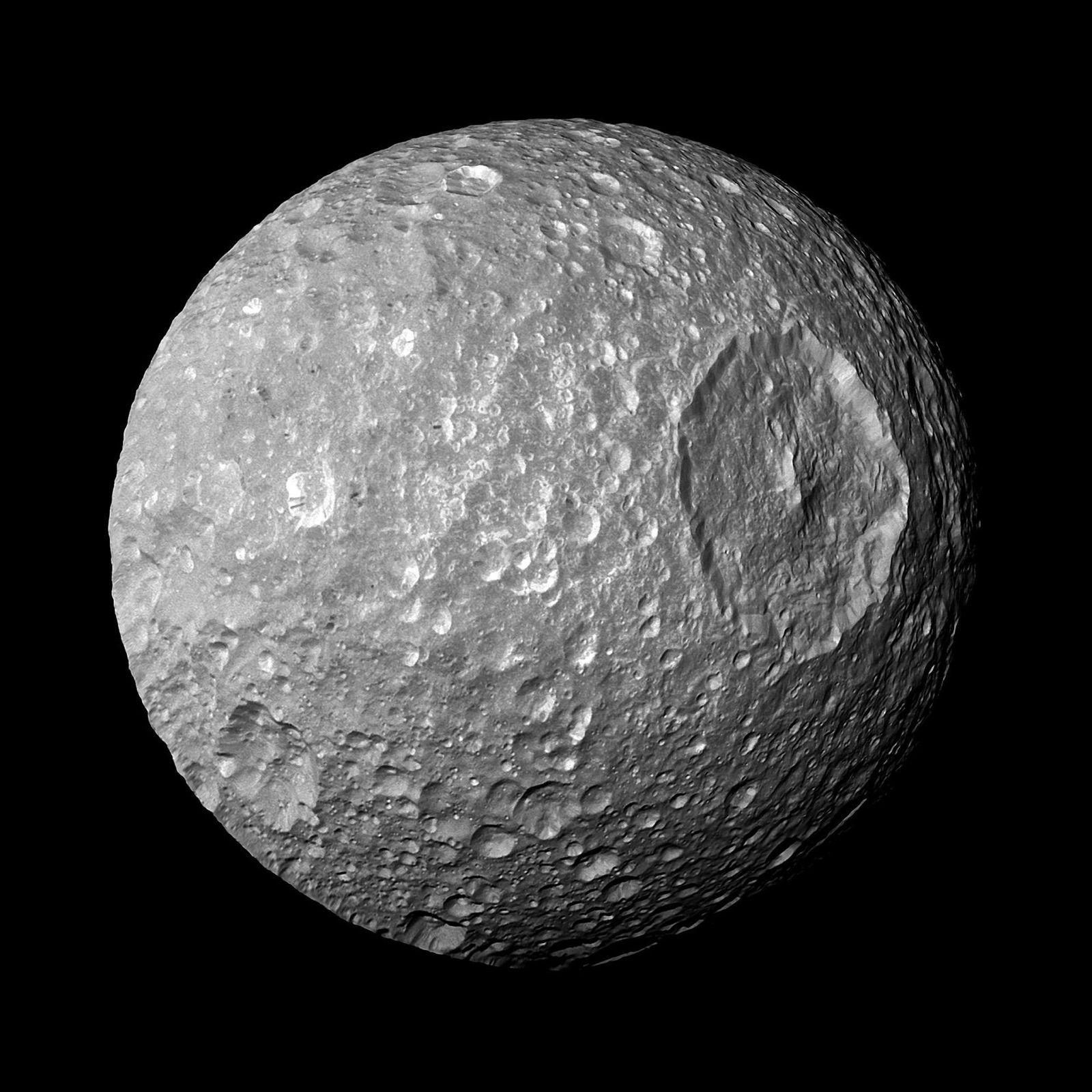
Prometheus is not the only moon pulling on Pandora gravitationally. Pandora also sits in a 3:2 mean-motion resonance with Mimas, one of Saturn's larger inner moons. For every three orbits Pandora completes, Mimas completes two, creating a periodic alignment that exerts a repeated gravitational influence. On top of that, Pandora holds a 21:19 mean-motion resonance with Epimetheus — but only under a specific condition. That resonance operates only while Pandora is on the outer orbit relative to Janus, Epimetheus's orbital companion. No equivalent resonance with Janus itself exists. This conditional, switching resonance reflects the unusual nature of the Janus-Epimetheus system, where those two moons share nearly the same orbit and periodically swap positions. Pandora therefore finds itself embedded in a web of gravitational relationships with at least three other moons simultaneously, each resonance tugging in slightly different ways and contributing to the overall complexity — and chaos — of its orbital behavior.
06 Pandora's future: a collision in slow motion
Pandora's chaotic orbital situation is not merely an abstract mathematical curiosity — it has a concrete, dramatic endpoint. Because of the ongoing gravitational interactions between Prometheus and Pandora and the rings of Saturn, dynamical models predict that Prometheus and Pandora will eventually crash into each other, or that one or both will collide with Mimas. This catastrophe is not imminent by human timescales; scientists estimate it will happen within the next 20 million years. To put that in perspective, 20 million years ago on Earth, the ancestors of modern whales were still largely land-dwelling mammals. So while the collision is virtually certain on astronomical timescales, no one alive — or any descendant of anyone alive — will ever witness it. What such a collision would do to Saturn's ring system is an open question, but adding the mass of one or two moons into the mix would almost certainly reshape the rings in dramatic ways.
 ⤢
07 Rethinking Pandora's role at the F Ring
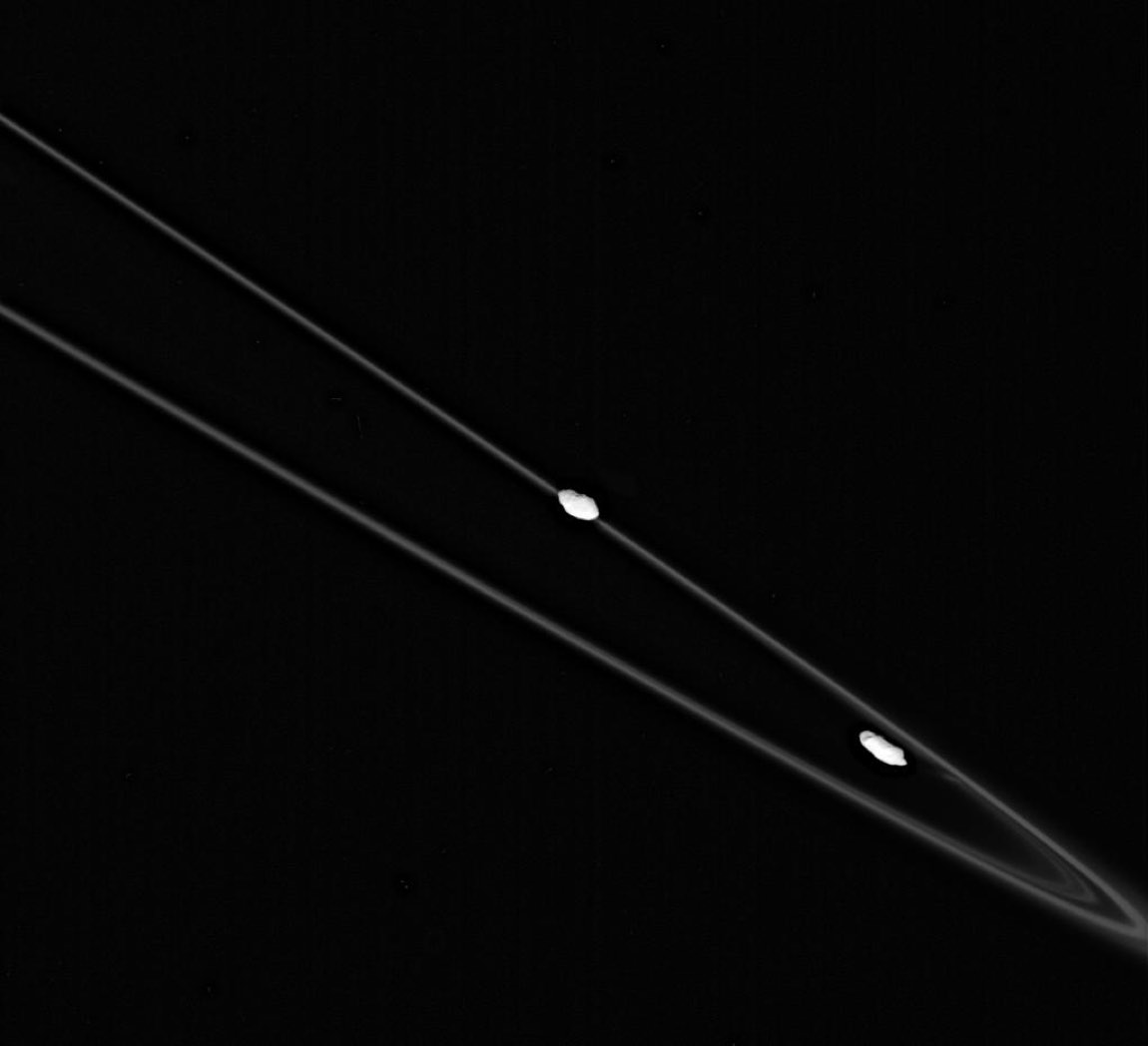
For decades after its discovery, Pandora was described in textbooks as an outer shepherd satellite of Saturn's F Ring. The shepherd-moon concept holds that two flanking moons gravitationally herd ring particles inward and outward, keeping a narrow ring confined to a tight band. Pandora was supposed to be the outer shepherd, with Prometheus playing the inner role. Recent studies have overturned Pandora's part of that story. Current research indicates that Pandora does not actually contribute meaningfully to confining the F Ring — only Prometheus, orbiting just inside the ring, acts as a genuine shepherd. Pandora's gravitational influence on the ring particles apparently isn't strong enough, or isn't positioned correctly, to do the herding job that was assumed. This is a good example of how a simple, intuitive model — two moons, one on each side, keeping a ring in line — can persist in the literature for years before more careful analysis reveals a more complicated and lopsided reality.
08 Voyager 1 and what it revealed
The discovery of Pandora is inseparable from the story of Voyager 1, NASA's pioneering outer-solar-system probe. When Voyager 1 swept past Saturn in 1980, it carried cameras capable of resolving features that Earth-based telescopes could never detect around such a distant planet. The photographs it transmitted back to Earth were analyzed systematically, and in that image data scientists identified Pandora — a small, irregular body orbiting just outside the F Ring. That initial detection earned the moon its provisional designation, S/1980 S 26, with the year embedded in the name as a timestamp of discovery. Voyager 1's flyby was a single, unrepeated event; the probe did not linger or orbit, so the data it collected represented a snapshot rather than a sustained study. Much of what was learned about Pandora's surface — the craters, ridges, and grooves — came from that brief encounter, making Voyager 1's images foundational documents for everything that followed in Pandora science.
09 Open questions still waiting for answers Deeper
Despite four decades passing since Pandora's discovery, the moon remains poorly characterized in several fundamental ways. The porous-icy-body model for its interior is the leading hypothesis but is explicitly unconfirmed because the density and albedo measurements carry too much uncertainty to be treated as definitive. The precise mechanism by which the chaotic orbital resonances with Prometheus will eventually play out — whether in a Pandora-Prometheus collision, a collision involving Mimas, or some other dynamical reshuffling — is not settled. The long-term effects of Pandora's gravitational interactions on the structure of the F Ring are also incompletely understood, especially now that Pandora's traditional shepherd role has been questioned. The Cassini mission, which orbited Saturn from 2004 to 2017, provided additional data on the Saturn system broadly, but Pandora is small enough and far enough off the main agenda that many of its basic properties remain loosely constrained. A targeted close flyby or even an impactor study could resolve several of these questions in a single mission.
 ⤢