Moon · Deep guide · orbits Saturn
Polydeuces
Also called: Saturn XXXIV · S/2004 S 5
A 3-km trojan that wanders farther from its balance point than any other.
What is it?
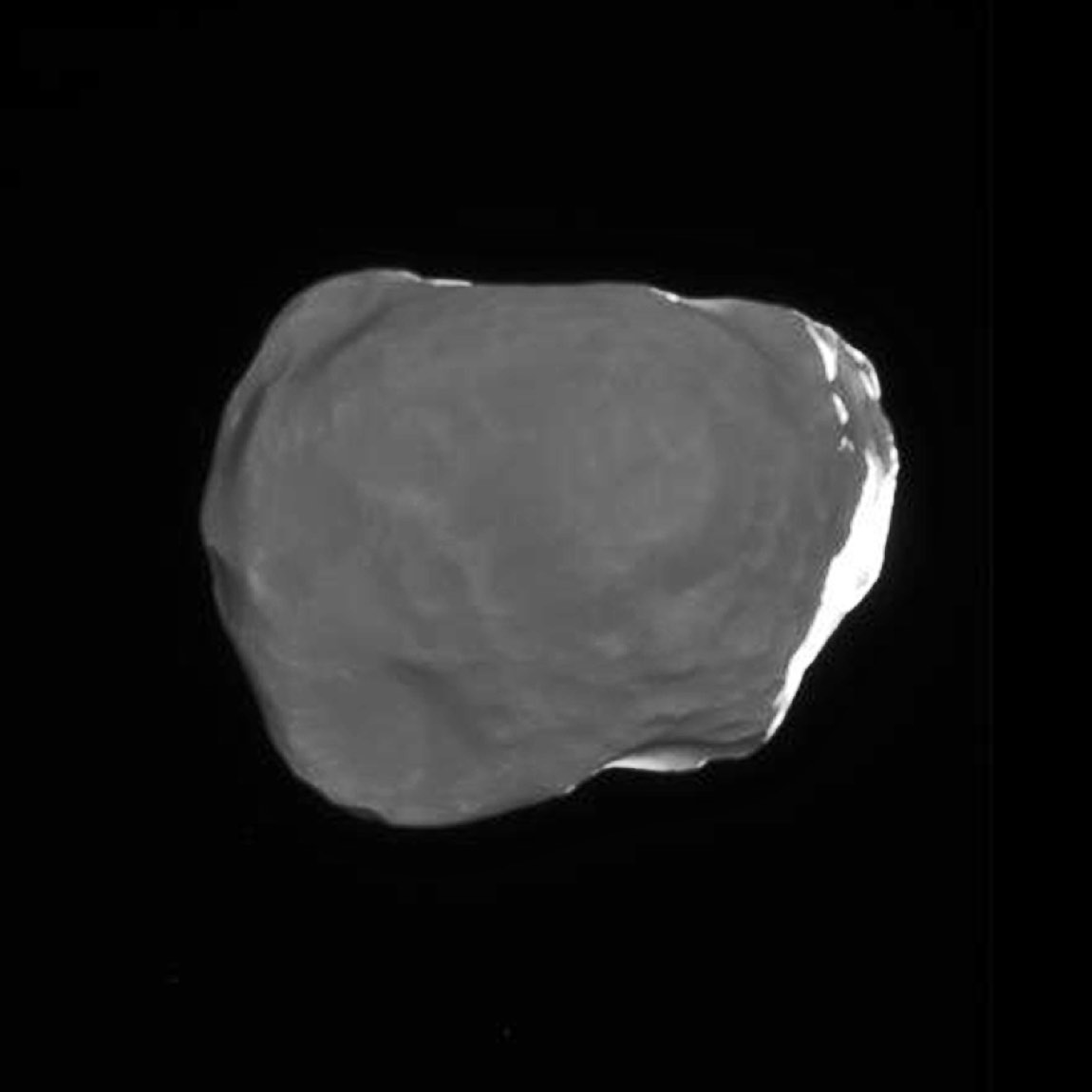
Polydeuces is a tiny moon of Saturn, about 3 km across, that trails Dione by roughly 60° in the same orbit. The Cassini imaging team spotted it in October 2004 by blinking images to catch objects moving against the stars. Other moons tug it so strongly that it drifts farther from its Lagrange point than any of Saturn's four known trojans. Its smooth, bright surface is probably coated in fine ice from the E ring.
The deep dive
Researched for the Atlas from Wikipedia — Polydeuces (moon) (9,877 characters read) · updated Nov 14, 2026
01 Found in a Blink: How Cassini Spotted It
The discovery of Polydeuces unfolded over just a few weeks in late 2004, beginning with routine image analysis rather than a dedicated search. On 24 October 2004, members of the Cassini Imaging Science Team were working through frames the spacecraft had captured three days earlier, on 21 October. They used the blink comparison technique — rapidly alternating between images to make any moving object jump out against the fixed backdrop of stars. Polydeuces gave itself away by shifting 3 to 6 pixels per frame across just four wide-angle camera frames taken in under six minutes. That tiny drift immediately hinted that the object was orbiting Saturn at roughly the same distance as Dione. Within days, follow-up images confirmed the co-orbital relationship, and by 4 November the team had enough data for a preliminary orbit. The IAU formally announced the discovery on 8 November 2004, only eighteen days after the frames were first examined. Polydeuces was one of six new Saturnian objects Cassini identified in 2004 alone, alongside Methone, Pallene, and three provisional objects.
02 Pre-Discovery Images Hidden in Plain Sight Deeper
Once researchers had a reliable orbit for Polydeuces, they could work backwards through Cassini's archive and predict where the moon should have been in earlier images. That technique — called ephemeris-based pre-discovery detection — turned up 52 separate detections of Polydeuces in Cassini's narrow-angle camera images taken between 9 April 2004 and 9 May 2004, months before anyone realized what they were looking at. In 2006, the search went even further back, uncovering Cassini images of Polydeuces from 2 April 2004 — more than six months before the official discovery date. These pre-discovery frames are scientifically valuable because they extend the arc of observational data used to refine the orbit, reducing uncertainties in parameters like the libration period and eccentricity. The episode illustrates a recurring theme in planetary science: the discovery moment is often just the moment someone looks carefully, while the evidence has been quietly accumulating in data files for months or even years beforehand.
03 A Name Borrowed from Greek Myth's Twin
Before receiving its permanent name, the moon was known by the unglamorous provisional label S/2004 S 5, the designation the IAU assigned at the time of the discovery announcement. The name Polydeuces was approved by the IAU Working Group on Planetary System Nomenclature on 21 January 2005, less than three months after discovery. In Greek mythology, Polydeuces is an alternate name for Pollux, the twin brother of Castor and the son of Zeus and Leda — the same divine pair whose names grace two of the brightest stars in the constellation Gemini. The choice is quietly appropriate: Polydeuces the moon perpetually shadows Dione just as a twin shadows a sibling, never straying fully independent. The moon also carries the official Roman numeral designation Saturn XXXIV, marking it as the thirty-fourth moon of Saturn to be discovered. That catalog number coexists with the mythological name in formal astronomical literature, though the name Polydeuces is what most scientists use day to day.
04 The Tadpole Path: An Orbit Unlike Any Other Deeper
Polydeuces does not simply ride 60° behind Dione in a fixed position. Because gravitational nudges from other nearby moons disturb its trajectory, its angular distance from Dione oscillates continuously between 33.9° and 91.4°, completing one full oscillation cycle every 790.931 days — just over 2.17 years. Astronomers call this oscillation libration, and no other known trojan moon of Saturn librates as dramatically as Polydeuces. When this libration is combined with the fact that Polydeuces also moves slightly closer to and farther from Saturn as its orbital radius varies by as much as ±7,660 km, the moon traces what looks like a looping, kidney-shaped path around Dione's L5 point in a reference frame that rotates with Dione. The technical name for this shape is a tadpole orbit, and it is the defining signature of a trojan object. The orbital inclination of just 0.2° keeps the whole motion almost perfectly flat in Saturn's equatorial plane, so the tadpole loop is essentially two-dimensional — a graceful, slow-motion figure drawn in space over the course of more than two Earth years.
05 Why Polydeuces Is Surprisingly Eccentric Deeper
Most moons that share an orbit with a large companion tend to have their orbital shapes sculpted by the same forces acting on the companion. Dione has an orbital eccentricity of just 0.002, kept slightly non-circular by its 1:2 mean-motion resonance with Enceladus. Polydeuces, however, has an eccentricity of 0.019 — nearly ten times larger — and the resonance that shapes Dione's orbit is too weak to account for Polydeuces's distinctly more elongated path. One hypothesis is that Polydeuces has been eccentric since the moment it formed, and that its orbit simply has not evolved much over the billions of years since. Because the moon is so small, the tidal forces and gravitational interactions that gradually circularize larger moons' orbits may have been too feeble to work effectively on Polydeuces. If this interpretation is correct, its current eccentricity is essentially a frozen memory of the conditions in the early Saturnian system — a kind of orbital fossil preserved in its motion around the planet today.
06 Formed from Leftover Rubble at a Balance Point
Polydeuces is thought to have assembled from material that became gravitationally trapped in Dione's trailing L5 Lagrange point during an intermediate phase of Saturn's moon-forming history — after Dione and Tethys were still growing and before the gas in Saturn's circumplanetary disk had fully dissipated. At Lagrange points, the combined gravitational pulls of Saturn and Dione create a region of relative stability where loose debris can collect and slowly coalesce rather than being scattered away. The same process is thought to have produced Dione's leading trojan Helene and Tethys's two trojans, Telesto and Calypso. Interestingly, dynamical models predict that Dione's L4 and L5 points should have gathered comparable amounts of material, implying that Helene and Polydeuces ought to be roughly similar in size. They are not: Helene is vastly more massive than Polydeuces, with the two differing by more than an order of magnitude. As of the article's most recent data, no one has a satisfying explanation for why the material was distributed so unevenly between the two Lagrange points.
07 A Moon So Small It May Have Died and Reformed
With a volume-equivalent mean diameter of just 3.06 km — small enough to fit comfortably within many cities — Polydeuces is fragile by solar system standards. Its assumed density of 0.5 g/cm³ (lighter than water ice alone, suggesting a very porous interior) means it holds itself together weakly. Calculations based on the estimated rate of impacts in the Saturnian system indicate that Polydeuces has probably experienced at least one fully disruptive impact during the past billion years. That leaves researchers with two uncomfortable options: either Polydeuces is genuinely young, having formed or reformed less than a billion years ago; or it is an ancient, primordial moon that has been shattered and re-accreted multiple times over the 4.5-billion-year history of the Saturnian system, reconstructing itself from its own debris each time. Both scenarios are plausible given current data, and distinguishing between them would require information about the moon's internal structure and composition that Cassini was never able to gather.
08 Coated by Enceladus: The E Ring Connection
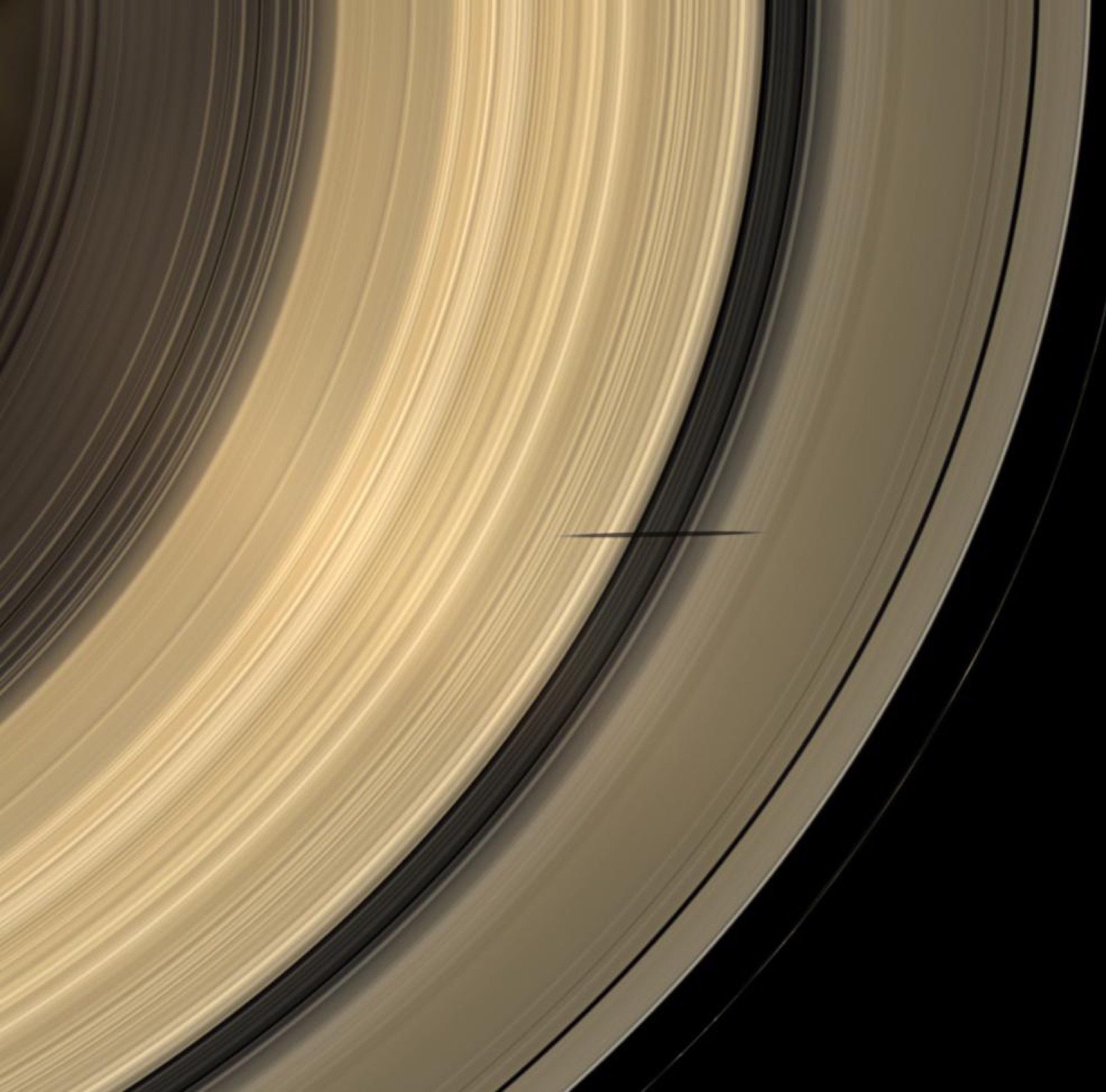
Polydeuces orbits within Saturn's vast E Ring, a diffuse torus of microscopic water-ice particles that stretches across the region between the orbits of Mimas and Titan. The E Ring is constantly replenished by cryovolcanic plumes erupting from the south pole of Enceladus, which spray fine icy grains into space that gradually spread throughout the ring. As Polydeuces sweeps through this environment, those particles settle onto its surface, building up a smooth, bright coating. The effect is so thorough that any craters Polydeuces might have accumulated from impacts are thought to be completely buried under E Ring material — giving it a featureless, rounded appearance similar to two other small inner moons, Methone and Pallene. The surface brightness of Polydeuces is approximately comparable to Dione's but noticeably darker than its fellow Dione trojan, Helene. Why the two siblings bathed in the same E Ring environment ended up with different surface brightnesses remains unresolved; possible explanations include an uneven distribution of incoming particles or recent impact events that freshened Helene's surface.
09 What Cassini's Cameras Actually Resolved Deeper
Over its thirteen-year mission in orbit around Saturn, Cassini made 22 close approaches within 130,000 km of Polydeuces — but most of those passes yielded no useful imagery. The spacecraft's closest approach of all came on 17 February 2005, passing just 6,446.7 km from Polydeuces, yet no images were taken on that date. Resolved pictures were obtained on only three encounters: 22 May 2006 at a closest approach of 64,089.9 km, and then on 10 May 2015 and 16 June 2015 at distances of 33,997.8 km and 34,794.3 km respectively. The 2015 flybys were the first time Polydeuces appeared larger than 10 pixels across in any image, and they produced the data behind the most recent size estimate of 3.50 km × 3.10 km × 2.62 km published as of 2020. Those same images revealed the moon's elongated, slightly irregular shape — not a clean ellipsoid, but a lumpy body with a relatively smooth limb. Because Cassini never flew close enough to detect gravitational tugs from Polydeuces, its mass and true density remain unmeasured.
10 Four Trojans, One System, Many Questions
Saturn is the only planet in the solar system known to host trojan moons, and it has four confirmed examples: Helene and Polydeuces share Dione's orbit, while Telesto and Calypso share Tethys's. Helene occupies Dione's leading L4 point, 60° ahead, while Polydeuces occupies the trailing L5 point, 60° behind. Tethys's arrangement mirrors this, with Telesto at L4 and Calypso at L5. The brightness relationships among these four moons raise an intriguing parallel puzzle: just as Helene is brighter than Polydeuces, Calypso is brighter than Telesto — meaning the trailing L5 trojan is the dimmer one in both pairs. Whether this pattern reflects systematic differences in how E Ring particles accumulate at leading versus trailing Lagrange points, or whether it is a coincidence driven by recent impacts, is still an open question. The existence of trojan moons at all hints at the relatively calm dynamical history of Saturn's inner system; in a more chaotic environment, these fragile co-orbital configurations would likely have been disrupted long ago.
11 Open Questions That May Wait Decades for Answers Deeper
Polydeuces leaves researchers with a cluster of unanswered questions, some of which may not be resolved without a future dedicated mission to Saturn. The moon's mass and density are entirely unconstrained by observation because it is too small to measurably deflect Cassini or any other spacecraft. The assumed density of 0.5 g/cm³ is borrowed from other small inner moons and may be wrong. The geometric albedo is unknown because Polydeuces has never been observed at low phase angles. The reason for its anomalously high eccentricity compared to Dione's lacks a confirmed explanation. The mass asymmetry between Helene and Polydeuces — both supposedly formed from similar Lagrange-point debris — has no accepted theoretical resolution. And the question of whether Polydeuces is primordial or geologically young, repeatedly reassembled from impact debris, remains open. With Cassini's mission concluded and no successor Saturn orbiter currently approved, these questions may persist as theoretical puzzles for many years, solvable only through improved dynamical modeling or a future spacecraft that can study Polydeuces up close.