 Photograph · NASA / JPL / Space Science Institute · Public domain
Moon · Deep guide · orbits Saturn
Helene
Also called: Saturn XII · Dione B
Dione's leading companion, with one battered hemisphere and one smooth one.
What is it?
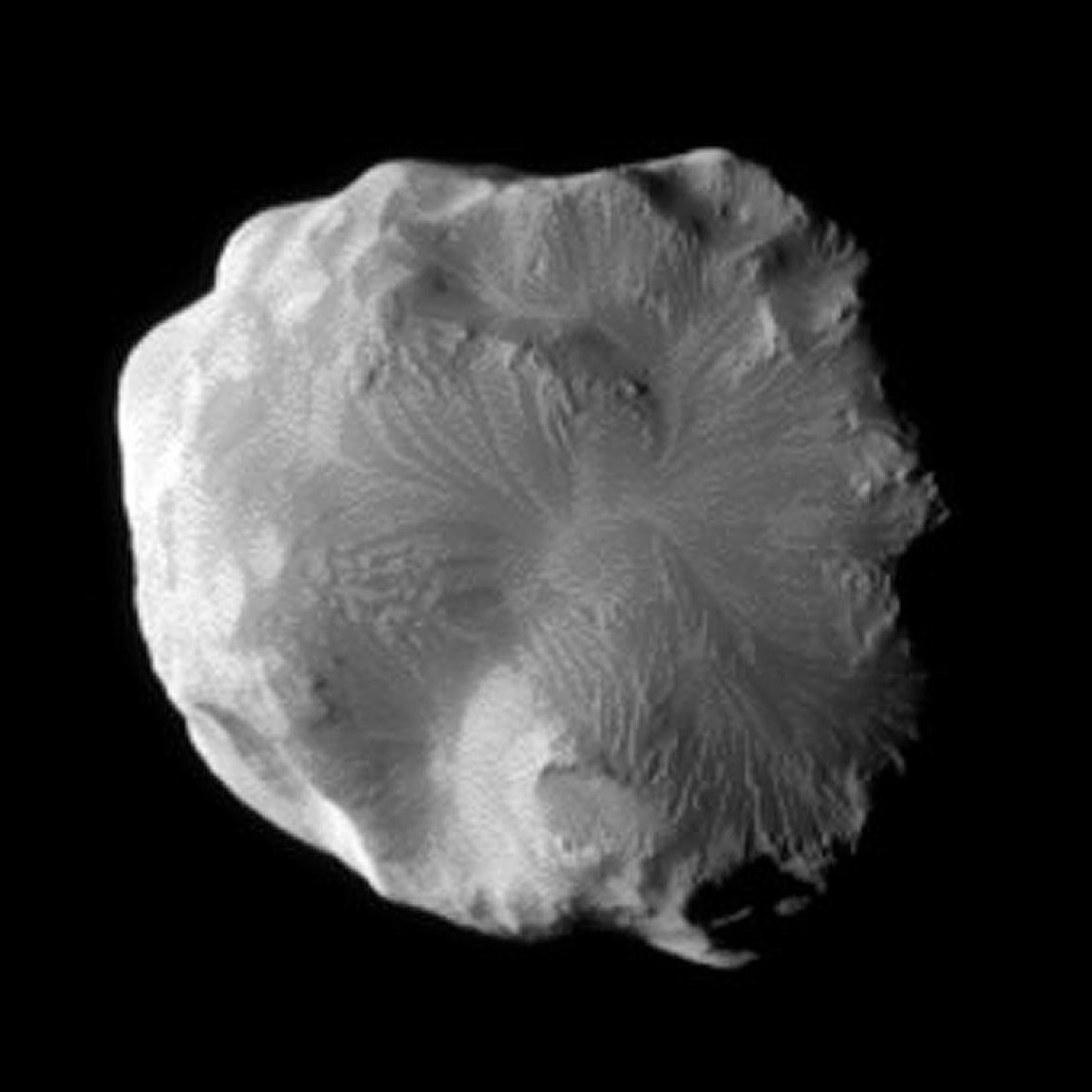
Helene is a small trojan moon of Saturn, about 36 km across, that orbits 60° ahead of Dione in the same path. Pierre Laques and Jean Lecacheux discovered it from Pic du Midi Observatory in 1980. Cassini flew within 1,800 km in March 2010. Its images show more than 70 craters, with the trailing side about ten times more cratered than the smoother leading side, and broad, softened depressions that are probably old, worn-down craters.
The deep dive
Researched for the Atlas from Wikipedia — Helene (moon) (2,806 characters read) · updated Nov 14, 2026
01 Discovered from a Mountain in the Pyrenees
Helene was spotted in 1980 by French astronomers Pierre Laques and Jean Lecacheux working at the Pic du Midi Observatory, a high-altitude telescope perched in the Pyrenean mountains. Ground-based detection of a moon so small and so distant from Earth is a remarkable achievement, and the discovery earned the object the preliminary designation S/1980 S 6. Two years later, in 1982, it received the formal numerical label Saturn XII, making it the twelfth confirmed moon of Saturn in the catalog of the time. The official name Helene came later still, in 1988, chosen to honor Helen of Troy from Greek mythology. The choice was deliberate and mythologically consistent: Helen was the granddaughter of Cronus, the Titan whom the Romans called Saturn. This lineage made her an appropriate namesake for a moon in Saturn's family, continuing the tradition of naming Saturnian moons after figures from the same mythological circle.
02 A Moon That Shares Another Moon's Orbit
Helene occupies one of the most unusual orbital positions in the entire solar system. It is co-orbital with Dione, one of Saturn's larger moons, meaning the two bodies travel around Saturn at essentially the same distance. Rather than colliding or being flung away, Helene sits stably in Dione's leading Lagrangian point, known as L4, which lies roughly 60 degrees ahead of Dione along the shared orbital path. This gravitational sweet spot, where the pulls of Saturn and Dione balance in just the right way, allows Helene to tag along indefinitely without drama. Because of this relationship, Helene carries the informal designation Dione B. It is one of only four known trojan moons in the solar system, a rare category of natural satellites that hitchhike at the Lagrangian points of a larger companion moon rather than orbiting independently. This configuration makes Helene scientifically valuable as a natural laboratory for understanding gravitational resonance.
03 Three Generations of Spacecraft Eyes
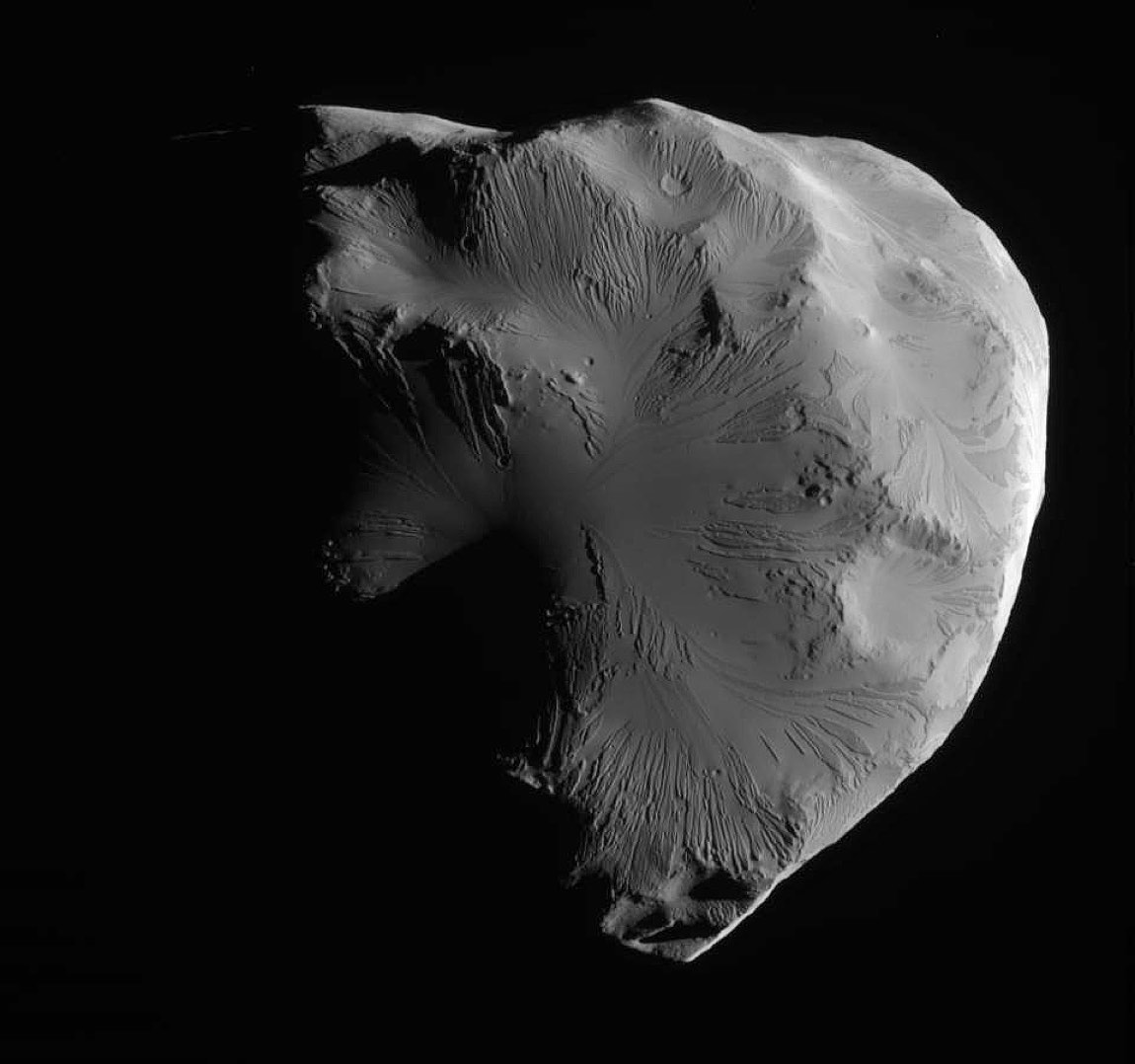
Helene has been observed by progressively more capable spacecraft over four decades. The first close looks beyond ground-based telescopes came from the Voyager flybys of Saturn in the early 1980s, which arrived shortly after the discovery and offered views impossible from Earth. Then the Cassini–Huygens mission entered Saturn orbit in 2004 and transformed understanding of the entire Saturnian system, including Helene. Cassini's observations were not a single event but an extended campaign conducted over many years under varying lighting conditions, which allowed scientists to build a much richer picture of the surface. The closest images captured to date came from a dedicated flyby on March 3, 2010, when Cassini passed within 1,800 kilometers of Helene. A second highly successful imaging sequence followed in June 2011. Beyond those highlighted passes, many other approaches were made across the full duration of the Cassini mission, each contributing additional data about surface texture, topography, and reflectivity.
 ⤢
04 A Landscape of Ancient, Softened Basins Deeper
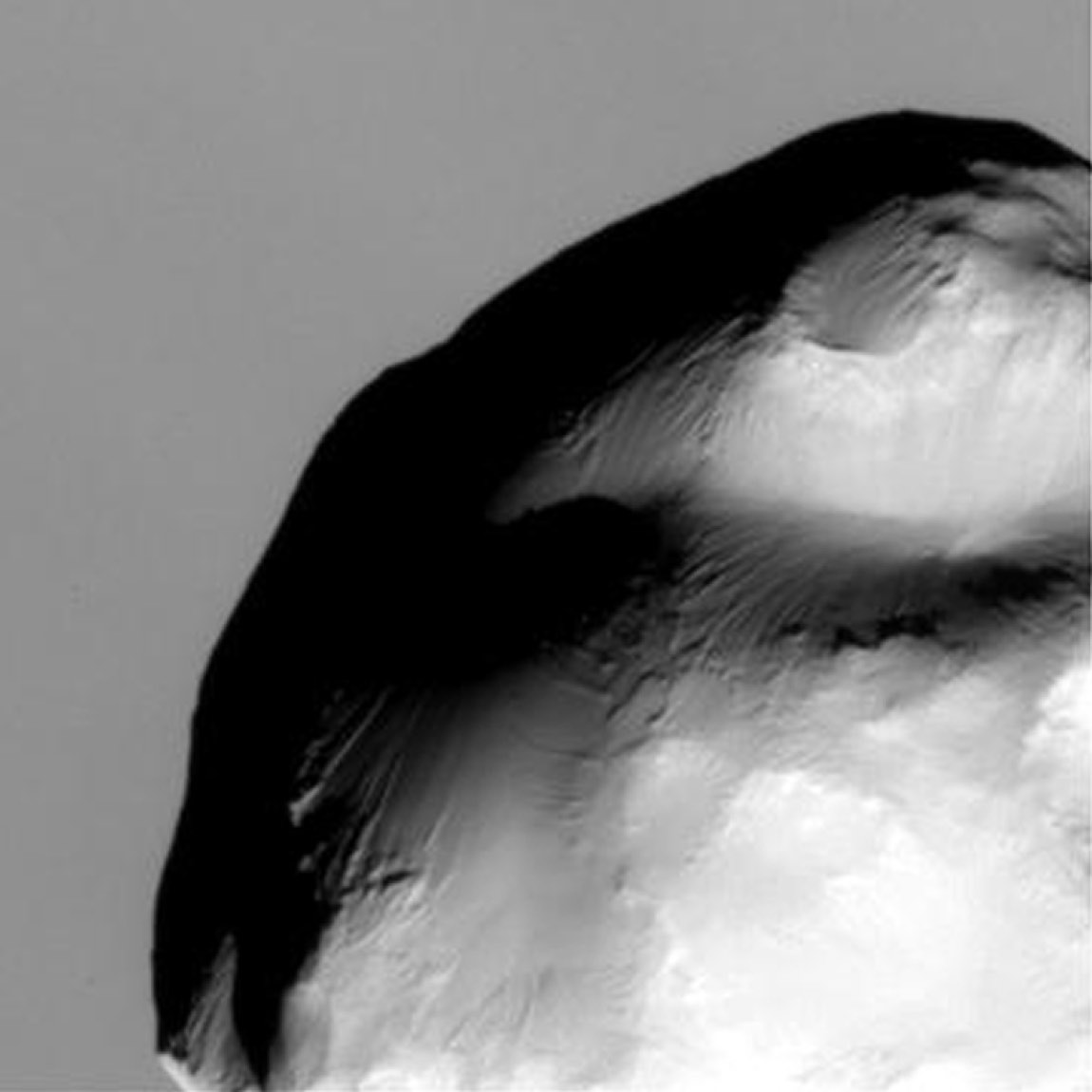
Cassini's cameras resolved Helene's surface at up to 24 meters per pixel, fine enough to reveal a landscape dominated by broad, shallow depressions ranging from 2 to 10 kilometers across. These basins are not sharp-rimmed like fresh impact craters; their interior slopes never exceed 12 degrees, giving them a gentle, bowl-like profile. Scientists interpret them as the decayed remains of old impact craters whose sharp features have been worn down over time. Tracing the slopes of many of these basins are thin, elongated raised grooves that extend for kilometer scales. Digital elevation models indicate these grooves stand between 50 and 100 meters above the surrounding terrain — roughly the height of a 30-story building — which is substantial relief on such a small body. The grooves are interpreted as mass flow features, evidence that material has moved downslope and piled up, leaving behind a positive ridge. Their presence signals that Helene is not a geologically frozen relic but a world where surface processes are still actively reshaping the landscape.
05 An Extreme Difference Between Two Hemispheres
One of the most striking things about Helene is how dramatically its two hemispheres differ from each other. The trailing hemisphere — the side that faces backward along the direction of orbital motion — is heavily cratered, bearing the accumulated scars of billions of years of impacts. The leading hemisphere, by contrast, looks comparatively smooth and lightly marked. The difference is not subtle: crater density on the trailing side is ten times greater than on the leading side. This bimodal appearance raises immediate questions about why the two faces have such different histories. One possibility is that the smooth leading hemisphere has been more recently resurfaced by the same mass-wasting and erosional processes evidenced by the grooves, effectively burying or erasing older craters. The fact that small craters across the moon appear somewhat buried also supports the idea that recent accretional processes of some kind have been depositing fresh material, blanketing older features and giving portions of the surface a younger-looking character.
06 Snow-Like Dust That Flows Like Candle Wax Deeper
The material blanketing Helene's surface has unusual physical properties that may explain the flow features seen across the moon. Its relatively high reflectance points to grain sizes between 1 and 100 micrometers — finer than table salt and consistent with a frost-like or snow-like regolith. Research drawing on stress-strain laboratory testing of impact-gardened lunar regolith samples adds a surprising mechanical detail: at low packing densities, such material behaves as a non-Newtonian Bingham material, meaning it shares the plastic, slow-flowing character of candle wax or glaciers rather than behaving like a simple granular powder. The implication for Helene is significant. Under the moon's low gravity, this waxy regolith may creep and flow across slopes in a manner that mimics what glaciers do on Earth, gradually smoothing basins, filling small craters, and producing the elongated grooves observed on the surface. This would make surface material behavior — not just impact bombardment — a primary driver of the geology visible today.
 ⤢
07 Chaotic Surface Activity Over Time Deeper
Geological processes on a small, airless moon might seem predictable, even monotonous across geologic time. Helene challenges that assumption. Simulation models of the moon's surface activity history show that the time series of that activity is chaotic — meaning small differences in initial conditions lead to dramatically different outcomes over time, in the technical sense used by physicists and mathematicians. This characterization does not mean random or violent, but it does mean that the precise sequence of surface changes cannot be predicted far into the future even with accurate starting information. For scientists, this chaotic signature complicates efforts to reconstruct the moon's geological history from its present-day surface. It also implies that Helene's landscape today is one of many possible configurations the moon could have reached, not an inevitable end state. This kind of dynamical unpredictability is unusual to document for such a small body and makes Helene an interesting case study in the application of chaos theory to planetary geology.
08 The Mythology Behind the Name
The name Helene was officially assigned in 1988, eight years after the discovery. In Greek mythology, Helene — better known in English as Helen of Troy — was most famous as the mortal whose abduction helped ignite the Trojan War. But her relevance to the Saturnian naming scheme rests on her family tree. She was the granddaughter of Cronus, the great Titan ruler whom the Romans identified with Saturn. Because the convention for naming Saturn's moons draws from figures associated with Cronus and the broader mythological family, Helene qualified neatly. The moon also carries two other designations that have remained in use alongside the proper name: Saturn XII, the sequential catalog number assigned in 1982, and the informal Dione B, which describes its orbital relationship to its larger companion. Having three simultaneous designations — a mythological name, a Roman numeral, and a relational tag — is a reflection of how naming conventions for solar system bodies evolved piecemeal over the decades before standardization.
09 Open Questions Helene Leaves Unanswered Deeper
Despite everything Cassini revealed, Helene leaves several important questions unresolved. The source of the accretional material that appears to be burying small craters is not fully explained — where exactly this fresh material originates and at what rate it arrives remain open issues. The precise mechanism driving the asymmetry between the heavily cratered trailing hemisphere and the smooth leading hemisphere is debated, with erosion and resurfacing as candidates but no definitive answer yet established. The chaotic nature of the surface activity history means scientists cannot simply run a geological clock backward to determine the age of specific features with confidence. And while the non-Newtonian behavior of the surface regolith is a compelling hypothesis for the flow features, it is partly based on analogy with lunar regolith rather than direct sampling of Helene's surface material. No mission is currently planned to return to Helene, so these questions may remain open for a long time, dependent on further analysis of existing Cassini data or future orbital missions to the Saturn system.
 ⤢