Moon · Deep guide · orbits Neptune
Nereid
Also called: Neptune II
Neptune's third-largest moon, on one of the most stretched-out orbits of any moon.
What is it?
Nereid was discovered in 1949 by Gerard Kuiper on photographic plates from the McDonald Observatory, the second moon of Neptune ever found. It is about 340 km across and travels an extremely elongated orbit, taking about 360 days to circle Neptune once. Voyager 2 saw it only from far away in 1989, showing a grey surface brighter than Neptune's small inner moons. Water ice has been detected on its surface.
The deep dive
Researched for the Atlas from Wikipedia — Nereid (moon) (12,523 characters read) · updated Nov 15, 2026
01 Gerard Kuiper and the 1949 Discovery
Nereid was discovered on 1 May 1949 by Gerard P. Kuiper, working with photographic plates taken through the 82-inch telescope at McDonald Observatory in Texas. At the time of discovery, Kuiper estimated its apparent magnitude at 19.5 — faint enough that this single number stood as the only photometric information on Nereid for nearly four decades, until 1987. Kuiper himself proposed the name, drawing on Greek mythology: the Nereids are sea-nymphs and attendants of the god Neptune. It was the second moon of Neptune found after Triton, and it held that position as the most recently discovered Neptunian moon until Voyager 2 arrived. The sole exception was a single observation of an occultation by the moon Larissa in 1981, which predated Voyager's formal discoveries but did not constitute a confirmed independent detection at the time.
02 The Puzzle of Nereid's Flickering Brightness
Among Nereid's strangest traits is a brightness that refuses to stay put. Since photometric monitoring began in earnest in 1987, observers have recorded short-term variations of up to roughly 1.5 magnitudes within a single night — a swing that represents a dramatic change in reflected sunlight. Across all studies combined, Nereid's brightness has been seen to deviate between −1.0 and +1.5 magnitudes from its average. The pattern itself shifts over years: from 1987 to 1991 Nereid appeared highly active, then settled into a quieter state, then showed intermediate behavior after a second observational gap. Multiple independent teams have confirmed the variations, and they are far too large to blame on instrument error. Yet not every astronomer who has observed Nereid has detected any variation at all, which deepens the mystery. The leading idea is that Nereid's rotation axis is slowly changing its orientation as seen from Earth, altering the face we observe over time.
03 Pinning Down a Rotation Period, Decade by Decade Deeper
Measuring how fast Nereid spins proved surprisingly contentious. A 1991 study reported a rotation period of about 13.6 hours paired with a dramatic brightness swing of 1.3 magnitudes. A 1997 study found no detectable period at all, with data uncertainties of around 0.04 magnitudes. Then in 2003, a period of 11.52 ± 0.14 hours was measured, but with a tiny peak-to-peak amplitude of only 0.029 ± 0.003 magnitudes — far quieter than the 1991 result. A 2008 analysis examined twenty years of ground-based data and failed to detect any periodic modulation above 0.08 magnitudes, though the data precision could not confirm or deny the 2003 value. By 2013 a period of 11.50 ± 0.10 hours with a variation of 0.031 ± 0.001 magnitudes matched the 2003 findings closely. The most precise determination came in 2016 when the Kepler space telescope — valued for observing continuously for weeks at a time — measured 11.594 ± 0.017 hours with an amplitude of 0.033 magnitudes, settling the debate in favor of an approximately 11.6-hour day.
04 Size, Shape, and an Unresolved Silhouette
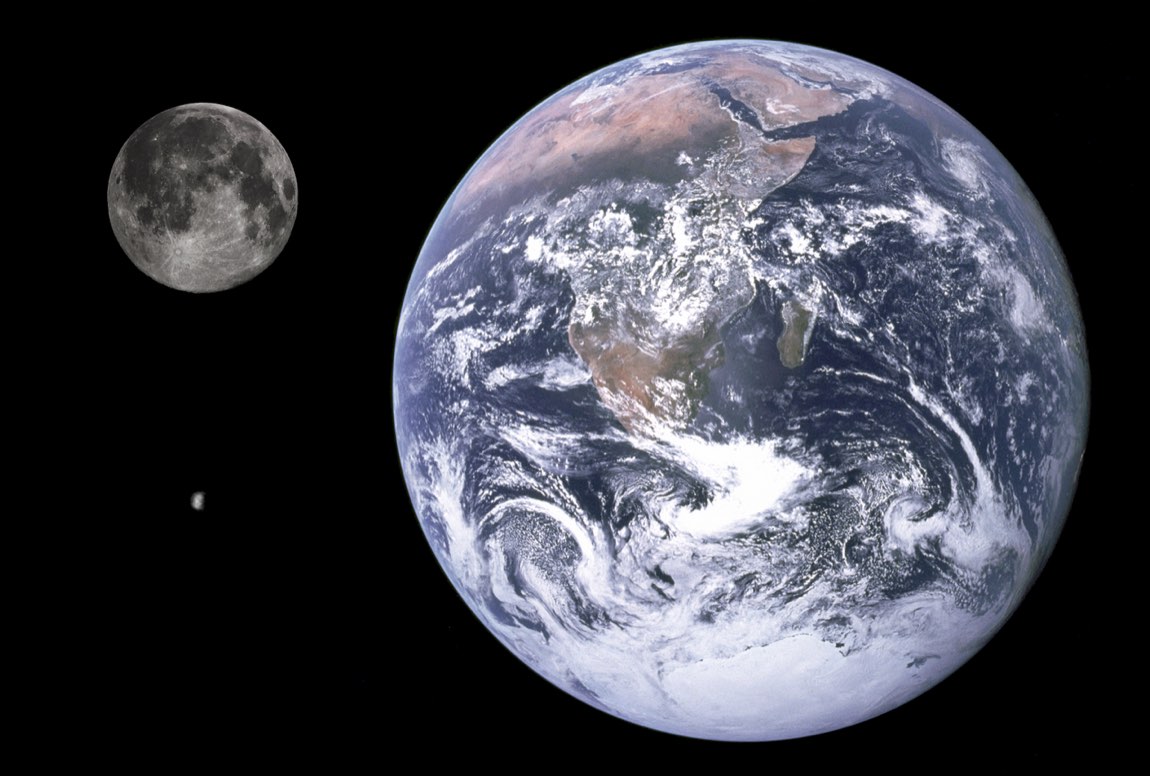
Nereid has a mean radius of about 170 kilometres, making it comparable in size to Saturn's moon Mimas. That places it right at the boundary where self-gravity might or might not be strong enough to pull a body into a roughly spherical shape — squarely in what researchers call the grey area. When Voyager 2 flew past, its images lacked the resolution needed to settle the question of shape. A 2016 study used constraints from observations to establish that Nereid is at most only moderately elongated, with a maximum aspect ratio of 1.3:1. However, thermal modeling using data from both the Spitzer and Herschel space telescopes favored more elongated shapes within those same constraints. The same thermal analysis suggested that Nereid's surface roughness is very high, likely resembling that of Saturn's chaotically tumbling moon Hyperion. Nereid also displays an exceptionally large opposition surge of 0.43 magnitudes, thought to be caused mainly by coherent backscattering, with an additional but unquantified contribution from shadow hiding.
05 Surface Clues: Ice, Color, and a Possible Twin
Spectrally, Nereid appears neutral in color, and water ice has been detected on its surface. Early work in the 1990s found that its spectrum sits between those of Uranus's moons Titania and Umbriel, suggesting a surface blending water ice with some spectrally neutral material. Nereid may also have significant albedo variation across its surface — that is, some regions are probably much brighter or darker than others — because some observed brightness changes are too large to be explained by shape effects alone, even under unrealistically elongated geometries. This has led to comparisons with Iapetus, Saturn's dramatically two-toned moon. A potential family connection exists with the Neptunian moon Halimede, which shares Nereid's gray neutral color and may be a fragment knocked off Nereid during a collision long ago. Intriguingly, observations by the James Webb Space Telescope have shown that Nereid does not match the known spectral types of Kuiper belt objects, distinguishing it from the outer Solar System bodies it was once thought to resemble.
06 An Orbit Unlike Almost Any Other Moon
Nereid's orbit is one of the most extreme among all known moons. It travels an average distance of 5.51 million kilometres from Neptune, but its eccentricity of 0.75 means that distance varies enormously: at its closest (periapsis) it comes within 1.37 million kilometres, and at its farthest (apoapsis) it swings out to 9.65 million kilometres — a range spanning 8.28 million kilometres in a single orbit. For scale, the entire distance from the Moon to Earth is roughly 0.38 million kilometres, so Nereid's orbital stretch is more than twenty times that gap. The orbit is inclined 7.1° to the Laplace plane and 28.4° to Neptune's equator. Among all moons in the Solar System, only S/2023 S 38 has a more eccentric orbit. Among irregular satellites specifically, no other known irregular moon has an inclination below 26°, yet Nereid's inclination to the Laplace plane is only 7.1°. It also holds the records for the lowest average distance and closest periapsis approach of any irregular moon, with Triton excluded.
07 How Nereid Shapes Its Neighborhood Deeper
Nereid's large size gives it an outsized influence on the population of smaller moons orbiting Neptune. Because it sweeps through a wide swath of orbital space, the probability of it colliding with smaller irregular moons over the lifetime of the Solar System is very high. Any object striking Nereid would be far smaller and would be destroyed in the impact, gradually depleting the population of small moons in the region. This process is thought to explain a notable gap: there are very few other irregular moons orbiting Neptune at distances between 1.5 and 15 million kilometres — equivalent to 0.01 to 0.1 astronomical units from the planet. Beyond 15 million kilometres the effect diminishes, so moons in more distant orbits are relatively safe. In a parallel to the situation at Saturn, Nereid accounts for roughly 98% of the mass of Neptune's entire irregular satellite system when Triton is excluded. Saturn's Phoebe, the second-largest normal irregular moon in the Solar System, holds a similar dominant position in its own system.
08 Chaotic Spin, Precession, or Something Simpler? Deeper
Before the 2016 Kepler measurement resolved Nereid's rotation, two competing explanations for its long-term brightness changes were debated. The first proposed chaotic rotation, similar to Saturn's moon Hyperion: if Nereid deviated from a perfect sphere by just 1% and rotated slower than once every two weeks, gravitational torques from its highly elliptical orbit could send its spin axis wandering randomly. The second idea invoked forced precession, analogous to Earth's precession of the equinoxes, suggesting brightness variations would be periodic rather than random. This model required a highly elongated shape with an axis ratio of at least 1.9:1 and rotation periods of several days. The confirmed period of 11.594 ± 0.017 hours rules out both: it is far too fast for significant forced precession, which would require hundreds of years under that rate, and it also excludes chaotic tumbling. The 2016 team proposed instead that the long-term changes simply reflect shifting viewing geometry as Neptune moves along its orbit, though this model still cannot fully account for the very large brightness swings observed before 1991.
09 Captured Wanderer or Neptunian Native?
Two main theories contest Nereid's origins. The first holds that it is a captured Kuiper belt object, pulled into Neptune's gravity from the outer Solar System. The second proposes that Nereid formed as an inner moon of Neptune and was flung into its current chaotic orbit during the violent capture of Triton, which disrupted whatever regular moon system Neptune originally had. A 2026 study added a significant new data point: Nereid's spectrum is markedly different from minor planets of the outer Solar System, suggesting it formed around Neptune rather than arriving from elsewhere. If confirmed, this would make Nereid the sole surviving intact original moon of Neptune from before Triton's destructive arrival. The question remains genuinely open. Nereid's fast rotation — typical for irregular satellites that form elsewhere — could suggest a late capture or a collision that reset its spin, but the spectral evidence pushes toward an in-situ origin.
10 One Fleeting Visit from Voyager 2
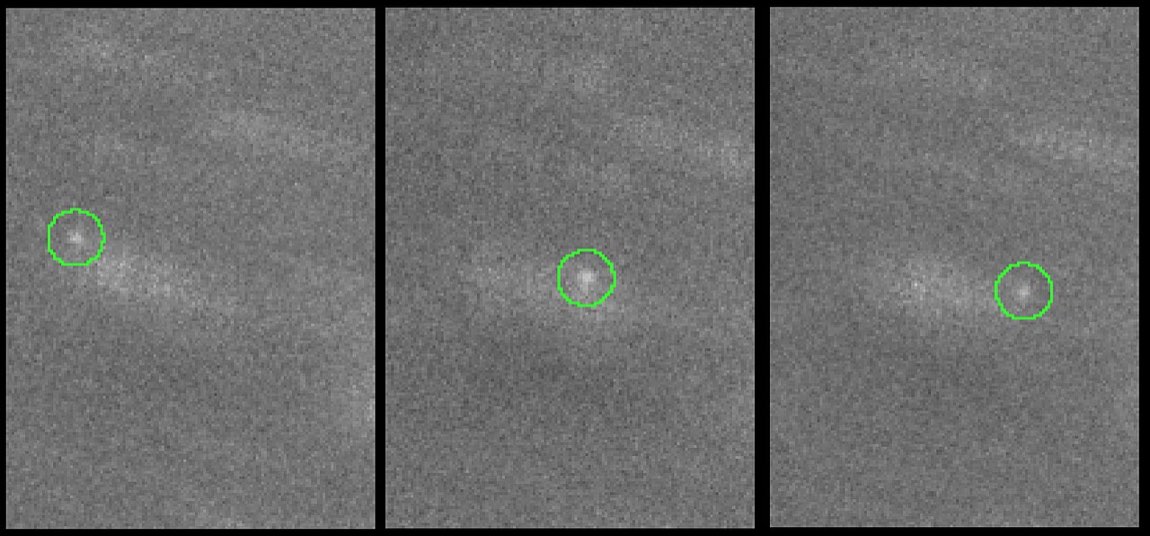
The only spacecraft ever to observe Nereid up close was Voyager 2, and even that encounter was distant. The probe passed Nereid while the moon was near the farthest point of its orbit, achieving a closest approach of 4,700,000 kilometres — roughly twelve times the distance from Earth to the Moon. The observing window stretched between 20 April and 19 August 1989. During that time Voyager 2 collected 83 images, but the resolution ranged from only 70 to 800 kilometres per pixel, far too coarse to distinguish individual surface features. Despite these limitations, the flyby did establish Nereid's size, confirmed that it appears gray in color, and revealed that it has a higher albedo than Neptune's other small satellites. Before Voyager 2 arrived, everything known about Nereid came from ground-based observations capable of providing only its brightness and orbital parameters — a situation that left fundamental physical properties unknown for forty years after discovery.
11 A Future Mission in the Proposal Stage
No spacecraft has been approved to visit Nereid since Voyager 2's brief 1989 passage, but a proposed mission called Arcanum would change that if it is ever selected. The Arcanum concept is primarily designed to orbit Neptune and conduct extended observations of Triton, but its trajectory includes a flyby of Nereid as a secondary objective before entering Neptunian orbit. Such a flyby would be a dramatic improvement over Voyager 2: even a moderately close approach at higher resolution could resolve questions about Nereid's shape, confirm whether its surface has distinct bright and dark hemispheres like Iapetus, characterize its surface composition in detail, and perhaps clarify why its brightness has varied so dramatically over decades. As of the information available in the article, Arcanum has not been selected, so Nereid's close-up portrait remains the blurry Voyager frames from more than three decades ago.
12 An Irregular Moon That Defies the Category Deeper
Nereid is officially classified as an irregular satellite of Neptune, sharing the defining traits of that group: a distant orbit, high eccentricity, and significant inclination relative to Neptune's equatorial plane. Yet Nereid sits uncomfortably within that category. Its inclination of only 7.1° to the Laplace plane is far lower than any other known irregular moon, all of which exceed 26°. Its average orbital distance is also the smallest of any irregular moon. It is by far the largest of the normal irregular moons anywhere in the Solar System, holding roughly two-thirds of the total mass of all irregular moons combined — excluding Triton, which is itself considered anomalous among irregular satellites due to its exceptional size. Some researchers argue Nereid should instead be classified as a perturbed regular satellite, one that formed close to Neptune and was thrown into its current wild orbit by outside forces. For now, it is often explicitly excluded or distinguished from the other irregular satellites when that population is studied as a group.
 ⤢