 Photograph · Matt Holman / Harvard-Smithsonian Center for Astrophysics · CC0
Moon · Deep guide · orbits Neptune
Halimede
Also called: Neptune IX · S/2002 N 1
A grey irregular moon that may be a splinter from a collision with Nereid.
What is it?
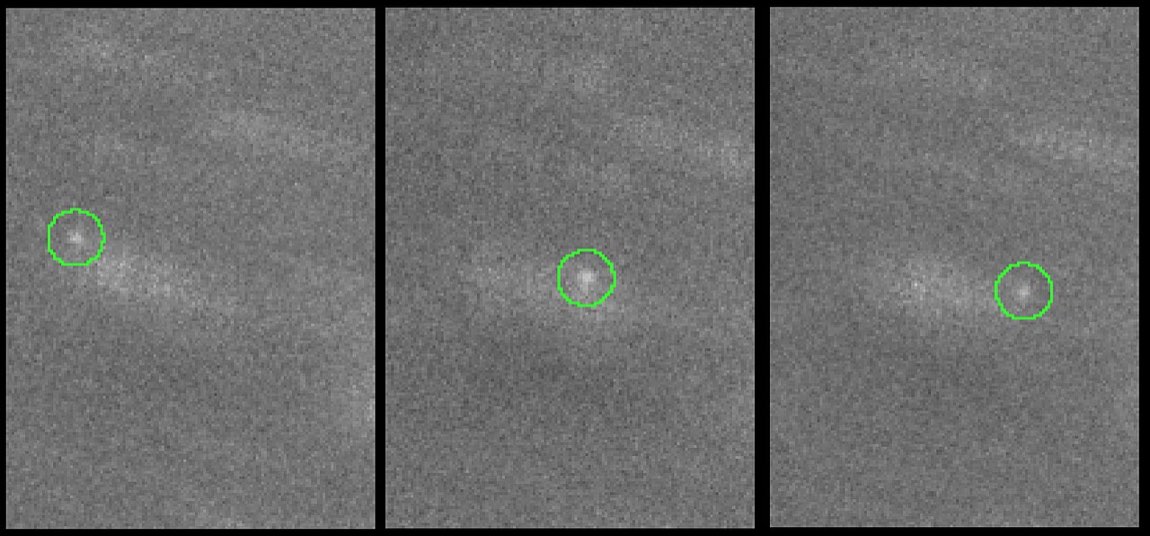
Halimede was discovered in August 2002 at Cerro Tololo in Chile, when astronomers stacked long exposures from the 4-metre Blanco Telescope to reveal faint moons. It is roughly 40–60 km across and circles Neptune backwards on a tilted, elongated orbit that takes about 5.1 years. Its grey colour matches Nereid's, and its path can bring it close to that moon, leading to the idea that Halimede is a fragment knocked off Nereid long ago.
The deep dive
Researched for the Atlas from Wikipedia — Halimede (moon) (10,053 characters read) · updated Nov 15, 2026
01 How the Discovery Team Found Halimede
Finding Halimede required a clever technical trick called the shift-and-add technique. Rather than staring at a fixed patch of sky, the team at Cerro Tololo Inter-American Observatory in Chile took many long-exposure images and then digitally shifted each frame to track Neptune's slow crawl across the background stars. Stacking the aligned frames caused any moon orbiting Neptune to build up into a detectable point of light, while unrelated stars smeared into streaks and faded into the noise. Using this method on images captured by the 4-meter Víctor M. Blanco Telescope on 14 August 2002, Matthew Holman, JJ Kavelaars, Tommy Grav, Wesley Fraser, and Dan Milisavljevic pulled Halimede out of the dark alongside two other new moons, Sao and Neso. The discovery was the first time a Neptunian moon had been found from the ground since Nereid in 1949, a gap of more than half a century. When the Minor Planet Center formally announced the find on 13 January 2003, Neptune's official moon count jumped to 11.
02 Precovery: Finding Old Photos of a New Moon Deeper
Even after a moon is discovered, astronomers can effectively travel back in time by hunting through archival telescope images for earlier appearances of the object — a process called precovery. After refining Halimede's orbital solution, Holman's team dug through images from an earlier survey of the Neptune system taken with the Canada–France–Hawaii Telescope at Maunakea Observatory and found Halimede hiding in frames from 18 July 1999, more than three years before its official discovery date. That pushed the known observation arc back significantly. The team also conducted fresh follow-up observations in 2003 and 2004, enlisting the 8.2-meter Very Large Telescope at Cerro Paranal, the 2.5-meter Nordic Optical Telescope at La Palma, and the 5-meter Hale Telescope at Palomar Observatory, with orbit predictions contributed by Brian G. Marsden and Robert A. Jacobson. By 2026, the cumulative observation arc stretches more than 22 years, covering more than four complete orbits of Halimede around Neptune, giving scientists an unusually solid grip on the moon's orbital behavior for such a recently found and distant object.
03 What the Name Halimede Tells Us
The moon sat under the temporary label S/2002 N 1 for nearly five years before the International Astronomical Union's Working Group for Planetary System Nomenclature stepped in on 3 February 2007 and gave it both a proper name and the Roman numeral designation Neptune IX. The IAU names Neptune's irregular moons after the fifty Nereids of Greek mythology — sea nymphs who were daughters of the sea god Nereus and the Oceanid Doris. Halimede was one of these fifty daughters. The choice of name also carries a hidden code: because Halimede orbits Neptune in a retrograde direction, its name was deliberately given an ending in the letter "e," following a convention borrowed from the naming rules for Jupiter's irregular moons. That single trailing vowel signals, to anyone who knows the convention, that this moon travels backward relative to Neptune's own journey around the Sun. It is a small but elegant example of how astronomical naming systems encode physical information directly into the labels scientists use every day.
04 An Orbit That Never Stays Still Deeper
Halimede's orbit is not a fixed ellipse — it is a shape that breathes and tilts over thousands of years because the Sun's gravity continuously tugs at a moon so far from Neptune. Over a 10,000-year window, the semi-major axis wanders between 16.55 and 16.63 million km, averaging about 16.59 million km. The eccentricity swings far more dramatically, ranging anywhere from 0.19 to 0.90. That means at its most stretched, the orbit is nearly parabolic, while at its most circular it is comparatively tame. The inclination is equally restless, varying between 111° and 145° with respect to the ecliptic, averaging 120°. To cope with this instability, orbital scientists describe Halimede using proper orbital elements — values averaged over a long baseline rather than any single snapshot. The orbit also shows both apsidal precession, with a period of 5,395 years, and nodal precession, with a period of 5,156 years. Both cycles are slow enough that no human civilization could directly observe them, yet they shape the moon's long-term fate entirely. No orbital resonances with other Neptunian moons have been identified, and Halimede shares no recognized orbital family with the other known irregular moons of Neptune.
05 Halimede's Surprisingly Shallow Retrograde Tilt Deeper
Among every known retrograde irregular moon in the entire Solar System, Halimede holds the record for the lowest average inclination, sitting at 120° with respect to the ecliptic. That number sounds large, but inclination for retrograde orbits is measured from the same 0°–180° scale as prograde orbits, with retrograde simply defined as anything above 90°. Subtracting 90° from Halimede's 120° average gives a true tilt of only 60° away from the ecliptic plane — meaning this moon, despite traveling backward, orbits at a moderate angle rather than near-perpendicular to the solar plane. For comparison, the most inclined known prograde irregular moon anywhere in the Solar System is Margaret, which averages 60.5° of tilt with respect to the ecliptic. The two moons thus sit at nearly mirror-image inclinations from opposite sides of the 90° retrograde threshold. This unusual geometry makes Halimede a minor statistical outlier among retrograde moons and raises questions about the specific dynamical event that placed it in such a relatively shallow backward orbit.
06 A 41% Chance of Hitting Nereid
Because Halimede's eccentricity can swell as high as 0.90, the moon's closest approach to Neptune at periapsis can shrink to roughly 1.66 million km — close enough for its orbit to cross the path of Nereid, one of Neptune's largest irregular moons. A 2004 study led by Holman and collaborators ran simulations over 4.5 billion years and concluded that Halimede has a 41% probability of actually colliding with Nereid during that span, essentially giving it a near-coin-flip chance of a catastrophic impact across the remaining lifetime of the Solar System. Despite that alarming long-term probability, the two moons are not close to each other right now: over any 30,000-year stretch, they do not approach within 180,000 km of each other — still nearly half the distance from Earth to the Moon. The repeated gravitational close encounters that make a collision possible would also scatter Halimede's orbit unpredictably, so the actual future is highly sensitive to initial conditions. This violent orbital relationship has made Halimede one of the most dynamically interesting small moons in the outer Solar System.
07 Could Halimede Be a Chip Off Nereid?
The orbital overlap between Halimede and Nereid is not the only thing connecting them: telescope measurements from 2003 found that the two objects share a strikingly similar neutral, gray color. That shared coloring suggests a similar surface composition — probably one rich in water ice — and prompted some astronomers to propose that Halimede is literally a piece of Nereid, broken off by a past collision. Holman and colleagues floated this idea in 2004, and a separate study published the same year backed them up by confirming the color match and hinting at a possibly similar surface composition. However, a 2005 study by Ćuk and Gladman added an important caveat: for Halimede to have formed as a Nereid fragment, both moons would most plausibly need to have been part of circumplanetary debris that was ejected and dynamically mixed when Neptune captured its large moon Triton long ago. If Halimede did not form from Nereid at all, the alternative explanation is that it is one of Neptune's original irregular moons, gravitationally captured by the planet during the chaotic early history of the Solar System. Neither scenario has been definitively ruled out.
08 How Bright — or Dim — Is Halimede?
In visible light, Halimede glows at an apparent magnitude of about 24, which is roughly 250 times fainter than the dimmest objects visible to the naked eye on a perfect night and far beyond the reach of any amateur telescope. Only large professional observatories using long-exposure imaging can detect it at all. Because Halimede is so faint and so far from Earth, its diameter has never been directly measured; instead, scientists estimate its size by combining its known brightness with an assumed reflectivity, called geometric albedo. If the surface reflects just 4% of incoming sunlight — typical for dark, primitive outer Solar System material — the diameter works out to about 62 km. If the albedo is a slightly brighter 6%, the diameter shrinks to 54 km. At a reflectivity of 10%, the estimate drops further to 42 km. This range of 42 to 62 km means Halimede is roughly the size of a mid-sized city, though scientists cannot yet pin down where in that range the true value falls without a dedicated spacecraft flyby or a lucky stellar occultation measurement.
09 A Moon That Wobbles in Brightness Deeper
Telescope observations taken in 2003 caught Halimede changing brightness noticeably over just a few days, with the V-band absolute magnitude dropping from 9.01 ± 0.07 on 27–28 July to 9.74 ± 0.08 by 1 August. A change of roughly three-quarters of a magnitude within that short a window is a strong signal that the moon is not a smooth sphere rotating to present the same face toward observers. Instead, the variation points to an irregular, non-spherical shape tumbling through space and presenting different cross-sectional areas — and therefore different amounts of reflected sunlight — as it rotates. The observations did not pin down an exact rotation period, but the direction of the evidence is clear: Halimede is lumpy. This is not unusual for a small body in this size range, since self-gravity is too weak to pull objects of roughly 42 to 62 km into a rounded shape. The same observations that revealed the brightness variation also confirmed the moon's gray color, linking its surface properties to Nereid and strengthening the case for a shared origin.
10 What the Gray Color Really Means Deeper
Halimede's neutral gray color is scientifically significant beyond just connecting it to Nereid. Many objects in the Kuiper Belt — the distant reservoir of icy bodies beyond Neptune — display what astronomers call "ultrared" coloring, produced by complex organic molecules called tholins that build up on surfaces exposed to cosmic radiation over billions of years. Halimede and the other known irregular moons of Neptune conspicuously lack this ultrared signature. The article notes that this absence suggests that the surfaces of Neptunian irregular moons have been altered either by collisions — which would excavate fresh, unprocessed material from beneath — or by the sublimation of volatile ices, which could strip away or redistribute the reddening compounds. The gray, water-ice-rich surface that Halimede apparently shares with Nereid therefore says something about surface processing in Neptune's orbital environment, not just about the two moons' possible shared ancestry. It is a reminder that a moon's color is shaped not only by what it is made of but also by what has happened to it over billions of years.
11 Halimede's Place Among Neptune's Moons
Neptune has a complex family of moons divided broadly into regular moons, which orbit close to the planet in nearly circular, low-inclination paths, and irregular moons, which are distant, tilted, and eccentric. Halimede belongs firmly in the irregular category. In terms of average orbital distance, it is the second-innermost known retrograde irregular moon of Neptune, with only the giant moon Triton sitting closer. Triton is itself a captured object on a retrograde orbit, though it is vastly larger and behaves very differently from the small irregular moons. The discovery of Halimede alongside Sao and Laomedeia in early 2003 brought Neptune's total known moon count from 8 to 11 at that time, a significant jump. Halimede appears to be broadly similar in size to the parent bodies thought to have formed two recognized groupings of Neptunian irregular moons — the Sao group and the Neso group — which hints that objects of this size class played a foundational role in populating the outer Neptune system through collisional fragmentation events long ago.
12 Open Questions About This Distant Moon
Despite more than two decades of observations stretching back to recovered images from 1999, Halimede remains poorly understood in fundamental ways. Its diameter is known only within a range of 42 to 62 km because its true albedo has never been measured directly. Its rotation period has not been determined, only inferred to exist from brightness variations. Its internal composition and structure are entirely unknown. The question of whether it originated as a fragment of Nereid or as an independently captured body remains unresolved and perhaps unresolvable from Earth-based observations alone. No spacecraft has ever visited Halimede or even flown through the outer Neptune system since Voyager 2 passed Neptune in 1989, and Voyager did not detect Halimede at all since the moon was not known to exist at the time. Any future Neptune mission, should one be funded and launched, would have the opportunity to transform Halimede from a faint gray dot into a world with a recognizable surface — but as of 2026, that future remains hypothetical.