Moon · Deep guide · orbits 22 Kalliope
Linus
Also called: Kalliope I · (22) Kalliope I · S/2001 (22) 1
The small moon of asteroid Kalliope, found with the Keck telescope in 2001.
What is it?
Linus was discovered on 29 August 2001 by Jean-Luc Margot and Michael Brown using the Keck telescope in Hawaii; another team detected it days later with the Canada–France–Hawaii Telescope. It is about 28 km across and circles Kalliope roughly every 3.6 days at about 1,100 km. Its orbit slowly precesses, likely because Kalliope is not perfectly round. Linus is named after the son of the muse Calliope in Greek myth.
The deep dive
Researched for the Atlas from Wikipedia — Linus (moon) (1,576 characters read) · updated Nov 15, 2026
01 A Moon Large Enough to Be an Asteroid
Linus is genuinely impressive for a satellite of a small body. With an estimated diameter of 28 ± 2 km — roughly the distance across a mid-sized city — it would qualify as a sizable asteroid in its own right if it were orbiting the Sun independently rather than circling Kalliope. That size distinction matters: the vast majority of known asteroid moons are tiny, battered chips barely a few kilometers across. Linus stands apart. In fact, among all the moons confirmed in the main asteroid belt, only the smaller components of the double-asteroid systems 617 Patroclus and 90 Antiope are known to be larger. Everything else is smaller. That places Linus in a very exclusive category, and it makes the Kalliope system one of the more massive and dynamically complex pairings known in the inner solar system's rocky population.
02 Two Teams, One Discovery Weekend
The discovery of Linus unfolded over just a few days in late summer 2001, and unusually, two independent teams deserve credit. Jean-Luc Margot and Michael E. Brown spotted the moon on August 29, 2001, using the Keck telescope on Mauna Kea, Hawaii. Just four days later, on September 2, 2001, a separate team detected the same object using the Canada-France-Hawaii Telescope — also located on Mauna Kea. The fact that both discoveries happened within days of each other, on telescopes sitting on the same dormant volcano, speaks to how competitive the search for asteroid moons had become in the early 2000s and how powerful the new generation of adaptive-optics instruments had grown. Prior to such technology, resolving a 28-kilometer companion nestled close to a distant main-belt asteroid would have been essentially impossible from the ground.
03 From Placeholder Name to Mythological Honor
Before it had a proper name, the moon carried the dry provisional designation S/2001 (22) 1 — the standard International Astronomical Union shorthand meaning the first satellite discovered around asteroid 22 in the year 2001. The naming proposal was included directly in the discovery paper itself, which is relatively unusual, and the IAU formally approved the name Linus in July 2003. The choice was layered with intention. Primarily it references the mythological Linus, son of the muse Calliope — a fitting connection, since the parent asteroid 22 Kalliope is itself named after that same muse. In mythology, Linus was credited as the inventor of melody and rhythm. But the discoverers also openly acknowledged two modern namesakes: Linus Torvalds, the creator of the Linux operating system kernel, and Linus van Pelt, the beloved blanket-carrying philosopher of Charles Schulz's Peanuts comic strip. Few asteroid moons carry quite such a layered cultural tribute.
04 Why Kalliope's Shape Keeps Linus Moving Deeper
One of the more technically interesting aspects of Linus is the behavior of its orbit over time. Astronomers have estimated that the orbit of Linus precesses — meaning the orientation of the orbital ellipse slowly rotates — at a notably rapid rate, completing one full precession cycle in just several years. This is fast compared to what a perfectly spherical central body would produce. The leading explanation ties directly to Kalliope itself: because Kalliope is not a sphere but an irregularly shaped M-type asteroid, its gravitational field is lumpy and asymmetric. That uneven pull continuously nudges Linus's orbital path, causing the precession to build up at a rate that reflects Kalliope's departure from a simple, symmetric shape. Measuring the precession rate therefore gives scientists an indirect tool for probing the mass distribution inside Kalliope — information that would be very hard to gather any other way from Earth-based observations.
05 A Moon That Seems to Change Its Brightness
Observers have noticed that the brightness of Linus does not stay constant between different observing sessions — it has varied appreciably. This kind of brightness fluctuation is a familiar signature in asteroid science, and it usually points toward one of two things: either the reflecting surface is unevenly bright in different spots, or the object is not round. For a body the size of Linus, an elongated or irregular shape is a plausible and perhaps likely explanation. As Linus rotates, a wider face would reflect more sunlight toward Earth at some times and a narrower profile less at others, producing exactly the kind of variability that has been recorded. The 28 ± 2 km figure given for its diameter should therefore be understood as an estimate — the true shape of Linus remains uncertain, and pinning it down more precisely would require either a close spacecraft flyby or very high-resolution imaging that current instruments struggle to deliver at main-belt distances.
06 How Linus Might Have Come to Be Deeper
Two competing formation scenarios exist for Linus, and the article is careful not to firmly endorse either one. The first is an impact-ejecta model: a large collision struck Kalliope with enough force to blast debris into orbit, and some of that material eventually coalesced into Linus. This is the same general mechanism thought to explain Earth's own Moon. The second scenario involves a captured fragment: rather than forming from Kalliope's own material, Linus could be a piece of a disrupted parent body — a hypothetical proto-Kalliope — that broke apart and left multiple fragments in similar orbits, one of which Kalliope gravitationally claimed. Both pathways are considered scientifically credible, and distinguishing between them would likely require precise measurements of Linus's bulk density and composition to compare with Kalliope's interior properties. As of the information available, that question remains open.
07 The Parent Asteroid: An M-Type World
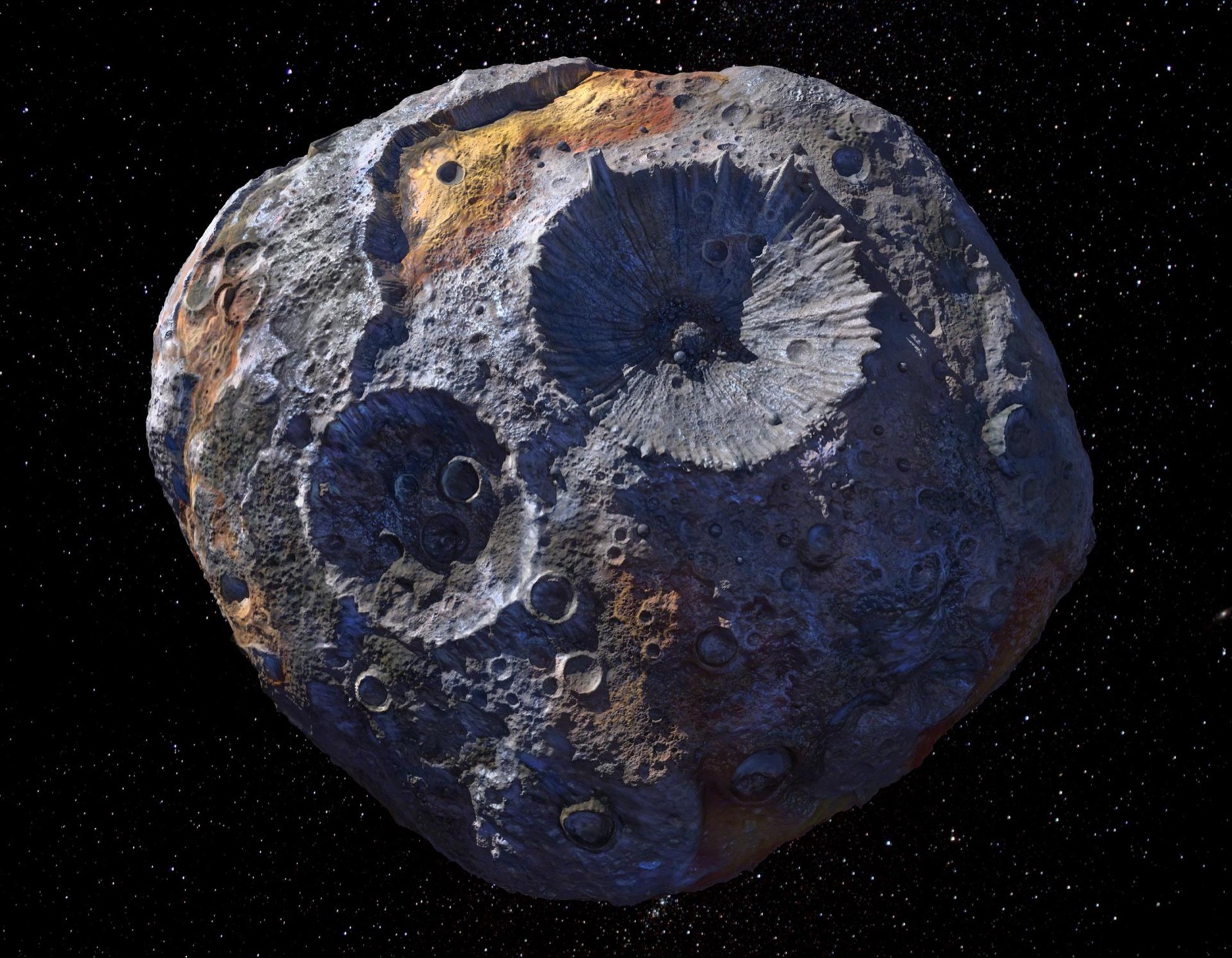
Linus orbits 22 Kalliope, which is classified as an M-type asteroid — a category long associated with metallic compositions, though the picture has become more complicated as scientists have gathered more data on specific M-type bodies. Kalliope itself is described as a large M-type asteroid, meaning it is one of the more substantial objects in the main belt. The designation of Linus carries that lineage directly: its formal name is (22) Kalliope I, anchoring it unambiguously as the first confirmed moon of asteroid number 22. The relationship between a moon's properties and those of its parent body is scientifically valuable because moons like Linus can be used to calculate the mass of Kalliope through careful orbital analysis — something that would otherwise require a dedicated spacecraft rendezvous to determine accurately.
08 Linus in the Context of Known Asteroid Moons Deeper
The discovery of Linus in 2001 came during a remarkable surge in asteroid moon detections that followed improvements in adaptive optics and the deployment of large ground-based telescopes like Keck. Before this era, asteroid moons were theoretical curiosities more than confirmed realities. Linus is notable within this growing population not just for its size but for what it represents structurally: a main-belt binary system where the secondary body is large enough to have its own measurable gravitational influence on the system dynamics. The article notes that only the companions of 617 Patroclus and 90 Antiope are larger among known main-belt asteroid moons, which means the Kalliope-Linus system sits near the top of a size distribution that falls off steeply toward smaller, less detectable objects. Many asteroid moons found since 2001 are mere kilometer-scale slivers, making Linus's estimated 28 ± 2 km diameter all the more remarkable.
09 What It Takes to Spot a 28-Kilometer Moon
Detecting Linus from Earth required two of the most powerful ground-based telescopes in the world — the Keck telescope and the Canada-France-Hawaii Telescope, both perched atop Mauna Kea in Hawaii. At main-belt distances, a 28-kilometer object orbiting a larger asteroid is extraordinarily difficult to resolve because the angular separation between moon and parent can be tiny, and the moon's faint reflected light is easily drowned out by the glare of the primary. Adaptive optics systems, which correct for the blurring effect of Earth's atmosphere in real time, were essential to making these detections possible. Without them, ground-based telescopes would smear the image enough that Linus would vanish into the glow of Kalliope entirely. The near-simultaneous independent detection by two separate teams in late August and early September 2001 confirms that the technology had genuinely matured to the point of making such discoveries reproducible.