Asteroid · Deep guide
22 Kalliope
Also called: 22 Kalliope · (22) Kalliope · A852 WA
A metal-type asteroid named after the Muse of epic poetry, circled by its moon Linus.
What is it?
Kalliope is a large M-type asteroid about 150 km across in the main belt. It was discovered in 1852 by John Russell Hind in London and named after Calliope, the Greek Muse of epic poetry. A small moon, Linus — named after Calliope's son in myth — orbits it, letting astronomers measure Kalliope's mass and density.
The deep dive
Researched for the Atlas from Wikipedia — 22 Kalliope (2,664 characters read) · updated Nov 14, 2026
01 An M-type asteroid with a confusing surface
Kalliope belongs to the M-type class of asteroids, a designation that historically suggested a largely metallic composition — essentially a flying chunk of iron and nickel. For Kalliope, though, the picture refuses to stay simple. Its bulk density of about 3.4 g/cm3 is consistent with a metal-rich body, but spectroscopic studies have revealed evidence of hydrated minerals and silicates, pointing instead toward a stony surface. Adding further doubt, Kalliope has a low radar albedo — metal reflects radar waves strongly, so a purely metallic surface should shine brightly in radar observations, and Kalliope does not. The emerging consensus is that Kalliope is probably a mixture of metal and silicates rather than a solid iron cannonball. Its surface chemistry and its bulk properties are telling somewhat different stories, and reconciling them remains an active puzzle for planetary scientists studying the M-type population.
02 Inside a probable rubble pile Deeper
Although Kalliope's measured bulk density sits at roughly 3.4 g/cm3, that number does not straightforwardly describe what the asteroid is made of — it describes the whole body, empty spaces included. If Kalliope is a rubble pile, as many asteroids of its size are thought to be, then its interior may be 20 to 40 percent empty space: a loosely packed aggregate of rocks and metal fragments held together by their own weak mutual gravity rather than rigid strength. Correcting for that porosity pushes the inferred material density up to between 4.2 and 5.8 g/cm3. That elevated material density supports the idea that at least some of Kalliope's constituent material is dense metal, since silicate rock alone typically has densities well below 4 g/cm3. So while the surface looks stony and hydrated, the interior mass budget seems to demand a significant metallic component mixed in somewhere through the body.
03 A tilted, retrograde world
Kalliope spins in an unusual orientation. Lightcurve analysis — the technique of tracking how an asteroid's brightness rises and falls as it rotates — indicates that its rotation pole most likely points toward ecliptic coordinates of β = −23° and λ = 20°, with an uncertainty of about 10°. That geometry gives Kalliope an axial tilt of 103°, meaning it leans past the perpendicular and spins in a slightly retrograde sense: opposite to the direction most solar system bodies rotate. Earth's axial tilt of 23.5° gives us our seasons; Kalliope's tilt of over 100° puts it in a category closer to Uranus, which rolls nearly on its side. The retrograde spin has implications for how Kalliope interacts gravitationally with its moon Linus and for how the system evolved after the collision that likely created the Kalliope asteroid family.
04 How Kalliope's true size was pinned down Deeper
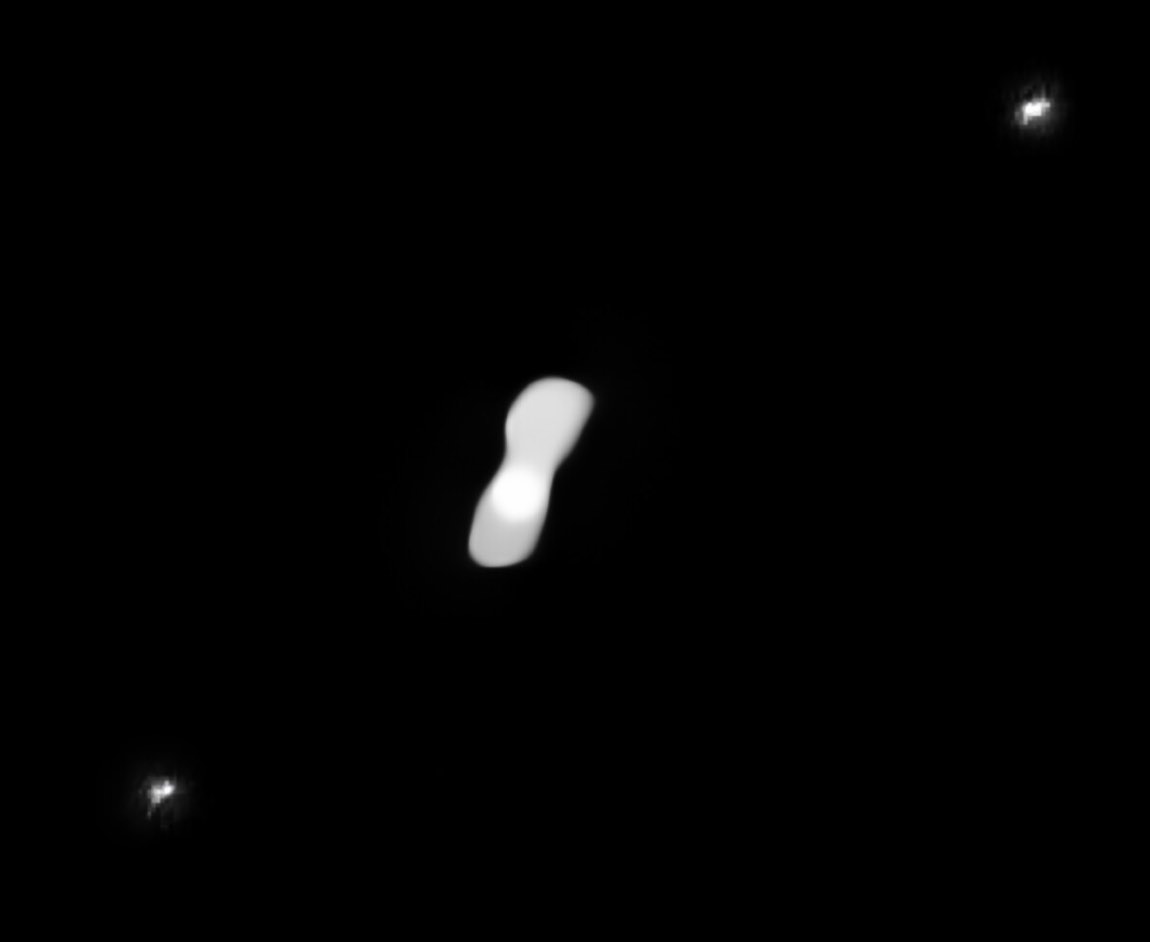
Early estimates of Kalliope's diameter came from infrared observations made by the IRAS satellite, which inferred size from how much heat the asteroid radiates. Those measurements suggested a larger body. When astronomers were able to observe mutual eclipses — moments when Kalliope and its moon Linus pass in front of and behind each other as seen from Earth — they obtained a much more direct and precise measurement. The resulting diameter of approximately 166 km turned out to be 8 percent smaller than the IRAS figure. That difference matters: an 8 percent reduction in diameter translates to a noticeably smaller volume and therefore affects every density calculation that follows. Resolved images obtained with the Very Large Telescope at the European Southern Observatory also confirmed that Kalliope is somewhat elongated and slightly asymmetric rather than a tidy sphere — a shape that is entirely consistent with a rubble-pile structure that has never been melted into a smooth, round body.
05 Linus: a moon large enough to name
Kalliope's companion, officially designated (22) Kalliope I and named Linus, is not a trivial speck. At roughly 28 km in diameter, Linus would qualify as a respectable asteroid in its own right if it were orbiting the Sun independently rather than circling Kalliope. It travels around Kalliope at a distance of about 1,100 km from the center of the primary — equivalent to roughly 13.2 times Kalliope's own radius. To put that separation in perspective, Kalliope itself is about 166 km across, so Linus orbits at a distance roughly six and a half times the diameter of the body it accompanies. The moon is named after Linus of Greek mythology, a son of the Muse Calliope, maintaining the mythological family connection that began with the naming of the asteroid itself after the Muse of epic poetry.
06 Two teams discover Linus at once
The discovery of Linus in 2001 came as something of a double event. Jean-Luc Margot and Michael E. Brown spotted the moon on 29 August 2001, but independently, a separate team led by William Merline also detected it just three days later. Competing discoveries like this are not unheard of in planetary science, particularly when new technology suddenly makes previously invisible objects accessible to multiple research groups simultaneously. In this case, the technology enabling both teams was adaptive optics — systems fitted to large ground-based telescopes that use deformable mirrors to cancel out the blurring effect of Earth's atmosphere in real time, producing images sharp enough to resolve objects very close to a bright companion. The existence of two independent detections within days of each other underscores how much the deployment of adaptive optics opened up the study of asteroid companions around the turn of the millennium.
07 The first occultation of a moon's moon Deeper
On 7 November 2006, a group of Japanese observers achieved a milestone in asteroid science: for the first time, they successfully recorded a stellar occultation by the satellite of an asteroid rather than by an asteroid itself. As Linus passed in front of a background star, observers at different locations timed the moment the star disappeared and reappeared, producing geometric chords that could be used to reconstruct the cross-sectional shape of the passing body. The prediction that made this possible was issued just one day before the event by Berthier and colleagues, drawing on more than five years of regular observations of the Kalliope–Linus system using adaptive optics on ground-based telescopes. The resulting chord measurements allowed an estimate of Linus's size in the range of 20 to 28 km — a range that brackets the later adopted value of about 28 km. The feat demonstrated that careful long-term monitoring of binary asteroid systems can enable precise, rapid-turnaround predictions of rare, fleeting events.
08 Fifteen stellar occultations and counting
Beyond the landmark occultation of Linus itself, Kalliope as a whole has been a productive target for occultation astronomy. Between 2004 and 2021, the asteroid was observed to pass in front of fifteen separate background stars, each event recorded by ground-based observers. Stellar occultations are among the most powerful tools available for studying asteroid shapes and sizes without sending a spacecraft. When an asteroid blocks a star, the duration of the blackout at each observing site translates directly into a chord across the asteroid's silhouette. Combining many chords from many sites produces a two-dimensional outline of the asteroid's cross-section. For an elongated, asymmetric body like Kalliope, accumulating multiple occultations captured at different orientations over seventeen years helps build up a progressively more accurate three-dimensional model of its irregular form.
09 A family born from ancient catastrophe
In 2022, researchers announced that 22 Kalliope is not an isolated survivor wandering the asteroid belt alone — it is the largest member of an asteroid family. Asteroid families are groups of objects that share similar orbits and are understood to be the debris field left behind after a large collision shattered or heavily cratered a parent body long ago. The Kalliope family is estimated to have formed approximately 900 million years ago, meaning the catastrophic event that created it occurred during a time when complex animal life was just beginning to emerge on Earth. That collision likely reshaped Kalliope's surface and structure significantly. The 2022 study also raised the intriguing possibility that Kalliope's moon Linus may have been formed at the same time — blasted loose from the parent body by the same impact or assembled from debris in its aftermath, rather than being a pre-existing companion.
10 Discovery and the name behind the asteroid
Kalliope was discovered on 16 November 1852 by John Russell Hind, a British astronomer who was a productive finder of asteroids and variable stars during the mid-nineteenth century. At the time of its discovery, the asteroid belt was still a relatively newly charted region of the solar system, and the practice of naming asteroids after figures from classical mythology was well established. Kalliope takes its name from Calliope, the Greek Muse of epic poetry — the muse credited with inspiring Homer and the tradition of heroic verse. The name was an apt choice for an object that turned out to hold its own scientific epics within it: a complex surface composition still not fully understood, a substantial moon, and membership in a family forged by one of the solar system's ancient collisions. The moon Linus continues the mythological thread, named for a son of Calliope in Greek tradition.
11 Open questions that remain unanswered Deeper
Despite over 170 years of observation since its discovery, Kalliope still presents researchers with unresolved fundamental questions. Chief among them is the true nature of its composition: is the metallic signature in its density real and physically present as chunks of iron-nickel alloy throughout the interior, or is the bulk density elevated by some other cause? The hydrated minerals identified spectroscopically are themselves puzzling — hydration typically implies that liquid water was once present, which is easier to explain for a stony or carbonaceous body than for an M-type. How Linus formed — whether from the same collision that created the asteroid family 900 million years ago or from some earlier event — is also unresolved. The elongated, asymmetric shape of Kalliope suggests a complex collisional history, but without a close spacecraft flyby, the detailed surface geology that would help reconstruct that history remains out of reach. Each new occultation adds a little more data, but the picture is still incomplete.