Moon · Deep guide · orbits Neptune
Larissa
Also called: Neptune VII · S/1981 N 1 · S/1989 N 2
A cratered Neptunian moon first glimpsed when it passed in front of a star in 1981.
What is it?
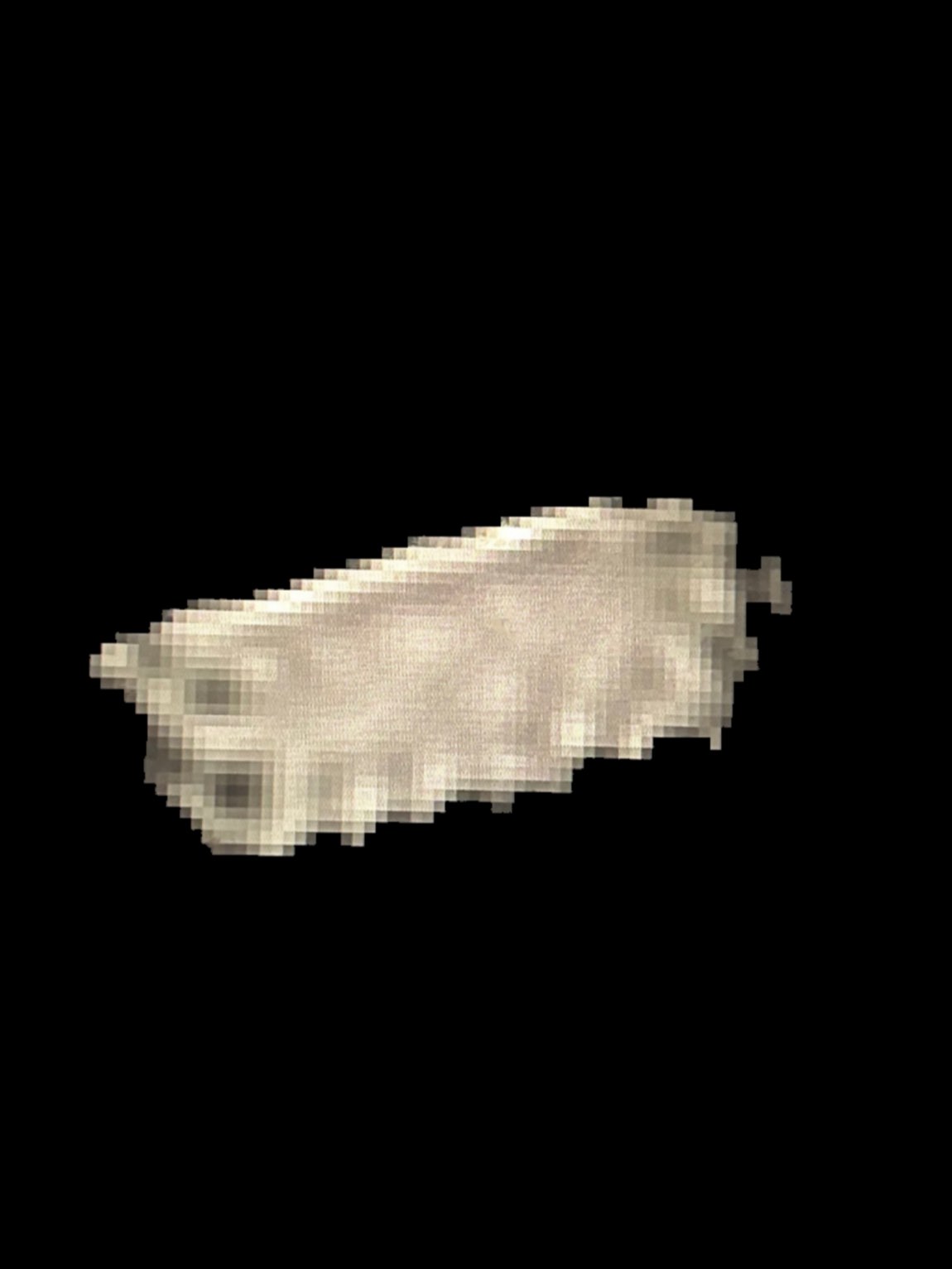
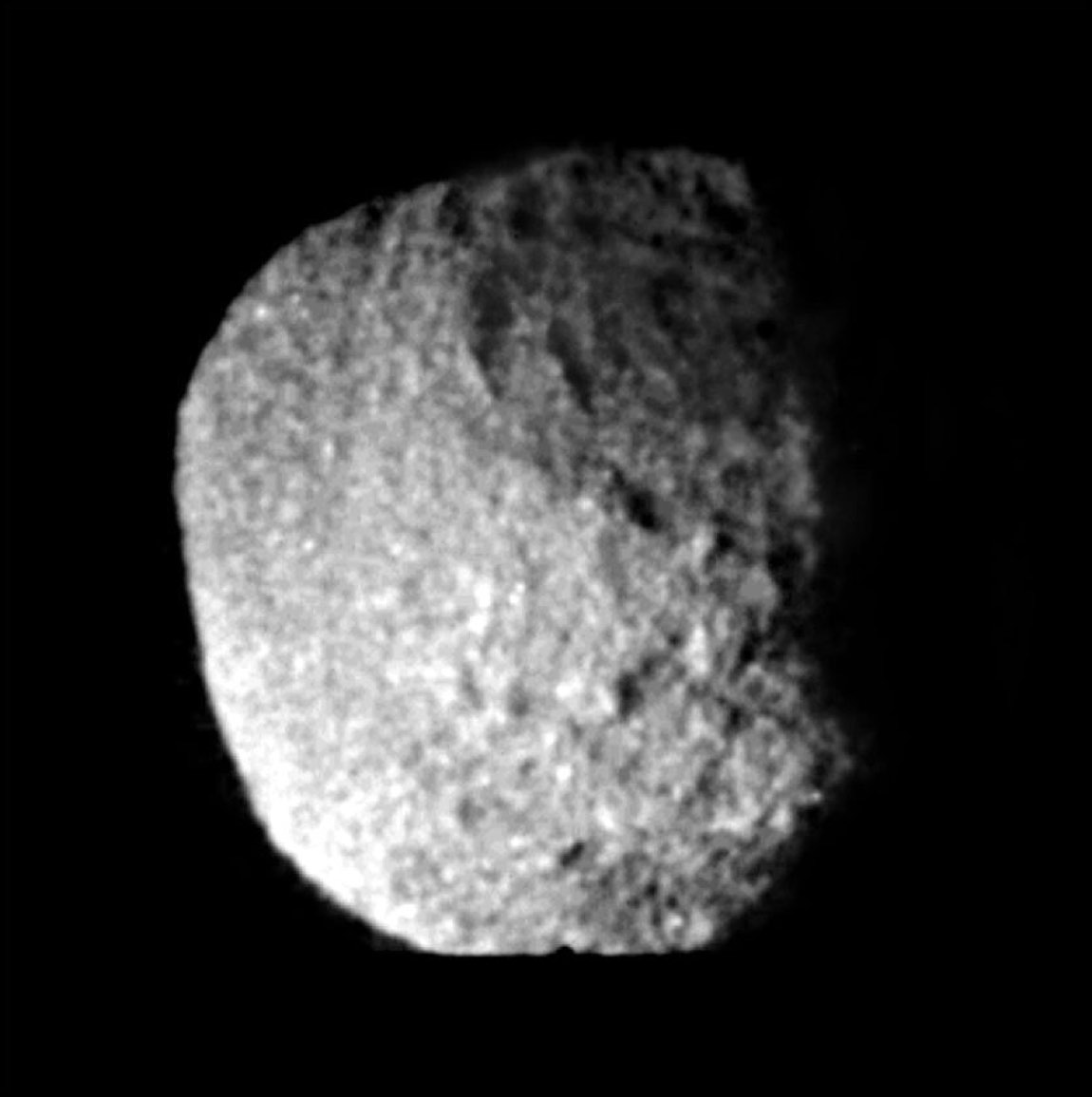
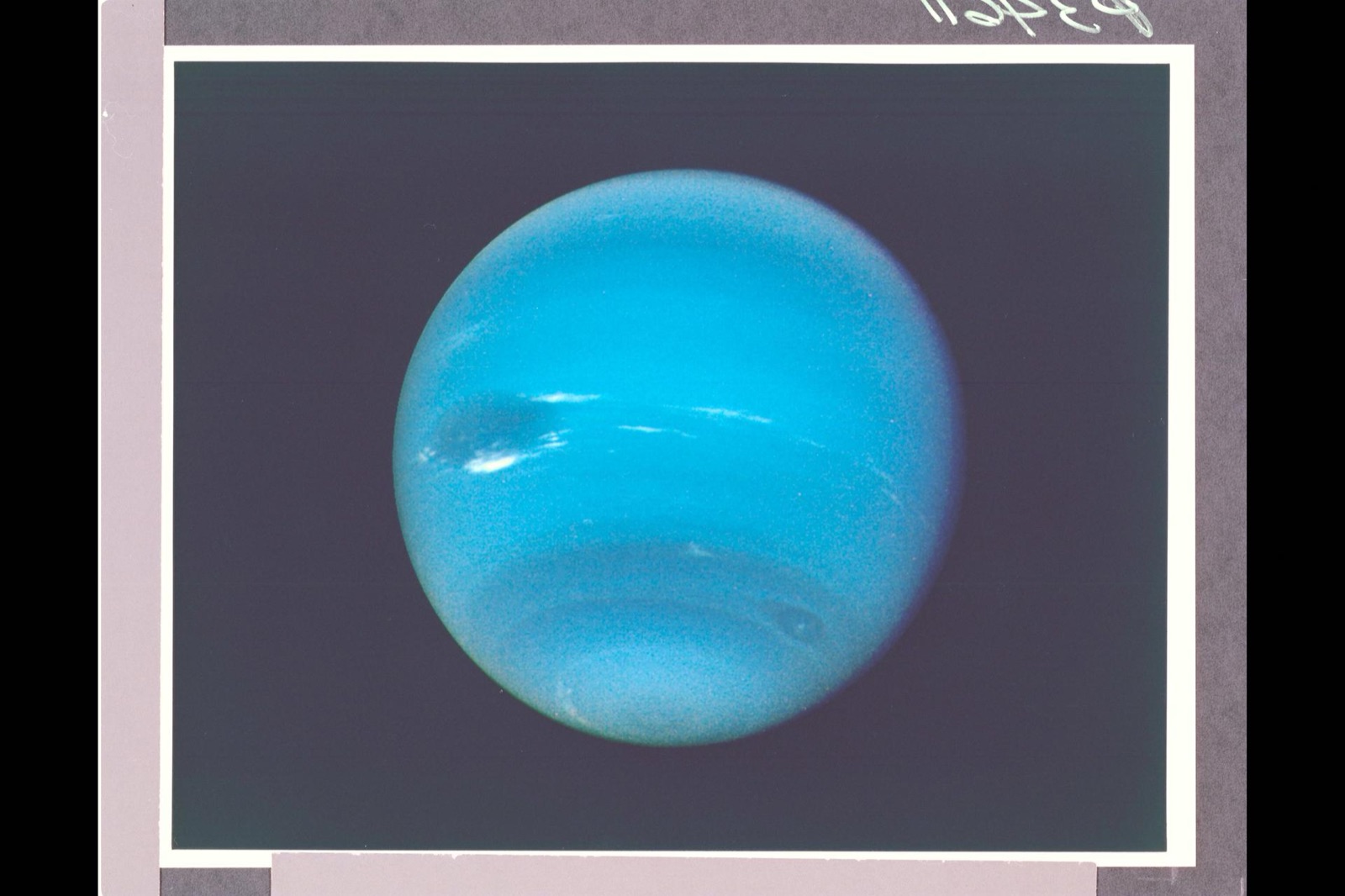
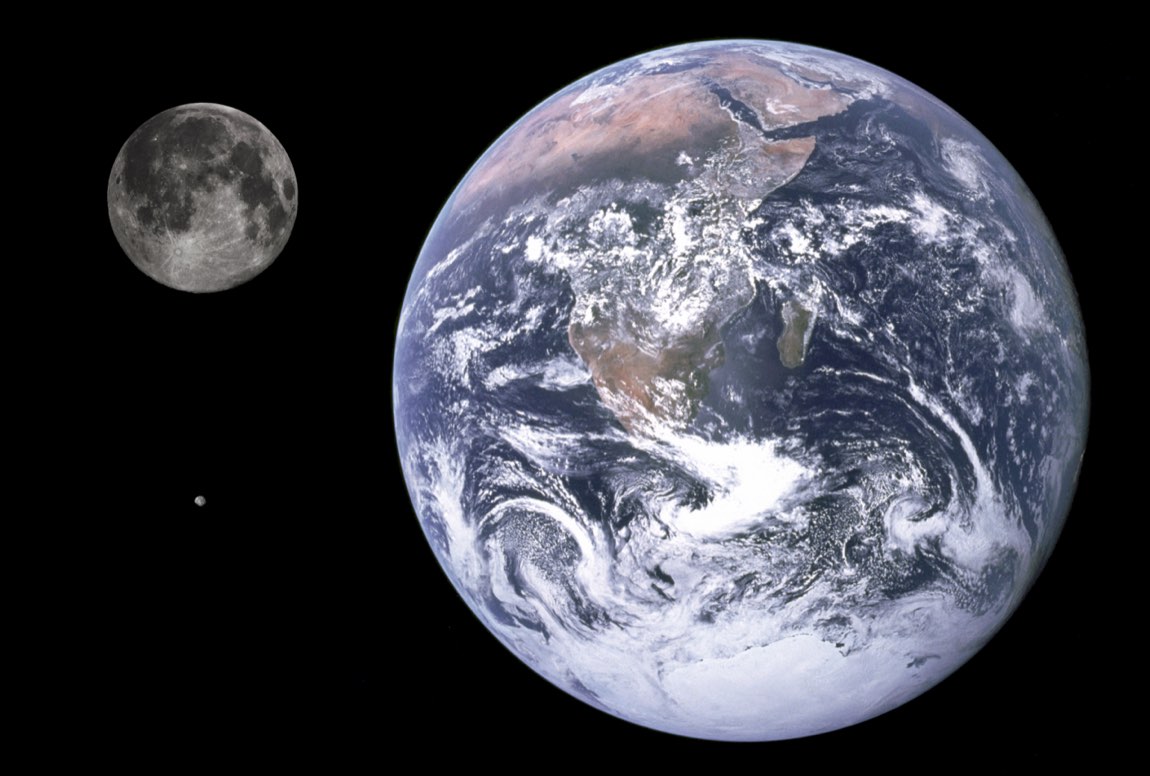
Larissa was first detected in May 1981, when astronomers watching a star blink out behind Neptune's neighbourhood caught an unexpected dip in starlight. Voyager 2 confirmed and imaged it in 1989. Larissa is an irregular moon about 216 km long, heavily cratered and showing no signs of geological change. Its orbit is slowly decaying due to tides, and it may eventually hit Neptune or break up into a ring.
The deep dive
Researched for the Atlas from Wikipedia — Larissa (moon) (2,788 characters read) · updated Nov 15, 2026
01 Two discoveries separated by eight years
Larissa has the unusual distinction of being discovered twice. The first time was entirely by accident: on May 24, 1981, Harold J. Reitsema, William B. Hubbard, Larry A. Lebofsky, and David J. Tholen were watching Neptune pass in front of a background star — a stellar occultation — when something briefly interrupted the starlight in a way that hinted at an unseen orbiting body. The finding was announced just five days later, on May 29, 1981, and the candidate moon received the temporary designation S/1981 N 1. But ground-based observations could not confirm it conclusively. The moon effectively vanished from scientific view for nearly a decade until Voyager 2 swept past Neptune in 1989. Stephen P. Synnott, working with ten frames taken over five days of Voyager imaging, pinned down a recovery date sometime before July 28, 1989, and the moon received a second provisional designation, S/1989 N 2, on August 2 of that year. Only after both sightings were reconciled did the International Astronomical Union formally assign the name Larissa, confirming it on September 16, 1991. Few moons in the solar system carry two separate discovery designations from two completely different observing campaigns.
02 A rubble pile born from ancient wreckage
Larissa almost certainly did not form in its current state. Scientists believe it is a rubble pile — a loose gravitational aggregate — reassembled from fragments of Neptune's original inner satellites. The leading explanation for why those earlier moons were destroyed traces back to Triton, Neptune's large, geologically active moon. When Triton was captured into orbit around Neptune, it arrived on a highly eccentric path that would have sent gravitational shockwaves through the inner satellite system. The resulting perturbations disrupted whatever moons existed at the time, scattering debris that eventually re-accreted into the small, irregular bodies we see today, including Larissa. This violent heritage explains why Larissa and its neighbors sit inside the orbit of Triton: they are second-generation objects, built from the rubble of a catastrophic reorganization of Neptune's moon system. The fact that Larissa shows no sign of geological modification — no resurfacing, no fracture systems smoothed over — is consistent with a body assembled from cold, inert fragments rather than one that ever experienced significant internal heating or differentiation.
03 An irregular, heavily cratered world
Larissa is the fourth-largest satellite of Neptune, but it is decidedly not a tidy sphere. Its shape is irregular and non-spherical, meaning it lacks the mass needed for self-gravity to pull it into a round form. Its surface appears heavily cratered, bearing the accumulated scars of billions of years of impacts. Crucially, there is no sign of any geological modification — no volcanic resurfacing, no tectonic activity, nothing that would have erased or softened those craters over time. This makes Larissa a preserved record of bombardment history, its face unchanged since the craters first formed. Voyager 2 was the only spacecraft to photograph Larissa with enough resolution to reveal actual surface detail rather than a featureless smudge, and those images confirmed the cratered landscape. Among Neptune's inner moons, Larissa was distinctive in this regard: the probe's geometry and timing allowed for real photographs of its surface, while the other small inner moons appeared only as dots or blurry specks in Voyager's frames. That single flyby in 1989 remains the entirety of close-up observational data humanity possesses about this world.
04 Spiraling inward toward a dramatic fate
Larissa's orbital future is bleak by any measure. Its orbit lies below Neptune's synchronous orbit radius, the distance at which a moon would orbit at exactly the same rate as the planet rotates. Any moon inside that boundary experiences tidal deceleration: Neptune's gravity continuously saps orbital energy, causing the moon to spiral slowly inward. Over an astronomically long timescale, this process will bring Larissa to one of two possible ends. If it survives intact long enough, it will plunge into Neptune's atmosphere. Alternatively, as it draws closer it will eventually cross its Roche limit — the distance inside which Neptune's tidal forces overcome the moon's own self-gravity. At that point, tidal stretching would tear Larissa apart, scattering its material into a planetary ring. This is precisely the fate that awaits Triton as well, though Triton's timeline and mechanism differ. For Larissa, a rubble pile with relatively weak internal cohesion, the ring-formation scenario may be especially plausible. The orbit is nearly circular today, suggesting the tidal decay is a slow, steady process rather than a chaotic one, but the direction of travel is irreversible.
05 Surface chemistry: hints of ancient water Deeper
Despite being a frozen, airless body billions of kilometers from the Sun, Larissa's surface chemistry tells a surprisingly water-rich story — though the water is long gone. Spectroscopic observations reveal a deep absorption feature at 3 micrometers associated with OH, the hydroxyl group, along with the presence of phyllosilicates, which are clay-like minerals. These minerals do not form in dry environments; they require prolonged interaction with liquid water. The article is explicit that Larissa lacks clear signatures of water ice itself, which makes the phyllosilicates all the more telling: the water participated in chemistry and was then lost or locked into mineral structures. This composition is said to resemble carbonaceous chondrite meteorites and main-belt asteroids like Ceres, objects that formed in the early solar system from material that experienced low-temperature aqueous alteration. Scientists infer that the material accreted by Larissa was altered by water exposure at temperatures below 300 to 400 K, and that the bulk of this material was never heated above 700 K — a threshold that would have driven off the hydroxyl-bearing minerals entirely. Larissa's surface is therefore a chemical fossil, preserving evidence of water chemistry that occurred long before the moon took its current form.
06 How dark and how reflective is Larissa? Deeper
Larissa is not a bright object. Its surface albedo — the fraction of incoming light it reflects — is a modest 0.08 at wavelengths of 1.4 and 2.0 microns, meaning it reflects only about 8 percent of the light hitting it at those near-infrared wavelengths. For comparison, fresh asphalt reflects roughly 4 percent of visible light, so Larissa is somewhat brighter than a road surface but far from mirror-like. Things get darker at 3.0 microns, where the albedo drops to just 0.03, coinciding with the deep OH absorption feature that signals hydroxyl-bearing minerals. At 4.6 microns the albedo climbs back up to 0.09. This wavelength-dependent variation in reflectivity is not arbitrary; it encodes the surface's chemical fingerprint, with different minerals absorbing and reflecting at characteristic wavelengths. The overall low albedo is consistent with the carbonaceous chondrite comparison: these are carbon-rich, dark materials rather than bright icy surfaces. The numbers also help explain why Larissa was so difficult to detect and characterize from Earth: a small, dark, distant body demands either a lucky occultation event or a visiting spacecraft to reveal its true nature.
07 The one and only close encounter: Voyager 2
Every photograph, every piece of resolved surface data, and every close-range measurement of Larissa comes from a single source: Voyager 2, which flew past the Neptune system in 1989. No other spacecraft has visited Neptune, let alone its inner moons, in the decades since. The probe captured images detailed enough to show Larissa's cratered surface clearly — a rarity among Neptune's small inner satellites, which were too faint or too poorly positioned to yield anything more than dots in Voyager's cameras. The 1989 flyby was also the moment that confirmed Larissa definitively as a real, solitary object in its orbit, resolving the ambiguity left by the 1981 occultation hint. Synnott's announcement described ten imaging frames taken over five days, a small dataset by modern standards but enough to establish the moon's orbital parameters and basic shape. No follow-up mission has been approved or launched in the more than three decades since. Larissa remains one of the least-visited substantial bodies in the outer solar system, known in its broad outlines but essentially uncharted in detail — a situation unlikely to change without a dedicated Neptune orbiter mission.
08 Where the name Larissa comes from
The name Larissa carries two layers of mythology. First, Larissa was a lover of Poseidon, the Greek god of the sea whose Roman counterpart is Neptune, the planet the moon orbits. Naming moons of Neptune after figures associated with Poseidon or the sea follows a consistent mythological convention established by the International Astronomical Union. But Larissa also has a geographic and mythological identity independent of Poseidon: she is the eponymous nymph of the city of Larissa in Thessaly, Greece — a real city that still exists today and is one of the oldest continuously inhabited places in Europe. The name was assigned and then formally confirmed by the IAU on September 16, 1991, roughly two years after Voyager 2's flyby cemented the discovery. The moon also carries the more bureaucratic designation Neptune VII, indicating it is the seventh moon of Neptune in the official catalog, as well as the two earlier provisional designations — S/1981 N 1 from the occultation era and S/1989 N 2 from the Voyager recovery — making its naming history among the more layered of any planetary satellite.
09 Larissa's place among Neptune's satellites Deeper
Larissa sits as the fifth-closest inner satellite to Neptune and ranks as the fourth-largest of all Neptune's known moons. That combination — relatively large but still inner — puts it in an interesting position within Neptune's satellite hierarchy. The inner satellite system is composed of bodies that, as described, are likely rubble piles re-accreted after Triton's capture disrupted whatever originally occupied those orbits. Larissa is among the larger survivors of that reconstruction. Meanwhile, Triton itself — a captured Kuiper Belt object — dominates the system in size and mass, orbiting on a retrograde path further out. The inner satellites, Larissa included, all orbit in the prograde direction and in roughly the same plane, consistent with their formation from a common debris disk. The fact that Larissa's orbit is nearly circular rather than highly eccentric suggests that whatever violent origins the rubble-pile model implies, the subsequent orbital evolution has been relatively gentle and regular. Its position inside the synchronous orbit radius links its long-term fate directly to tidal physics rather than to the kind of gravitational chaos that destroyed the original satellites.
10 Open questions: what we still do not know Deeper
Larissa is known in outline but mysterious in detail, and the gaps in knowledge are significant. The rubble-pile model for its origin is a leading hypothesis, but it has not been tested against direct interior measurements — there are none. The precise timeline of its inward spiral, and whether it will ultimately ring-ify or crash into Neptune's atmosphere, depends on internal properties like rigidity and density that remain unconstrained. The spectroscopic evidence for phyllosilicates and carbonaceous chondrite-like composition is intriguing, but it raises its own questions: where and when did the aqueous alteration occur that created those minerals? Was it in the parent bodies that were later smashed apart by Triton's perturbations, or did it happen even earlier in the protoplanetary disk? The absence of water ice signatures despite evidence for water-rock chemistry is a puzzle that connects Larissa to broader debates about volatile delivery and retention in the outer solar system. And the surface crater record, though visible in Voyager images, has never been systematically mapped or dated. Without a return mission to Neptune, most of these questions will remain unanswered for the foreseeable future.
 ⤢