Moon · Deep guide · orbits Saturn
Kiviuq
Also called: Saturn XXIV · S/2000 S 5
A possible double-lobed moon whose orbit overlaps Phoebe's.
What is it?
Kiviuq is a prograde irregular moon of Saturn, about 17 km across, in the Inuit group. Kavelaars and colleagues found it in 2000, and it is named after a hero of Inuit legend. Its brightness swings by more than two magnitudes as it spins, so it may be very elongated or even a contact binary. Its orbit is in a Kozai cycle and overlaps Phoebe's, and the two will probably collide one day.
The deep dive
Researched for the Atlas from Wikipedia — Kiviuq (moon) (1,358 characters read) · updated Nov 14, 2026
01 A hero's name from the Arctic
When a moon is discovered, it gets a cold, bureaucratic placeholder — in this case S/2000 S 5 — until astronomers agree on something better. For Kiviuq, the choice was inspired: the moon was named after Kiviuq, a hero of Inuit mythology. This was no accident of tradition. Saturn's irregular satellites discovered around the same time were being sorted into dynamical families, and the cluster Kiviuq belongs to was linked to the Arctic cultural world, becoming known as the Inuit group. The name therefore carries double meaning: it honors Indigenous storytelling traditions and signals the moon's physical kinship with its neighbors. The adjective forms — Kiviupian or Kiviuqan — are both in circulation, a small linguistic debate that mirrors the genuinely unsettled science surrounding the object itself. JJ Kavelaars and colleagues announced the discovery in 2000, adding one more dim, distant speck to the growing census of Saturn's outer moons.
02 What irregular satellites actually are
Kiviuq is classified as a prograde irregular satellite, and both words matter. 'Irregular' distinguishes it from the regular moons closer to Saturn, which formed in a flat disk around the young planet and travel in nearly circular, low-inclination orbits. Irregular moons like Kiviuq sit much farther out, following tilted, elongated paths that betray a different origin — most likely capture from elsewhere in the solar system rather than in-place formation. 'Prograde' means Kiviuq orbits in the same direction Saturn rotates, unlike the retrograde irregulars that circle the planet backward. Despite being prograde, Kiviuq's orbit is still far from tame: it roams at an average distance of 11.3 million kilometers from Saturn, more than 29 times the distance from Earth to the Moon. At that remove, the Sun's gravity is a constant, destabilizing nuisance, tugging and warping the orbit over timescales that dwarf human civilization.
03 Red color and a shared ancestry
Look at Kiviuq through an infrared spectrograph and you will see something telling: its spectral signature is very similar to two other Inuit-group satellites, Siarnaq and Paaliaq. All three are light red. That color similarity is not just aesthetically interesting — it is one of the main lines of evidence supporting the idea that the Inuit group shares a common origin. The working hypothesis is that a larger body, perhaps a captured Kuiper Belt object, was broken apart long ago, and the fragments settled into related orbits around Saturn. Kiviuq, Siarnaq, and Paaliaq may therefore be siblings in a very literal sense, pieces of the same ancestral body. The spectral match strengthens this case, though it cannot prove it conclusively: objects from different sources can share similar colors if their surfaces have been processed by the same space-weathering environment for billions of years. The debate about exactly how the Inuit group formed remains open.
04 A Kozai resonance slowly reshaping its path Deeper
Of all the unusual things about Kiviuq's orbit, the Kozai resonance is the most consequential. In a Kozai resonance, gravitational perturbations — in this case primarily from the Sun acting on a moon orbiting far from Saturn — cause a cyclical exchange between orbital inclination and eccentricity. When Kiviuq's inclination decreases, its eccentricity grows, stretching the orbit into a more elongated ellipse; when the inclination swings back up, the eccentricity shrinks again. The two quantities oscillate in a slow, coupled dance. This is not a stable long-term equilibrium but a dynamic one, and over geological timescales it means Kiviuq's orbit traces out a wide envelope of shapes. The practical consequence is dramatic: the current orbital elements of Kiviuq overlap strongly with those of Phoebe, Saturn's large retrograde irregular moon. The overlapping orbits mean that a collision between Kiviuq and Phoebe is considered a likely eventual outcome, though 'eventual' here almost certainly means timescales of hundreds of millions to billions of years.
05 On a collision course with Phoebe
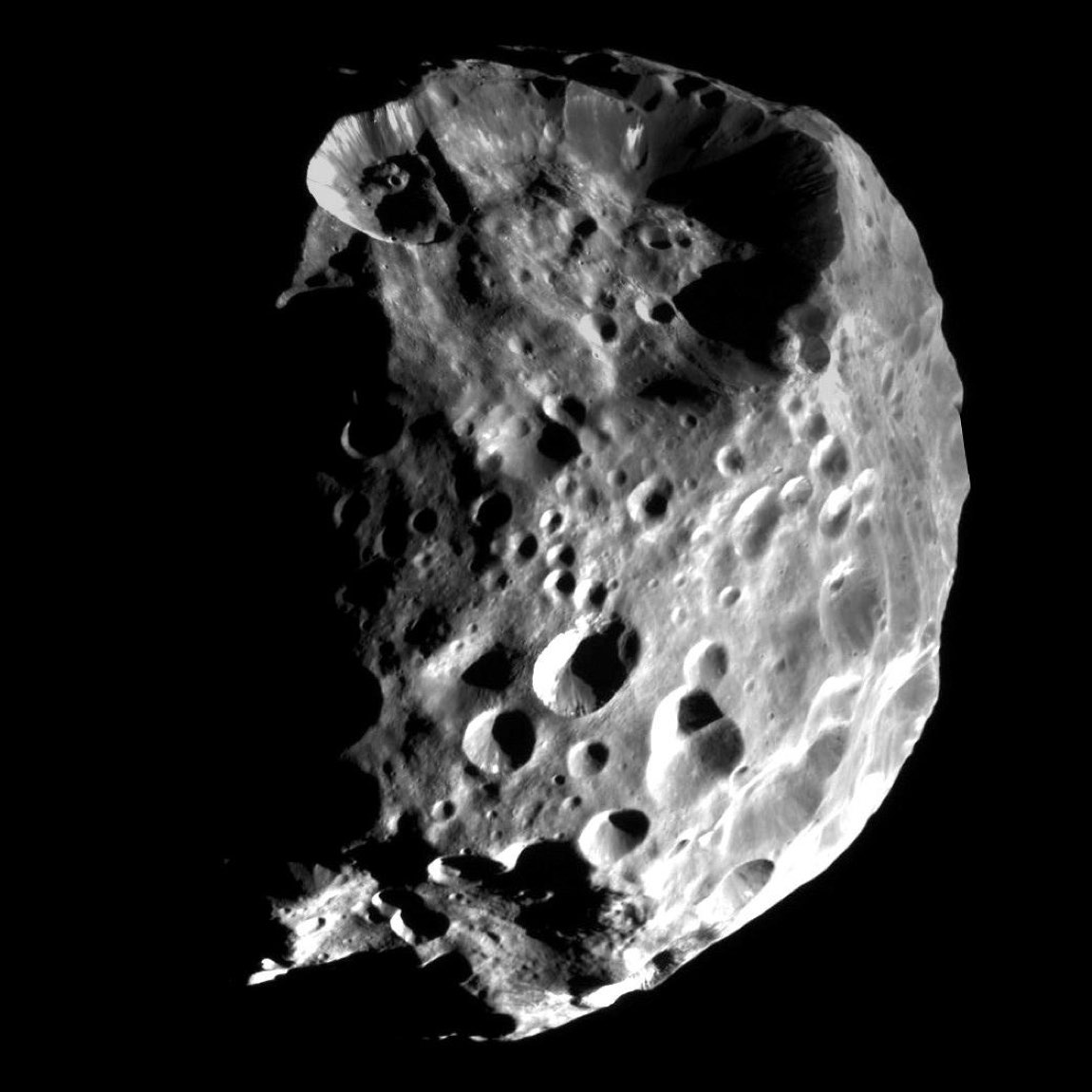
Phoebe is Saturn's most famous irregular moon — dark, roughly spherical, about 213 kilometers across, and the target of some of Cassini's best close-up imaging. Kiviuq, at about 17 km in diameter, is a much smaller object, barely a twelfth of Phoebe's size. Yet the two moons are, in a gravitational sense, headed toward one another. Because Kiviuq's Kozai resonance keeps reshaping its orbit, and because the current orbital elements of the two moons already overlap, dynamical models suggest a collision is likely in the long run. What such an impact would look like is an open question: a 17-kilometer body striking a 213-kilometer one would not shatter Phoebe the way a large impactor might, but it would excavate a fresh crater and send debris cascading into the Saturnian system. The collision would be a small geological event in Phoebe's history and the end of Kiviuq as an independent object.
06 A wildly varying brightness over hours
If you could watch Kiviuq's brightness over the course of a single day, you would see it change by more than 2 magnitudes — a variation so large it immediately signals something unusual about the moon's shape. In astronomy, a 2-magnitude swing corresponds to a brightness ratio of roughly 6.3 to 1, meaning Kiviuq reflects about six times more light at its brightest than at its faintest. Regular, roughly spherical moons do not behave this way: they present nearly the same cross-section to any observer regardless of rotation. An object with such a large light-curve amplitude must be either very elongated, so that it alternately shows a broad face and a narrow edge as it spins, or it must have wildly different surface brightnesses across its body, or both. For Kiviuq, the leading interpretation is that the moon has a significantly elongated shape. This reading raises an even more provocative possibility: the shape might be explained by Kiviuq being a contact binary, two separate lobes resting against each other under mutual gravity.
07 Could Kiviuq be two bodies touching? Deeper
The contact binary hypothesis for Kiviuq sits at the intersection of shape modeling and dynamical history. A contact binary is not a moon with a dent but essentially two distinct objects that have drifted together so gently that they now rest in mutual contact, held together primarily by their own weak gravity rather than strength. Many small solar system bodies — comets, asteroids, Kuiper Belt objects — appear to have this structure, and it would not be surprising to find it among Saturn's captured irregular moons as well. If Kiviuq is indeed a contact binary, it probably arrived that way, already a paired object before Saturn ever captured it, or it became one through an extremely slow gentle collision after capture. The light-curve amplitude of over 2 magnitudes is consistent with this geometry but does not prove it. Confirming the contact binary structure would require resolved imaging, which Cassini provided only limited data for from its single observation run in 2010.
08 Cassini's one good look at Kiviuq
On 30 August 2010, the Imaging Science Subsystem camera aboard the Cassini–Huygens spacecraft pointed at Kiviuq from a distance of 9.3 million kilometers — roughly 24 times the Earth–Moon distance — and gathered light-curve data. This single observing session was brief, as Cassini's primary mission kept it focused on Saturn, its rings, and the larger moons. Nevertheless, the 2010 data were good enough to measure Kiviuq's rotation period for the first time. The initial result placed the rotation period at 21 hours and 49 minutes, and that figure was later refined to 21 hours and 58 minutes. For context, a Kiviuq day is very close to an Earth day in length — a coincidence with no deeper meaning, but one that makes the number easy to hold in mind. This remains essentially the full extent of dedicated spacecraft observation of Kiviuq; no mission has targeted it more closely, and no flyby has returned surface details.
09 How the rotation period was pinned down Deeper
Measuring the rotation period of a small, distant, unresolved moon requires patience and a reliable light curve. Because Cassini could not see Kiviuq as more than a point of light from 9.3 million kilometers away, the technique was entirely photometric: astronomers tracked how the total brightness of that point varied over time and looked for a repeating pattern. The period of that repeating cycle is the rotation period of the moon. Kiviuq's large light-curve amplitude — varying by more than 2 magnitudes — actually made this easier than it would be for a nearly spherical moon, because the signal was strong and unambiguous. The initial measurement of 21 hours and 49 minutes was later refined to 21 hours and 58 minutes, a difference of 9 minutes that matters if you are trying to build a precise rotational model but is otherwise modest. The refinement likely came from combining the Cassini data with ground-based observations, though the article does not specify the method of refinement.
10 A tiny world at an enormous distance
With a diameter of about 17 kilometers, Kiviuq is small enough that you could drive across it at highway speed in roughly ten minutes. Its surface gravity is a tiny fraction of Earth's — far too feeble to retain any atmosphere or to pull a person standing on its surface into anything resembling a confident footstep. Despite its modest size, Kiviuq orbits Saturn at an average distance of 11.3 million kilometers, far enough that Saturn itself would appear as a bright but visually small disk in Kiviuq's sky, stripped of the dramatic ring views that make Titan or Enceladus so compelling. The 449-day orbital period means Kiviuq's year is longer than Earth's, another reminder that the outer solar system runs on a different clock. At these distances and scales, Kiviuq belongs to a population of objects that are as much remnants of the early solar system as they are moons in the conventional sense.
11 Open questions and what could answer them Deeper
Several fundamental questions about Kiviuq remain unanswered. Whether it is truly a contact binary requires resolved shape data that do not yet exist — only a dedicated close flyby or an orbiter with a powerful camera could settle the question. The Kozai resonance is modeled but its long-term behavior depends on the precise mass distribution of all the bodies involved, introducing uncertainty into the collision timeline with Phoebe. The spectral similarity to Siarnaq and Paaliaq strongly suggests common origin in a disrupted parent body, but the composition of that parent — its density, internal structure, and place of origin in the early solar system — is essentially unknown. Ground-based photometry can track the light curve but cannot distinguish surface color patches from shape effects without additional data. Future missions targeting Saturn's irregular moon population, or serendipitous stellar occultations that Kiviuq passes in front of, could sharpen the picture significantly. For now, Kiviuq is defined as much by what we do not know as by what we do.