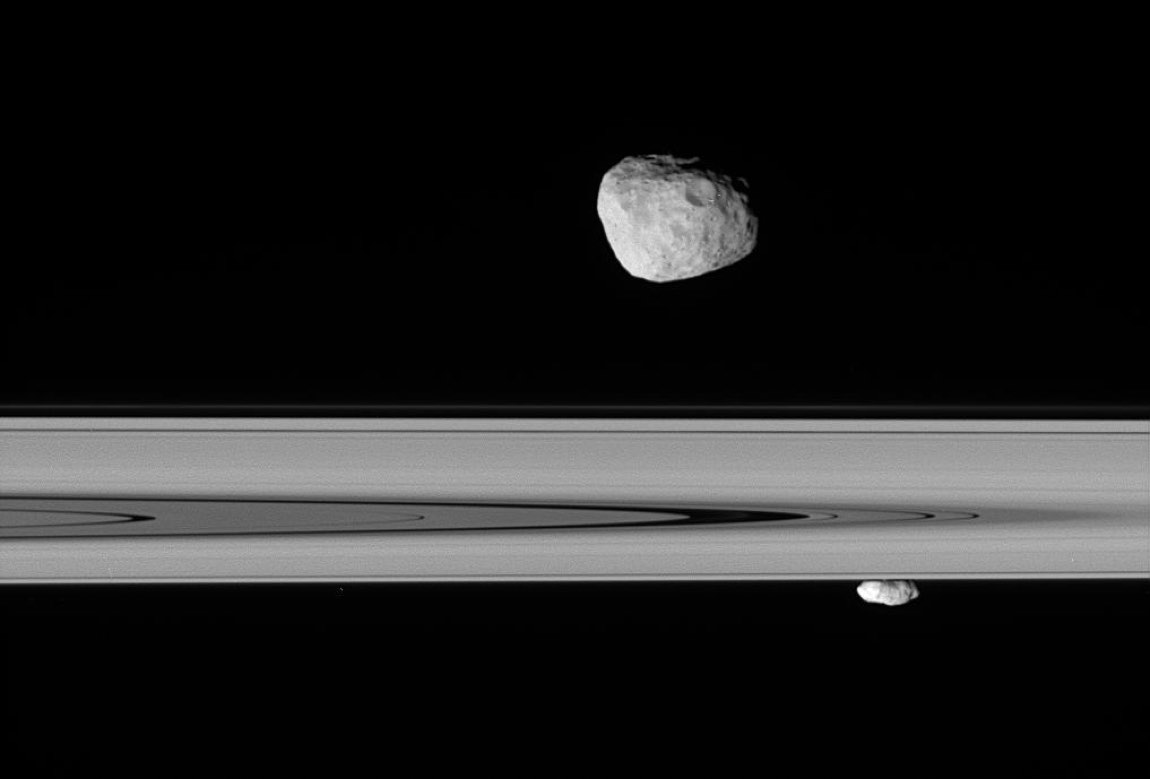
 Photograph · NASA / Jet Propulsion Laboratory / Space Science Institute · Public domain
Moon · Deep guide · orbits Saturn
Janus
Also called: Saturn X · S/1966 S 2
Named for the two-faced Roman god — fitting for a moon that shares its orbit with a partner.
What is it?
Janus is a small, icy inner moon of Saturn about 178 km across that shares its orbit with Epimetheus. Audouin Dollfus identified it in December 1966, though it had been photographed unknowingly earlier that autumn. Only in 1978 did astronomers realise two moons were sharing the orbit, and the two now trade places about every four years. Janus is likely a rubble pile; together with Epimetheus it helps keep the sharp outer edge of the A ring.
The deep dive
Researched for the Atlas from Wikipedia — Janus (moon) (5,230 characters read) · updated Nov 14, 2026
01 A Tangled Discovery Across Twelve Years
The story of finding Janus is unusually messy, even by the standards of outer-planet astronomy. Jean Texereau photographed the moon on 29 October 1966 without recognising what he had captured. Audouin Dollfus then made the credited identification on 15 December 1966, giving the object the temporary designation S/1966 S 2. Just three days later, on 18 December, Richard Walker spotted something in the same orbital zone — but its position stubbornly refused to match the earlier sightings. Rather than resolving the puzzle, Walker's observation deepened it. For twelve years the contradiction sat unanswered until, in October 1978, Stephen M. Larson and John W. Fountain cracked it: the conflicting positions made perfect sense if two separate moons were sharing nearly identical orbits. Walker, originally thought to have made a redundant observation, was retroactively credited with discovering the second moon, Epimetheus. Voyager 1 then settled the matter conclusively in 1980 by imaging the orbital configuration directly.
02 Pioneer 11's Accidental Detection
Before any camera confirmed Janus as a distinct world, an instrument designed for something else entirely picked up its presence. When Pioneer 11 flew past Saturn on 1 September 1979, three onboard energetic-particle detectors registered a dip in the particle flux — the "shadow" cast by a solid body blocking a stream of high-energy particles. The object was assigned the provisional designation S/1979 S 2. This technique, essentially using the moon as an eclipse screen for invisible radiation rather than visible light, is a reminder that moons can announce themselves through physics as much as through photography. The particle-shadow detection gave scientists an approximate orbital position to work with, helping to anchor subsequent ground-based observations. Janus was then observed directly by Dan Pascu on 19 February 1980 (designated S/1980 S 1) and by a four-person team — Fountain, Larson, Reitsema, and Smith — just four days later on 23 February 1980 (S/1980 S 2), each observation adding another thread to the still-unravelling story.
03 How the Orbit-Swap Actually Works
Janus and Epimetheus execute a gravitational dance unlike anything else known among moons in the Solar System. Their mean orbital radii differ by only about 50 km — less than the mean radius of either moon — so by Kepler's laws the inner one laps the outer one, but agonisingly slowly: the inner orbit is completed only about 30 seconds faster, meaning the gap closes at just 0.25° per day. As the trailing moon gradually catches up over roughly four years, the pair's mutual gravity kicks in. The approaching moon gains momentum and climbs to a wider, slower orbit; the other loses momentum and drops to a tighter, faster one. They have, in effect, swapped places — and the whole cycle begins again. The closest the two ever get is about 10,000 km, roughly the distance from London to Tokyo. Because Janus is about four times more massive than Epimetheus, it barely flinches during the swap: its orbital radius changes by only about 20 km, while Epimetheus shifts by about 80 km. Confirmed swaps have occurred in January 2006, 2010, 2014, 2018, and 2022.
04 The Horseshoe: A Shape Only Visible in Relativity Deeper
The orbit-swapping behaviour acquires an elegant geometric description when viewed from the reference frame of one moon looking at the other. In that co-rotating perspective, each moon traces a path that opens wide on either side and curves back on itself like a horseshoe. The two moons effectively librate — oscillate back and forth — about their mutual L4 and L5 Lagrange points, the same gravitationally stable positions that host Jupiter's Trojan asteroids. While horseshoe orbits have been observed among certain asteroids sharing Earth's or Saturn's orbit around the Sun, the Janus–Epimetheus system is the only confirmed example of two moons locked in this configuration with each other anywhere in the Solar System. The dynamics can be rigorously described using the circular restricted three-body problem, treating Saturn as the dominant body and the two moons as the remaining players, notable because the moons are similar enough in size that neither can be treated as negligible. This makes the system a rare natural laboratory for a usually idealised mathematical scenario.
05 A Future Destined to Unravel Deeper
The current co-orbital relationship between Janus and Epimetheus is not permanent. Both moons interact gravitationally with Saturn's A Ring, and over the far future those interactions will cause the moons' orbits to migrate gradually outward. The article states that this drift will probably cause the co-orbital configuration to collapse. The expected endpoint is a qualitatively different arrangement: rather than swapping orbits as near-equals, Epimetheus would instead settle into a stable libration around either the L4 or L5 Lagrange point of Janus, becoming in effect a trojan satellite of the larger moon. That would transform a unique peer-to-peer gravitational partnership into a more conventional leader-follower relationship similar to the trojan asteroids associated with planets. The timescale for this transition is not specified in current observations, but the eventual outcome underscores that planetary systems are not static — even configurations as remarkable as this one are only temporary chapters in a much longer gravitational story.
06 Shepherding Saturn's A Ring
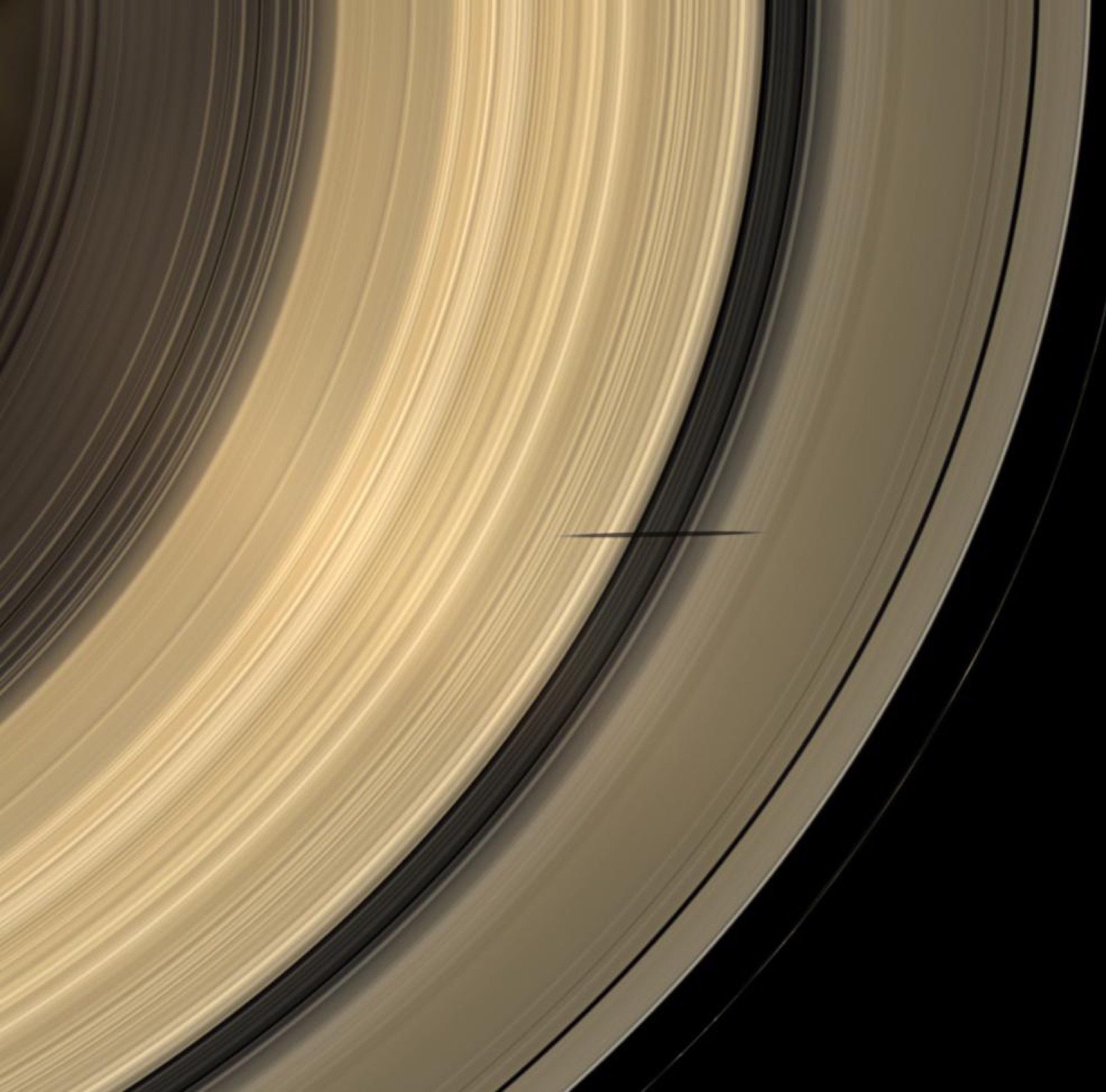
Beyond their mutual acrobatics, Janus and Epimetheus perform a service for Saturn's ring system. Together they act as shepherd moons, their gravity enforcing the sharp outer boundary of the A Ring through a 7:6 orbital resonance — meaning the ring particles complete seven orbits for every six completed by the moons. This resonance creates a repeated gravitational nudge at the same point in each ring particle's orbit, preventing material from drifting outward and maintaining the ring's crisp edge. The shepherding effect is not constant: it is more pronounced when the more massive Janus occupies the inner, resonant orbit during each four-year cycle and weaker when Janus has swapped to the outer orbit. This periodic strengthening and relaxing of the gravitational influence may leave subtle signatures in the ring's structure that Cassini's data are still being analysed to fully characterise. The interplay shows how the same moons can simultaneously maintain an exotic orbital relationship with each other while also sculpting the broader ring environment around them.
 ⤢
07 The Janus–Epimetheus Dust Ring
Sharing an orbital zone with another moon has a physical consequence beyond just the gravity: Janus and Epimetheus together generate their own faint ring. When meteoroids strike the surfaces of either moon, they blast loose small particles that then spread along the shared orbital path, forming a diffuse dust ring. The Cassini spacecraft captured this structure in 2006 using images taken in forward-scattered light — a technique that makes fine dust far more visible than it would appear in direct or reflected light. The ring spans a radial extent of about 5,000 km, occupying the zone between and around the two moons' orbits. It is not the sharply bounded structure of the A or B rings but rather a tenuous haze of ejecta slowly dispersing through space. This kind of impact-generated ring is now understood to be associated with several of Saturn's small inner moons, suggesting that the constant rain of interplanetary debris on small, low-gravity bodies is a surprisingly effective ring-building mechanism over geological time.
08 Surface Clues to a Rubble-Pile Interior
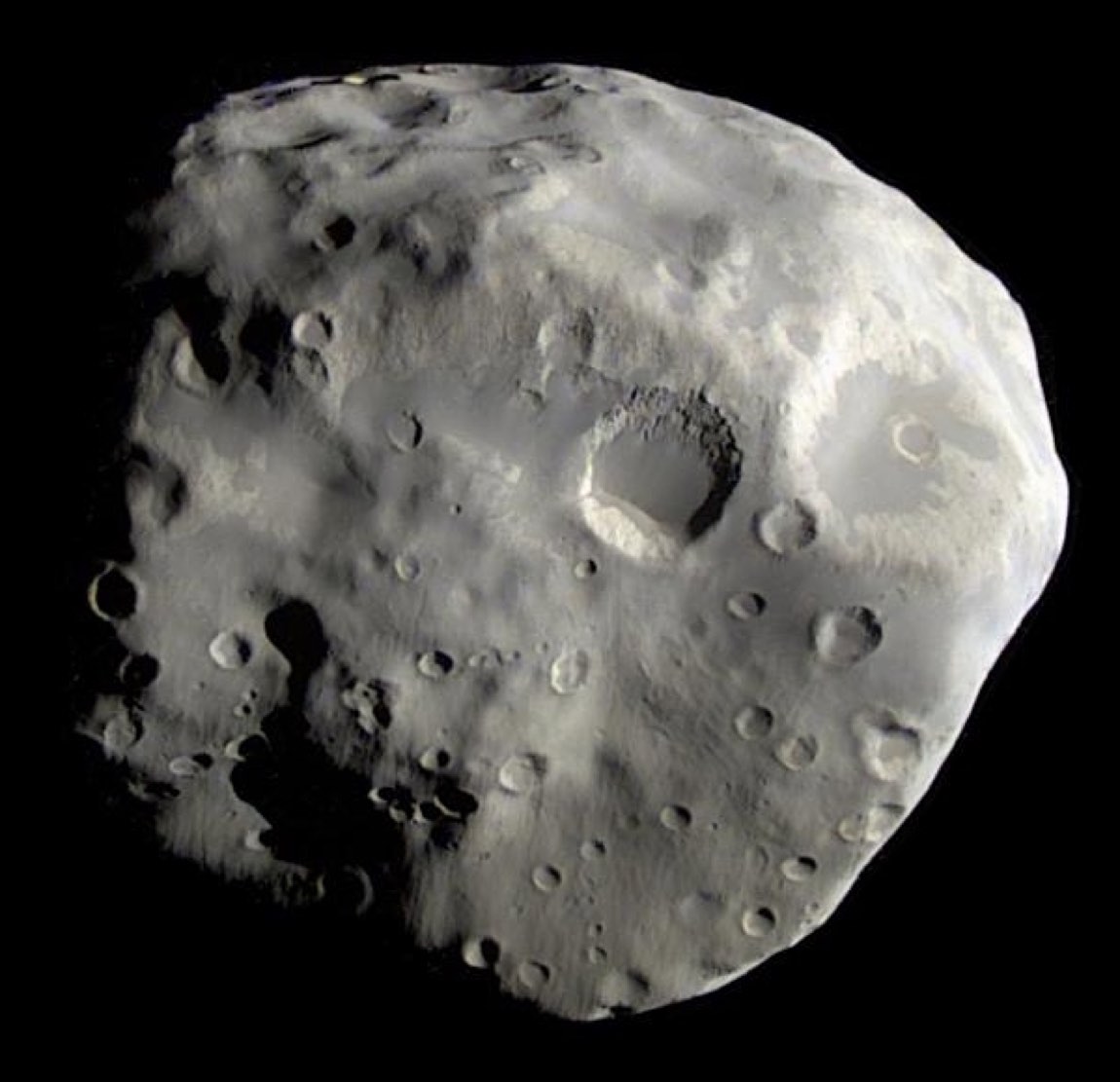
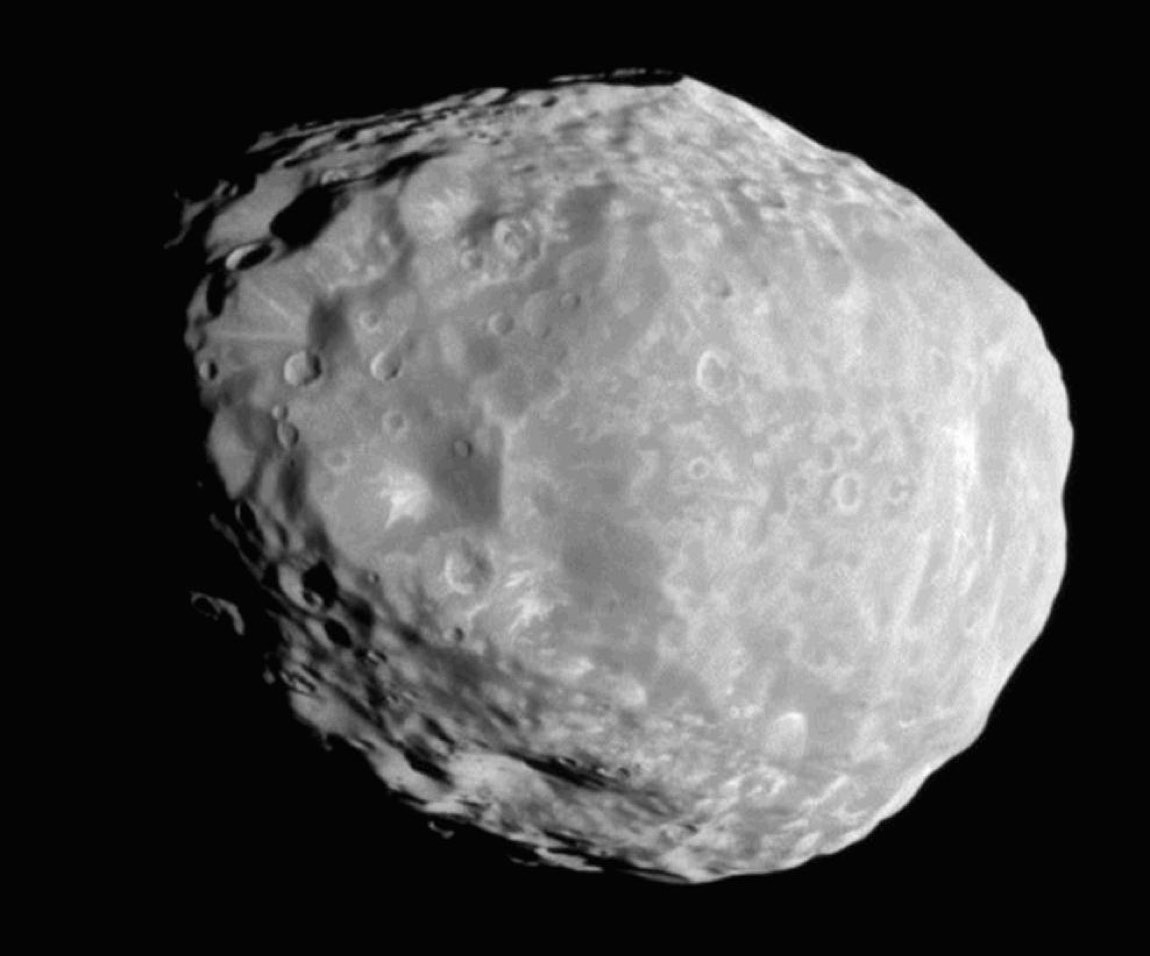
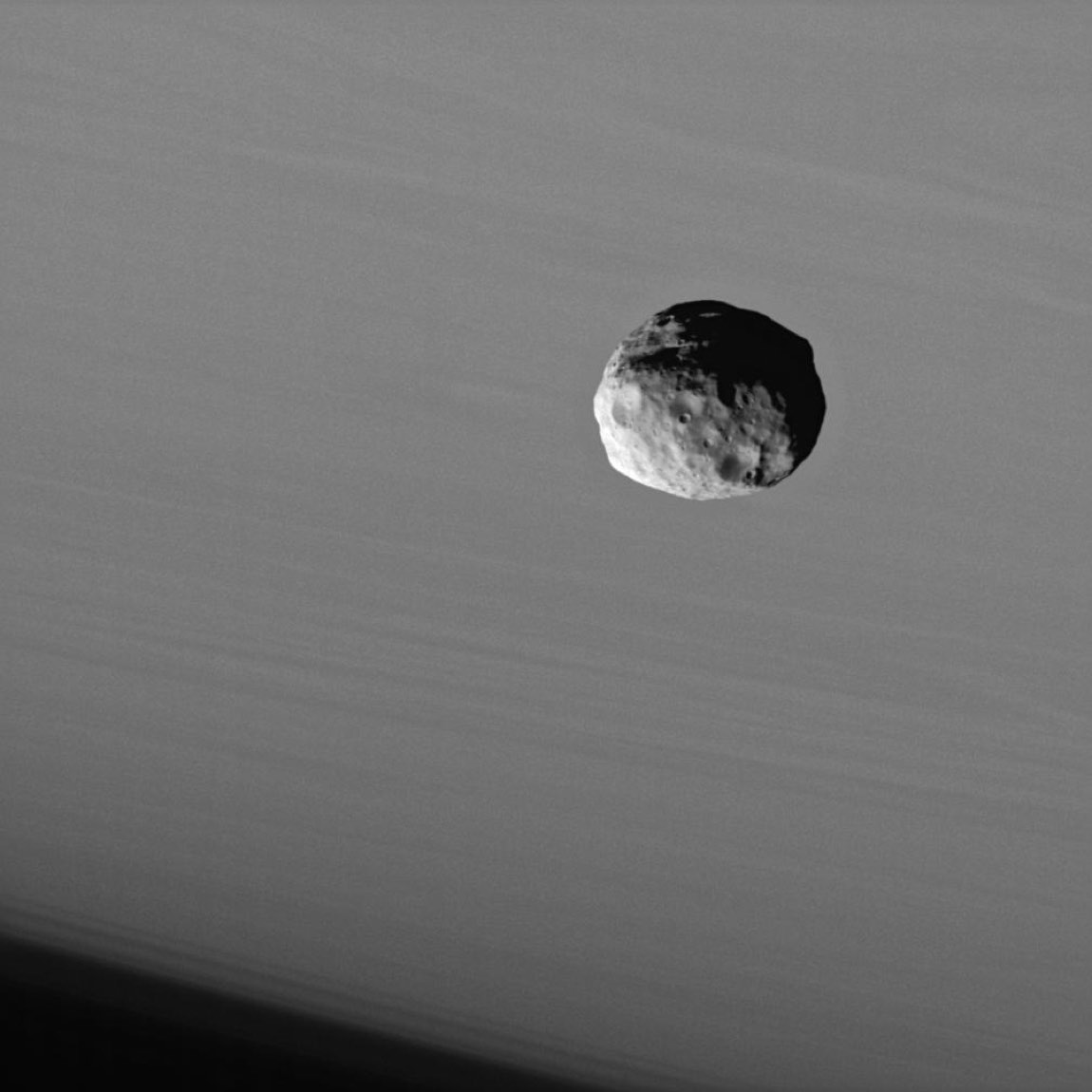
Janus presents a heavily battered face to any visiting spacecraft. Its surface is extensively cratered, with several individual craters exceeding 30 km in diameter — large features on a moon whose mean radius is itself only modest. There are few linear features such as grooves or ridges, suggesting that the interior does not transmit stress in the organised way a solid rock body might. This cratered, lineament-poor appearance is consistent with the physical parameters derived from observations: Janus has a very low density and a relatively high albedo. Low density points strongly to an icy composition, while high albedo — meaning the surface reflects a substantial fraction of incoming sunlight — further supports the idea of an ice-rich surface. Taken together, these properties have led scientists to classify Janus as likely a rubble pile: a loosely consolidated aggregate of icy chunks held together more by gravity than by any rigid internal structure. Such bodies are thought to be common products of collisional disruption and re-accumulation in the early Solar System.
09 Reading Age in the Craters Deeper
Because impact craters accumulate over time, the density and state of a moon's cratering record provides a rough chronometer — more craters generally means an older surface that has had longer to collect impacts. By this logic, the article places Janus in an interesting middle position among Saturn's inner moons: its surface appears older than that of Prometheus but younger than that of Pandora. This kind of relative age-dating by crater comparison is a standard tool in planetary science, though it carries uncertainties because the impact rate in the outer Solar System is not perfectly known, and geological resurfacing events can reset or partially obscure the record. For Janus, whose rubble-pile structure would not easily support the kind of tectonic or volcanic resurfacing seen on geologically active worlds, the cratering record is likely a more faithful archive. The few craters larger than 30 km hint at impacts energetic enough that they might have significantly disrupted a loosely bound body, raising questions about whether Janus has been shattered and re-accreted at some point in its past.
10 Craters Named for Mythological Twins
The craters on Janus carry names drawn from a specific corner of classical mythology: the legend of Castor and Pollux, the divine twins of Greek and Roman tradition. The same naming convention applies to craters on Epimetheus. This thematic pairing is itself a small piece of intentional poetry — craters on two moons that perpetually trade orbits as though they were twins take their names from the most famous pair of celestial twins in ancient storytelling. The moon itself, meanwhile, is named after a very different figure: Janus, the Roman god of beginnings, transitions, and doorways, famously depicted with two faces looking simultaneously forward and backward. The name was informally suggested shortly after Dollfus's 1966 identification, but official adoption by the International Astronomical Union did not come until 1983, the same year Epimetheus received its formal name. The seventeen-year gap between discovery and official naming reflects how tangled and contested the early observational history of these two moons remained.
11 Voyager 1's Confirming Eye
The theoretical resolution proposed by Larson and Fountain in 1978 — that two separate moons shared one confusingly crowded orbital zone — still needed hard confirmation. That came from Voyager 1 in 1980, which carried cameras capable of resolving the two moons as distinct objects and verifying that their orbits were indeed separate but nearly identical. This was part of a broader harvest of discoveries: Voyager 1's Saturn flyby revealed an enormous amount about the planet's ring structure, its magnetosphere, and its collection of moons that ground-based telescopes simply could not match. For Janus and Epimetheus specifically, Voyager provided the first resolved images, showing the heavily cratered, irregular shapes of both bodies and laying the groundwork for all subsequent physical characterisation. The Cassini mission, arriving at Saturn decades later, dramatically extended this knowledge — including the 2006 discovery of the shared dust ring — but it was Voyager 1 that transformed Janus from a disputed point of light into a confirmed and photographed world.
12 A One-of-a-Kind Lab for Orbital Physics Deeper
The Janus–Epimetheus system occupies a genuinely singular position in Solar System science: it is the only known case in which two moons share a horseshoe co-orbital relationship with each other. Horseshoe orbits are known for some asteroids relative to planets — there are examples among Earth's and Saturn's retinue of small co-orbital asteroids — but the moon-moon version has no other confirmed parallel. This makes Janus and Epimetheus an irreplaceable natural experiment. The system allows researchers to test predictions from the circular restricted three-body problem against reality, in a regime where both interacting bodies have non-negligible mass. It also raises questions that remain open: how did two moons end up in such a finely tuned configuration in the first place? Did they form from a single parent body that was disrupted, perhaps explaining their similar orbits? Or did they migrate independently into this configuration? The article does not resolve these questions, and they remain active areas of inquiry, making the Janus–Epimetheus pair one of the more theoretically rich targets in planetary science.
 ⤢