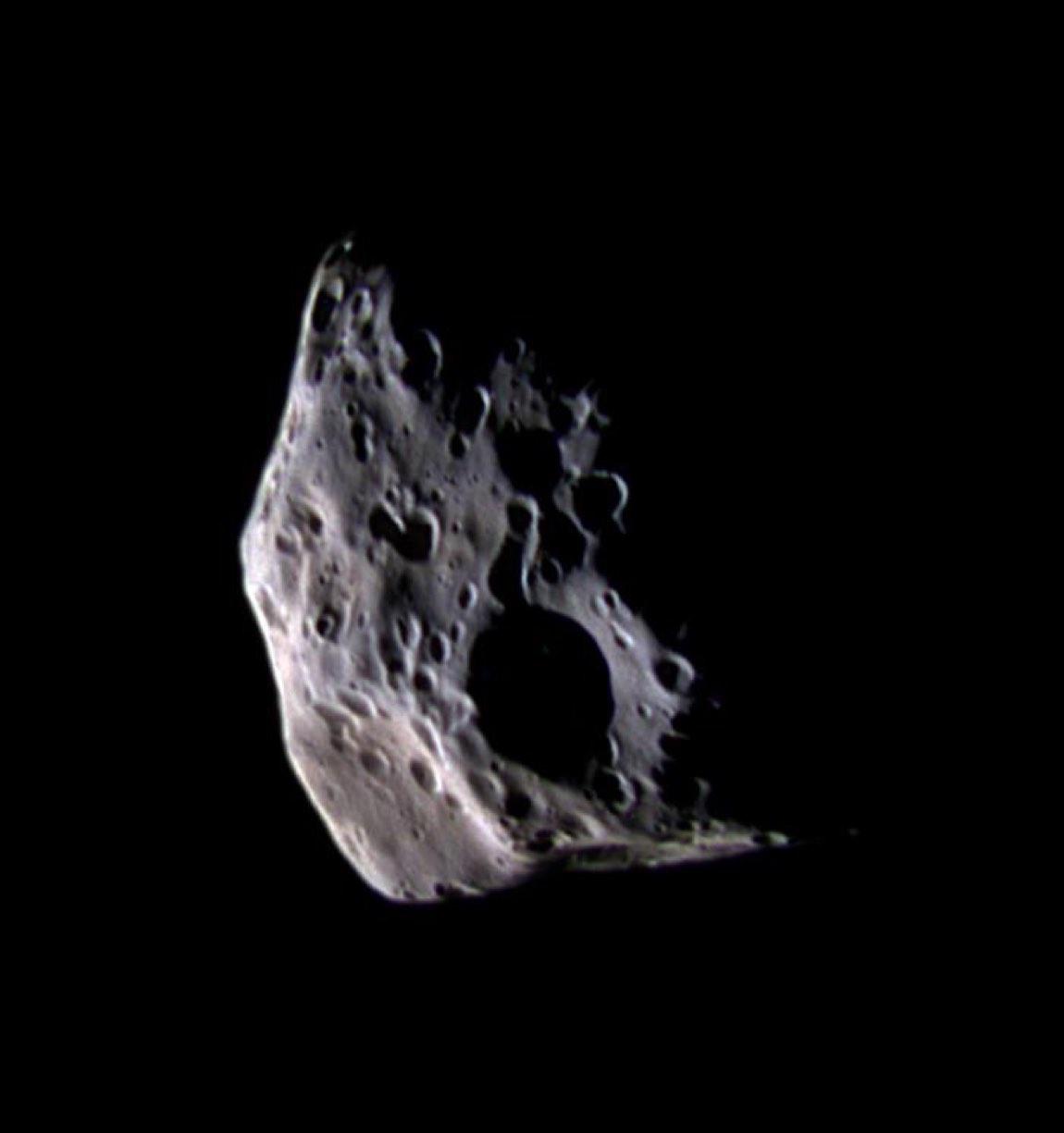
 Photograph · NASA/JPL/Space Science Institute · Public domain
Moon · Deep guide · orbits Saturn
Epimetheus
Also called: Saturn XI
Half of the Solar System's strangest dance: two moons that trade orbits every four years.
What is it?
Epimetheus shares almost the same orbit as the larger moon Janus. Every four years the inner moon catches up with the outer one, their gravity swaps a little momentum, and the two switch places without coming closer than about 10,000 km. Richard Walker spotted it in December 1966, but at the time everyone assumed only one moon was there; Stephen Larson and John Fountain worked out in 1978 that there were two, which Voyager 1 confirmed in 1980. Epimetheus is a porous, icy body about 117 km across.
The deep dive
Researched for the Atlas from Wikipedia — Epimetheus (moon) (6,268 characters read) · updated Nov 14, 2026
01 A Discovery Hidden in Plain Sight
The story of how Epimetheus was found is a small masterpiece of scientific confusion. On 15 December 1966, astronomer Audouin Dollfus spotted what he thought was a single new moon and proposed calling it Janus. Three days later, Richard Walker made another observation of what everyone still assumed was the same lone body. For twelve years, nobody seriously questioned that assumption — the idea of two moons sharing almost exactly the same orbit seemed physically impossible, since they should eventually collide. Then, in October 1978, Stephen M. Larson and John W. Fountain went back to those 1966 photographic records and showed that the data only made sense if there were two distinct objects orbiting side by side. Voyager 1 confirmed this conclusively in 1980. The IAU ultimately credited the discovery of Epimetheus to Walker, Larson, and Fountain jointly. A probable sighting also turned up in two Pioneer 11 images, earning the temporary designation S/1979 S 1, though scientists could not calculate a reliable orbit from just two frames. The moon finally received the official name Epimetheus in 1983.
02 The Orbital Swap Nobody Saw Coming
Janus and Epimetheus share an orbit so similar that, as of 2006, Janus's mean orbital radius from Saturn was only 50 km less than Epimetheus's — a gap smaller than either moon's own mean radius. Because the inner moon travels slightly faster under Kepler's laws, it gains on the outer one by just 0.25° every single day, completing its orbit a mere 30 seconds more quickly. As the gap closes, gravity steps in dramatically: the inner moon's momentum increases and the outer moon's decreases, nudging them apart in radius so that they literally trade places. They never come closer than about 10,000 km to each other. Because Janus is four times the mass of Epimetheus, the orbit swap affects them unequally — Janus shifts by roughly 20 km in orbital radius each time, while Epimetheus shifts by roughly 80 km. This gravitational square dance repeats approximately every four years, with recent close approaches occurring in January 2006, 2010, 2014, 2018, and 2022.
03 Horseshoe Orbits: A Unique Solar System Dance Deeper
From the reference frame of either moon, the other traces a shape resembling a horseshoe rather than a simple ellipse — which is exactly what gives this orbital class its name. The two moons librate around their mutual L4 and L5 Lagrange points, the same gravitationally stable positions where trojan asteroids cluster near planets. Some asteroids are known to follow horseshoe orbits around the Sun, but the Janus–Epimetheus system is the only confirmed example of two moons sharing this configuration anywhere in the Solar System. Mathematically, the arrangement is best understood through the circular restricted three-body problem, treating Saturn as the dominant body and the two moons as comparably sized perturbers of each other. Looking further into the future, however, gravitational interactions with Saturn's A Ring are expected to push both moons' orbits gradually outward. Models suggest this migration will eventually destabilize the co-orbital arrangement, leaving Epimetheus to settle into a more conventional trojan relationship — librating around Janus's own L4 or L5 point rather than swapping orbits with it.
04 Resonances Beyond the Janus Partnership Deeper
Epimetheus does not only interact gravitationally with Janus. When Epimetheus is on its outer orbit relative to Janus, it participates in a 15:17 mean-motion resonance with Prometheus and a 19:21 mean-motion resonance with Pandora — meaning Epimetheus completes 15 orbits for every 17 of Prometheus's, and 19 for every 21 of Pandora's. These resonances are orbital-state dependent: they exist only when Epimetheus is the outer of the two co-orbital moons. When it switches to the inner orbit after a swap, those particular resonance conditions no longer apply, and Janus in general does not participate in equivalent resonances with those same moons. This switching on and off of resonance relationships with every four-year orbital exchange makes Epimetheus one of the more dynamically complex small bodies in the Saturn system, contributing to the sculpting of ring structures alongside its better-known role as Janus's gravitational dance partner.
05 An Ancient, Battered, and Porous Icy World
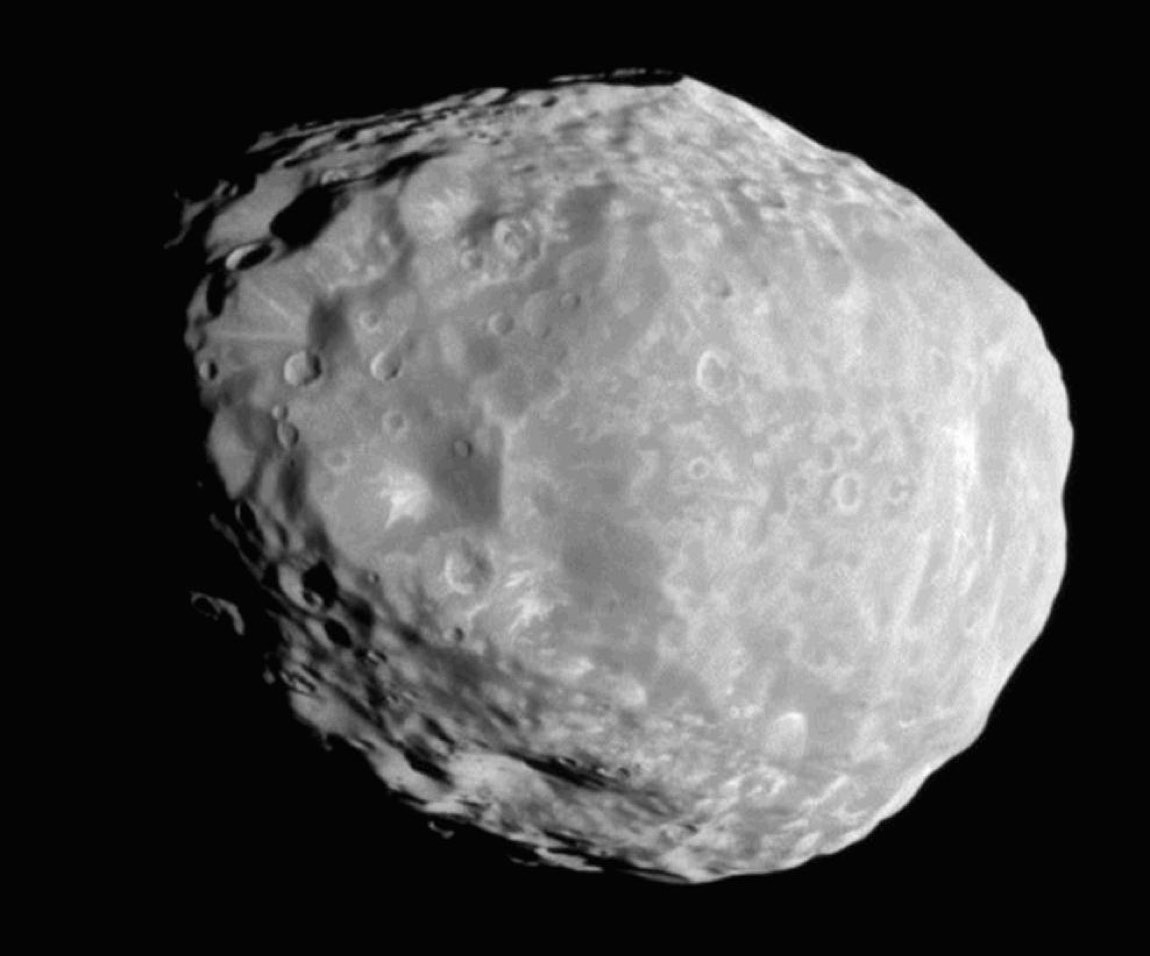
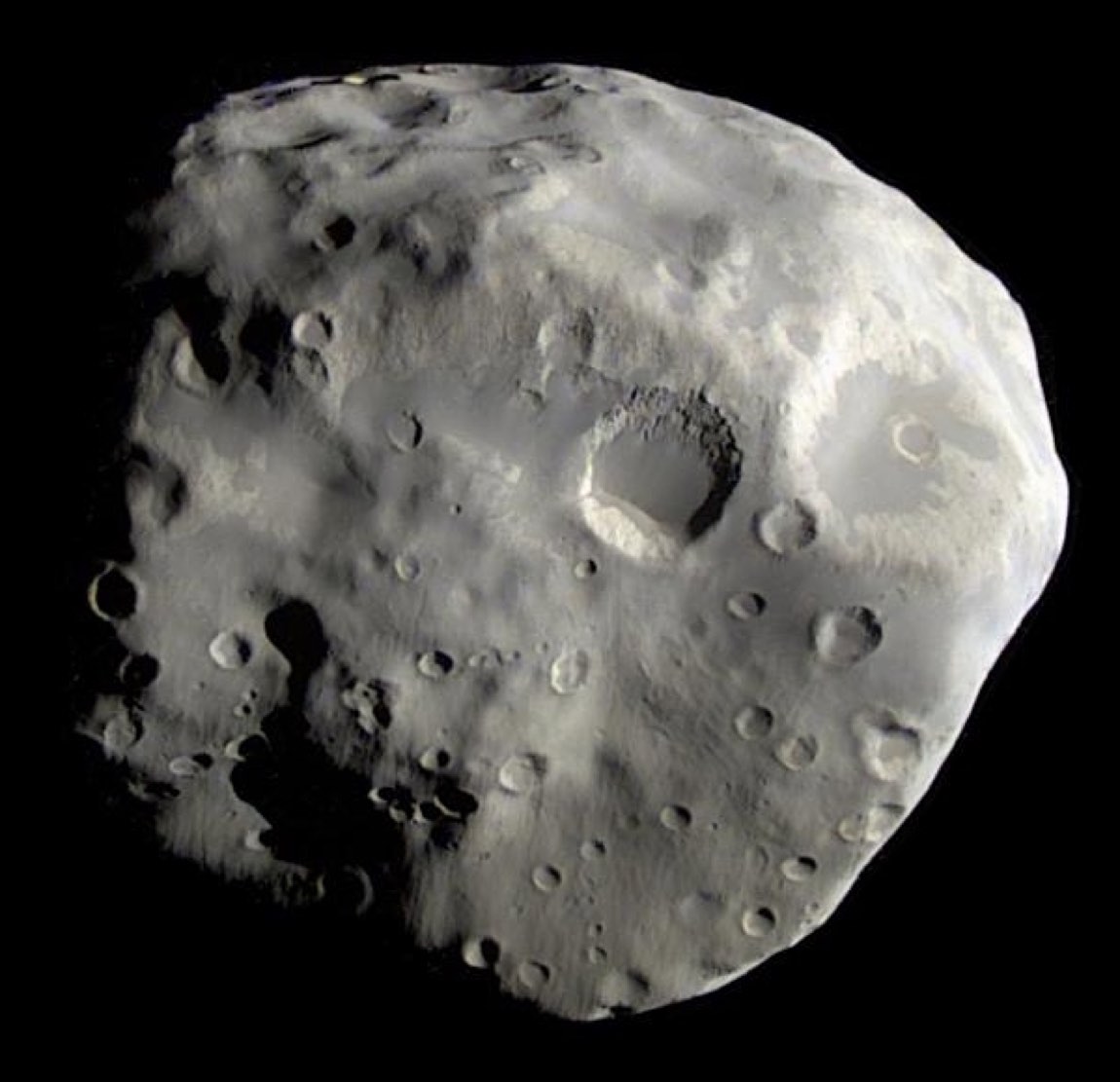
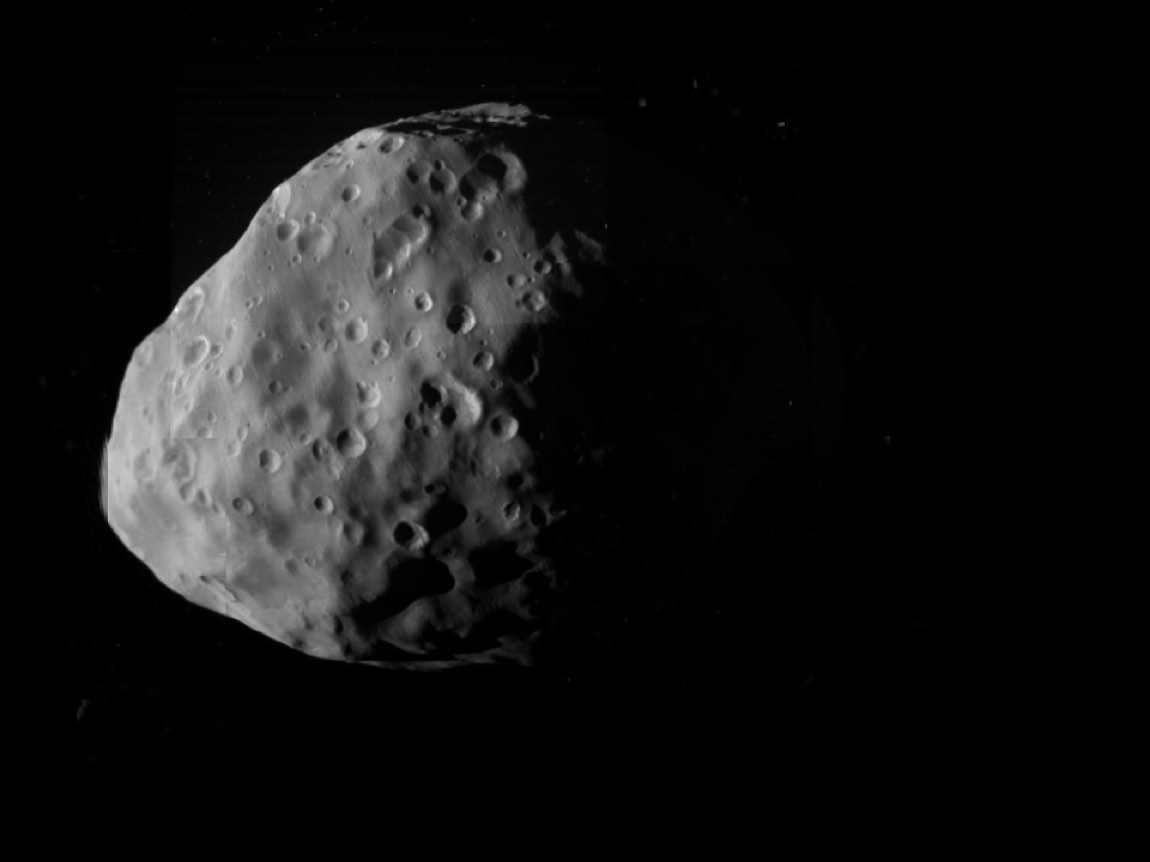
Epimetheus is covered in craters larger than 30 km in diameter, alongside ridges and grooves of varying scales. The sheer density of that cratering tells planetary scientists that the surface is very old — it has been accumulating impacts for an enormous span of time without major resurfacing events wiping the slate clean. Its very low density and relatively high albedo together suggest that Epimetheus is a highly porous body made predominantly of water ice, though scientists openly acknowledge considerable uncertainty in these measurements, meaning the porous-ice interpretation has not yet been definitively confirmed. Janus and Epimetheus may have originated from the breakup of a single larger parent body, which would neatly explain why two moons ended up sharing essentially the same orbit. If that disruption scenario is correct, it must have happened early in the history of Saturn's satellite system, since subsequent evolution has not driven the two into a collision or into radically different orbits.
06 Two Terrains Tell Competing Stories
Close imaging of Epimetheus reveals at least two visually distinct types of terrain. One type is darker and smoother; the other is brighter, slightly more yellowish, and shows fractured texture. Scientists interpret the darker material as something that flows or creeps downhill along slopes and likely has a lower water-ice content than the brighter regions. The brighter, fractured terrain is thought to behave more like bedrock — a harder substrate from which the mobile darker material has migrated away. Despite the visual contrast, both terrain types are believed to be rich in water ice overall. The southern hemisphere is dominated by a large, flat basin with a central peak, covering much of that polar region. This feature may be the eroded remnant of a massive ancient impact crater, though the interpretation has not been confirmed with certainty. Together, these surface clues paint a picture of a world shaped by both violent collisions and slow, gravity-driven movement of loose surface material.
 ⤢
07 Named Features and Their Mythological Roots
Craters on Epimetheus follow a naming convention tied to the legend of Castor and Pollux, the twin heroes of Greek mythology — a thematic choice that echoes the paired, twin-like relationship between Epimetheus and Janus themselves. The moon is named after the Titan Epimetheus, brother of Prometheus and son of Iapetus, figures already memorialized elsewhere in the Saturn system. The formal naming of the moon itself did not occur until 1983, the same year the IAU also officially approved the name Janus, even though Janus had been used informally since Dollfus proposed it in 1966. One crater name has been misspelled as "Hilairea" in the USGS database, a small clerical error preserved in the official record.
08 A Dust Ring Born from Meteoroid Bombardment
Epimetheus and Janus are not merely passengers in Saturn's ring system — they actively generate their own faint ring. Cassini spacecraft images taken in forward-scattered light in 2006 revealed a diffuse dust ring occupying the region around both moons' orbits, with a radial extent of about 5,000 km. The ring is not made of material that condensed there primordially. Instead, meteoroids constantly rain onto the surfaces of both moons, and the resulting impacts blast tiny particles off into space. Those ejected particles then spread out along the moons' orbital paths, creating a tenuous, diffuse band of debris. Forward-scattered light — where the observer looks back toward a light source, in this case the Sun — is the most effective way to see such thin dust structures, which is why Cassini's geometry during those 2006 observations was crucial to the detection.
09 Shepherding Saturn's Outermost Ring Edge Deeper
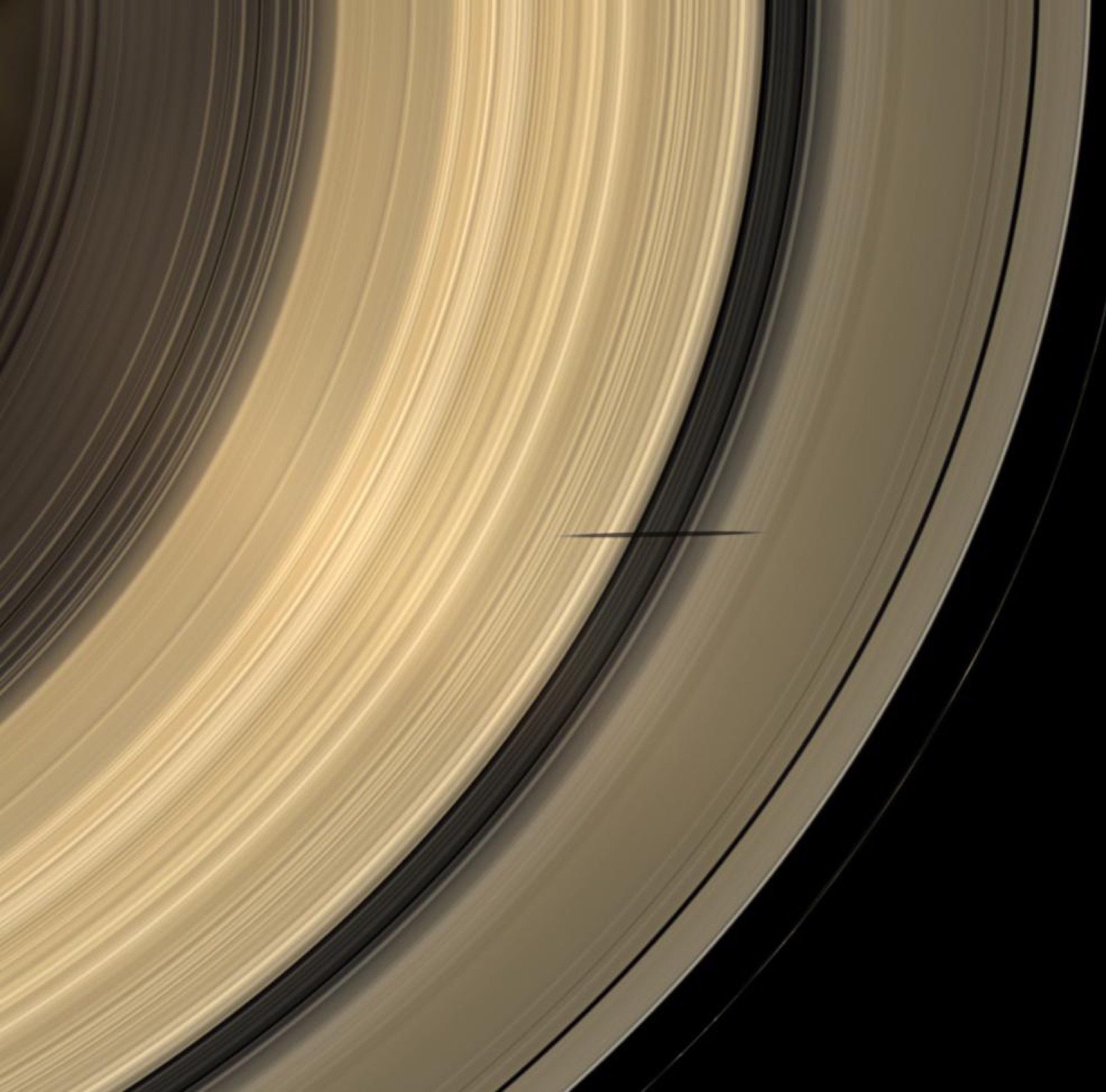
Beyond their own private dust ring, Epimetheus and Janus jointly play an important gravitational role in maintaining the sharp outer boundary of Saturn's A Ring through a 7:6 orbital resonance. At this resonance, ring particles complete seven orbits for every six completed by the moons, and the repeated gravitational nudges this produces keep the ring edge clearly defined rather than allowing it to blur and spread outward. The effect is not equal between the two moons: it is described as more pronounced when the more massive Janus occupies the inner, resonant orbit — which, given the four-year swap cycle, means the shepherding influence itself waxes and wanes on roughly that timescale. This makes Epimetheus and Janus among the most dynamically active shepherd moons in the Solar System, simultaneously maintaining a ring edge, generating their own dust ring, and executing their unique orbital exchange.
10 How Voyager and Cassini Shaped Our Knowledge
Before spacecraft visits, Epimetheus existed only as a fuzzy anomaly in ground-based photographic plates from 1966. Voyager 1's 1980 flyby provided the first direct confirmation that two separate moons occupied the shared orbit, turning a theoretical prediction by Larson and Fountain into established fact. Pioneer 11 had earlier captured two images that probably showed Epimetheus, catalogued as S/1979 S 1, but those images were insufficient for orbit determination. Cassini delivered the most detailed look at Epimetheus, capturing the surface geology that revealed the two terrain types, the large southern basin, and the extensive cratering record. It was also Cassini's forward-scattered light imaging in 2006 that uncovered the faint shared dust ring. Together, these missions transformed Epimetheus from a confusing data point into one of the Solar System's best-studied examples of co-orbital dynamics and ancient icy surface geology.
11 Open Questions That Remain Unanswered Deeper
Despite decades of observation and two major spacecraft programs, Epimetheus still keeps several secrets. The moon's density and albedo suggest a porous water-ice interior, but the article's own sources acknowledge considerable uncertainty in those values, leaving the internal structure genuinely unconfirmed. The question of whether Janus and Epimetheus formed from the disruption of a single parent body is plausible but not proven — and if that disruption did occur, pinning down when in the early Solar System it happened remains an open problem. The long-term fate of the co-orbital configuration is predicted but not observed: will the outward orbital migration driven by A Ring interactions really convert Epimetheus into a trojan of Janus, and on what timescale? The alternating activation and deactivation of Epimetheus's resonances with Prometheus and Pandora with every orbital swap also invites more detailed dynamical modeling. Each of these threads represents a genuine frontier in small-body planetary science.
 ⤢