 Photograph · NASA/JPL-Caltech/Space Science Institute
Moon · Deep guide · orbits Saturn
Hyperion
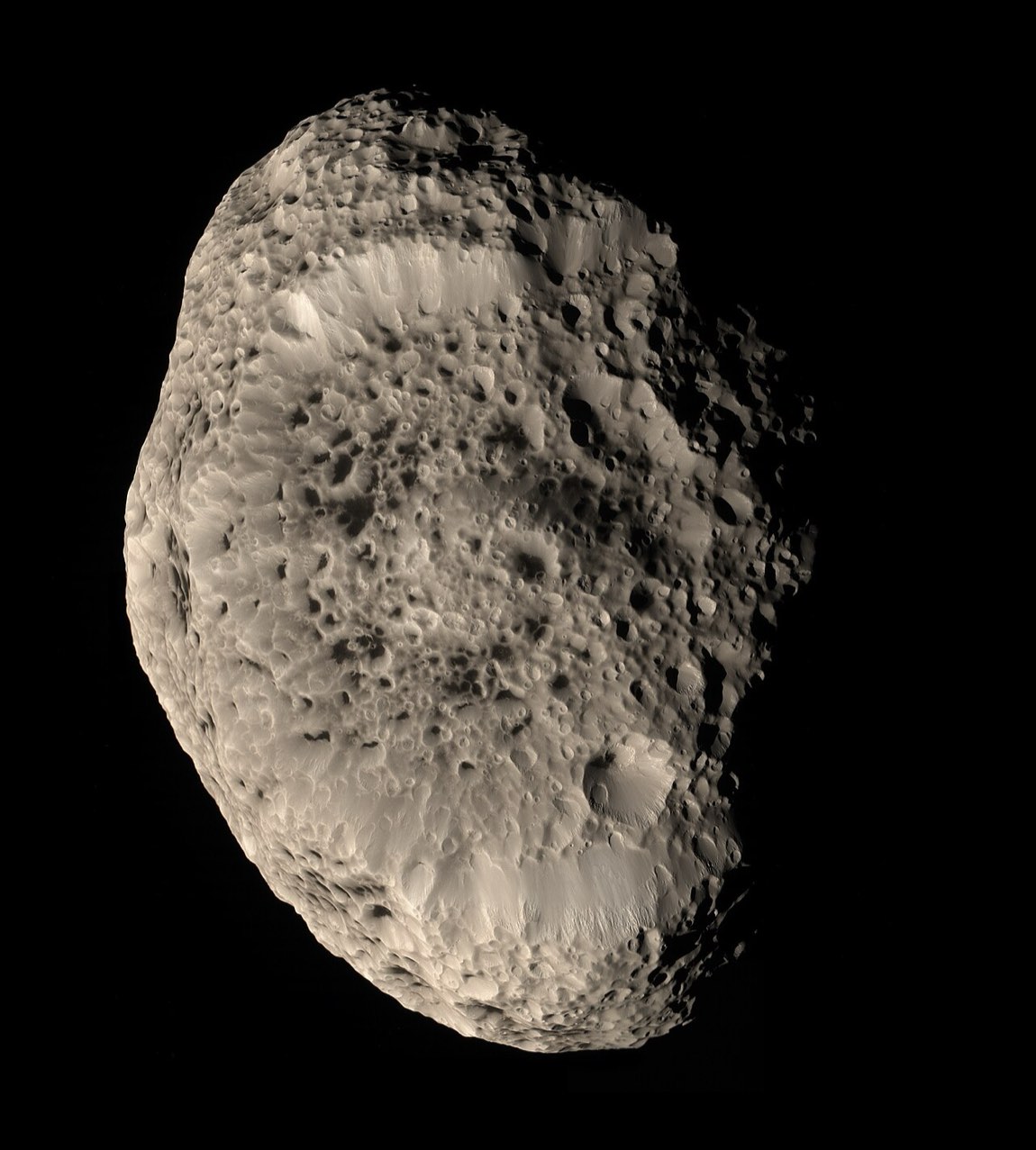
The Solar System's most chaotic moon is a tumbling sponge of ice.
What is it?
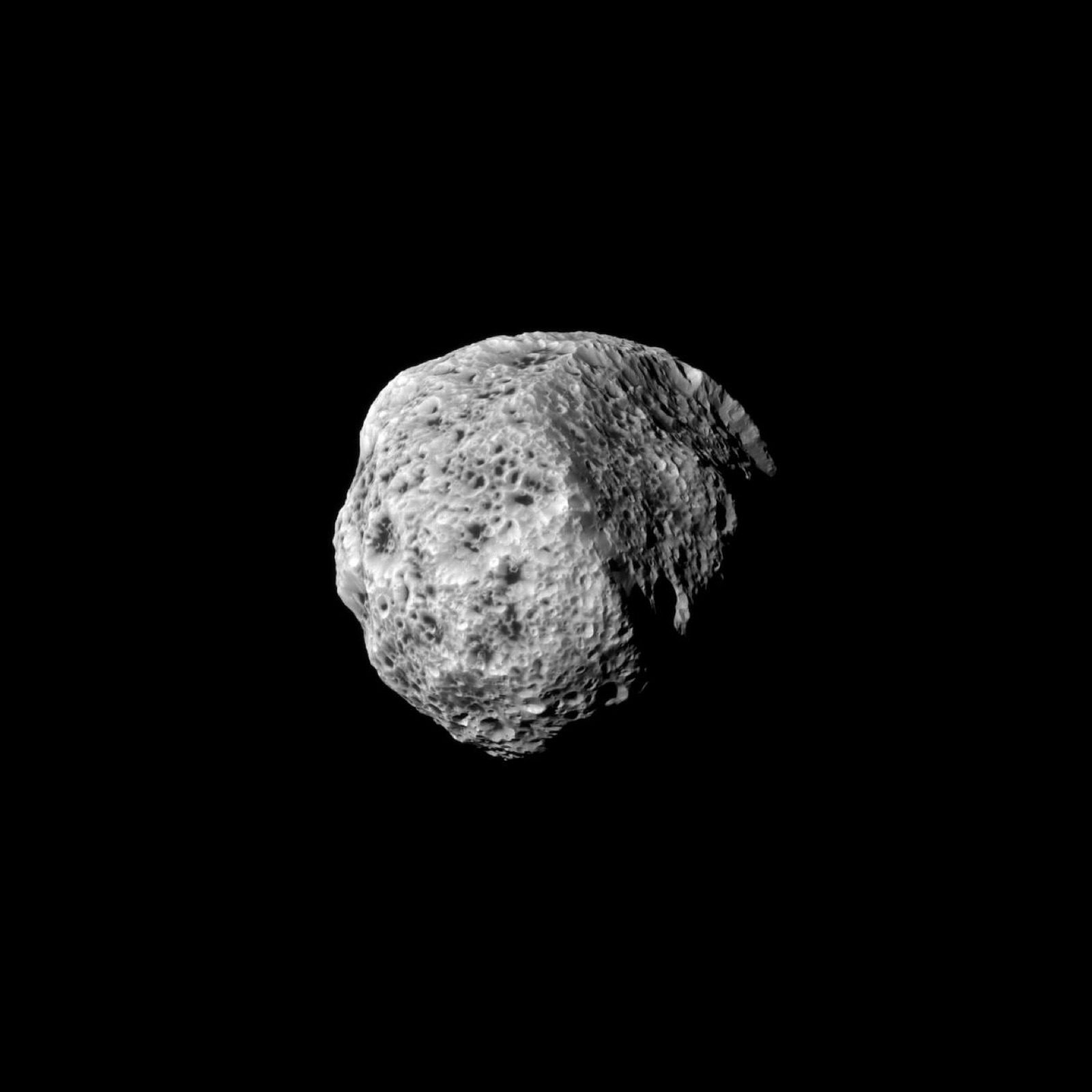
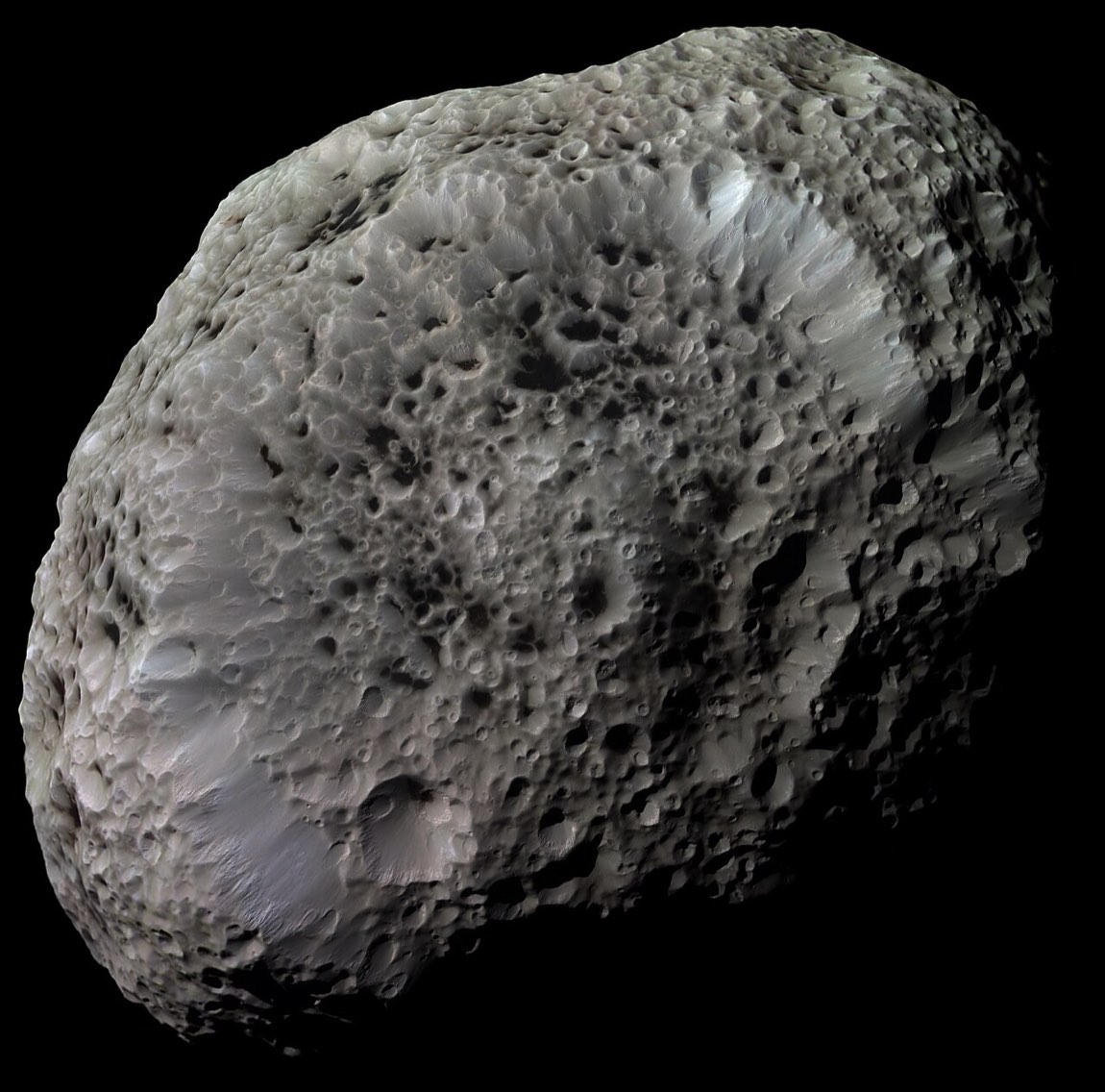
Hyperion looks like a bath sponge the size of a small country: a porous, potato-shaped moon whose deep, sharp-walled craters never filled in because its surface is so weak. It is the largest known body that tumbles chaotically — its rotation is genuinely unpredictable from one orbit to the next, thanks to gravitational kicks from neighboring Titan.
The deep dive
Researched for the Atlas from Wikipedia — Hyperion (moon) (11,188 characters read) · updated Sep 20, 2026
01 A Moon Spinning Without a Pattern
Most large moons in the Solar System are tidally locked, meaning one face permanently points toward their parent planet — just as our Moon always shows the same side to Earth. Hyperion breaks this rule entirely. Its rotation is genuinely chaotic: the axis around which it spins wobbles so dramatically that its orientation in space is essentially unpredictable over long timescales. Scientists quantify this unpredictability using a measure called the Lyapunov time — the interval beyond which prediction becomes impossible. For Hyperion, that window is only about 30 days. Over shorter stretches, its spin can be forecast, but beyond a month or so, all bets are off. Hyperion is the only regular planetary natural satellite in the entire Solar System confirmed to behave this way. Chaotic rotation is thought to be common among binary asteroids, but among large moons orbiting planets it is extraordinarily rare. The only comparable cases are Nix and Hydra, the small moons of Pluto. This tumbling chaos likely explains why Hyperion's surface looks broadly uniform rather than showing the stark bright-and-dark hemispheric contrast seen on many of Saturn's other moons.
02 Titan's Gravitational Grip on Hyperion Deeper
Hyperion does not orbit Saturn in isolation — it is locked in a gravitational dance with the much larger moon Titan. The two bodies share a 3:4 orbital resonance, meaning that for every four orbits Titan completes around Saturn, Hyperion completes exactly three. This is not a coincidence but a dynamical trap: Titan's gravity continuously nudges Hyperion, preventing the smaller moon's orbit from circularizing over time. Every conjunction between the two moons — the moment when they align on the same side of Saturn — occurs specifically at Hyperion's apocenter, the farthest point in its orbit. This regular but asymmetric gravitational tugging keeps Hyperion's orbit moderately eccentric even though planetary physics would normally damp such eccentricity away. Researchers also believe this same resonance may actively encourage Hyperion's chaotic rotation, because the interplay between the orbital eccentricity and Titan's tidal forces restricts the range of conditions under which a stable, locked spin could ever take hold. In this sense, Titan is both the sculptor of Hyperion's orbit and, indirectly, the reason Hyperion tumbles so unpredictably.
03 A Rubble Pile Floating in Space
Hyperion's internal structure is far from solid rock. Data from the Cassini spacecraft's flybys in 2005 and 2006 revealed that approximately 40 percent of Hyperion's volume is simply empty space — it is more gap than matter. This extraordinary porosity, measured at about 0.42 ± 0.06, is one of the highest known for any moon-sized body. Scientists believe Hyperion may be physically similar to a loosely accreted rubble pile: chunks of water ice and a small amount of rock weakly bound together by their own faint gravity, with vast voids between them. This structure has real consequences for its surface. When a meteorite strikes a typical solid moon, it blasts out a crater and hurls material upward. On Hyperion, the porous, compressible surface instead tends to absorb the impact, compressing inward rather than excavating outward. Most debris that is ejected never falls back, because Hyperion's surface gravity is so weak. The result is a landscape of deep, sharp-edged craters that accumulate over billions of years without being refilled or erased — at least, not by ordinary small impacts.
04 Where That Dark Coating Comes From
At first glance, Hyperion's coloring is puzzling. Most of Saturn's inner moons are bright and icy, but Hyperion has a notably low albedo of 0.33, meaning it reflects only about a third of the sunlight that hits it. Its surface is covered by a dark, reddish material that fills the floors of its craters and tints the whole body. This substance contains long chains of carbon and hydrogen, and it closely matches the color and composition of dark material found on Iapetus, Saturn's famously two-toned moon. Scientists suspect the dark coating is not native to Hyperion. Instead, it may be debris that originated from Phoebe, a much darker and more distant moon of Saturn. Phoebe sheds material that drifts inward through the Saturn system; much of it is thought to be swept up by Iapetus, but some apparently reaches Hyperion as well. Intriguingly, Hyperion's surface appears redder than Phoebe itself, suggesting the material may have been chemically altered after arriving, or that it has mixed with other compounds already present on Hyperion's icy surface.
 ⤢
⤢
05 Two Giant Craters and What They Tell Us Deeper
Hyperion carries the scars of at least two enormous impacts. The Helios crater spans about 140 km across and reaches at least 10 km deep, with a central peak rising from its floor. Accounting for Hyperion's likely pre-impact shape, the true excavation depth may be closer to 25 km. For context, Helios is comparable in size to the Herschel crater on Mimas — a scar 145 km wide that is often cited as nearly large enough to have shattered that moon — yet Hyperion's total volume is only about 30 percent that of Mimas, making Helios proportionally even more dramatic. The even larger unnamed feature, sometimes called the giant crater, measures roughly 250 by 200 km — approximately the width of Hyperion itself — and plunges about 35 km deep, with a central block or dome roughly 50 by 100 km across. One rim wall extends into the Bond-Lassel Dorsum, a discontinuous ridge nearly 300 km long. This impact was so violent that it triggered global shaking and resurfacing that erased virtually all prior topography across the entire moon. Strikingly, the giant crater was not recognized as an impact feature until 1996; earlier researchers interpreted the same region as a spallation scar from a different event.
06 The Named Features: Only Five Exist
Despite Hyperion's dramatic landscape, the International Astronomical Union has officially named only five features on its surface: four craters and one ridge called the Bond-Lassel Dorsum. These names were assigned in 1982, shortly after the Voyager 2 flyby, and no new names have been officially approved since the IAU last mentioned Hyperion in a formal report in 1990. The Bond-Lassel Dorsum honors the two discovery teams — William and George Bond in the United States and William Lassell in Britain — and forms part of the rim wall of the giant unnamed crater. The dearth of named features is not simply a matter of astronomers being slow to act. It reflects a genuine scientific problem: Hyperion's chaotic rotation makes it nearly impossible to establish a stable, agreed-upon coordinate system for the moon. The original coordinate system was created arbitrarily during the Voyager era, before the chaotic rotation was even confirmed, and the origin point and the exact shape model it used are not reliably known today. As a result, many researchers have resorted to defining their own local coordinate systems, further complicating any formal naming process.
07 Polygon Craters and Hidden Fractures Deeper
Most impact craters in the Solar System are roughly circular, because an explosion expanding outward from a point tends to produce a round rim. Many of Hyperion's smaller craters break this rule: they display polygon-shaped edges, with straight sides meeting at angles rather than tracing smooth curves. Scientists interpret these irregular outlines as a surface signature of hidden subsurface faults. When an impactor strikes, the blast preferentially removes material along pre-existing fracture lines in the ice, just as a window shatters along its weakest paths. The result is a crater whose shape is partly controlled by the underground geometry of cracks rather than purely by the physics of the explosion. An Earth analogy offered by researchers is Meteor Crater in Arizona, whose roughly square outline similarly reflects jointing patterns in the underlying rock. On Hyperion, mapping the orientations of these polygon craters could, in principle, reveal the global pattern of internal fractures — information that would otherwise be invisible from the surface. The steep walls of all of Hyperion's craters, whether polygon-shaped or not, also drive mass wasting events — slow downslope movement of material — driven by temperature swings between day and night and by shaking from nearby impacts.
08 A Fragment of Something Larger
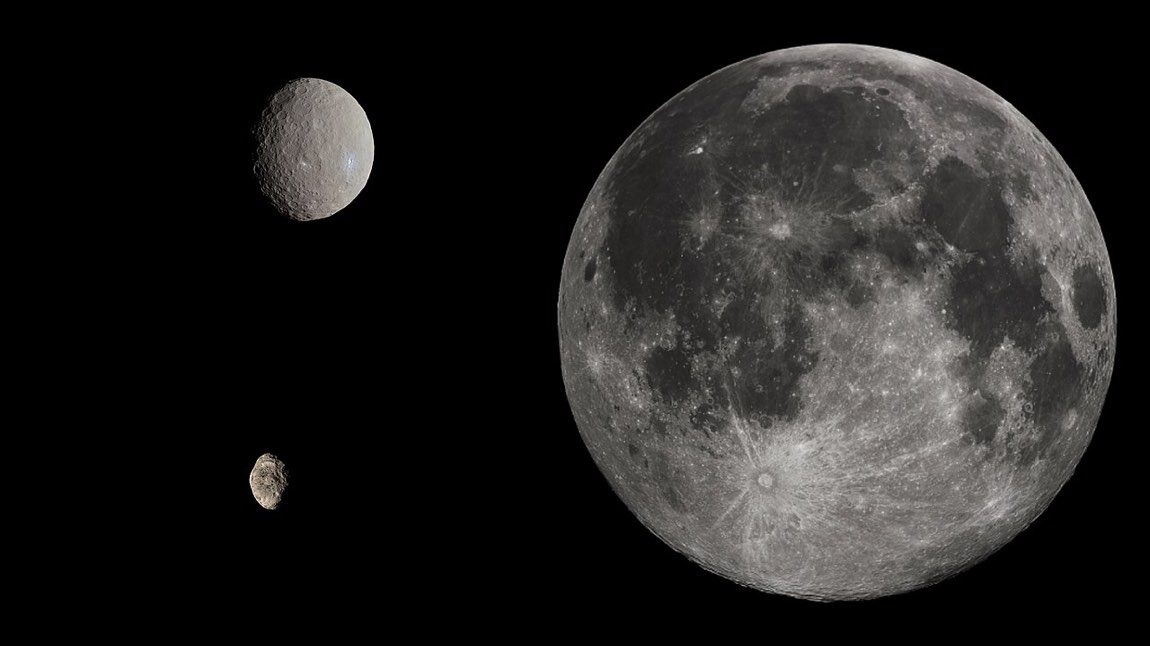
Hyperion's highly irregular shape — it is one of the largest known bodies in the Solar System that is not in hydrostatic equilibrium, meaning gravity has not pulled it into a sphere or ellipsoid — raises an obvious question: why isn't it round? The leading hypothesis is that Hyperion is actually a fragment, the broken remnant of a much larger ancestor body that was shattered by a catastrophic impact long ago. Before that collision, a proto-Hyperion may have ranged from roughly 350 to 1,000 km in diameter — that spans from just below the size of Mimas to just below the size of Tethys, both of which are large enough to have rounded themselves under gravity. The impact that destroyed it left behind the jagged chunk we see today. The consequences of such a breakup would have reached far beyond the collision site: over roughly 1,000 years after the event, ejecta from the destroyed body would have rained down on Titan at low speeds, potentially delivering significant amounts of volatile material that contributed to the building of Titan's thick atmosphere.
 ⤢
⤢
09 Cassini's Close Encounters with Hyperion
The Voyager 2 spacecraft flew through the Saturn system but observed Hyperion only from a distance, managing to resolve individual craters and a large ridge without capturing the full texture of the surface. It was the Cassini orbiter that finally revealed Hyperion in detail. Early Cassini images hinted at something unusual, but the breakthrough came with the spacecraft's first targeted flyby on 25 September 2005, which disclosed the full strangeness of the sponge-like surface. The closest approach during that encounter occurred on 26 September 2005, at a distance of just 500 km — roughly the driving distance from New York City to Boston and back. Cassini returned for additional close passes: one on 25 August 2011 at about 25,000 km, another on 16 September 2011 at about 58,000 km, and a final farewell flyby on 31 May 2015 at roughly 34,000 km. The 2005 and 2006 flyby data together provided the compositional analysis confirming that Hyperion is roughly 40 percent empty space and composed predominantly of water ice with very little rock.
10 The Discovery and Its Rushed Publication
Hyperion holds a notable place in astronomical history as the first non-rounded moon ever discovered — the first time astronomers recognized that a moon could be something other than a smooth, gravity-rounded ball. It was found in September 1848 independently by two teams: William Cranch Bond and his son George Phillips Bond working in the United States, and William Lassell observing from the United Kingdom. Lassell saw it two days after William Bond, but he moved faster in print and beat the Bonds to formal publication. The name Hyperion came from a naming scheme that astronomer John Herschel had proposed in an 1847 publication, suggesting names drawn from Greco-Roman mythology for Saturn's known satellites. Lassell had already endorsed that scheme and applied it to the new moon, naming it after the Titan Hyperion — god of watchfulness and observation, and elder brother of Cronus, the Greek equivalent of the Roman god Saturn. The moon also carries the formal designation Saturn VII. The discovery came just one year after Herschel's naming framework was published, illustrating how rapidly the Saturn system was being explored in the mid-nineteenth century.
11 An Electrically Charged Surface Deeper
Among Hyperion's more unexpected properties is that its surface carries a static electric charge. This makes Hyperion only the second known body in the Solar System to have a confirmed electrically charged surface — the first being Earth's own Moon. The discovery was made from Cassini data and was announced as a finding of the mission's Hyperion flybys. The physical mechanism behind the charging likely involves the continuous bombardment of Hyperion's surface by charged particles trapped in Saturn's magnetosphere. These particles hit the porous, low-density surface, and because Hyperion lacks the kind of dense atmosphere or magnetic field that might redistribute or neutralize charge, the electrical buildup persists. The practical implications of a charged surface for any future lander or sample-return mission would be significant, as charged surfaces can attract fine dust and interfere with electronic instruments — a challenge already encountered in designing equipment for operations on the lunar surface, and one that would need to be addressed for any close-up robotic investigation of Hyperion.
12 Open Questions Scientists Are Still Debating Deeper
Despite several Cassini flybys and decades of ground-based study, Hyperion leaves researchers with substantial uncertainties. The origin of the dark reddish material coating its surface is still not fully resolved: while the Phoebe-to-Iapetus-to-Hyperion delivery pathway is favored, the reason Hyperion appears redder than its presumed source material on Phoebe is unexplained. The coordinate system problem remains genuinely unsettled — whether the original arbitrary IAU system from the Voyager era retains any official status is ambiguous, and the exact origin point and shape model it relied upon are not actually known. The internal structure, while broadly consistent with a rubble pile, has not been imaged directly; the porosity figure of about 0.42 ± 0.06 is inferred from density measurements rather than direct observation. Whether the giant crater truly erased all previous surface topography globally, or only regionally, is a matter of interpretation. And the precise mechanism connecting the 3:4 resonance with Titan to Hyperion's chaotic rotation — while theoretically plausible — continues to be refined as dynamical models improve.
 ⤢
⤢
You would weigh…
Surface gravity 0.02 m/s² vs Earth’s 9.81 m/s². Try every world →