Moon · Deep guide · orbits Neptune
Hippocamp
Also called: Neptune XIV · S/2004 N 1
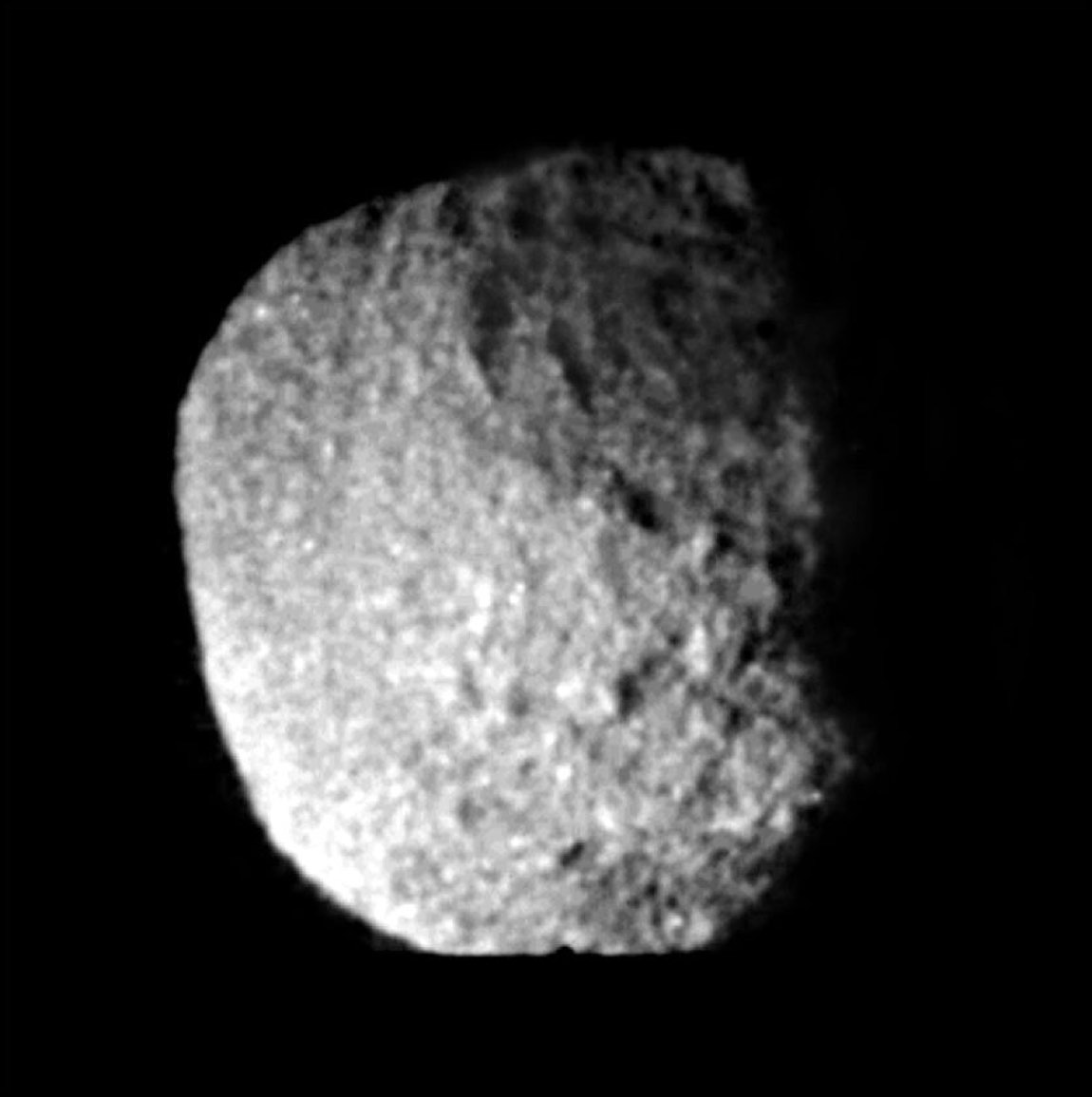
A tiny moon that may be a chip knocked off Proteus by a giant impact.
What is it?
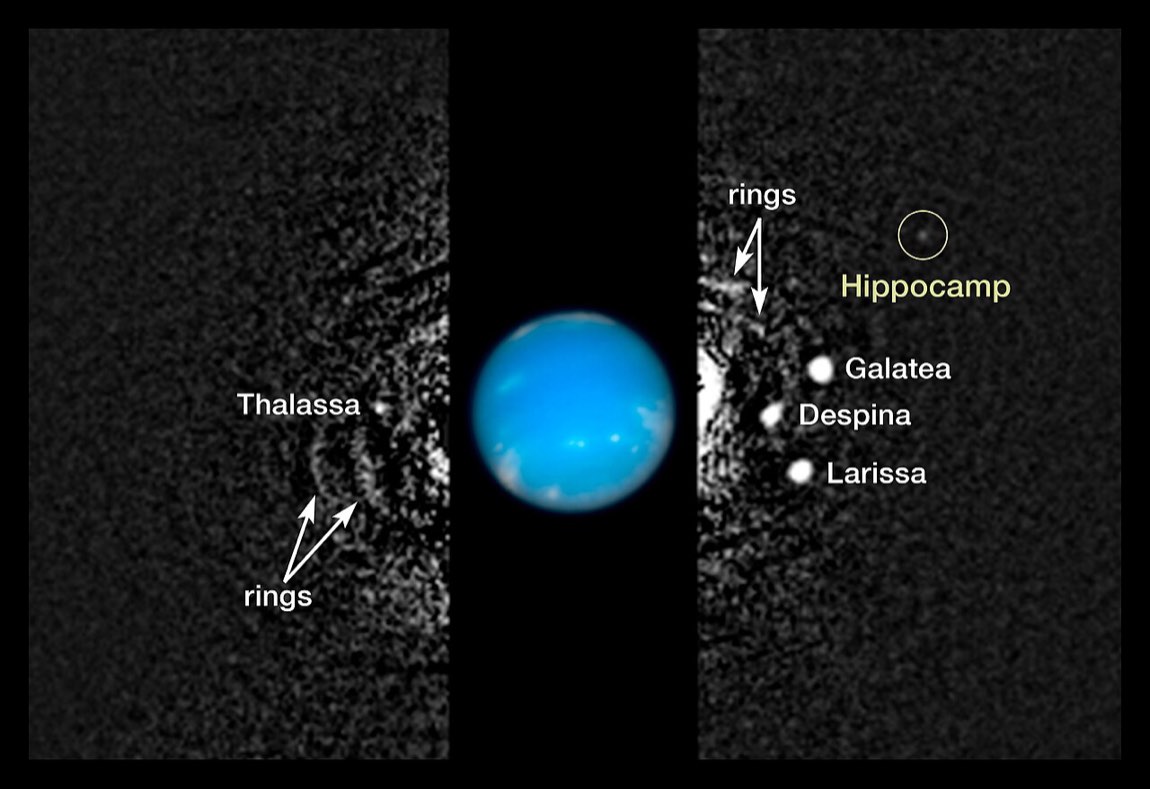
Hippocamp was found in 2013 by Mark Showalter, who digitally stacked archival Hubble images of Neptune to follow faint moving objects. It is only about 35 km wide, too faint for Voyager 2 to have spotted in 1989. Hippocamp orbits about 12,000 km inside Proteus, which is about 1,000 times more massive. Researchers suggest it formed from debris blasted off Proteus by the impact that made its giant Pharos crater. It is named after the mythical sea-horse.
The deep dive
Researched for the Atlas from Wikipedia — Hippocamp (moon) (11,495 characters read) · updated Nov 15, 2026
01 How Mark Showalter stumbled upon it
The discovery of Hippocamp was essentially a happy accident built on methodical technique. Mark Showalter of the SETI Institute was not hunting for moons at all — he was studying Neptune's ring arcs. Because the inner moons and ring arcs orbit Neptune so quickly, Showalter had developed a clever image-stacking method similar to photographic panning: he collected many short-exposure Hubble images and digitally warped each one to cancel out the smearing caused by orbital motion, then stacked them to coax faint details out of the noise. Having finished his ring-arc work, he extended the analysis on a whim to regions beyond the ring system. There, on 1 July 2013, Hippocamp appeared as a faint but unambiguous white dot. To be sure it was real, he combed through more than 150 archival Hubble frames stretching back to 2004 and pinned the moon down at ten separate observation times. He also searched Voyager 2's 1989 flyby images but found nothing — Hippocamp is simply too dim for Voyager's cameras to have recorded it. The formal announcement came on 15 July 2013 through the International Astronomical Union's Central Bureau for Astronomical Telegrams.
02 Why the name Hippocamp fits so well
Every moon of Neptune must, by International Astronomical Union rules, be named after a figure from Greco-Roman mythology connected to the sea god Poseidon or his Roman counterpart Neptune. Showalter's team considered several candidates, including Polyphemus — the gigantic one-eyed son of Poseidon and Thoosa — before settling on Hippocamp. The hippocampus of Greek myth is a creature with the upper body of a horse and the lower body of a fish, and it served as the emblem of Poseidon; in Roman mythology Neptune was often depicted driving a sea-chariot pulled by hippocampi. Showalter's personal motivation was more down-to-earth: a passion for scuba diving and genuine affection for the real seahorse genus Hippocampus. The moon carried the provisional label S/2004 N 1 from its announcement until 25 September 2018, when the Minor Planet Center assigned it the Roman numeral designation Neptune XIV. The IAU's naming committee approved Hippocamp on 20 February 2019, and the Space Telescope Science Institute announced it publicly the same day.
03 A moon born from another moon's wound Deeper
The leading hypothesis for Hippocamp's origin reads almost like a chain of catastrophes. When Neptune captured Triton from the Kuiper Belt long ago, Triton's initially eccentric orbit wreaked havoc on whatever moons Neptune originally had, ejecting some and smashing others to rubble. After Triton's orbit was eventually circularized by tidal friction, some of that rubble re-accreted into the present inner moons, including Proteus. Proteus itself then suffered a colossal cometary impact that carved the crater Pharos, roughly 250 km across — more than half the diameter of Proteus itself. The collision nearly shattered Proteus and blasted a huge quantity of debris into space. Showalter and colleagues propose that some of this debris settled into a stable orbit roughly 1,000 to 2,000 km interior to Proteus and gradually coalesced into Hippocamp. Under this model, Hippocamp is a third-generation satellite: born from a moon that was itself born from the wreckage of Neptune's original satellite system. Intriguingly, Hippocamp accounts for only about two percent of the volume of material the Pharos impact should have ejected, and the fate of the remaining debris is still unexplained.
04 Nine destructions and nine rebirths Deeper
Even after coalescing from Proteus's ejecta, Hippocamp's existence has apparently never been quiet. Neptune's inner moon region is a shooting gallery for cometary impactors, and researchers estimate that Hippocamp has been completely disrupted — blasted apart and re-accreted — roughly nine times over the past 4 billion years. Each destruction-and-reassembly event has a useful side effect: it damps down the orbital eccentricity and inclination that would otherwise build up from gravitational nudges by Proteus. This is the most likely reason Hippocamp's orbit today is nearly perfectly circular and nearly perfectly flat. Each disruption event probably also stripped away some mass, which may partly explain why so little material from the Pharos crater can be accounted for today. The image of a moon that has been pulverized, re-collected, pulverized again, and re-collected again nearly a dozen times over billions of years makes Hippocamp one of the more geologically eventful small bodies in the Solar System, even if the events left no structures we can currently observe at Hubble's resolution.
05 Its orbital slot: snug between two neighbors
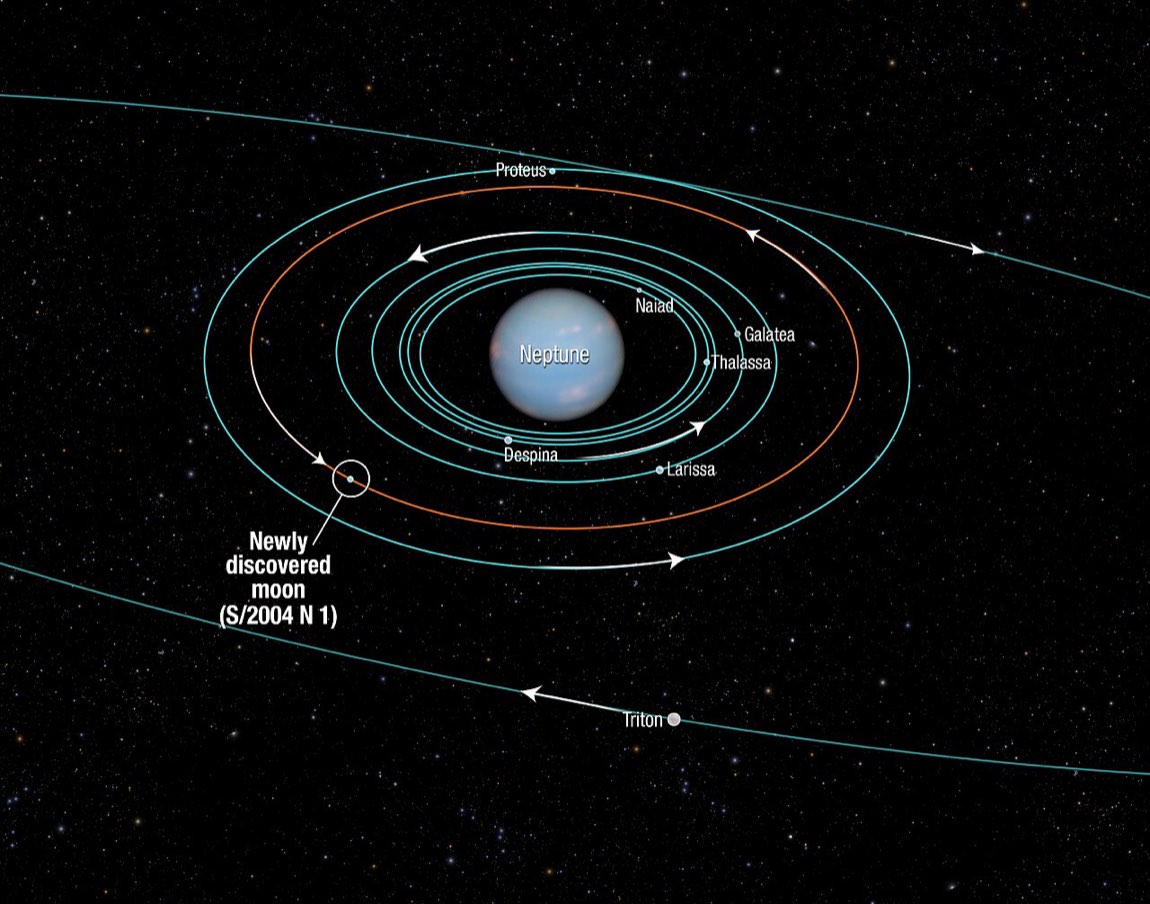
Hippocamp circles Neptune every 22 hours and 48 minutes at a distance of 105,283 km from Neptune's center — about 4.3 Neptune radii, or just over a quarter of the Earth–Moon distance. That puts it between the orbits of Larissa (inward) and Proteus (outward), making it the second-outermost of Neptune's regular inner satellites. It sits only 12,000 km interior to Proteus, a gap so narrow that the two moons' orbital semi-major axes differ by just ten percent. Among the regular Neptunian satellites there is a general trend of increasing moon diameter with increasing distance from Neptune, but Hippocamp is a glaring exception — it is the smallest of these moons yet occupies a slot well out from Neptune rather than close in. Both its orbital inclination and eccentricity are close to zero, giving it a nearly perfect circular, equatorial path. Interestingly, the orbital periods of Larissa and Hippocamp are within about one percent of a 3:5 orbital resonance with each other, adding yet another layer of dynamical complexity to this crowded region.
06 Gravitational tug-of-war with Proteus Deeper
Because Hippocamp is so small and orbits so close to the far more massive Proteus, its trajectory is exquisitely sensitive to exactly how massive Proteus is. Orbital solutions computed with different assumed masses for Proteus produce differences in Hippocamp's predicted position of around 100 km — a detectable quantity given Hubble's precision. This means that monitoring Hippocamp over several decades could yield an independent measurement of Proteus's mass, something that is otherwise very difficult to obtain. Adding to the complexity, Proteus and Hippocamp are currently near — but not quite in — an 11:13 mean-motion resonance, meaning Hippocamp completes 13 orbits for roughly every 11 Proteus completes. Because both moons orbit beyond Neptune's synchronous orbit radius, Neptune's tidal forces are pushing them both slowly outward. Proteus, being much more massive, feels a stronger tidal push and is receding faster. Projecting this migration forward, Proteus is expected to drift about 40 km from Neptune every 18 million years, and in that time it will reach a true 11:13 resonance with Hippocamp — a future dynamical event that researchers are already modeling.
 ⤢
07 What we can and cannot say about its surface
Hippocamp is simply too small and too far away for detailed surface mapping with existing instruments. Its diameter is estimated at 34.8 km, and it is the second-smallest known moon of Neptune. At an apparent magnitude of about 26.5 it is extraordinarily faint; early estimates placed its diameter at 16 to 20 km, and only more recent observations revised that figure upward by roughly twofold. Nothing is known about surface features. By analogy with Neptune's other inner moons, Hippocamp is assumed to have a dark surface, with geometrical albedos among that group ranging from 0.07 to 0.10 and averaging around 0.09 — meaning these moons reflect roughly 9 percent of the sunlight that hits them, comparable to fresh asphalt. Hubble's NICMOS instrument has detected dark, reddish material on Neptune's larger inner moons consistent with organic compounds bearing carbon–hydrogen and/or carbon–nitrogen bonds, but the spectral resolution was not good enough to identify specific molecules. Water ice is presumed to be present given the outer Solar System context, but its spectral signature could not be confirmed, in contrast to what has been achieved for some small moons of Uranus.
08 A lopsided moon system and what it means Deeper
Hippocamp exists within what researchers describe as the most lopsided satellite system of any giant planet in the Solar System. Neptune's moon Triton alone makes up nearly all of the system's total moon mass; every other moon combined contributes only one third of one percent. This extreme imbalance is the direct consequence of Triton's capture from the Kuiper Belt after Neptune's original satellite system had already formed. Triton's initial orbit was highly eccentric, stirring chaotic gravitational perturbations that ejected some original moons entirely and caused others to collide and disintegrate. Tidal friction with Neptune eventually circularized Triton's orbit, after which the debris field left behind could begin re-accreting into the current inner moons. Hippocamp, as a proposed fragment of the Pharos impact on Proteus — itself a re-accreted moon — represents a third generation of construction from the same pool of rocky material. Understanding Hippocamp's origin therefore provides a window into the violent early history of the entire Neptunian system and the indirect consequences of Triton's capture billions of years ago.
09 How Hippocamp compares in size to its neighbors
With a diameter of 34.8 km, Hippocamp is dwarfed by virtually everything around it. Proteus, its nearest orbital neighbor outward, is so much larger that Hippocamp is estimated to be about 1,000 times less massive and 4,000 times less voluminous. The Pharos crater alone on Proteus spans roughly 250 km — more than seven times the entire width of Hippocamp. By contrast, Hippocamp is the second-smallest known moon of Neptune, beaten out only by one other. Its small size at its particular orbital distance is also unusual: the other regular inner moons of Neptune follow a pattern where diameter generally increases with distance from Neptune, but Hippocamp breaks that trend dramatically. Despite being one of the outer members of the inner group, it remains by a wide margin the smallest of Neptune's regular satellites. This anomalous size is itself a clue to its unusual origin as a fragment of an impact rather than a primary product of accretion in a size-ordered disk.
10 Open questions that keep researchers busy Deeper
Several significant puzzles remain unsolved. Most striking is the mass-balance problem: Hippocamp represents only about two percent of the volume of material that the Pharos impact on Proteus should have ejected, and no one yet knows what happened to the other ninety-eight percent. It may have been swept up by Proteus itself, lost to further cometary disruptions, or dispersed too thinly to coalesce — but the data do not currently distinguish between these possibilities. A second open question concerns the future of the near-resonance between Proteus and Hippocamp: as Proteus continues migrating outward faster than Hippocamp, the system will eventually enter a true 11:13 mean-motion resonance, and the dynamical consequences for Hippocamp are not yet fully modeled. A third question is whether Hippocamp's mass can be pinned down precisely enough through long-baseline Hubble monitoring to yield a reliable mass for Proteus from the roughly 100 km orbital perturbations. Finally, the surface composition remains entirely inferential — no spacecraft has examined Hippocamp up close, and whether its chemistry matches the other inner moons can only be confirmed by a dedicated Neptune mission.
11 Observing a moon too faint for Voyager
Hippocamp holds the curious distinction of being discovered not by a spacecraft flying past its host planet but by an astronomer patiently sifting archival telescope images years after they were taken. At an apparent magnitude of approximately 26.5, Hippocamp is far beyond the reach of any ground-based telescope or amateur instrument. Even Voyager 2, which passed Neptune in 1989 and returned detailed images of several inner moons, could not detect it — the moon was simply too dim for Voyager's cameras. The discovery relied on a specialized image-stacking technique that Showalter had originally developed for studying ring arcs, applied across more than 150 archival Hubble frames spanning 2004 to 2009. Follow-up observations were conducted by Showalter with Hubble in 2016. Because the archival Hubble images used in the discovery were publicly available, Showalter noted that in principle the moon could have been found by anyone who thought to look in the right way at the right place — a reminder that major discoveries sometimes hide in plain sight within public data archives.
 ⤢