Moon · Deep guide · orbits Neptune
Sao
Also called: Neptune XI · S/2002 N 2
A distant moon whose orbit slowly rocks back and forth under the Sun's pull.
What is it?
Sao was discovered in August 2002 at Cerro Tololo using the Blanco Telescope and the shift-and-add stacking method. It is roughly 30–45 km wide and orbits Neptune in the same direction the planet moves, about 22 million km out, taking about eight years per lap. Sao is in the Kozai resonance: the Sun's gravity makes its orbital tilt and stretch trade off against each other over roughly 3,000 years. It is the only known prograde irregular Neptunian moon doing so.
The deep dive
Researched for the Atlas from Wikipedia — Sao (moon) (8,557 characters read) · updated Nov 15, 2026
01 How Sao Was Pulled Out of the Dark
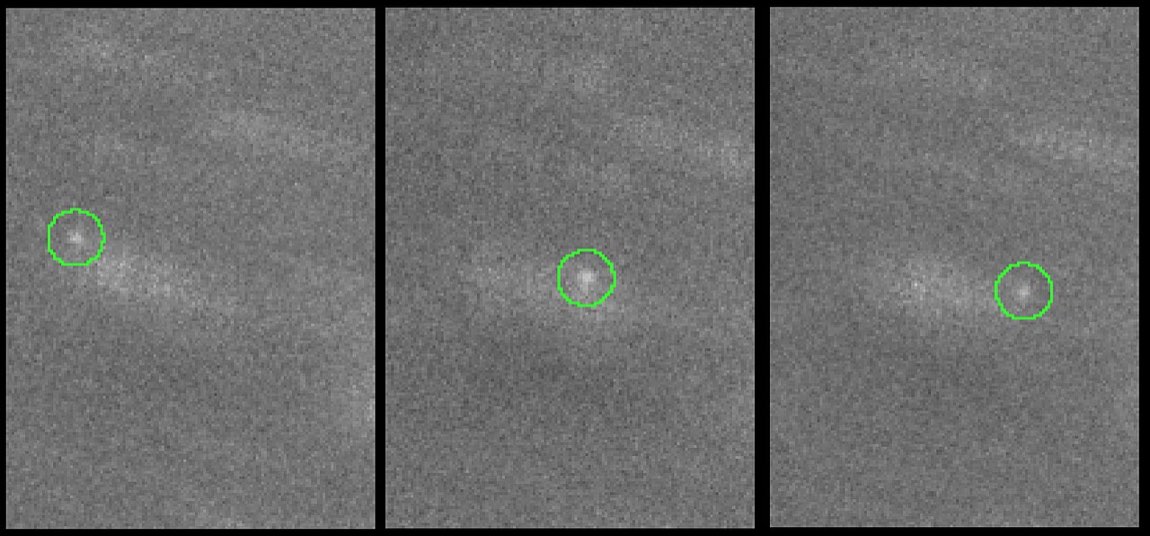
Finding Sao was not a matter of pointing a telescope and spotting something obvious. The search, led by Matthew Holman, began in 2001 and relied on stacking dozens of long-exposure images taken by the 4-meter Víctor M. Blanco Telescope at Cerro Tololo Inter-American Observatory in Chile. The key trick was the shift-and-add technique: each image was shifted slightly to compensate for Neptune's slow drift across the sky before all the frames were combined. That alignment caused any moon traveling with Neptune to brighten into a detectable point, while background stars smeared into harmless streaks. Using this method, the team pulled Sao out of the noise on 14 August 2002, alongside two other new Neptunian moons, Halimede and Neso, in the same batch of images. It was a remarkable haul — Sao was among the first Neptunian moons found from the ground since Nereid was spotted back in 1949, more than half a century earlier.
02 Pinning Down an Orbit Across Continents Deeper
A single discovery image tells you almost nothing about where a moon is actually going. To map Sao's orbit, astronomers launched a coordinated follow-up campaign across multiple continents and instruments. A team led by Brett Gladman used the 8.2-meter Very Large Telescope at Cerro Paranal Observatory on 3 and 5 September 2002. Other groups tracked the moon with the 2.5-meter Nordic Optical Telescope at La Palma Observatory and the 5-meter Hale Telescope at Palomar Observatory in California. Orbit predictions by Brian G. Marsden and Robert A. Jacobson guided all of these observations. Perhaps most valuably, Holman dug backward through archival Canada–France–Hawaii Telescope images and recovered Sao in frames dating to 23 July 2001 — more than a year before the official discovery date. That pre-discovery data dramatically extended the arc of observations and sharpened the orbital solution. The formal announcement came from the Minor Planet Center on 13 January 2003, pushing Neptune's total known moon count to 11 at the time.
03 A Name Drawn From the Sea-Nymphs of Myth
While the moon spent its first years under the unglamorous label S/2002 N 2, it was formally christened Sao on 3 February 2007 by the International Astronomical Union's Working Group for Planetary System Nomenclature, which also assigned it the Roman numeral designation Neptune XI. The name follows the IAU convention that irregular moons of Neptune must be named after Nereids — the fifty sea-nymph daughters of the sea-god Nereus and the Oceanid Doris in Greek mythology. Sao, written in Greek as Σαώ, is one of those fifty figures. The convention is fitting: Neptune is the Roman god of the sea, so surrounding the planet with the names of sea-nymphs gives the whole system a coherent mythological identity. The name also carries a quiet elegance — brief, two syllables, ancient — for an object so faint it took fifty-three years of increasingly powerful ground-based technology to detect after Nereid showed that distant Neptunian moons existed at all.
04 An Orbit That Refuses to Stay Still Deeper
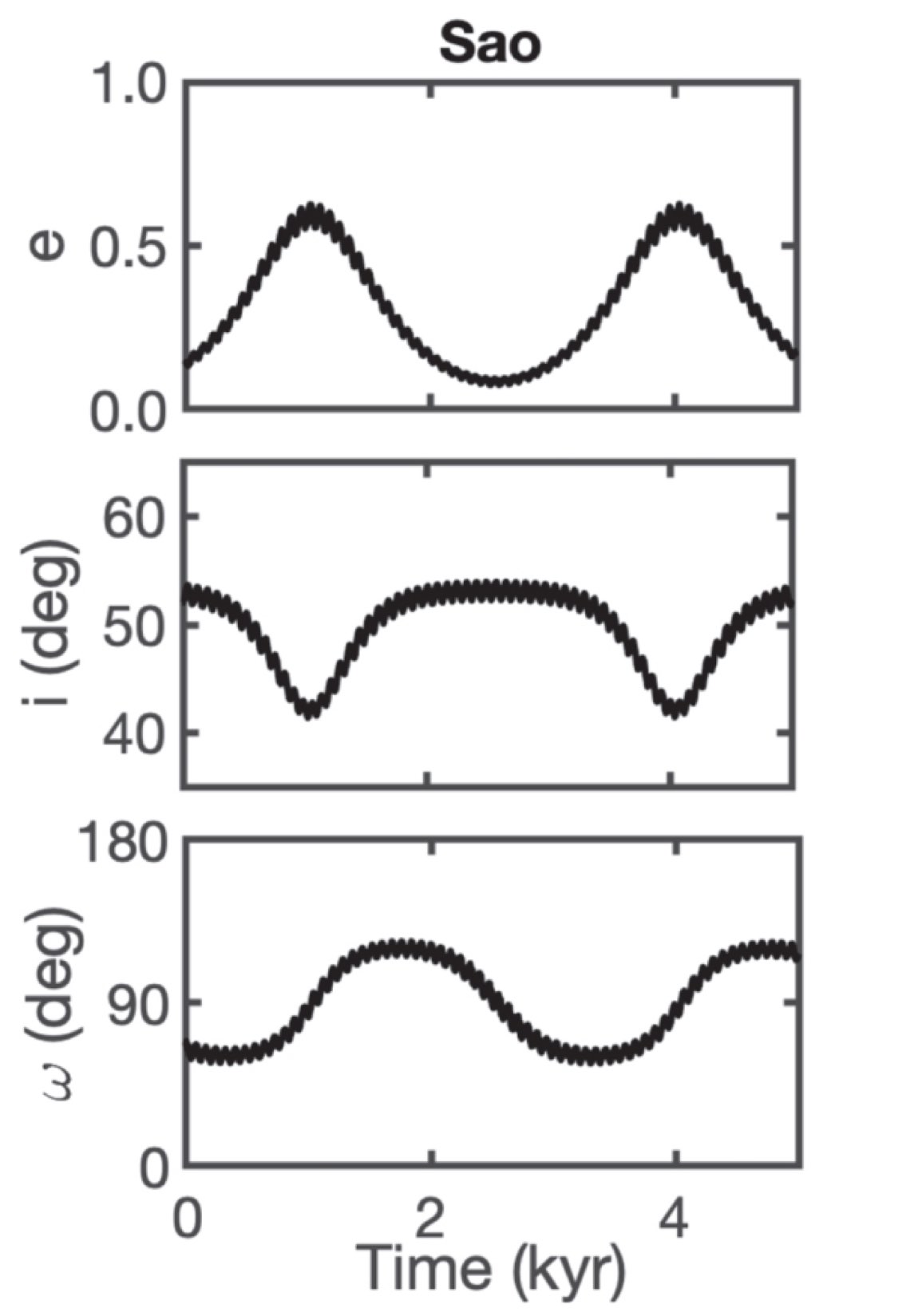
Sao's orbit is not a simple, stable ellipse — it is a living, breathing thing tugged constantly by the Sun's gravity. Over a 10,000-year timespan, the semi-major axis drifts between 22.1 and 22.4 million km from Neptune, averaging about 22.2 million km, which is roughly 0.148 AU. The orbital period hovers around 7.99 years on average, but solar perturbations can push it anywhere from 7.92 to 8.05 years. Far more dramatic is what happens to the eccentricity: it swings from as low as 0.07 — nearly circular — to as high as 0.63, an extremely elongated path. The inclination is similarly restless, ranging from 39° to 55° relative to the ecliptic. Because of this constant jostling, scientists describe Sao's orbit using proper orbital elements, which are computed by mathematically averaging the perturbed path over an extended period. Among all of Neptune's known prograde moons, Sao holds the record for the highest average inclination, sitting at 50°.
05 The Kozai Resonance: A 3,000-Year Dance Deeper
Sao's high inclination locks it into one of the more exotic phenomena in orbital mechanics: the Kozai resonance. First recognized in Sao by Holman and colleagues in 2004, this effect occurs when solar gravity periodically trades energy between a moon's eccentricity and its inclination. The two quantities oscillate out of phase over roughly 3,000 years — when inclination reaches its minimum, eccentricity peaks, and vice versa. The resonance also freezes one aspect of the orbit in a surprising way. Normally, an orbit's argument of pericenter — the angle describing where in the orbit the closest approach occurs — would slowly rotate all the way around from 0° to 360°, a process called apsidal precession. For Sao, the Kozai resonance prevents that circulation entirely. Instead, the argument of pericenter librates, rocking back and forth around 90° with that same ~3,000-year period. Separately, the orbit does experience nodal precession — the orientation of the orbital plane rotates — but on a longer 4,454-year cycle. Sao is the only known prograde irregular moon of Neptune trapped in this resonance.
06 Near Misses: Sao's Encounters With Nereid
Because Sao's eccentricity swings so widely, its distance from Neptune changes dramatically over millennia. At its most elongated, Sao's path can carry it close to Nereid, one of Neptune's largest and most famous irregular moons. These near-approaches are not just a curiosity — they carry real long-term consequences. Over a simulation spanning 4.5 billion years, researchers calculated that such gravitational encounters could lead to scattering events that significantly alter both moons' orbits. More strikingly, the simulations found a 1.6% chance that Sao and Nereid could actually collide over that timespan. A 2022 study led by Jet Propulsion Laboratory astrophysicists Marina Brozović and Robert A. Jacobson added another pairing to watch: Sao and Laomedeia can approach within 320,000 km of each other during a 30,000-year window — close enough that gravitational nudges between them are plausible. For context, 320,000 km is roughly the distance between Earth and the Moon.
07 The Sao Group: Fragments of a Lost Moon
Sao does not orbit Neptune in isolation. It belongs to a small family of prograde irregular moons called the Sao group, whose other confirmed members are Laomedeia and the more recently identified S/2002 N 5. The group was first suspected in 2004 based on the strikingly similar orbits of Sao and Laomedeia, but it was not formally confirmed as a three-member family until S/2002 N 5 was recognized as a matching member in 2024. The mutual dispersion velocities among the group's members — the speeds needed to place each fragment on its current orbit from a common parent — fall between 100 and 200 m/s, low enough to be consistent with a violent but singular event: the destruction of a once-larger irregular moon by a collision with a passing asteroid or comet. That original moon was probably captured by Neptune's gravity during the Solar System's chaotic early history, around the time the planets were forming. The group almost certainly contains many more smaller members, but they are too faint for current telescopes to detect.
08 What Color Clues Might Reveal About Its Past
If the Sao group truly formed from the breakup of a single parent body, then all its surviving fragments should be made of the same material — and therefore should share similar surface colors and reflectivity. This is the standard expectation for collisional families seen elsewhere in the Solar System, such as among the asteroids. The Sao group presents an interesting test case because two of its largest confirmed members, Sao and Laomedeia, appear to have similar brightness and comparable estimated sizes, which is noted as unusual compared with other known collisional families where the size distribution tends to be more uneven. Unfortunately the article does not report measured color data for Sao specifically, leaving the color-comparison prediction unverified with current observations. With instruments powerful enough only to barely detect these moons at all, obtaining spectra that would reveal surface composition remains a significant challenge, and the shared-color hypothesis stands as an open scientific question for future, more capable telescopes to answer.
09 How Big Is Sao, Really?
Nobody has directly measured Sao's diameter. The moon is simply too small and too far away for any existing telescope to resolve it as a disk rather than a point of light. Instead, astronomers estimate its size indirectly by combining its known brightness with an assumed geometric albedo — a measure of how reflectively bright its surface is. If Sao reflects 4% of incoming sunlight, an albedo of 0.04, its diameter works out to about 44 km (27 mi). If it is somewhat brighter, with an albedo of 0.06, the same brightness implies a smaller body of about 31 km (19 mi). Those two estimates bracket the likely truth, giving a diameter range of 31 to 44 km — roughly comparable to a small city's width. For reference, the larger estimate of 44 km is less than half the length of Rhode Island, the smallest U.S. state. Sao appears to be roughly the same size as its groupmate Laomedeia, assuming both moons share the same albedo, which is itself an assumption.
10 An Extremely Faint Target in the Night Sky
Even with the most powerful ground-based telescopes on Earth, observing Sao is an exercise in patience and sensitivity. In red light, specifically the R photometric band, Sao has an apparent magnitude of 25.4. To put that in perspective, the faintest stars visible to the unaided human eye hover around magnitude 6 — Sao is approximately 100 million times fainter than that threshold. No amateur telescope comes remotely close to reaching it. Even professional facilities require long-exposure imaging sessions to accumulate enough photons to detect the moon reliably. This extreme faintness is a direct consequence of two compounding factors: Sao's small size means it intercepts very little sunlight, and its enormous distance from the Sun — well over 4 billion km — ensures that the sunlight it does reflect is exceedingly dim by the time it arrives at Earth. These observational difficulties explain why so little is known about Sao's physical properties beyond a rough size estimate.
11 Sao's Place in Neptune's Moon Census
When the discovery of Sao, Halimede, and Laomedeia was announced by the Minor Planet Center on 13 January 2003, it brought Neptune's known moon total to 11 — a number that highlights just how incomplete our census of the outer Solar System remains. For comparison, the discovery of Nereid in 1949 had been the last ground-based detection of a Neptunian moon, meaning the field went more than half a century before Holman's team reopened it. Sao is classified as an irregular moon, a designation that distinguishes it from the regular moons orbiting close to Neptune in nearly circular, low-inclination paths. Irregular moons like Sao are thought to be captured objects — bodies that formed elsewhere in the Solar System and were gravitationally snared by Neptune long ago. Their distant, eccentric, and tilted orbits are the signature of that violent capture history, preserved across billions of years in the dynamics that astronomers like Holman, Brozović, and Jacobson continue to untangle today.
 ⤢