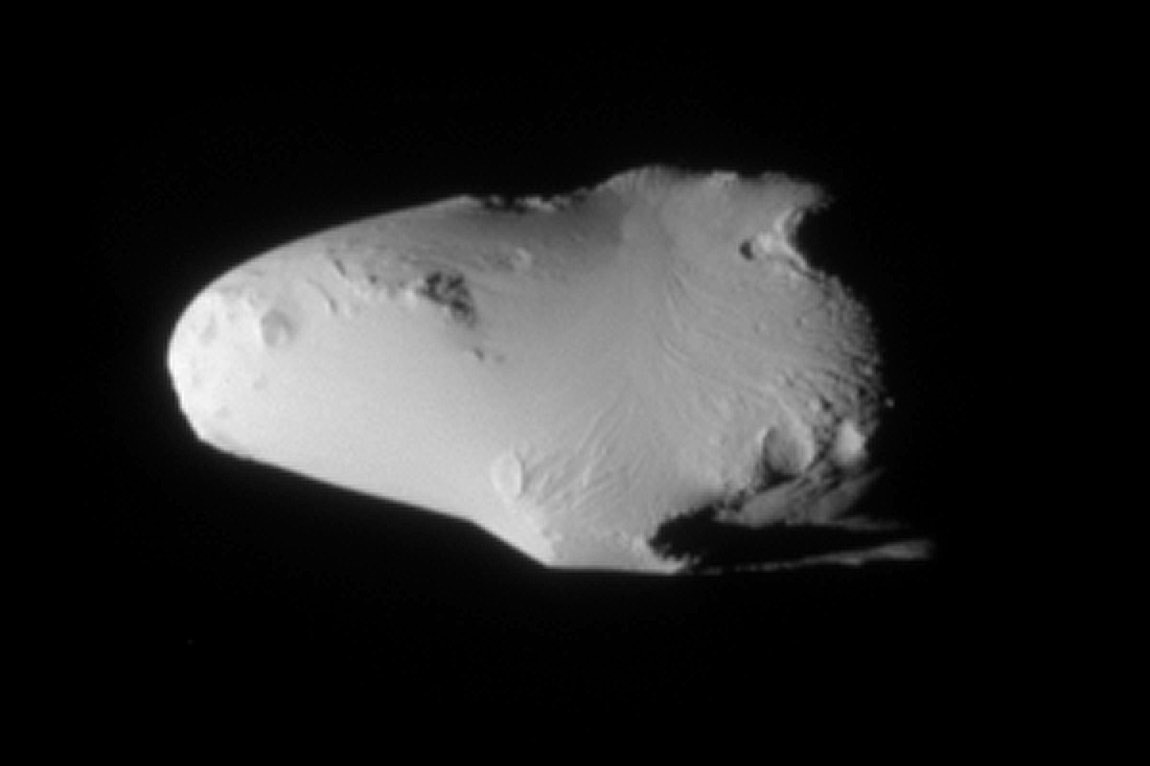
 Photograph · NASA / JPL / SSI · Public domain
Moon · Deep guide · orbits Saturn
Calypso
Also called: Saturn XIV · Tethys C
One of the most reflective surfaces in the Solar System, sandblasted by Enceladus's ice.
What is it?
Calypso is a small, irregular moon of Saturn about 19 km across that trails Tethys by 60° in the same orbit. Dan Pascu, Kenneth Seidelmann, William Baum and Douglas Currie found it from the ground in 1980. Its surface reflects light extremely well — a visual geometric albedo of about 1.34 — because it is constantly coated by fine ice from Saturn's E ring, which comes from the geysers of Enceladus.
The deep dive
Researched for the Atlas from Wikipedia — Calypso (moon) (1,524 characters read) · updated Nov 14, 2026
01 Five Names Before It Had One
Calypso had a confusing entrance into the astronomical record. Discovered in 1980 from ground-based observations by Dan Pascu, P. Kenneth Seidelmann, William A. Baum, and Douglas G. Currie, it was first tagged with the provisional designation S/1980 S 25 — meaning it was the 25th new Saturnian satellite identified that year alone. What makes this unusual is that the same small moon kept getting rediscovered and logged under fresh designations: S/1980 S 29, S/1980 S 30, S/1980 S 32, and finally S/1981 S 2. Each sighting looked like a new object because the moon is so faint and its orbit so peculiar. It took careful analysis to realize all five provisional designations pointed to a single body. Only in 1983, three years after its first detection, was it officially named Calypso, after the sea-nymph of Greek mythology. It also carries the formal designation Saturn XIV and the alternative label Tethys C, reflecting its intimate relationship with the much larger moon Tethys.
02 Locked at 60 Degrees: A Trojan Moon
Calypso does not follow a simple independent orbit around Saturn. Instead it is co-orbital with Tethys, permanently parked at Tethys's trailing Lagrangian point, known as L5, exactly 60 degrees behind that moon in its path. This gravitational sweet spot is one of two stable positions — called Lagrangian points — where a small body can be held in place by the combined gravity of Saturn and Tethys without being flung away or pulled in. The leading L4 point, 60 degrees ahead of Tethys, is occupied by another small moon called Telesto. Because of this arrangement, Calypso and Telesto are collectively called Tethys trojans, by direct analogy to the trojan asteroids that share Jupiter's orbit in the same 60-degree gravitational harbors. This relationship was first formally identified by Seidelmann and colleagues in 1981. Together with two other known trojan moons elsewhere in the Solar System, Calypso and Telesto make up half of the four trojan moons presently known.
03 What It Means to Share an Orbit Deeper
The concept of a trojan moon is elegant but easy to misread. Calypso does not trail Tethys like a dog on a leash — both worlds independently orbit Saturn, and Calypso simply happens to orbit at the same distance and speed as Tethys, arriving at the L5 point where gravitational forces from Saturn and Tethys cancel out just enough to allow stable residence. The L4 and L5 points are features of orbital mechanics first worked out by mathematician Joseph-Louis Lagrange in the eighteenth century, though the article does not discuss that history. What the article makes clear is that four trojan moons are presently known, and Calypso and Telesto together constitute half of that entire known population — making the Tethys system a rare and unusually complete example of this orbital configuration. The fact that Seidelmann, one of the original discoverers of Calypso, was also the person to first identify this trojan relationship in 1981 is a satisfying continuity in the science.
04 An Irregular Body Softened by Dust
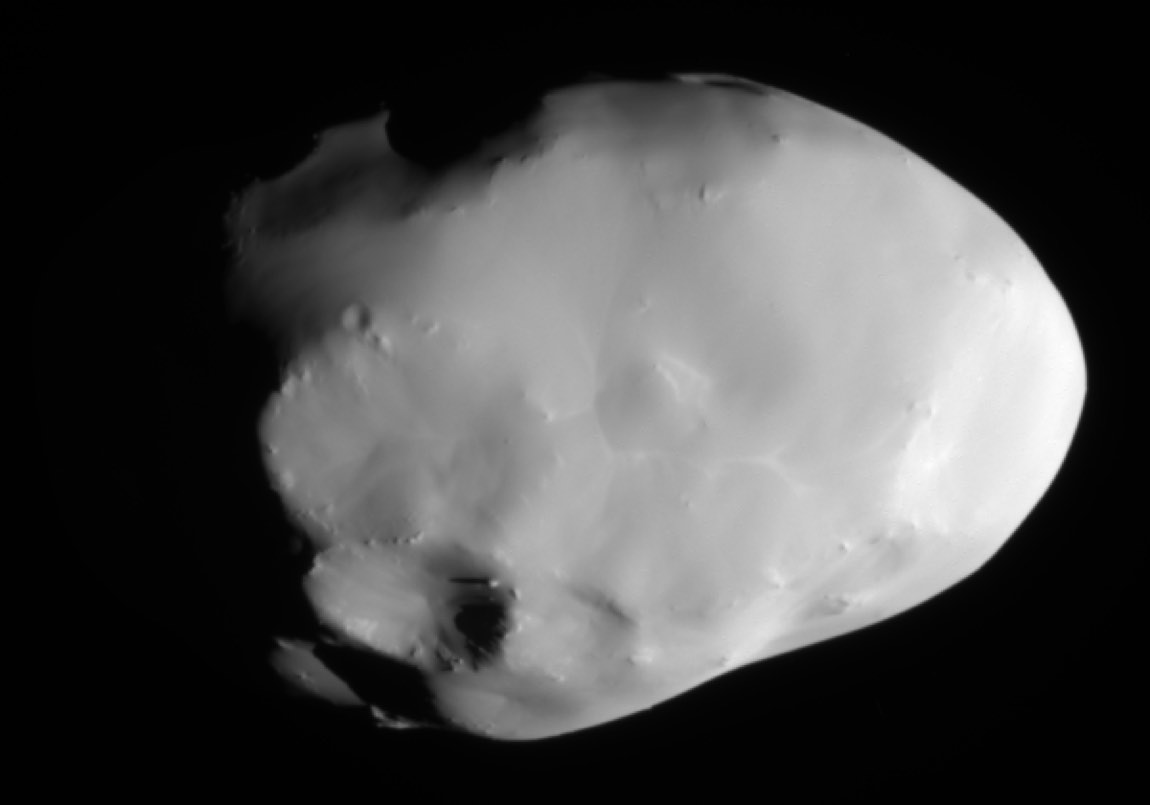
Calypso is not a tidy sphere. Like many small moons in Saturn's system and like many small asteroids, it is irregularly shaped — a lumpy, elongated object without enough mass to pull itself into a round form under its own gravity. Its surface bears overlapping large craters, the accumulated scars of billions of years of impacts. What makes Calypso visually distinctive, however, is that those craters do not look as sharp and fresh as craters on other heavily battered worlds. The article notes that Calypso appears to have loose surface material capable of smoothing the craters' appearance — a kind of powdery or granular layer that settles into depressions and softens their outlines over time. This gives the moon an almost pillow-like quality compared to jagged, cratered bodies elsewhere. The source and nature of this loose material connects directly to its extraordinary surface reflectivity, described in the section below.
05 The Most Reflective Surfaces in the Solar System
Calypso's surface has a visual geometric albedo of 1.34 — a number that deserves a moment's pause. An albedo of 1.0 would mean a surface reflects every single photon of visible light that hits it, like a perfect mirror. Calypso's albedo of 1.34 exceeds that theoretical ceiling, which is possible in geometric albedo measurements because of the way light scatters back toward the observer at certain angles, but it still places Calypso among the most reflective surfaces anywhere in the Solar System. In practical terms, its surface is dazzlingly bright. The article explains this is a direct consequence of continuous sandblasting by particles from Saturn's E-ring, a faint ring made of tiny water-ice particles. Those ice particles are generated by the famous south polar geysers of Enceladus and spread throughout the E-ring, and over time they coat Calypso's surface in a fresh, clean veneer of reflective ice — the same process that keeps the surface bright despite constant bombardment.
06 Enceladus's Geysers, Calypso's Shine Deeper
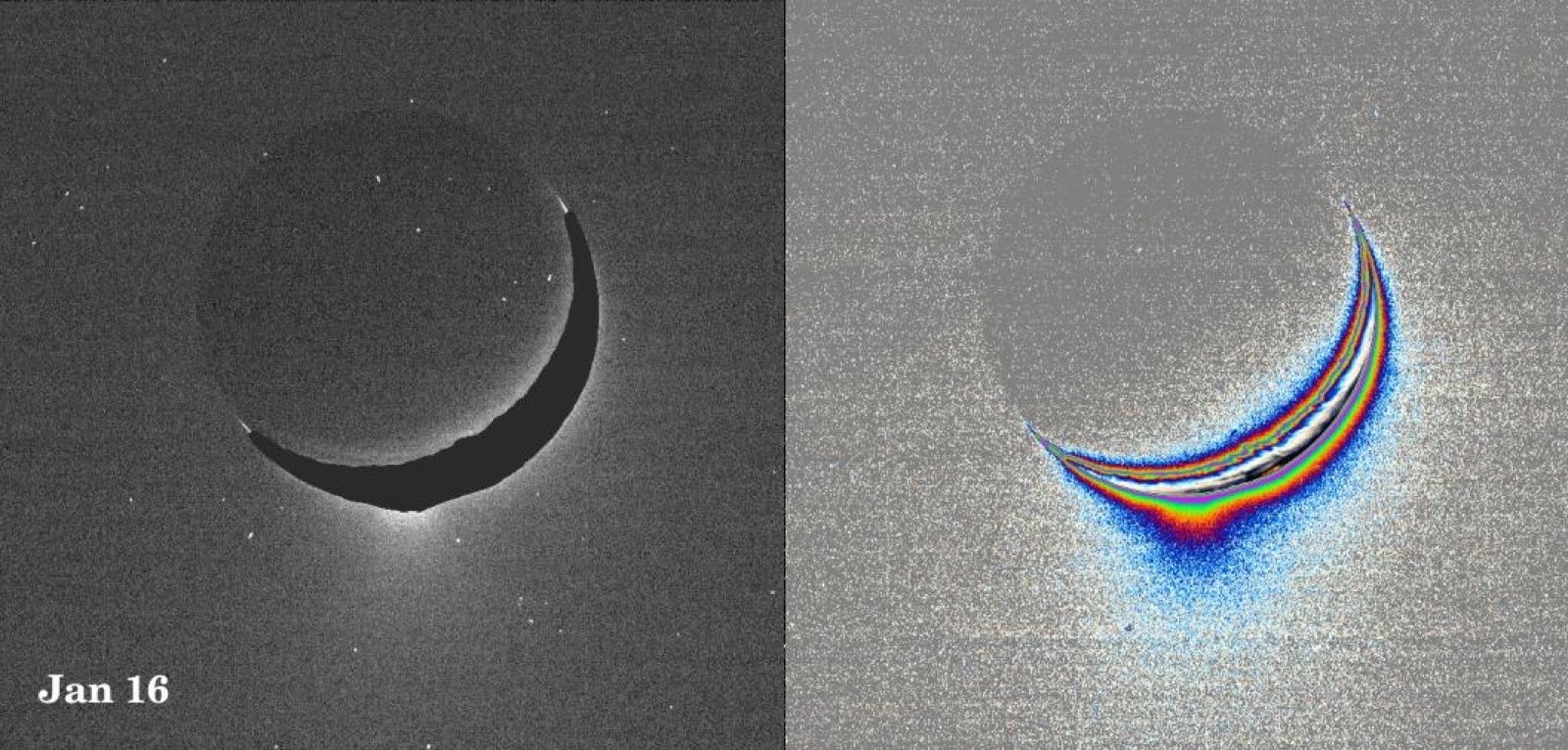
The chain connecting Calypso's brilliant surface to a completely different moon is one of the more striking examples of system-wide interactions in Saturn's neighborhood. Enceladus, one of Saturn's most scientifically famous moons, erupts water vapor and ice particles from geysers concentrated at its south pole. These particles escape into space and populate Saturn's E-ring, a diffuse and faint ring structure. Calypso orbits within or near this ring environment, and the E-ring particles continually rain down onto its surface and sandblast away darker, older material — a process the article specifically names as the cause of the moon's very high albedo. The result is that Calypso's extraordinary brightness is not an intrinsic property of its composition alone but a dynamic, ongoing cosmetic effect driven by another moon's internal geology. This interplay illustrates how connected the moons of Saturn are, with processes on one body visibly shaping the appearance of another entirely.
07 Ground-Based Discovery in the Age of Spacecraft
The timing of Calypso's discovery in 1980 places it in an interesting historical moment. Voyager 1 flew past Saturn in November 1980 — the same year Calypso was first observed — and Voyager 2 would follow in August 1981. Yet Calypso was found not by those spacecraft but from ground-based observations, by a team of four astronomers: Dan Pascu, P. Kenneth Seidelmann, William A. Baum, and Douglas G. Currie. Detecting such a small, faint moon at Saturn's distance from Earth, without the advantage of a close flyby, required careful photographic observation and analysis. The repeated re-detection of the same moon under five different provisional designations reflects just how difficult that ground-based work was — the object barely registered against the glare of Saturn and the complexity of its moon system. That four separate sightings were logged before anyone confirmed they were the same body says as much about the limits of the technology as it does about the skill of the team involved.
08 A Name from the Sea: Calypso's Mythology
The name Calypso was officially assigned in 1983, three years after discovery. In Greek mythology, Calypso was a sea-nymph, most famous from Homer's Odyssey, where she detained the hero Odysseus on her island of Ogygia for seven years. The choice of name fits within the broader convention for Saturnian moons, many of which are named for figures from Greek and Roman mythology. The moon also carries two alternative designations: Saturn XIV, its catalog number reflecting the order in which Saturnian moons received official designations, and Tethys C, a label that explicitly acknowledges its orbital relationship with the larger moon Tethys. In mythology, Tethys was a Titaness of the sea, and the choice of a sea-nymph as the name for one of her co-orbital companions has a certain thematic coherence — though the article does not state whether this parallelism was intentional in the naming decision.
09 Open Questions About a Tiny Moon Deeper
For all that is known about Calypso, the article leaves a number of things unsaid — which is itself informative. The internal structure of Calypso is not addressed: whether it is a solid, coherent body or a loosely bound rubble pile held together by its own weak gravity remains an open question for most small irregular moons of its type. The exact thickness and composition of the loose surface layer that smooths its craters are not characterized in detail. The dynamics of exactly how E-ring particles are deposited and at what rate they resurface the moon are described only in broad terms. And Calypso's precise dimensions are not given in the article — it is described as irregularly shaped, but no axis measurements appear. These gaps reflect the general state of knowledge about small inner Saturnian moons: observed in overview by Voyager and Cassini imagery but not yet studied with the resolution or dedicated instrumentation that would resolve questions about their internal makeup, surface age, and long-term evolution.
 ⤢