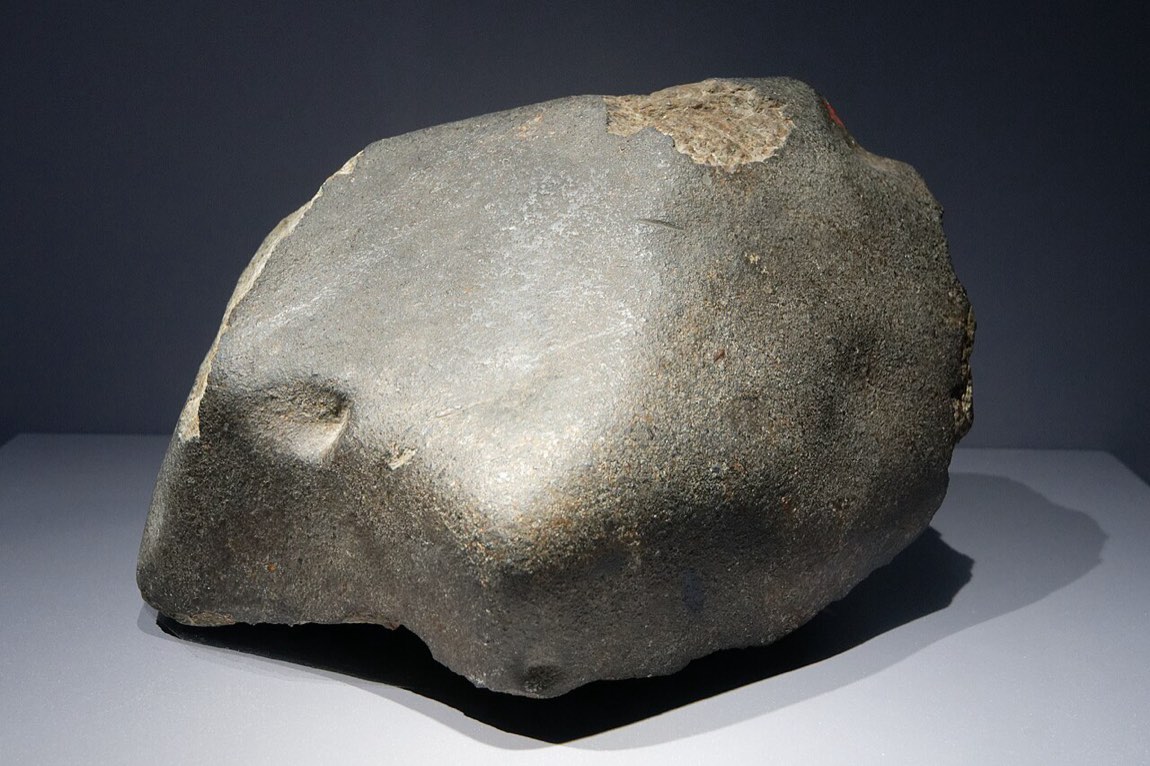
 Photograph · Chemical Engineer · CC BY-SA 3.0
Meteorite · Deep guide
Wold Cottage Meteorite
Also called: Wold Newton meteorite
A smoking 25 kg stone that landed beside a Yorkshire ploughman in 1795, Britain's largest witnessed fall.
What is it?
At about 3 p.m. on 13 December 1795, a stone crashed down a few metres from ploughman John Shipley near Wold Cottage farm in Yorkshire, England. It punched through 30 cm of soil and into the chalk beneath, and witnesses found it warm and smoking. The landowner, Major Edward Topham, exhibited it in London and later raised a monument on the spot. Weighing 56 pounds (about 25 kg), it is the largest meteorite seen to fall in Britain and helped persuade scientists that rocks really do arrive from space.
The deep dive
Researched for the Atlas from Wikipedia — Wold Cottage meteorite (3,066 characters read) · updated Nov 15, 2026
01 A Ploughman's Close Call in December 1795
On the afternoon of 13 December 1795, at around three o'clock, a stone fell from the sky and buried itself in a field near Wold Cottage farm in Yorkshire, England — landing within a few yards of a ploughman named John Shipley. The near-miss was not a quiet affair. Multiple witnesses on the ground described a dark body streaking through the air, and several people reported hearing sounds of explosions as the object descended. When Shipley and others reached the landing point, the stone was still warm to the touch and visibly smoking, signs that it had only moments before completed a fiery passage through the atmosphere. The impact punched a crater approximately 1 yard (0.91 m) across, drove through 12 inches (300 mm) of topsoil, and embedded itself into the underlying chalk bedrock to a depth of 7 inches (180 mm). The combination of eyewitness testimony, audible detonations, residual heat, and a fresh impact scar made this one of the best-documented meteorite falls of its era.
02 The Showman Who Publicised Science
The land where the stone fell belonged to Major Edward Topham, a figure whose background was anything but typical for a patron of natural science. Topham was an ex-soldier, a playwright, and a newspaper proprietor — a man accustomed to managing public attention. Rather than keeping the find quiet, he seized on it as a spectacle worth sharing, exhibiting the meteorite publicly at Piccadilly in London. This decision mattered enormously for the scientific record. At a time when the very idea that rocks could fall from space was still fiercely contested, putting a fresh, witnessed specimen in front of London's educated public helped generate serious discussion. Topham also marked the site of impact with a substantial monument of his own commissioning: a brick structure 4 ft (1.2 m) square and 25 ft (7.6 m) high, bearing a plaque on one face. That monument still stands, making the Wold Cottage impact one of the very few meteorite fall sites in the world permanently marked by a purpose-built memorial erected at the time of the event.
03 From Naturalist's Cabinet to National Museum
The stone initially weighed 56 pounds (25 kg) — roughly the weight of a large bag of dog food — making it a substantial specimen by any standard. Its custodial history traces a path through the emerging institutions of British science. In 1804, the naturalist James Sowerby acquired the meteorite, bringing it into the orbit of the period's natural history community. Sowerby was well connected in scientific circles and would have understood the specimen's importance. Then, in 1835, the British Museum acquired it, placing the stone within a national collection. Today the meteorite can be seen at the Natural History Museum in London, which inherited the British Museum's natural history collections. That journey — from a smoking hole in a Yorkshire field to one of the world's great public science institutions — took just four decades, a relatively swift passage for a specimen of this age and significance.
04 Early Chemical Sleuthing on an Alien Rock Deeper
Before modern analytical chemistry existed, early investigators still managed to characterise the Wold Cottage stone with surprising precision by identifying two physically distinct portions. The first was an earthy part containing silicon, magnesium, iron, and a small amount of nickel; crucially, some of that iron and nickel was present in the elemental — that is, metallic — state rather than bound into minerals. The earthy substance was noted as resembling kaolin, the clay mineral produced by weathered feldspar, though it was described as relatively tough rather than soft. The second portion was malleable, meaning it could be deformed without cracking, and consisted mainly of iron with some nickel. Investigators also reported the presence of iron pyrites, an iron-sulphur compound. Finding metallic iron and nickel together in a rock was essentially unknown on Earth in that form, which made the chemical profile of the stone itself an argument for an extraterrestrial origin. Modern classification places Wold Cottage squarely as an L6 ordinary chondrite, a category defined by relatively low total iron content and a high degree of thermal metamorphism.
05 What L6 Ordinary Chondrite Really Means Deeper
The modern designation L6 ordinary chondrite packs a great deal of scientific meaning into two characters. Ordinary chondrites are the most common class of meteorite, primitive rocky bodies that preserve material from the early solar system. The L group is distinguished by a comparatively low total iron content relative to other ordinary chondrite groups, with the iron distributed among silicate minerals, oxides, and free metal. The number 6 refers to the petrologic type on a scale from 1 to 7, indicating the degree of thermal processing the rock experienced while still part of its parent body in the asteroid belt. A type 6 meteorite has been heated enough to nearly erase the original chondrule textures — the spherical droplets of once-molten silicate that give chondrites their name — and to equilibrate the mineral chemistry throughout the rock. In practical terms, Wold Cottage is a piece of an asteroid that was significantly cooked by internal heat early in solar system history, then eventually broke free and spent millions of years traveling before its final seconds as a fireball over Yorkshire.
06 Britain's Biggest, Europe's Second Largest Fall
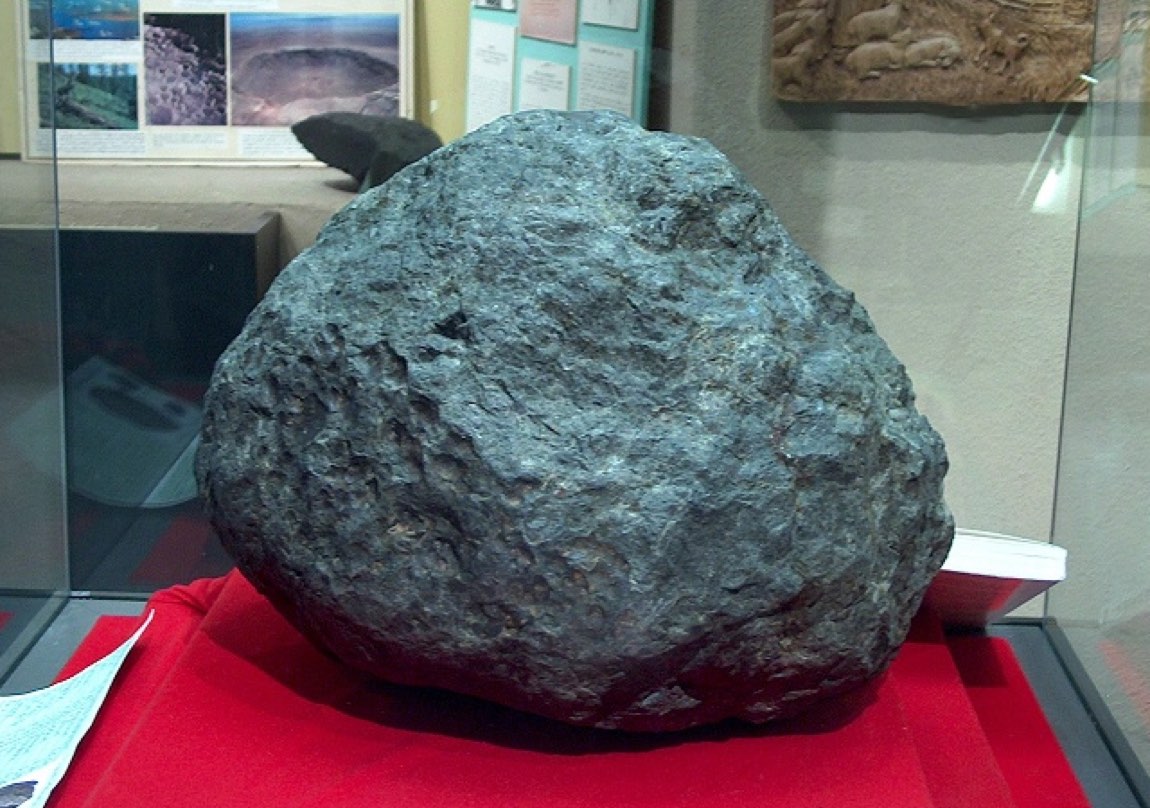
Among meteorites whose fall was actually observed, Wold Cottage holds a notable ranking. It is the largest meteorite ever witnessed falling in Britain, and it ranks as the second-largest observed fall in all of Europe. The stone that claims first place on that European list is the Ensisheim meteorite, which fell in 1492 in what is now Alsace, France — more than three centuries before the Yorkshire event. The Ensisheim stone was famously treated as a divine omen by Holy Roman Emperor Maximilian I, who had it chained inside a church. The comparison between the two falls illustrates how rare large, witnessed meteorite events are: across a continent over recorded history, only a handful of specimens large enough to compete with Wold Cottage's 56 pounds (25 kg) have been seen to arrive. That rarity is precisely what made the Yorkshire fall so scientifically valuable when it happened.
07 A Stone That Changed a Scientific Debate Deeper
In the late eighteenth century, the scientific establishment was genuinely divided over whether rocks could fall from space. The idea seemed to many natural philosophers to be a folk superstition dressed up in dramatic language. What the Wold Cottage fall contributed was a convergence of evidence that was difficult to dismiss: multiple independent eyewitnesses who described a dark body in the air, audible detonations heard across the area, a freshly smoking and warm stone found at a fresh impact point, and a chemical composition unlike any terrestrial rock — including metallic iron and nickel in elemental form. No single piece of that evidence was conclusive alone, but together, and combined with testimony about the fall, the Wold Cottage stone pushed the scientific community toward accepting that extraterrestrial matter genuinely arrives on Earth. The meteorite thus sits at a hinge point in the early scientific study of meteorites, a field that barely existed as a formal discipline when the stone fell.
08 Philip José Farmer and the Wold Newton Family
The Wold Cottage fall crossed from science into literary mythology through the imagination of American science fiction writer Philip José Farmer. In his fictional "biographies" of Tarzan — published as Tarzan Alive — and of Doc Savage, subtitled His Apocalyptic Life, Farmer constructed an elaborate premise built on the 1795 meteorite event. His conceit was that the radiation or some other effect of the falling stone altered the genetics of people who witnessed the fall, producing descendants of exceptional ability across generations. This fictional lineage became known as the Wold Newton family, a concept that attracted an enthusiastic community of writers and readers who expanded the idea to link dozens of fictional characters from popular literature into a shared fictional universe. The premise is a creative invention with no scientific basis, but it demonstrates how a genuine, documented historical event — a stone falling in a Yorkshire field — can acquire an entirely parallel life in imaginative culture.
09 Film, Fiction, and the Stone's Afterlife
Beyond Philip José Farmer's science fiction biographies, the Wold Cottage meteorite has found its way into other creative works. The experimental film Robinson in Ruins invokes the event through its main character, Robinson, who reads the meteorite fall as a sign that rocks from space always arrive at moments of historical significance — in this case connecting the 1795 fall with the 1795 amendment to the Settlement Act, a piece of legislation that the film associates with accelerating the development of capitalism in England. The interpretive leap is Robinson's, not the film's endorsement of historical causation, but it reflects how meteorite falls, with their sudden violence and unpredictability, lend themselves to being read as omens or punctuation marks in human affairs. More recently, the stone takes a central role in a 2019 detective novel, Sherlock Holmes and The Christmas Demon, by British author James Lovegrove. That a single meteorite fall can generate a monument, a scientific turning point, a fictional family tree, an art film reference, and a Victorian-pastiche mystery novel is itself an unusual legacy.
10 The Monument Still Standing in a Yorkshire Field
Major Edward Topham did not merely exhibit the meteorite in London and move on. He commissioned a permanent marker at the exact point of impact on his property: a brick structure measuring 4 ft (1.2 m) square at its base and rising to 25 ft (7.6 m) in height, with a plaque mounted on one face. At 25 feet tall, the monument is roughly the height of a two-and-a-half-story building — conspicuous in a flat agricultural landscape. The decision to build it reflects both Topham's showman instincts and his apparent genuine appreciation of the event's significance. Few meteorite falls anywhere in the world are commemorated by a structure built at the time of the fall, by the landowner, at the precise impact location. Most meteorite fall sites, even famous ones, are unmarked or were only memorialised long after the fact. The Wold Cottage monument therefore represents an unusually immediate and substantial act of commemoration for a natural event.