 Photograph · Konrad Andrä · CC BY-SA 2.0 de
Meteorite · Deep guide
Ensisheim Meteorite
Also called: Ensisheim · Thunderstone of Ensisheim
The stone that fell in 1492 near Ensisheim is Europe's oldest recorded fall with material still preserved.
What is it?
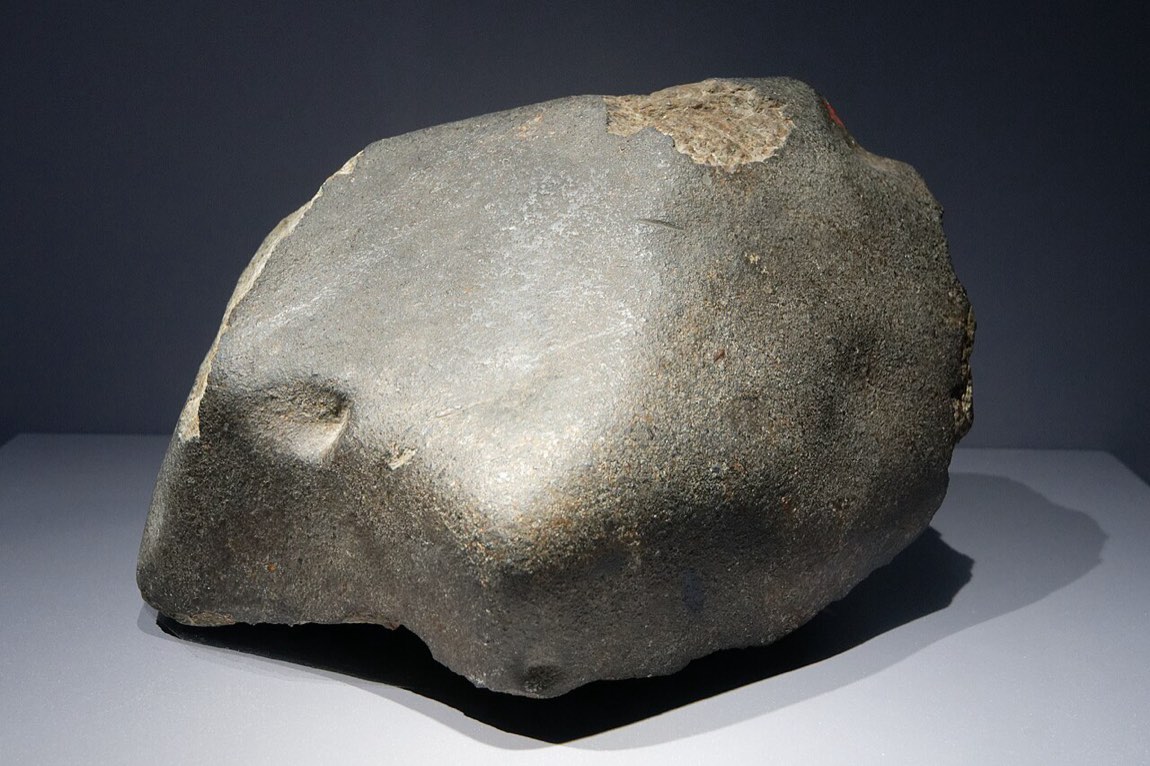
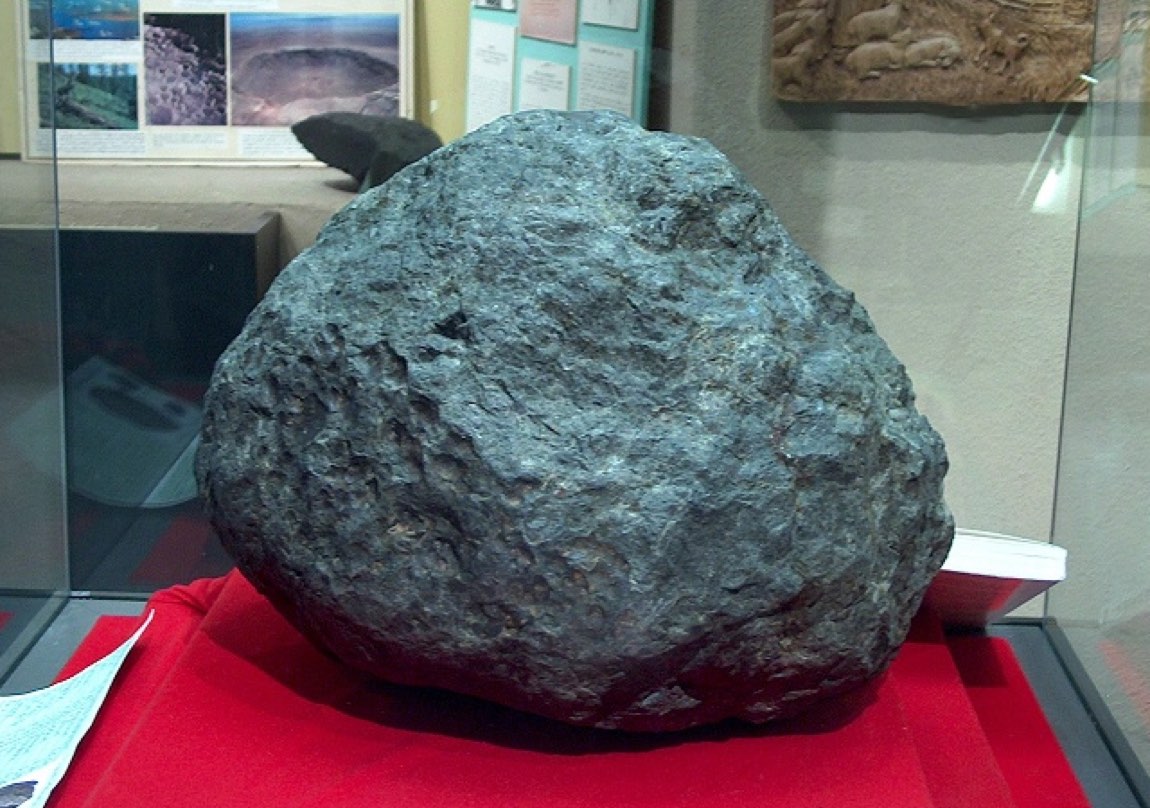
On 7 November 1492, a 127 kg stone crashed into a wheat field outside the walled town of Ensisheim in Alsace, now in France, leaving a hole about a metre deep. Its fireball was seen up to 150 km away. Townspeople began chipping off souvenirs until a magistrate stopped them to save it for King Maximilian, who treated it as a good omen and had it hung by a chain in the local church. The meteorite can still be seen in the town's museum. It is an LL6 ordinary chondrite.
The deep dive
Researched for the Atlas from Wikipedia — Ensisheim meteorite (3,302 characters read) · updated Nov 15, 2026
01 A Stone Falls on the Medieval World
On November 7, 1492, a fireball blazed across the sky above Alsace, visible to observers as far as 150 kilometres away, before a stone plunged into a wheat field outside the walled town of Ensisheim. The impact was no quiet event: contemporaries reported hearing the sound at least 100 miles away, a radius that would encompass a swath of territory roughly the size of a small country. When townspeople and farmers rushed to the site, they found a triangular stone sitting at the bottom of a hole one metre deep. Almost immediately, bystanders began breaking pieces off — an instinct that, left unchecked, would have destroyed the object entirely. Only the intervention of a local magistrate, acting to preserve the stone for royal inspection, halted the souvenir-taking. That single act of bureaucratic caution is a large part of why there is anything left to study today, making the Ensisheim fall a rare case where politics accidentally served science.
02 What Kind of Rock Fell from the Sky Deeper
The Ensisheim meteorite is classified as an LL6 ordinary chondrite, a designation that carries precise scientific meaning. The "LL" label indicates a low total iron content and a low proportion of metallic iron compared to other ordinary chondrites, while the "6" refers to its petrologic type — meaning the rock has been thermally metamorphosed to a high degree, erasing much of the fine-grained texture that chondrites show in their more primitive states. Ordinary chondrites as a class are the most common type of stony meteorite, thought to originate from undifferentiated parent bodies in the asteroid belt. The LL group in particular is linked by some researchers to S-type asteroids. At 127 kilograms upon its documented early weighing, the original stone was a substantial mass, though as the article of its later history shows, that figure would not hold steady. Its triangular shape, noted by contemporaries, reflects the aerodynamic ablation and fragmentation a meteoroid undergoes as it decelerates through the atmosphere.
03 Sebastian Brant and the Power of Broadsheets
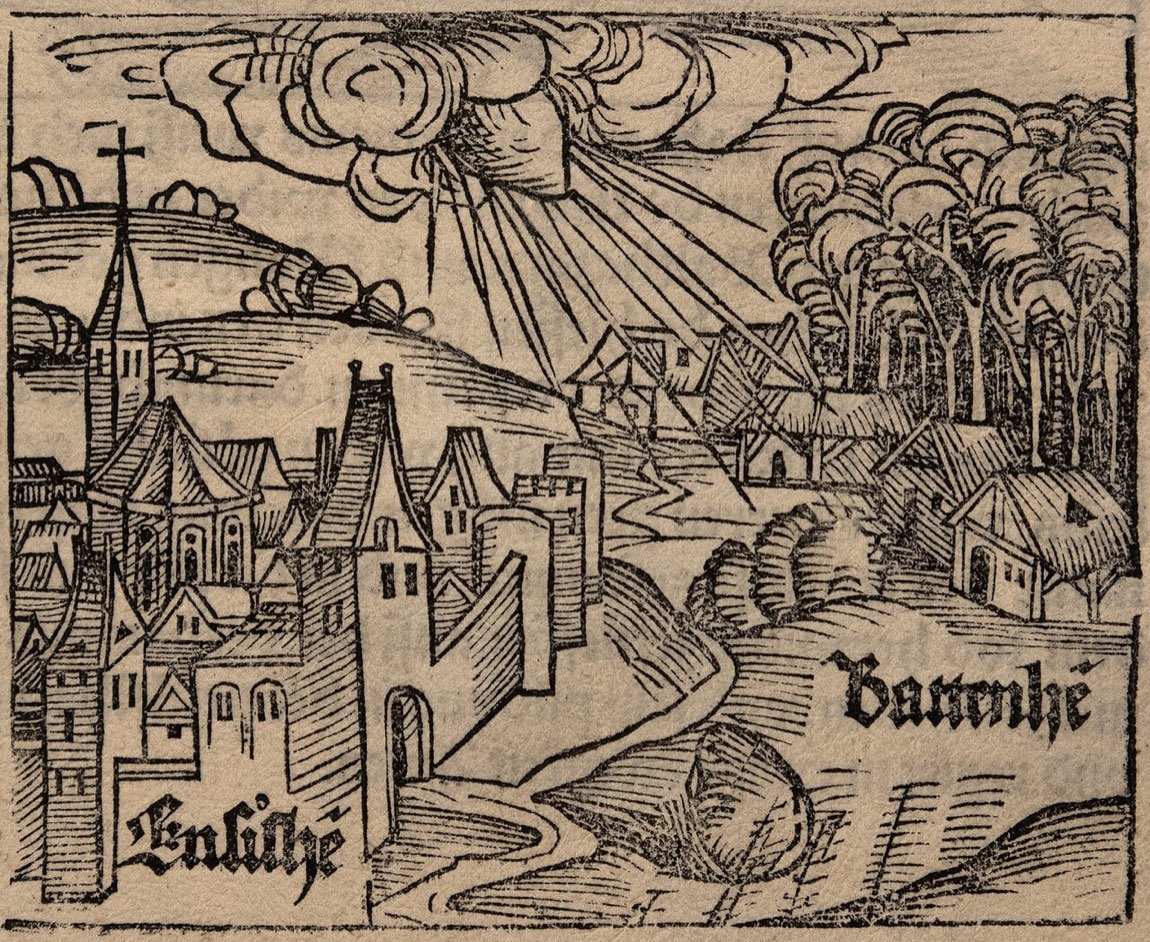
The speed with which news of the Ensisheim fall spread across Europe owed as much to media strategy as to the meteorite's dramatic arrival. Sebastian Brant, born in 1458 and best known today as the satirist behind Das Narrenschiff — "The Ship of Fools" — seized on the event immediately. He composed broadsheets in both Latin and German, pairing dramatic pictures with a poem framing the meteorite as a divine omen predicting King Maximilian's military success against France. These single-sheet printed publications, precursors to newspapers, could be produced quickly and distributed widely. When Maximilian defeated a far larger French army at the Battle of Senlis just two months after the fall, Brant produced another broadsheet pointedly reminding readers of his earlier prediction. By 1493, the political situation had shifted: Maximilian had signed the Treaty of Senlis with France, so Brant redirected his rhetoric, now casting the meteorite's omen toward the Turkish threat instead. The episode is a vivid demonstration of how natural phenomena were consciously weaponised for political messaging even in the fifteenth century.
04 A Royal Omen and Its Propaganda Life
King Maximilian, son of Holy Roman Emperor Frederick III, was literally on his way to a military campaign against France when the meteorite fell. His advisors interpreted the stone as a good omen, and Maximilian ordered it preserved in the local church, suspended by a chain — a display that gave the object an almost relic-like status. The meteorite's story then entered the machinery of royal propaganda in a remarkably direct way. Its fall was reported not just through Brant's broadsheets but also in the Nuremberg Chronicle, specifically in Folio 257, one of the most ambitious illustrated books of the era. A piece of the meteorite itself was dispatched all the way to Cardinal Piccolomini at the Vatican — the cardinal who would later become Pope Pius III — accompanied by verses composed by Brant. That a fragment crossed the Alps as a diplomatic gift underscores how potent the object had become as a symbol, well beyond its scientific novelty.
05 Dürer's Possible Eyewitness Sketch
Among the most tantalizing details attached to the Ensisheim meteorite is the suggestion that the German artist Albrecht Dürer may have sketched his observation of the fireball's fall on the reverse of his painting St. Jerome in the Wilderness. The article is careful to note this connection with the word "possibly," which is worth taking seriously: art-historical attribution of informal sketches can be genuinely uncertain, and the claim has not been stated as confirmed fact. If the attribution is correct, it would make the Ensisheim fall one of the very few astronomical events of the period to have been recorded by a major Renaissance artist from personal observation. Dürer was alive and active in the German-speaking world at the time, so the geographical and chronological overlap is plausible. Whether or not the sketch is definitively his, the detail reminds us that the fireball was vivid enough to leave impressions across many different kinds of records — official, literary, and potentially artistic.
06 Centuries of Loss: The Meteorite's Shrinking Mass Deeper
The physical history of the Ensisheim meteorite after its fall is a story of steady attrition. Bystanders began breaking off pieces within hours of its landing, and that process of fragmentation continued across the centuries. During the French Revolution, as described by Gustavus Detlef Hinrichs, the meteorite was dragged to Colmar, the capital of the province, and was "considerably reduced in weight" during this period — a phrase suggesting that chunks were removed, whether deliberately or through rough handling. By January 23, 1896, an official weighing recorded the stone at just 54.8 kilograms, or 111 pounds — less than half of its original documented mass of 127 kilograms. Of that reduced mass, nine kilograms were subsequently sent to Paris and housed, as of 1905, in the Museum of Natural History of the Botanical Garden. The meteorite that sits in the Musée de la Régence today is therefore a significantly diminished remnant of the stone that struck the wheat field in 1492, its losses a physical record of five centuries of human curiosity, politics, and upheaval.
07 Europe's Oldest Preserved Stony Fall
The Ensisheim meteorite holds a specific and carefully worded record: it is the oldest recorded stony European meteorite fall from which there is still some meteoritic material preserved. Each word of that designation matters. "Recorded" means there are contemporary written and visual accounts of the fall itself, not merely a stone found later and attributed to cosmic origin. "Stony" distinguishes it from iron meteorites, which are more durable and have their own preservation histories. "European" limits the geographic scope. And the phrase "some meteoritic material preserved" honestly acknowledges that what remains is a fragment of the original mass rather than an intact specimen. Older European meteorite events may well have occurred and even been documented in some fashion, but none of them left behind material that survives to the present day in a verifiable chain of custody. The combination of a witnessed fall, near-immediate political protection, and an unbroken institutional home in Ensisheim across more than five centuries is what makes the stone's survival possible.
08 The Musée de la Régence and Its Famous Tenant
The meteorite's current home is the Musée de la Régence in Ensisheim, a sixteenth-century building whose age is itself a reminder of deep historical continuity — the museum structure postdates the fall by only a few decades. Ensisheim itself was at the time of the fall a walled town in Alsace, then part of Further Germany, a territory of the Holy Roman Empire; the region is now part of France. The meteorite's storage in the local church, ordered by Maximilian, established an institutional relationship between the stone and the town that has persisted through wars, revolutions, and changes of national sovereignty. The fact that the stone returned to Ensisheim after its turbulent removal during the French Revolution, and that it remains there today, speaks to the town's strong identification with the object. For visitors, the museum offers a rare chance to stand in front of a rock that witnessed — if a rock can be said to witness anything — five and a half centuries of European history since its arrival from space.
09 The Fireball That Announced Its Own Arrival Deeper
The entry of the Ensisheim meteorite into Earth's atmosphere was an event of genuine spectacle by any era's standards. As a stony body decelerating from cosmic velocity through increasingly dense air, it would have heated and ablated, producing the luminous trail observed as a fireball visible across a radius of at least 150 kilometres. The sonic effects were equally dramatic: the sound of the impact was reportedly heard at distances of at least 100 miles, roughly 160 kilometres, by contemporaries. Sound propagation at that range is consistent with the hypersonic shock wave and the terminal explosion or "dark flight" transition that large incoming meteoroids produce. The wheat field impact left a hole one metre deep, indicating the stone had retained substantial velocity at the moment of ground contact — a function of its mass of 127 kilograms and the angle and speed of its final descent. Together, these observational details paint a picture of a bolide event that would have been genuinely alarming to anyone within earshot or eyeshot, which explains both the immediate crowd response and the rapid circulation of the story.
 ⤢