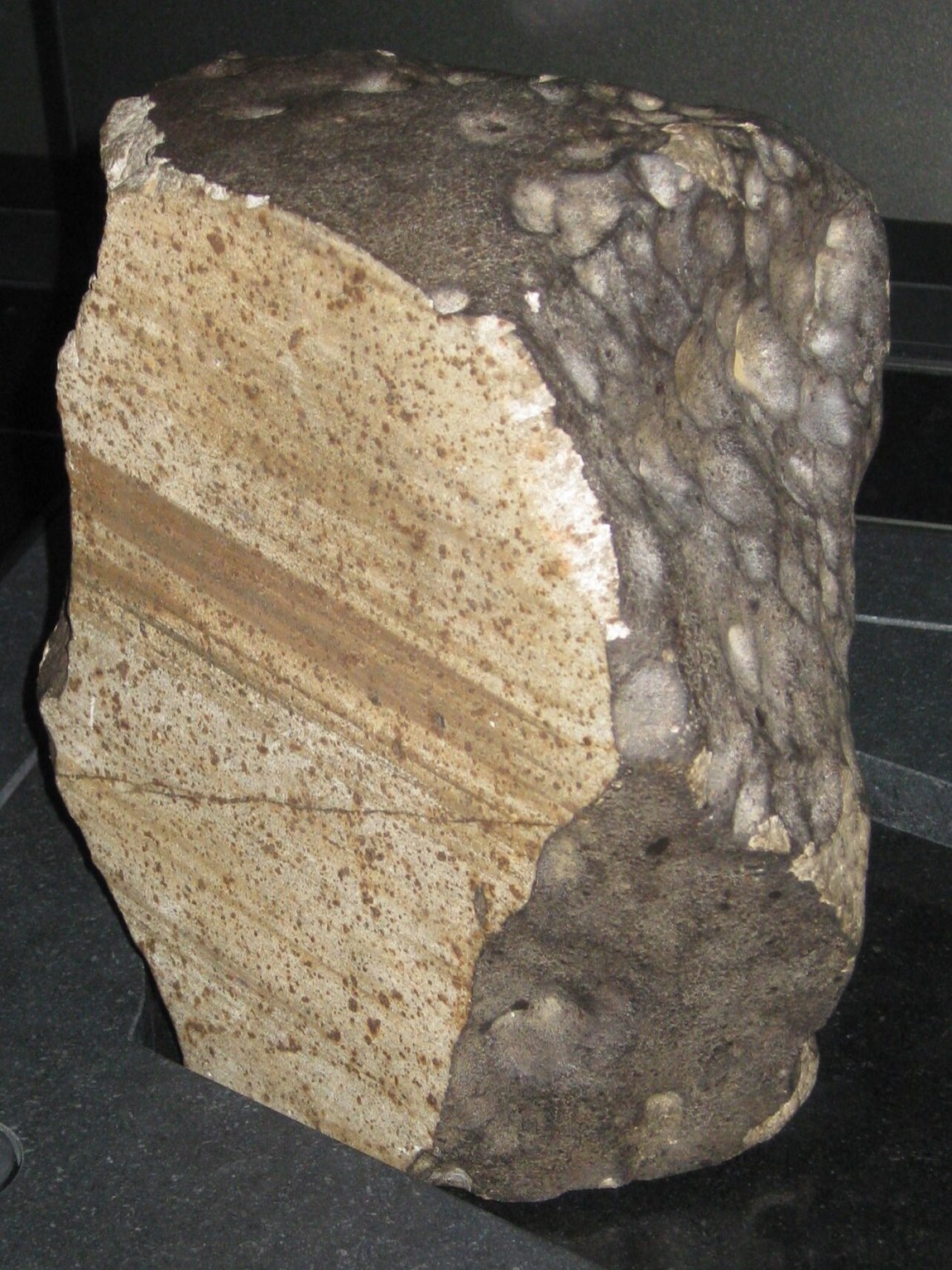
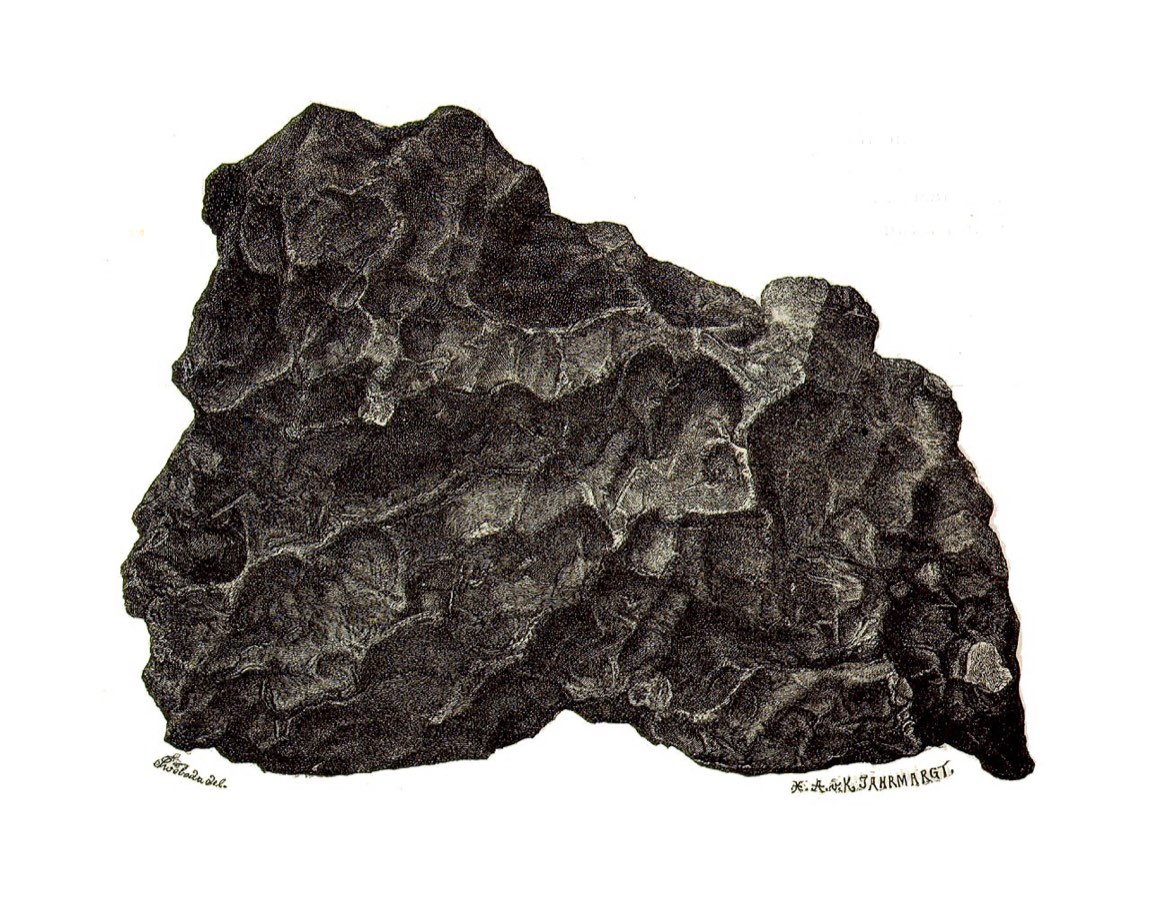
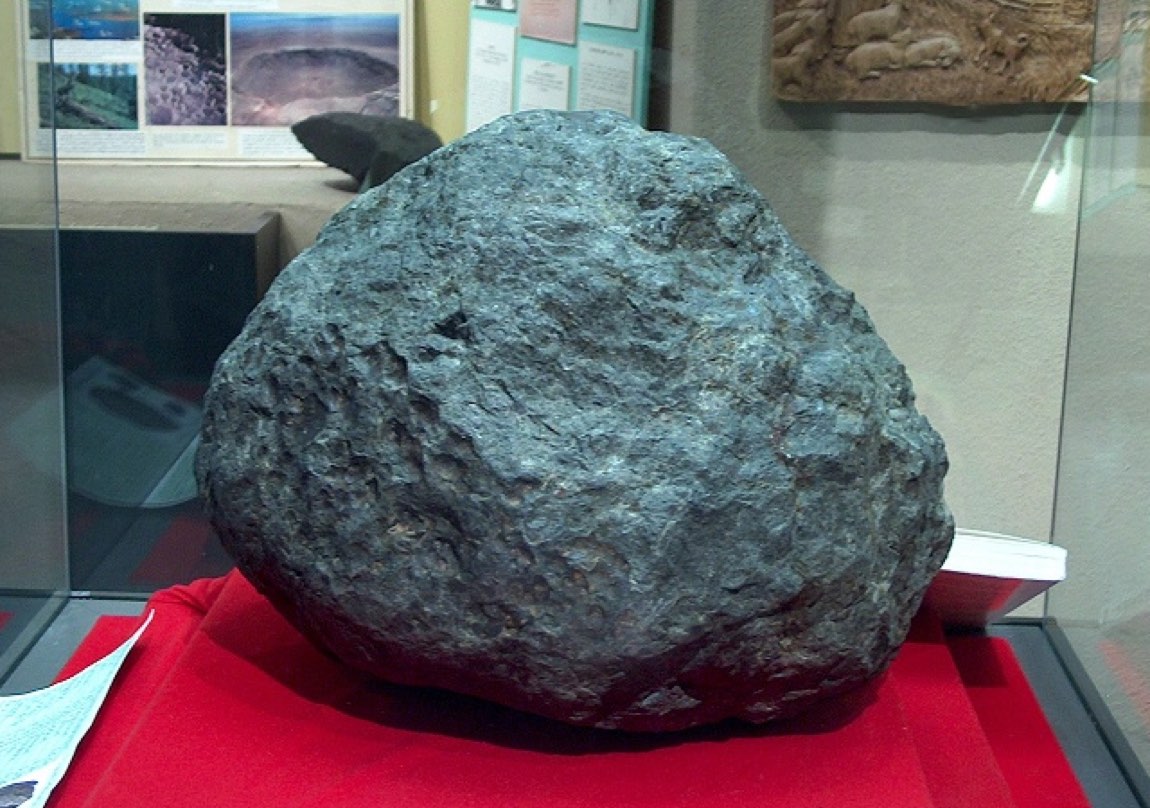
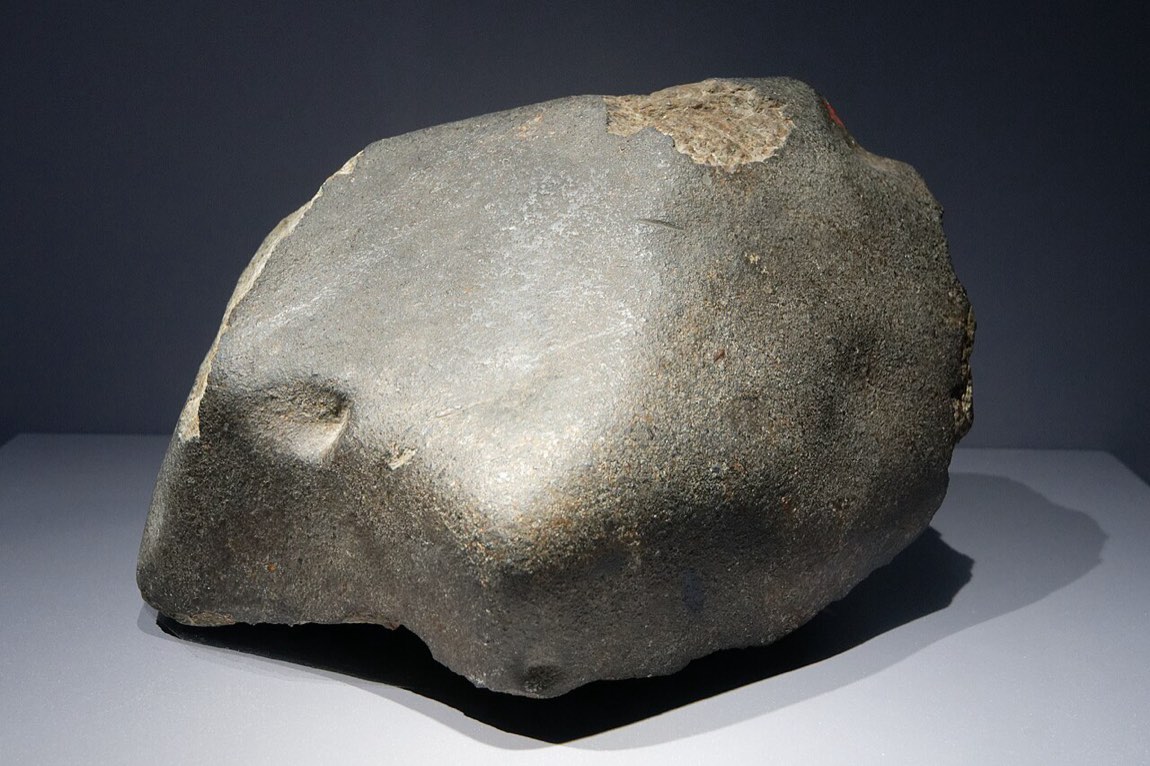
 Photograph · Marie-Lan Taÿ Pamart · CC BY 4.0
Meteorite · Deep guide
L'Aigle Meteorite
Also called: L'Aigle · Laigle
The 1803 stone shower in Normandy that finally convinced scientists that meteorites come from space.
What is it?
In the early afternoon of 26 April 1803, more than 3,000 stones rained down on the town of L'Aigle in Normandy, France. Until then, most scholars dismissed tales of stones falling from the sky as superstition. The French Academy of Sciences sent the young physicist Jean-Baptiste Biot to investigate. He gathered physical evidence and many eyewitness accounts and concluded the stones must have come from beyond Earth. His report is often said to have founded the science of meteoritics.
The deep dive
Researched for the Atlas from Wikipedia — L'Aigle (meteorite) (2,275 characters read) · updated Nov 15, 2026
01 A Rain of Stones on a April Afternoon
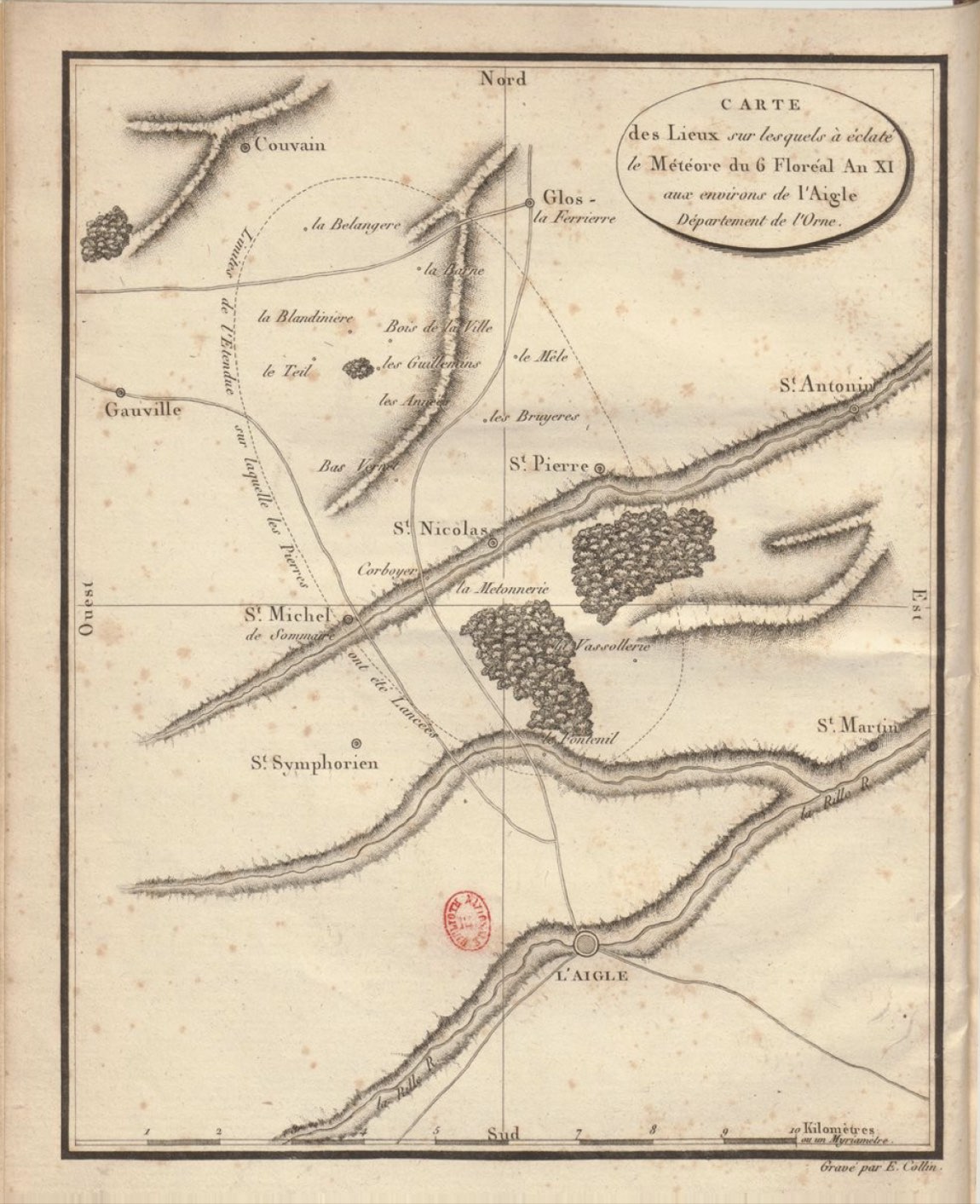
On 26 April 1803, in the early afternoon, the skies above the town of L'Aigle in Lower Normandy, France, delivered something extraordinary: a shower of more than 3,000 individual fragments of rock falling from a meteor. The event was witnessed by many people on the ground, who described what they saw as a rain of stones thrown by the meteor. The sheer number of fragments, all arriving together, made this fall impossible to dismiss as a local oddity or a hoax. No single person could have planted thousands of identical stones across a wide area of French countryside. That scale of evidence would prove to be the key that finally unlocked serious scientific investigation into where such objects come from, forcing the question out of folklore and into the laboratory.
02 Aristotle's Long Shadow Over Meteoritics Deeper
For roughly two thousand years before L'Aigle, the dominant explanation for meteors and falling stones came not from observation but from Aristotle's meteorology treatise. Aristotle argued that the Sun's heat generated two distinct types of vapours rising from Earth's surface: one hot and dry, the other cold and moist. These vapours soared into the atmosphere, formed clouds, and under the right conditions could ignite, producing the streaks of light people saw in the sky. Critically, this framework placed the origin of meteors firmly on Earth itself, making them a purely atmospheric phenomenon with no connection to outer space. Because Aristotle's authority carried enormous weight in natural philosophy, the scientific community accepted these ideas without serious challenge. As a consequence, anyone who reported seeing a stone actually fall from the sky was treated with deep scepticism, their testimony dismissed as ignorance or superstition. L'Aigle was the event that finally made this two-millennia-old consensus untenable.
03 Chladni's Lonely Prediction Nine Years Earlier Deeper
The L'Aigle meteorite did not arrive into a complete intellectual vacuum. In 1794, the German scientist Ernst Chladni had already theorised that meteorites originate beyond Earth and published a book laying out that argument. This was a genuinely radical claim at the time, running directly against the Aristotelian consensus that dominated educated opinion. Chladni's work was largely mistrusted or ignored by the scientific community, and other meteor showers that occurred in the intervening years failed to generate enough interest or evidence to validate his theory. It took nearly a decade and the overwhelming physical reality of more than 3,000 stones raining down on a French town to give Chladni's hypothesis the corroboration it needed. The L'Aigle event effectively transformed his minority opinion into the foundation of a new science.
04 Jean-Baptiste Biot and the Birth of Meteoritics
When news of the L'Aigle shower reached the French Academy of Sciences, the institution responded by dispatching a young scientist named Jean-Baptiste Biot to investigate in person. Biot conducted painstaking fieldwork, gathering two distinct categories of evidence. The first was physical: the sudden appearance of many identical stones that closely resembled rocks reported from other falls in other locations around the world. The second was testimonial: a large number of eyewitnesses who independently described watching stones fall from the meteor. Neither line of evidence alone would have been conclusive, but together they formed an argument Biot considered undeniable. His resulting paper declared that the stones must undoubtedly be of extraterrestrial origin. That paper is now regarded as the document that gave birth to the science of meteoritics — the systematic study of meteorites and their origins.
05 What Kind of Rock Is L'Aigle?
The L'Aigle meteorite is classified as an L6 type ordinary chondrite. Within the meteorite classification system, ordinary chondrites are the most common type of stony meteorite found on Earth, and the L designation refers to the low iron content of the group. The number 6 describes the degree of thermal metamorphism the rock has experienced, placing it toward the more heavily processed end of the chondrite scale, where the original chondrules — the tiny spherical mineral grains that give chondrites their name — have been partly recrystallised by heat inside the parent body. This classification tells scientists that L'Aigle is a piece of ancient solar system material that formed in the early history of the solar system, was later heated inside a larger rocky body, and eventually found its way to Earth as a fragment of that body.
06 Why One Meteorite Changed Everything
What made L'Aigle uniquely persuasive compared to earlier falls was not any single piece of evidence but the combination of quantity, geography, and documentation. More than 3,000 fragments fell over a defined area of Normandy, providing a statistical sample far too large to be faked or misidentified. The fragments were mutually consistent in composition and appearance, ruling out the possibility that witnesses had confused locally sourced rocks with something from the sky. And unlike previous incidents that were reported only by common people and dismissed by the educated class, the L'Aigle fall was formally investigated by a credentialed scientist working under the authority of France's most prestigious scientific body. Biot's institutional backing meant his conclusions could not be easily waved away, transforming the event from an anecdote into a scientific result.
07 The Meteorite's Home at Angers
Today the L'Aigle meteorite is preserved at the Muséum d'histoire naturelle d'Angers, a French natural history museum. It shares its display space with the Angers meteorite, a separate fall that struck France on 3 June 1822, nineteen years after L'Aigle. The pairing of the two meteorites in the same institution creates a kind of historical archive: the object that forced science to accept extraterrestrial origins displayed alongside a later fall that occurred in a world already transformed by that acceptance. The museum's custody ensures that the physical evidence Biot described in his landmark paper remains accessible to researchers and to the public, grounding an abstract scientific revolution in something you can actually stand in front of and examine.
08 Before L'Aigle: A World Without Meteoritics Deeper
It is worth pausing to appreciate how thoroughly the scientific community rejected meteorite falls before 1803. Reports were not simply doubted — they were actively categorised as superstition. The word 'mistrusted' in contemporary accounts captures the institutional attitude precisely: these were not open questions awaiting more data, they were claims considered beneath serious investigation. This created a strange situation in which physical objects that people had genuinely witnessed falling from the sky, and sometimes recovered from the ground still warm, were systematically excluded from scientific discourse. The L'Aigle event broke that exclusion not because the phenomenon itself had changed but because the evidence finally arrived at a scale and with a level of documentation that the institutional gatekeepers of science could not responsibly ignore. The history of L'Aigle is therefore also a history of how scientific consensus can resist evidence until the evidence becomes overwhelming.
09 Connecting L'Aigle to Other Historic Falls Deeper
Part of Biot's physical argument rested on noting that the L'Aigle stones were similar to other stones that had fallen from the sky in other places. This comparative observation was important because it implied a pattern: if rocks with the same characteristics kept appearing after meteors in locations across different countries, the simplest explanation was a common extraterrestrial source rather than a series of independent local atmospheric accidents. The L6 ordinary chondrite classification that modern scientists assign to L'Aigle connects it to a broad population of meteorites that share a similar compositional and thermal history, suggesting they originated from the same general region of the asteroid belt or even fragments of the same parent body. Biot lacked the geochemical tools to make that connection explicit, but his intuition that the stones belonged to a recognisable class was scientifically sound.
 ⤢