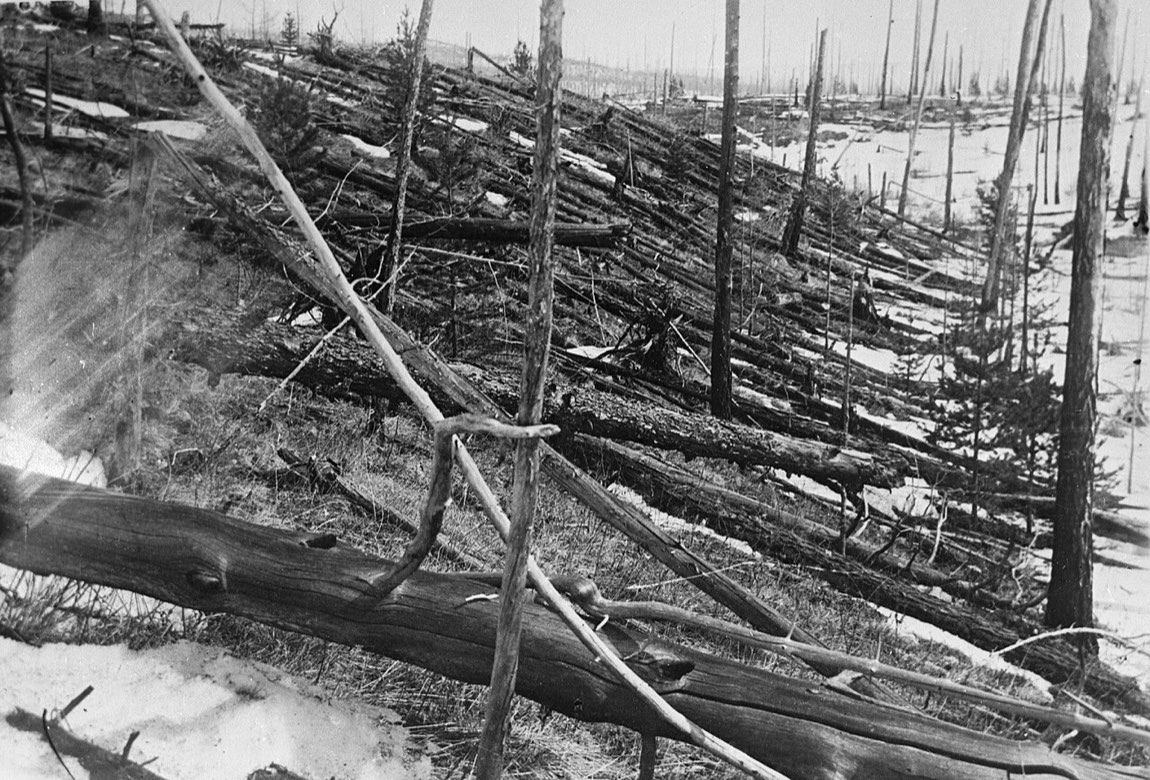
 Photograph · Leonid Kulik, the expedition to the Tunguska event · Public domain
Meteorite · Deep guide
Tunguska Event
Also called: Tunguska explosion
In 1908 something from space exploded over Siberia and flattened a vast forest, yet no meteorite was ever found.
What is it?
On the morning of 30 June 1908, a huge explosion over the remote Siberian forest near the Podkamennaya Tunguska River knocked people off their feet and broke windows up to 200 km away. Expeditions led by Leonid Kulik, who reached the site in 1927, found about 2,150 square kilometres of trees blown down in a radial pattern. Most scientists think a stony object 50–60 metres across exploded 5–10 km above the ground with an energy of 10–15 megatons. No fragment of the object has ever been formally identified, which is why it remains one of science's best-known mysteries.
The deep dive
Researched for the Atlas from Wikipedia — Tunguska event (55,040 characters read) · updated Nov 15, 2026
01 A Remote Land Built on Ancient Catastrophe
The ground beneath the Tunguska explosion is itself a relic of one of Earth's greatest disasters. The epicenter sits at the heart of the Siberian Traps, a vast volcanic province that erupted roughly 250 million years ago during the Early Triassic and is directly linked to the Permian–Triassic extinction event — the most devastating biological crisis in the history of life on Earth, wiping out iconic Russian prehistoric animals such as Inostrancevia and Scutosaurus. The specific landmark used to pinpoint the explosion's exact location is Mount Farrington, the rim of an ancient volcanic crater, with the epicenter placed about 3 km (1.9 mi) southwest of its summit. At the crater's center stands Mount Stoikovich, the solidified plug of an ancient volcanic pipe. The region is bounded by the Kimchu River to the north and the Khushma River to the south, with terrain that alternates between marshy lowlands and wooded hills across an elevation change of only about 100 m (330 ft). Some of the marshy tracts reach depths of up to 25 m (82 ft). The site remains frozen for eight to nine months a year, a frozen world sitting atop a geological memory of extinction.
02 What the Sky Looked Like Across a Continent
The explosion's most visually spectacular legacy was not the blast itself but the eerie light show it painted across western Eurasia for days afterward. On the evening of 30 June 1908, bright nights of rare intensity were observed across an area of about 12,000,000 km2 (4,600,000 sq mi) — roughly equivalent to the entire surface of North America. The sky displayed hues described as white, pink, red, golden, yellow-orange, or green. The phenomenon was so intense that people could read a newspaper or photograph monuments around midnight without any artificial lighting. It stretched as far south as Bordeaux, France, and Tashkent, and as far north as Aberdeen, Scotland, and Stockholm, Sweden. Astronomers including William F. Denning, observing from Bristol, England, reported having to abandon their work because the sky was simply too bright. Reports appeared in British newspapers including The Times from 2 to 4 July 1908. While the most striking bright nights faded within two or three days, luminous halos persisted for about ten days longer, and twilight anomalies remained perceptible until the end of the summer of 1908. The likely explanation is that dust and ice from the impacting body dispersed across the upper atmosphere, scattering sunlight long after sunset.
03 Three Deaths and What They Tell Us
Despite the explosion's enormous energy, the confirmed death toll was only three people — a consequence of the region's sparse population and the Evenks' largely tent-based lifestyle. All three fatalities were Evenks. Ivan Machakugyr was thrown nearly 40 metres (130 ft) against a tree by the shock wave, suffering an open fracture of his arm that led to a fatal infection. Lurbuman died immediately from neurological distress and extreme emotional shock caused by the violence of the explosion. The shaman Uiban died under less certain circumstances further from the epicenter, likely falling victim to one of the wildfires ignited by the blast. Evenk customs shaped the historical record significantly: the community traditionally buried their dead at the exact location of death and then avoided returning to those sites. Because the disaster caused at least three confirmed deaths, many Evenks were reluctant to discuss the event at all, which explains the scarcity of their accounts describing injuries and human losses. Meanwhile, at least thirty people in the tree-fall zone were exposed to blast effects and several lost consciousness for periods ranging from a few hours to several days — due to the shock wave, fear, stress, smoke inhalation, or concussion.
04 Kulik's Long Road to Ground Zero Deeper
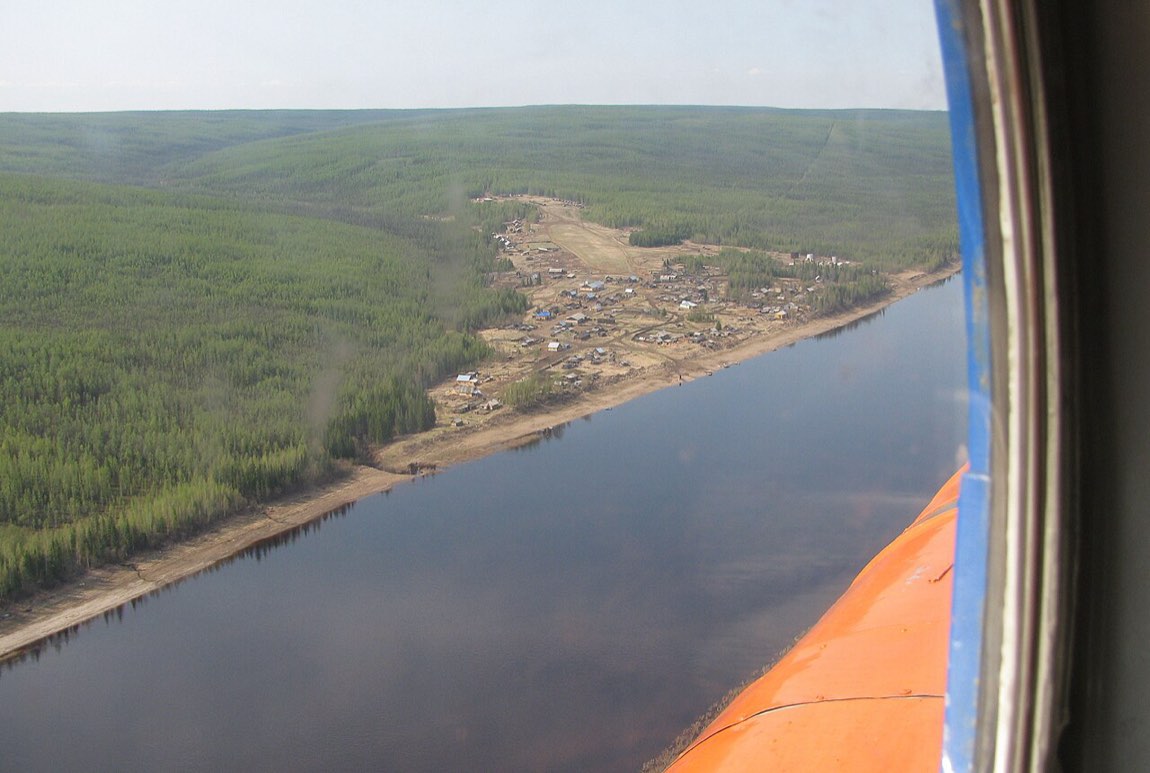
The story of how science came to understand Tunguska is almost as extraordinary as the event itself. No scientific analysis of the region occurred until 1921 — thirteen years after the explosion — partly because of the site's remoteness and partly because of the upheavals of revolution and civil war. That year, Russian mineralogist Leonid Kulik led a survey team to the Podkamennaya Tunguska River basin for the Soviet Academy of Sciences. Though they never reached the blast area, local accounts convinced Kulik a giant meteorite had struck. He persuaded the Soviet government to fund a full expedition by promising the prospect of salvaging valuable meteoric iron. His 1927 expedition finally reached the epicenter, where he and his team were astonished to find no crater — just a zone roughly 8 km (5.0 mi) across where trees were scorched and stripped of branches yet still standing upright. Over the next decade, three more expeditions followed. Kulik arranged an aerial photographic survey in 1938 covering the 250 km2 (95 sq mi) central portion of the levelled forest, producing 1,500 negatives each 18 by 18 cm (7.1 by 7.1 in). Those original negatives were destroyed in 1975 on the order of Yevgeny Krinov, then Chairman of the Committee on Meteorites of the USSR Academy of Sciences, as part of an initiative to dispose of increasingly flammable nitrate film. Positive prints survived in Tomsk.
 ⤢
05 The Butterfly in the Forest
The pattern left in the taiga by the explosion is one of the clearest physical clues to what happened. By the 1960s, researchers established that the zone of levelled forest covered 2,150 km2 (830 sq mi) and resembled a gigantic spread-eagled butterfly, with a wingspan of 70 km (43 mi) and a body length of 55 km (34 mi). Trees were knocked down radially away from the epicenter, stripped of branches and flattened by the blast wave. But at the very center, the trees were left standing — scorched and bare, but upright — because the blast wave was travelling almost straight downward at that point and stripped rather than toppled them. Soviet experiments conducted in the mid-1960s with model forests made of matches on wire stakes and small explosive charges sliding down wires reproduced butterfly-shaped blast patterns strikingly similar to the Tunguska site. Those experiments suggested the object approached at an angle of roughly 30° from the ground and 115° from north. This geometry is consistent with an aerial explosion rather than a ground strike. The similarity to the effects of the conventional Operation Blowdown in Australia further confirmed that large air-burst explosions, rather than impact craters, explain the observed tree-fall pattern.
06 Microscopic Evidence from Soil and Tree Resin Deeper
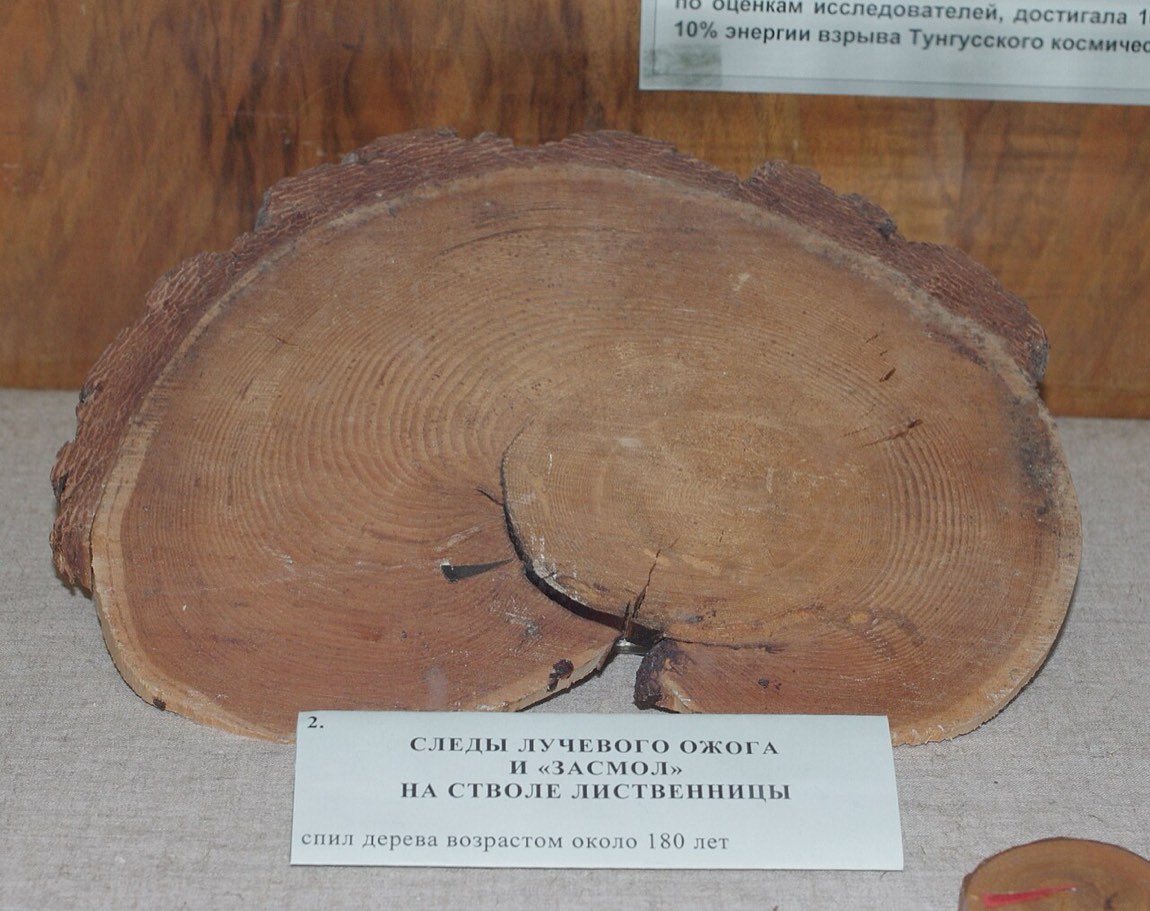
Because no macroscopic meteorite fragments were confirmed, scientists turned to microscopic evidence to characterize the impacting body. Expeditions in the 1950s and 1960s found microscopic silicate and magnetite spheres in soil siftings. Later work identified similar spheres trapped in the resin of trees from the blast area. Chemical analysis revealed these spheres contained high proportions of nickel relative to iron — a ratio characteristic of meteoritic material — and later studies found unusual ratios of numerous other metals relative to the surrounding environment. The concentration pattern of the spheres across different regions of the soil was consistent with the expected debris distribution from a meteor air burst. Peat bog analysis also revealed isotopic anomalies in carbon, hydrogen, and nitrogen at the layer corresponding to 1908, inconsistent with adjacent layers and absent in bogs outside the region. The affected peat layer also contained an unusually high proportion of iridium, echoing the iridium layer associated with the Cretaceous–Paleogene boundary. The nitrogen deposited in the layer is believed to have arrived as acid rain, a suspected fallout from the explosion. However, these isotopic and iridium results are contested: measurements performed in other laboratories have not confirmed them, leaving the geochemical evidence genuinely unresolved.
07 Asteroid or Comet: A Debate Still Open Deeper
The nature of the Tunguska object remains one of astronomy's longest-running disputes. In 1934, British meteorologist F. J. W. Whipple proposed it was a small comet — a body of dust, water ice, and frozen gases that could have been completely vaporized on atmospheric entry, leaving no debris. The glowing skies observed across Eurasia were cited in support, possibly explained by cometary dust and ice dispersed across the upper atmosphere. In 1978, Slovak astronomer Ľubor Kresák suggested the body was a fragment of Comet Encke, a periodic comet with an orbital period of just over three years, also responsible for the Beta Taurids meteor shower peaking around 28–29 June — almost exactly when the Tunguska event occurred. Against the comet hypothesis, astronomer Zdeněk Sekanina argued in 1983 that cometary material travelling along such a shallow trajectory should have disintegrated high in the atmosphere, not penetrated to the lower atmosphere as the Tunguska object apparently did. A 2001 study by Farinella, Foschini and colleagues estimated an 83% probability that the object moved on an asteroidal path from the asteroid belt, versus 17% for a cometary origin. In 2013, analysis of fragments from the Tunguska site by a joint US-European team was consistent with an iron meteorite, adding weight to the asteroidal side.
08 How Chelyabinsk Reshaped Tunguska Models
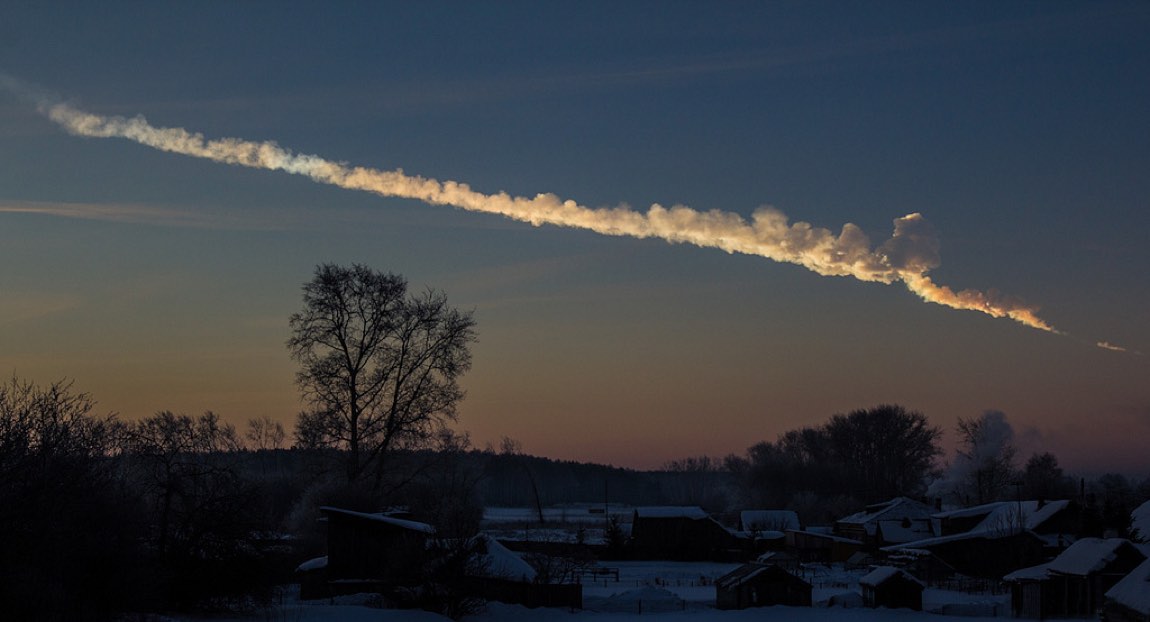
The February 2013 fireball over Chelyabinsk in Russia's Ural district transformed understanding of Tunguska. The Chelyabinsk object — an asteroid estimated at 17–20 m (56–66 ft) across with an initial mass of about 11,000 tons — released approximately 500 kilotons of energy and injured over 1,200 people, mainly from shattered glass. Its dynamics were similar enough to Tunguska that researchers used data from both events to run a statistical study of over 50 million combinations of bolide and entry properties. Four different computer models converged on consistent results: the most likely Tunguska impactor was a stony body between 50–80 m (164–262 ft) in diameter, entering the atmosphere at roughly 55,000 km/h (34,000 mph), exploding at 10–14 km (6–9 mi) altitude, and releasing energy equivalent to 10–30 megatons of TNT. For comparison, that is similar to the blast energy of the 1980 volcanic eruption of Mount St. Helens. The researchers also concluded that impactors of this size strike Earth only at an average interval on the scale of millennia, reinforcing Tunguska's status as a rare but real planetary hazard.
 ⤢
09 The Stratosphere, Ozone, and a Million Tons of Dust Deeper
The explosion's reach extended far above the visible sky. Observations of decreased atmospheric transparency recorded at the Mount Wilson Observatory in California were used to calculate that roughly a million tons of dust were released into the stratosphere. Further modelling suggests that shock waves from the falling meteor generated up to 30 megatons of nitric oxide (NO) in the stratosphere and mesosphere. The cascading chemical effects were substantial: a peak ozone depletion of 35–45% has been modelled for early 1909, followed by depletions of approximately 30% in 1910 and approximately 15% in 1911, alongside a tripling of UV-B intensity at ground level at latitude 30°N. These numbers reveal that even a mid-sized bolide air burst can impose measurable chemical stress on the atmosphere for years afterward. The bright nights observed across Eurasia immediately after the event also point to stratospheric injection of material, with the phenomenon covering about 12,000,000 km2 (4,600,000 sq mi) and persisting in the form of twilight anomalies until the end of the summer of 1908.
10 Lake Cheko: Crater or Ancient Water Body? Deeper
About 8 km (5.0 mi) north-northwest of the explosion's hypocentre lies a small bowl-shaped lake called Lake Cheko, unrecorded before 1908, whose origins remain contested. In 2007, scientists from the University of Bologna proposed it might be an impact crater formed by a 10 m (33 ft) fragment that survived the main explosion and struck the ground. Supporting evidence includes acoustic-echo soundings revealing a conical lake bed consistent with an impact crater, a long axis pointing toward the explosion's hypocentre about 7.0 km (4.3 mi) away, magnetic readings suggesting a possible metre-sized chunk of rock below the lake's deepest point, and sediment core analysis indicating the transition from pre-lake to lacustrine conditions occurred close to 1908. However, a 1961 investigation concluded the lake was at least 5,000 years old based on metres-thick silt deposits. Russian scientists in 2017 counted at least 280 annual sediment layers in a 1,260 mm core, implying the lake is at least 280 years old — predating the Tunguska event. They also identified a layer of radionuclide contamination from mid-20th century nuclear testing at Novaya Zemlya, yielding a sedimentation rate of 3.6–4.6 mm per year, roughly half that calculated by the Bologna team, undermining the crater interpretation.
11 The Myth of 80 Million Felled Trees
One of the most persistent numbers in popular accounts of Tunguska — that roughly 80 million trees were felled — turns out to be a figure with a troubled pedigree. Research by Mark Boslough and Andy Bruno published in 2025 traced the claim to a non-peer-reviewed 1982 paper by Brazo and Austin, published by the Institute for Creation Research. Those authors based their figure on a 1934 paper by Whipple, which itself only reported comments by Indian meteorologist Sudhanshu K. Banerji, who had in turn echoed preliminary data from astronomer Andrew Crommelin, who had presented as fact an estimate from Astapovich's 1933 study assuming a devastated area of roughly 8,000 km2 (3,100 sq mi). The figure then circulated widely after BBC News mentioned it in 2006 in connection with a documentary, and appeared again in a Scientific American centennial article in 2008. A separate Scientific American piece from the same year cited 60 million trees. The actual levelled forest covered 2,150 km2 (830 sq mi) — suggesting the popular estimate overstates the damage by a factor of about four. A BBC version citing 'more than 18 million' trees, possibly the result of a typographical error, turned out to be closer to reality than the widely repeated 80 million figure.
12 A Goose That May Have Died with the Forest
Among the most unexpected consequences attributed to the Tunguska event is the possible extinction of a species of goose. In a 2019 study, Belgian ornithologist Jacques Van Impe proposed a link between the explosion and the disappearance of Sushkin's goose (Anser neglectus), first described in 1897 by Russian naturalist Petr Sushkin. Its status as a distinct species rather than a subspecies or variation of the taiga bean goose had long been disputed. Van Impe documented that large populations wintered in Bashkortostan, near Tashkent, and at Hortobágy National Park in Hungary, where up to 150,000 individuals were recorded between 1908 and 1911. The taxon then declined rapidly, and the last known specimens were observed at the Budapest Zoo and Botanical Garden in 1934. Van Impe hypothesizes the goose nested in the Podkamennaya Tunguska basin — an area unexplored at the time — and that the explosion, fires, and resulting environmental degradation devastated the core of its breeding population. He also suggests that electromagnetic phenomena associated with the event might have disrupted the birds' migratory orientation or induced reproductive genetic anomalies. While hunting and habitat change may have worsened the decline, Van Impe considers them insufficient to explain the species' sudden collapse.
 ⤢
13 Seismic Records, Barographs, and Global Reach Deeper
The explosion registered far beyond Siberia, captured by instruments across two continents. Seismological stations in Irkutsk, Tashkent, and Tiflis within the Russian Empire, as well as in Jena in the German Empire, all recorded the event. The Russian records were first published in 1910 by geophysicist Grigori Levitski, while the Jena records appeared three years later; it was not until 1925 that a paper formally linked this data to the Tunguska event. Because the Richter scale was not proposed until 1935, the explosion's seismic equivalence — close to magnitude 5 — was only calculated in the late 20th century. Atmospheric pressure waves detected by barographs across the world were similarly not connected to the 1908 event until the 1930s. Among the stations that recorded these waves were those in Berlin, Potsdam, and on the Schneekoppe in the German Empire, and in London and Zagreb. Pressure changes were measured thousands of kilometres away, as far as Batavia in the Dutch East Indies (now Indonesia) and Washington, D.C. The United Nations formally acknowledged the event's planetary significance in 2016 when it proclaimed 30 June as the annual International Asteroid Day, to raise awareness about near-Earth objects and planetary defence.