 Photograph · H. Raab ( User:Vesta ) · CC BY-SA 3.0
Meteorite · Deep guide
Sikhote-Alin Meteorite
Also called: Sikhote-Alin
In 1947 a daylight fireball rained more than 23 tonnes of iron onto the forests of Russia's Far East.
What is it?
On the morning of 12 February 1947, people in the Sikhote-Alin Mountains of the Soviet Far East saw a fireball brighter than the Sun streak across the sky. The iron body broke apart as it plunged in at about 14 km/s, and its largest piece exploded about 5.6 km up. An estimated 23 tonnes of fragments reached the ground, some burying themselves several metres deep. It was the largest observed iron meteorite fall in recorded history, and its pieces often show thumbprint-like dents carved during the fiery descent.
The deep dive
Researched for the Atlas from Wikipedia — Sikhote-Alin meteorite (4,200 characters read) · updated Nov 15, 2026
01 A Fireball Brighter Than the Sun
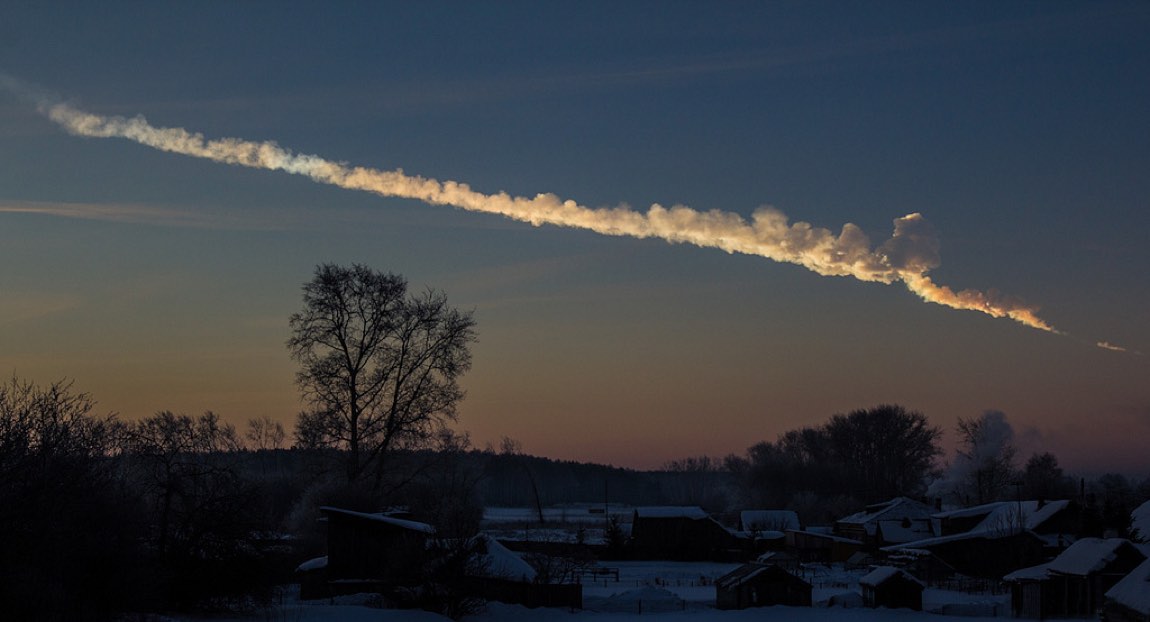
On the morning of 12 February 1947, at around 10:30, the skies over the Sikhote-Alin Mountains in Primorye lit up with a bolide that outshone the sun itself. The object came out of the north and descended at a steep angle of about 41 degrees, making it visible not just to those directly beneath its path but to observers spread across a radius of 300 kilometres (190 mi) from the impact point. That impact point lay not far from Luchegorsk, roughly 440 km (270 mi) northeast of Vladivostok. The event was not just a visual spectacle — the loud sounds of the fall carried equally far. Because it struck during full daylight, an unusually large number of eyewitnesses were able to report what they had seen, providing scientists with a rare and rich dataset for reconstructing exactly what had happened in those terrifying seconds. The aftermath was visible for hours: a smoke trail estimated at 32 km (20 mi) long hung in the sky long after the fragments had hit the ground.
02 How the Meteoroid Shattered on the Way Down
The meteoroid entered Earth's atmosphere travelling at approximately 14 km/s — equivalent to 50,400 km/h or 31,300 mph, fast enough to cross the continental United States in under ten minutes. That velocity, combined with the increasing air density of the lower atmosphere, generated catastrophic mechanical and thermal stress on the iron body. It began breaking apart during descent, and the resulting fragments fell together in a cluster rather than as a single impactor. The most dramatic moment came at an altitude of about 5.6 km (3.5 mi), when the largest surviving mass apparently exploded in what scientists call an air burst. This mid-air detonation shattered much of the remaining material violently, sending jagged shrapnel outward at high speed. Some fragments still carried enough velocity to bury themselves 6 metres (20 ft) into the frozen ground. The air burst is the key reason the fall produced two very different types of physical specimens, as the history of the fragments diverged sharply at that moment of explosion.
03 Reconstructing an Orbit from Eyewitness Accounts Deeper
Because the fall happened in broad daylight, it generated a volume of eyewitness reports that made scientific orbit reconstruction genuinely possible. V. G. Fesenkov, then chairman of the meteorite committee of the USSR Academy of Science, took on this task. By carefully evaluating the observational data, he was able to estimate the trajectory and from that back-calculate the meteoroid's orbit before it encountered Earth. The orbit turned out to be ellipse-shaped, with its aphelion — its point of greatest distance from the sun — situated within the asteroid belt. This places Sikhote-Alin in the same broad orbital family as many other small bodies that cross Earth's orbit. Fesenkov concluded that such an orbit was probably produced by collisions within the asteroid belt, consistent with the broader scientific understanding that iron meteorites originate as fragments of differentiated asteroid cores disrupted by impacts over billions of years. The daytime fall, usually a frustrating complication for meteorite hunters, thus became an unexpected scientific asset.
 ⤢
04 How Much Mass Actually Reached the Ground Deeper
The question of Sikhote-Alin's mass involves two very different numbers, and the gap between them tells the story of how brutal atmospheric entry is. The pre-atmospheric mass of the meteoroid — what it weighed before it hit our atmosphere — was estimated at approximately 90 tonnes (99 short tons; 200,000 pounds) by earlier researchers. A more recent estimate by Tsvetkov and colleagues placed that figure even higher, at around 100 tonnes (110 short tons; 220,000 pounds). Yet Krinov's estimate of what actually reached the surface as recoverable material came to only about 23,000 kg (51,000 lb) — roughly 23 tonnes. That means somewhere between 70 and 77 tonnes of the original object was destroyed during atmospheric passage, lost to ablation, fragmentation, and the energy of the air burst. Put another way, the atmosphere consumed at least three-quarters of the incoming mass, turning it into heat, light, and dust before it could reach the ground.
05 Craters, Trees, and the Strewn Field
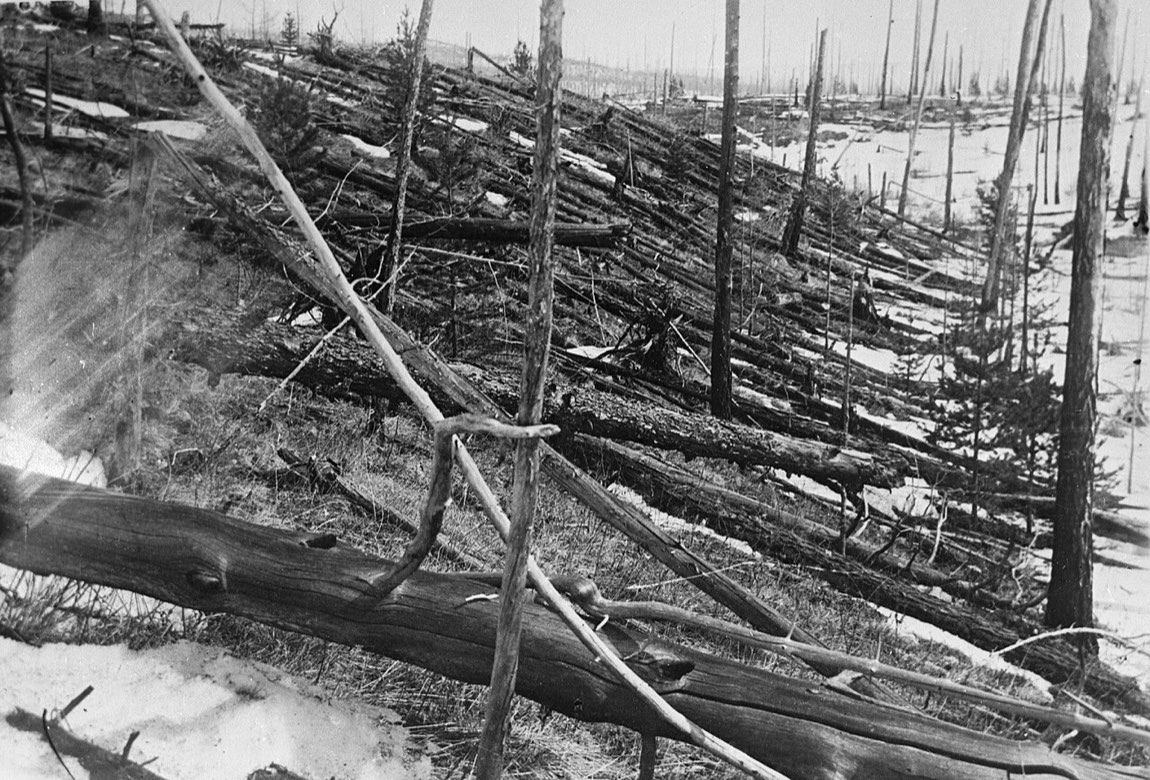
The debris from Sikhote-Alin did not scatter randomly across a vast landscape. Instead it fell within a well-defined elliptical strewn field covering about 1.3 km² (0.50 sq mi) — a surprisingly compact area given the drama of the fall. Within that zone, fragments struck with enough force to excavate genuine impact craters in the frozen ground. The largest of these craters measured about 26 m (85 ft) across and 6 m (20 ft) deep, a pit large enough to swallow a mid-sized house. Dozens of smaller craters pocked the surface alongside it. The violence of the fall also left its mark on the local forest: fragments of the meteorite were driven into the surrounding trees, embedding themselves in the wood like iron splinters from an artillery burst. This combination of craters, buried fragments, and tree damage gave recovery teams and scientists a vivid three-dimensional picture of the fall's energy distribution across the strewn field.
06 Iron, Nickel, and the Minerals Within Deeper
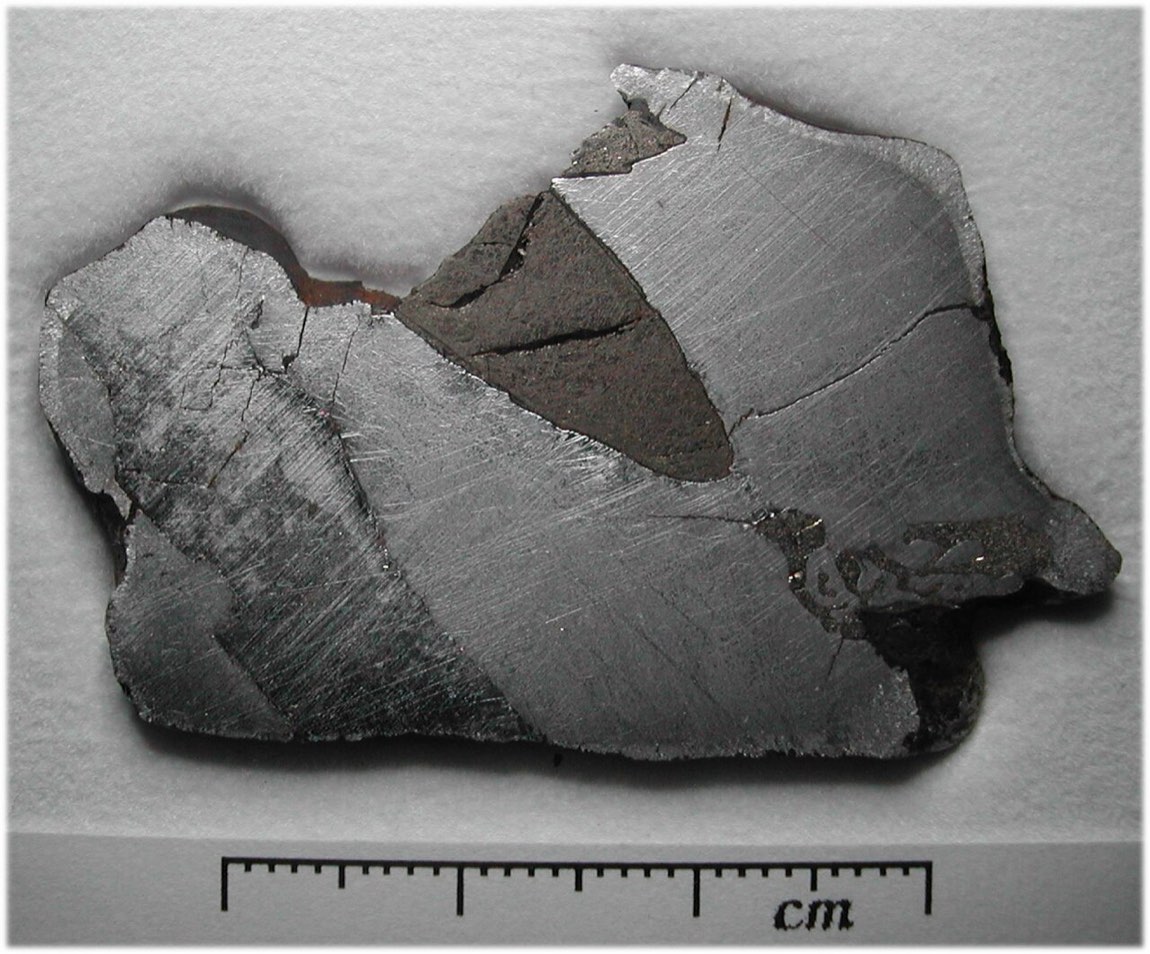
Sikhote-Alin is classified as a coarse octahedrite, a structural category defined by the characteristic interlocking crystal pattern that forms as iron-nickel metal cools extremely slowly deep inside a parent body. It belongs to meteorite group IIAB, one of the major chemical groupings of iron meteorites that scientists believe represent the cores of disrupted differentiated asteroids. By mass, the meteorite is approximately 93% iron and 5.9% nickel, with smaller contributions from cobalt at 0.42%, phosphorus at 0.46%, and sulfur at 0.28%, plus trace amounts of germanium and iridium. Embedded within this metallic matrix is a suite of minerals including kamacite and taenite — the two iron-nickel alloy phases whose intergrowth creates the classic Widmanstätten pattern — alongside plessite, troilite, chromite, and schreibersite. Each of these minerals is a record of conditions billions of years ago inside a planetary building block that never grew large enough to survive intact.
 ⤢
07 Two Kinds of Specimens, Two Different Stories
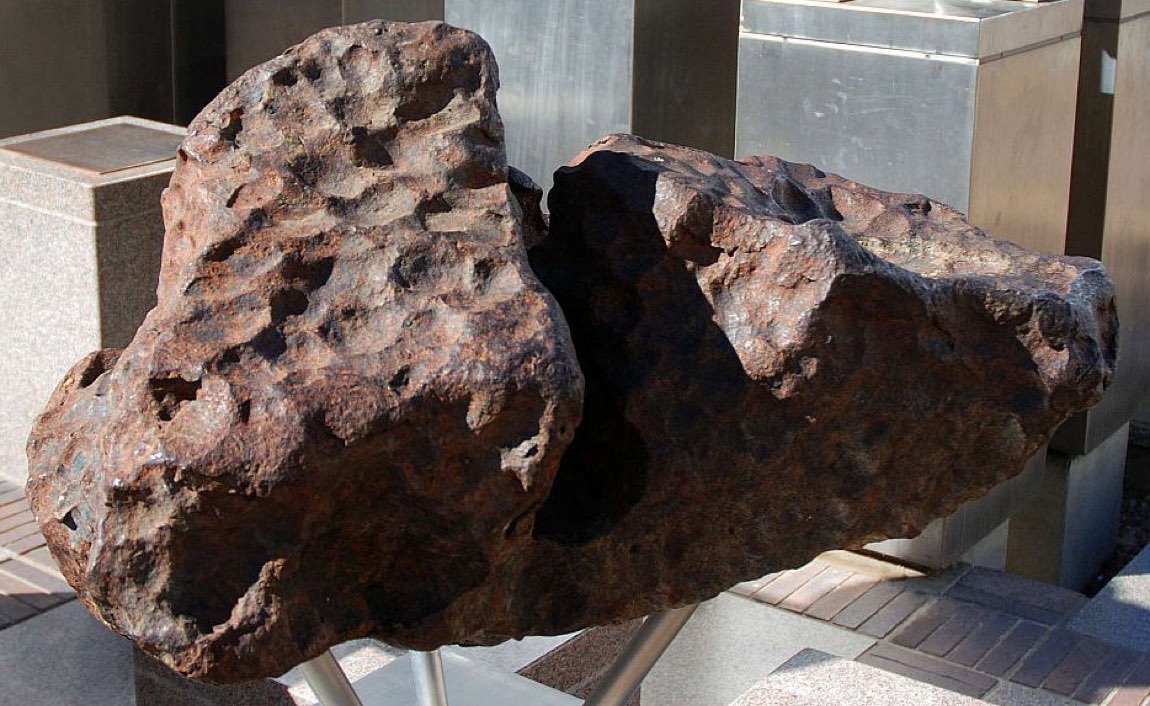
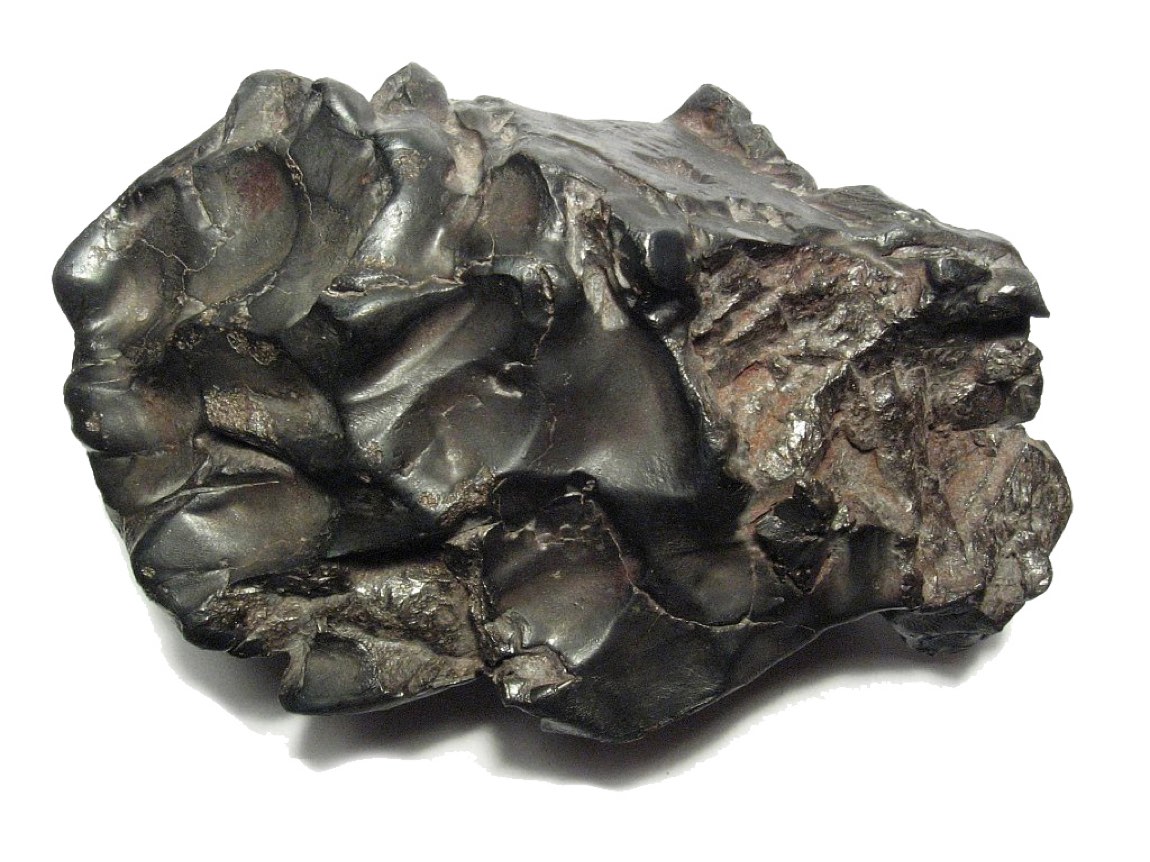
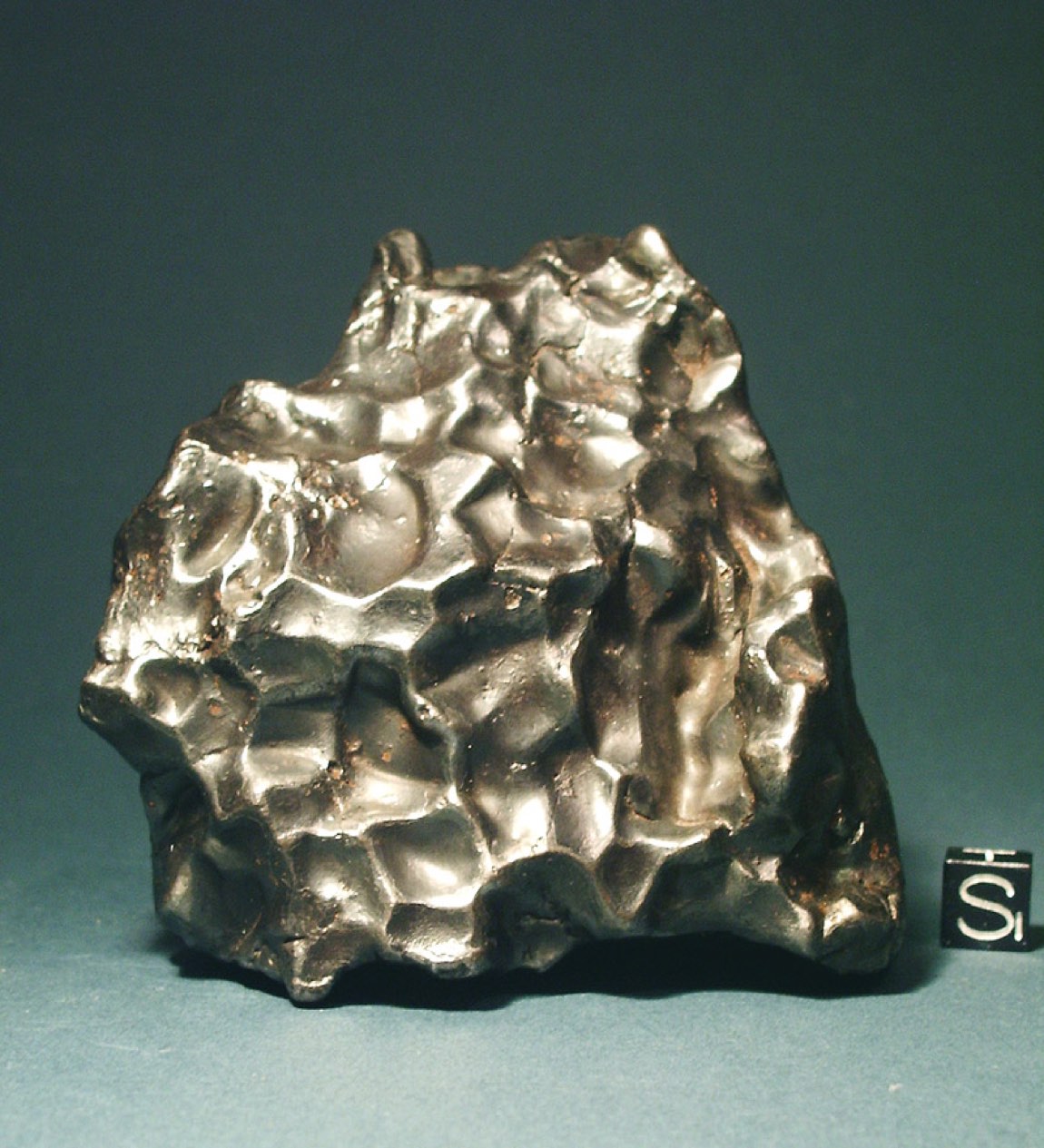
Among the thousands of pieces recovered from the Sikhote-Alin fall, collectors and scientists quickly recognized two fundamentally distinct specimen types, each telling a different chapter of the same event. The first type consists of individual, smooth-surfaced pieces covered in regmaglypts — distinctive rounded cavities that resemble thumbprints pressed into the metal. These formed through atmospheric ablation as hot gases scoured the surface during flight. Specimens of this type almost certainly separated from the main mass early in the descent, giving them enough solo flight time to develop a full fusion crust and those characteristic pits. The second type is shrapnel: sharp-edged, jagged pieces of torn metal with no fusion crust, bearing the unmistakable signature of violent fragmentation. Most of these originated in the air burst at 5.6 km (3.5 mi) altitude, or were blasted apart on impact with the frozen ground. Regmaglypted pieces are prized by collectors for their sculptural beauty; shrapnel pieces preserve the raw record of destruction.
08 An Artist Who Witnessed History and Painted It
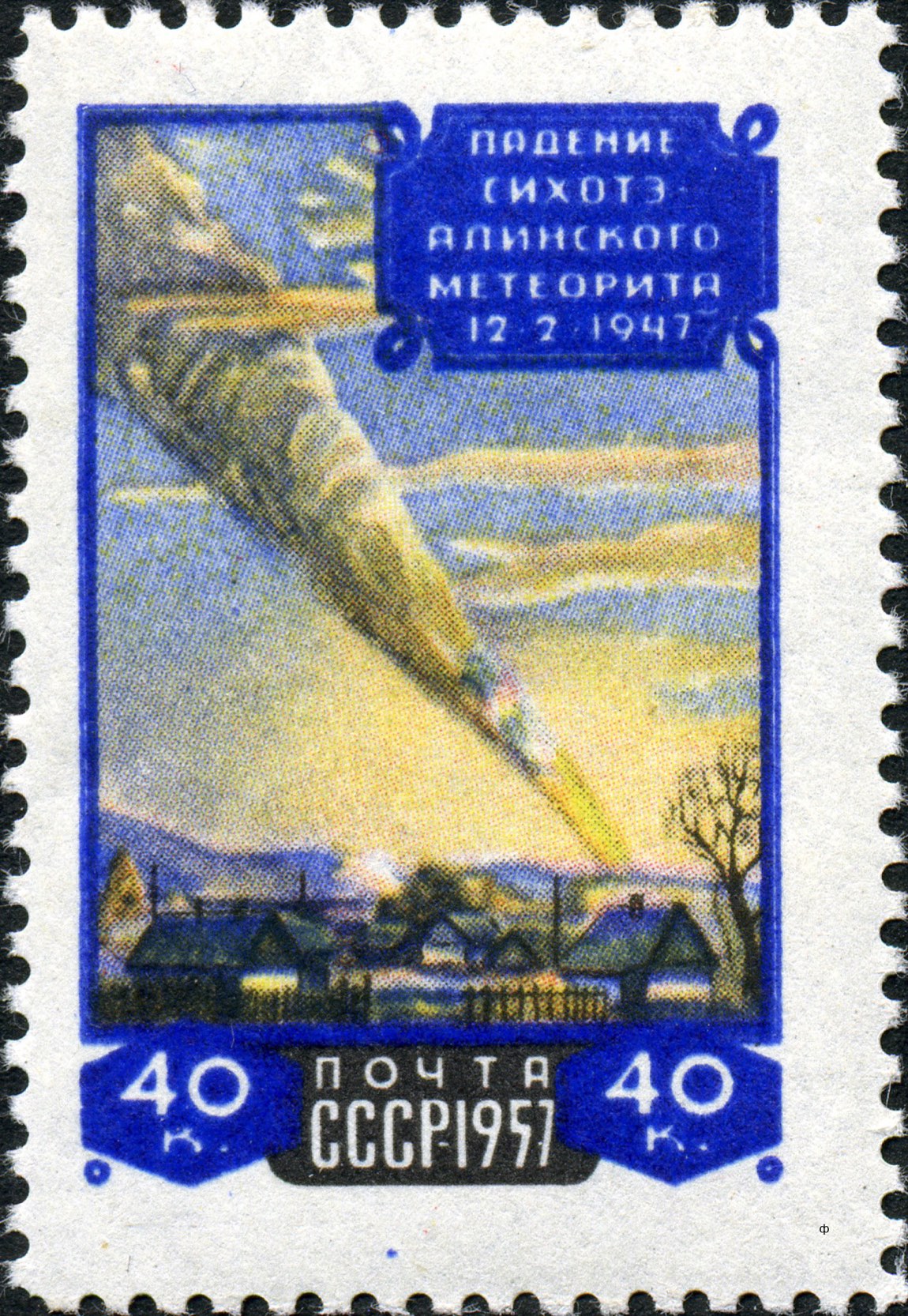
Among the many eyewitnesses to the Sikhote-Alin fall was a Soviet artist named P. I. Medvedev, who happened to be sitting at his window that February morning beginning a sketch when the fireball blazed across the sky. With remarkable presence of mind, he immediately turned his attention to what he was seeing and began drawing the scene as it unfolded. The resulting painting became the definitive visual record of the event. Its scientific importance was recognized at the highest levels: on 20 November 1957, the Soviet Union issued a commemorative postage stamp for the tenth anniversary of the Sikhote-Alin meteorite shower, and it reproduced Medvedev's painting as its central image. That stamp transformed what might have remained an obscure scientific event into a moment of national memory. It also illustrates how a single fortunate coincidence — an artist looking out a window at exactly the right moment — can produce a document of lasting value to science and culture alike.
09 The Largest Witnessed Iron Fall in Recorded History
Individual iron meteorite falls had been witnessed before 1947, and large masses of iron had been recovered from the ground across human history. But the Sikhote-Alin event occupies a unique position in the record: never before in documented history had a fall of this magnitude been directly observed as it happened. The combination of factors that makes this event so extraordinary — the enormous pre-atmospheric mass of up to 100 tonnes (110 short tons; 220,000 pounds), the survival of an estimated 23 tonnes of material to the surface, the production of genuine craters, and the presence of hundreds of human eyewitnesses — had simply never converged before in any event that left a written record. This makes Sikhote-Alin not merely a scientifically important meteorite but a genuine threshold event in the human relationship with the cosmos: the first time people watched, in real time and in large numbers, as a planetary-scale iron body arrived from the asteroid belt and remade a piece of their landscape.
 ⤢