 Photograph · Geoffrey Notkin, Aerolite Meteorites of Tucson Original uploader was Geoking42 a · CC BY-SA 2.5
Meteorite · Deep guide
Canyon Diablo Meteorite (Meteor Crater impactor)
Also called: Canyon Diablo · Meteor Crater meteorite · Barringer Crater impactor
The iron asteroid that blasted Arizona's Meteor Crater, and later helped measure the age of the Earth.
What is it?
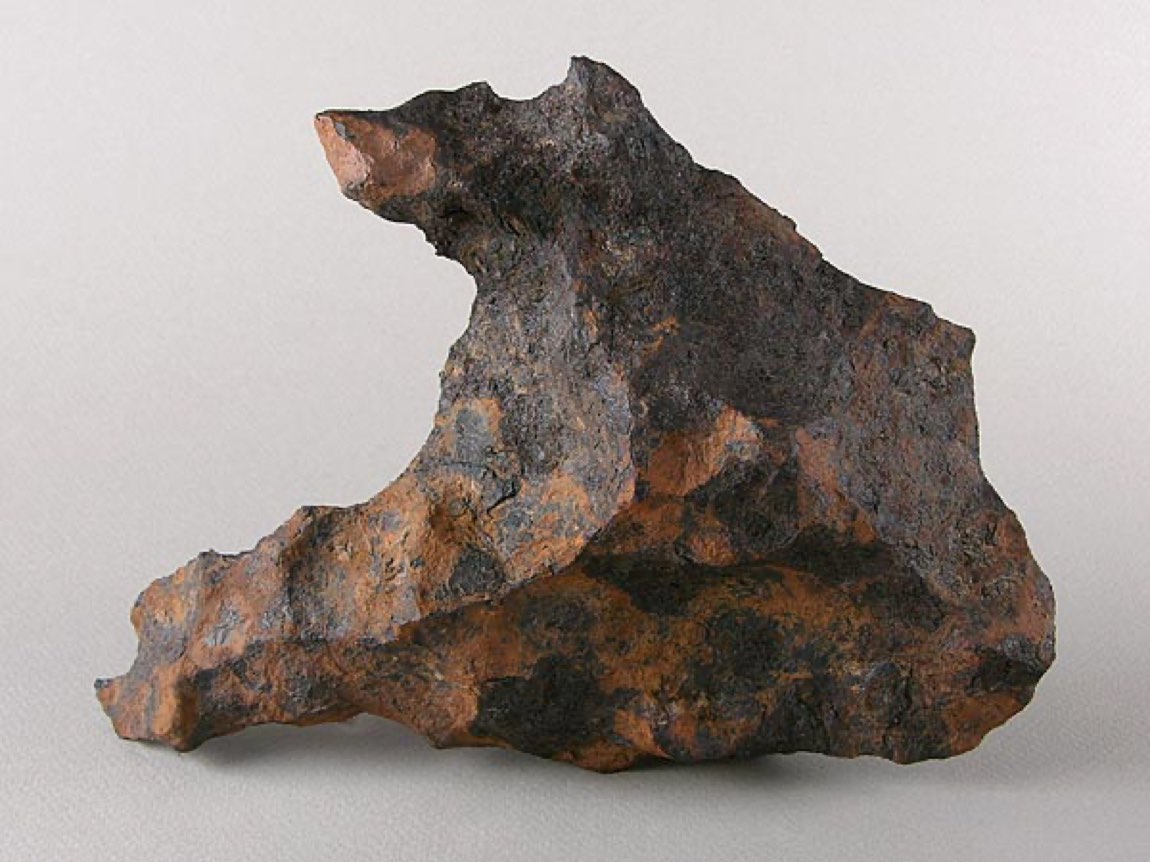
About 50,000 years ago an iron asteroid roughly 50 metres wide struck northern Arizona and dug out Meteor Crater, also called Barringer Crater. Its surviving fragments, found scattered around the crater rim, are called Canyon Diablo meteorites after the nearest post office in 1891. Native Americans knew and used them long before scientists did. In 1953 the chemist Clair Patterson measured lead isotopes in a Canyon Diablo sample and arrived at an age for the Earth of about 4.55 billion years, a figure still close to today's value.
The deep dive
Researched for the Atlas from Wikipedia — Canyon Diablo (meteorite) (4,050 characters read) · updated Nov 15, 2026
01 How the crater's origin was finally settled
For decades spanning the late 19th and early 20th centuries, Meteor Crater sat at the center of one of geology's most stubborn debates. The crater showed little evidence of volcanism, yet many scientists resisted the idea that a rock from space could punch such a dramatic hole in the landscape. The argument was not fully resolved until the early 1930s, when cumulative work by Daniel M. Barringer, F. R. Moulton, and Harvey Harlow Nininger tipped the scientific consensus decisively toward an impact origin. Barringer in particular invested years and considerable personal resources into championing the extraterrestrial explanation. The resolution of that debate did more than settle one local question — it helped establish the broader framework for recognizing impact structures anywhere on Earth, a framework that geologists and planetary scientists still rely on today.
02 The measurement that dated the Earth Deeper
Among the most consequential scientific uses of these meteorite fragments was a study conducted in 1953 by geochemist Clair Cameron Patterson. Working with samples of the Canyon Diablo meteorite, Patterson measured the ratios of lead isotopes locked inside the rock. Applying uranium-lead radiometric dating — a method that exploits the steady, clockwork-like decay of uranium into lead — he was able to calculate a refined age for the Earth of 4.550 billion years, with an uncertainty of plus or minus 70 million years. To put that precision in perspective, 70 million years is less than 1.6 percent of the total age derived. Iron meteorites like Canyon Diablo are ideal for this kind of measurement because they formed from the same primordial material as the planets and have remained chemically isolated ever since, preserving their isotopic record with extraordinary fidelity.
03 An iron octahedrite's crystalline identity Deeper
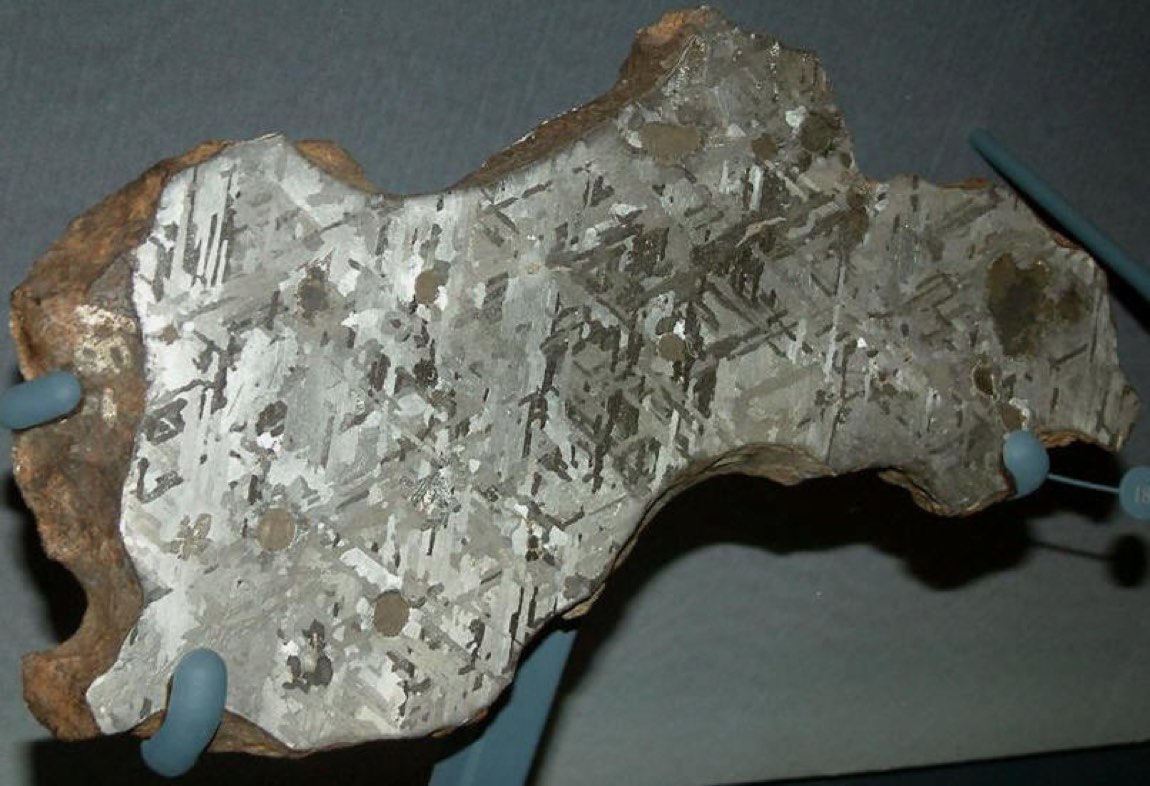
Canyon Diablo is formally classified as an iron octahedrite — specifically a coarse octahedrite — which describes both its dominant metal composition and the geometric pattern visible when a polished slice is etched with acid. That pattern, called a Widmanstätten structure, forms only when iron-nickel metal cools extraordinarily slowly, over millions of years, deep inside a parent body. The two principal iron-nickel alloys responsible are kamacite, the most abundant component in this meteorite, and taenite, which forms the boundary bands between kamacite crystals. This slow crystallization is part of what makes the rock such a reliable chemical archive. The coarse designation refers to the width of the kamacite bands: coarse octahedrites have bands wider than roughly 1.3 millimeters, reflecting an unusually leisurely cooling history inside their parent asteroid.
 ⤢
04 Diamonds, lonsdaleite, and exotic minerals within
The list of minerals identified in Canyon Diablo fragments reads like a showcase of extreme chemistry. Alongside the expected iron-nickel alloys, researchers have documented diamonds and lonsdaleite — both pure carbon, but with different crystal structures — as well as moissanite, a form of silicon carbide noted as the second hardest natural mineral. Small diamonds are sometimes found nestled inside troilite-graphite nodules threaded with metal veins. Schreibersite, an iron-nickel phosphide, is another phase of interest to astrobiologists because phosphide minerals may have played a role in prebiotic chemistry. Cohenite and haxonite are iron and iron-nickel carbides, while daubréelite is an iron chromium sulfide rarely seen outside meteorites. The sheer variety of phases reflects the reducing, oxygen-poor environment inside the original asteroid's metallic core.
05 Troilite as the world's sulfur standard Deeper
Among its many scientific contributions, Canyon Diablo holds a unique metrological role: the troilite found in this meteorite serves as the global standard reference material for sulfur isotope ratios. Troilite is a variety of the iron sulfide mineral pyrrhotite, and isotope geochemists worldwide express sulfur isotope measurements relative to the Canyon Diablo Troilite, or CDT, standard. This matters because sulfur isotopes are used to trace biological activity in ancient rocks, reconstruct past ocean chemistry, and fingerprint volcanic eruptions, among many other applications. Having a universally agreed-upon reference point makes data from different laboratories directly comparable. The choice of Canyon Diablo troilite reflects how well-characterized and widely available this meteorite's material became after more than a century of scientific collection and study.
06 Pre-historic use before scientific discovery
Long before geologists or meteorite hunters arrived on the scene, Native Americans in the region were already familiar with the iron-rich fragments scattered around the crater rim. The article records that Canyon Diablo meteorites were initially known and used by pre-historic Native Americans, though it does not detail the specific uses. This kind of cultural familiarity with meteoritic iron is documented at other sites worldwide, where indigenous peoples fashioned the material into tools, ornaments, and trade goods centuries before European contact. The meteorites were formally named in 1891, by the scientific convention of assigning a name based on the nearest post office — in this case Canyon Diablo, Arizona. That post office gave its name to material that had been lying on the ground for roughly 50,000 years before anyone wrote a catalog entry for it.
 ⤢
07 Where the biggest fragments ended up
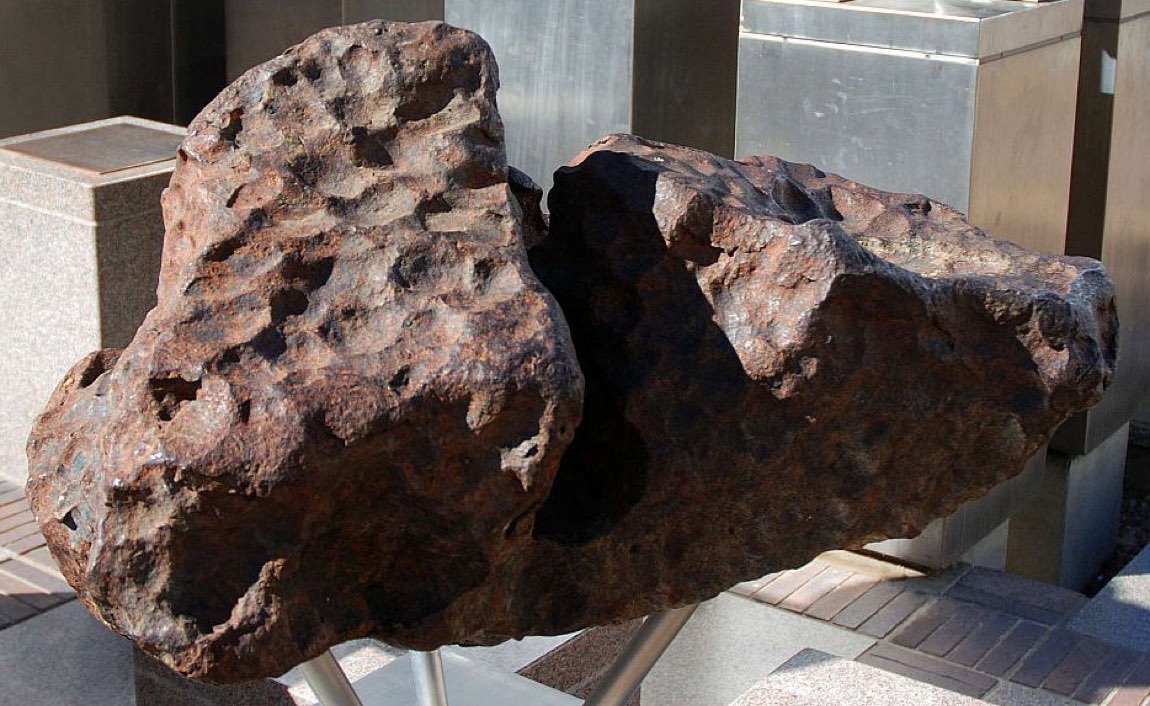
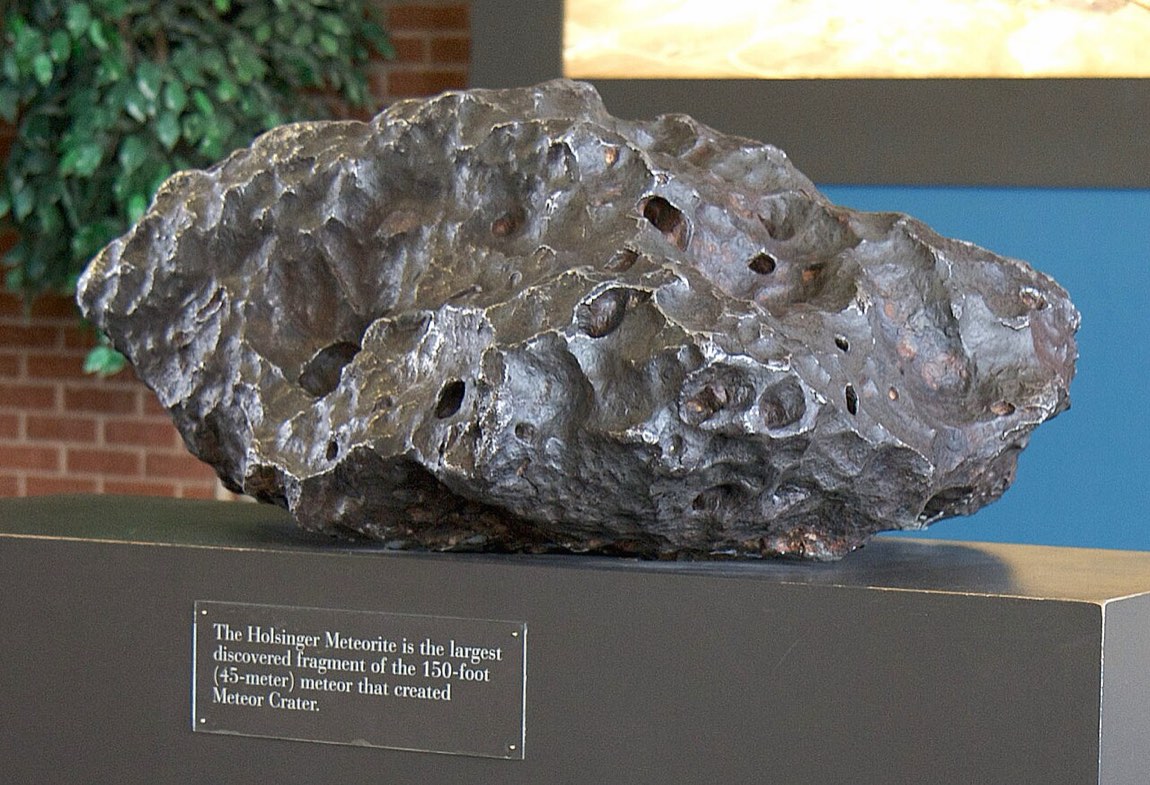
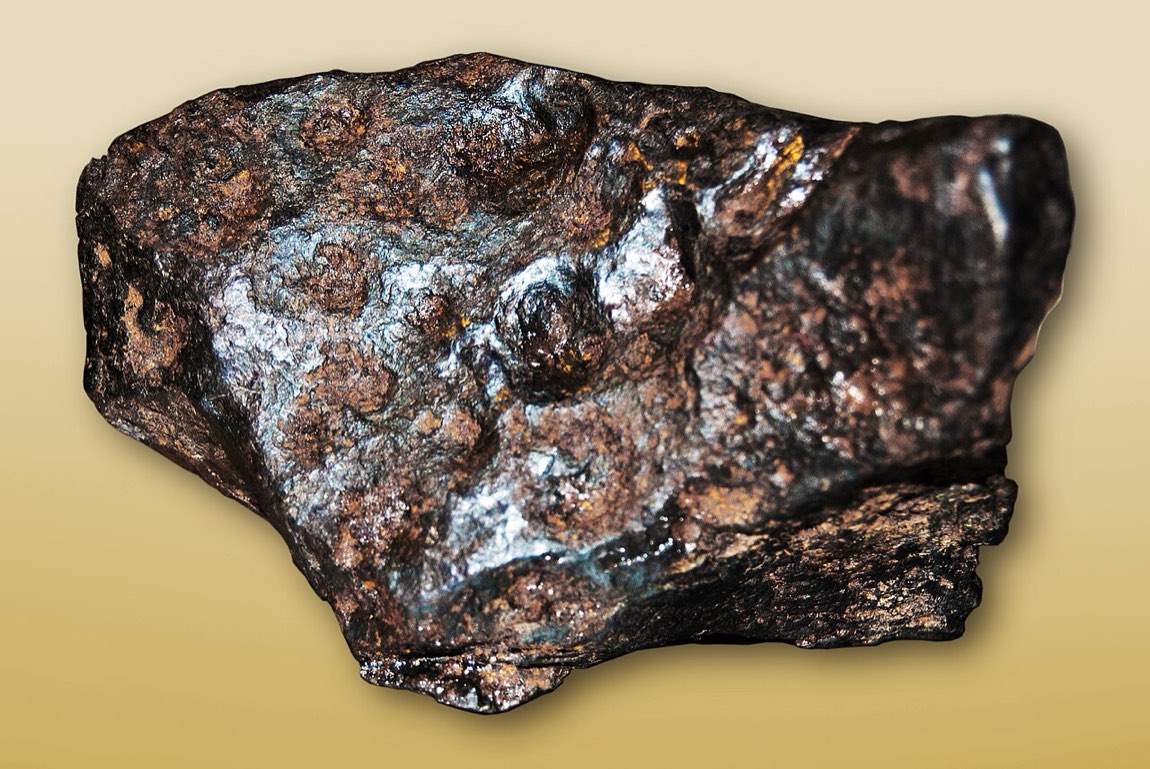
The impact blasted metallic fragments across a wide area, and over the following century those pieces found their way into institutions on multiple continents. The largest known fragment, called the Holsinger Meteorite and weighing 639 kilograms — roughly the mass of a grand piano — is now displayed at the Meteor Crater Visitor Center on the crater rim itself. The largest fragment held outside the United States weighs 485 kilograms and resides at Canterbury Museum in Christchurch, New Zealand. Paris holds two significant pieces: 360 kilograms at the Muséum national d'Histoire naturelle and 226.8 kilograms at the MINES ParisTech Mineralogy Museum. Berlin's Archenhold Observatory displays a 283.5-kilogram fragment, and Lowell Observatory in Flagstaff, Arizona — not far from the crater — keeps a 242.6-kilogram piece. Dozens of additional fragments, ranging from hundreds of kilograms down to grams, are held by universities, natural history museums, planetariums, and private collectors across the United States and beyond.
08 The strewn field's geography and naming
When an impactor breaks apart during atmospheric entry or at the moment of detonation, its fragments scatter across a region known as a strewn field, with larger pieces generally traveling farther. The Canyon Diablo strewn field extends outward from the crater, and the actual Canyon Diablo — the physical canyon — lies about 2.5 miles west of the crater, placing it in the westernmost part of that field. The meteorite's name follows the standard meteorite nomenclature rule of using the nearest post office at the time of naming, which in 1891 was Canyon Diablo, Arizona. This convention means the meteorite is named after a geographic feature that is not the crater itself, a small quirk that sometimes causes confusion since the crater is far more famous by its other name, Meteor Crater, or its formal designation, Barringer Crater.
09 A rock that traveled 50,000 years to your museum
The impactor struck approximately 50,000 years ago, during the Upper Paleolithic, a time when woolly mammoths still roamed North America and anatomically modern humans were expanding out of Africa. The asteroid itself was roughly 50 meters — about 160 feet — in diameter, comparable in width to a 15-story building laid on its side. After impact, its metallic remains were scattered around the crater, eventually collected starting in the 19th century, and distributed to institutions on at least three continents. Today, fragments as small as 69.2 grams sit in private hands in Florida, while fragments exceeding 200 kilograms occupy gallery cases in Paris, Berlin, and New Zealand. The journey from interplanetary space to a museum display case spans roughly 50 millennia of geological time and two centuries of scientific effort.
 ⤢