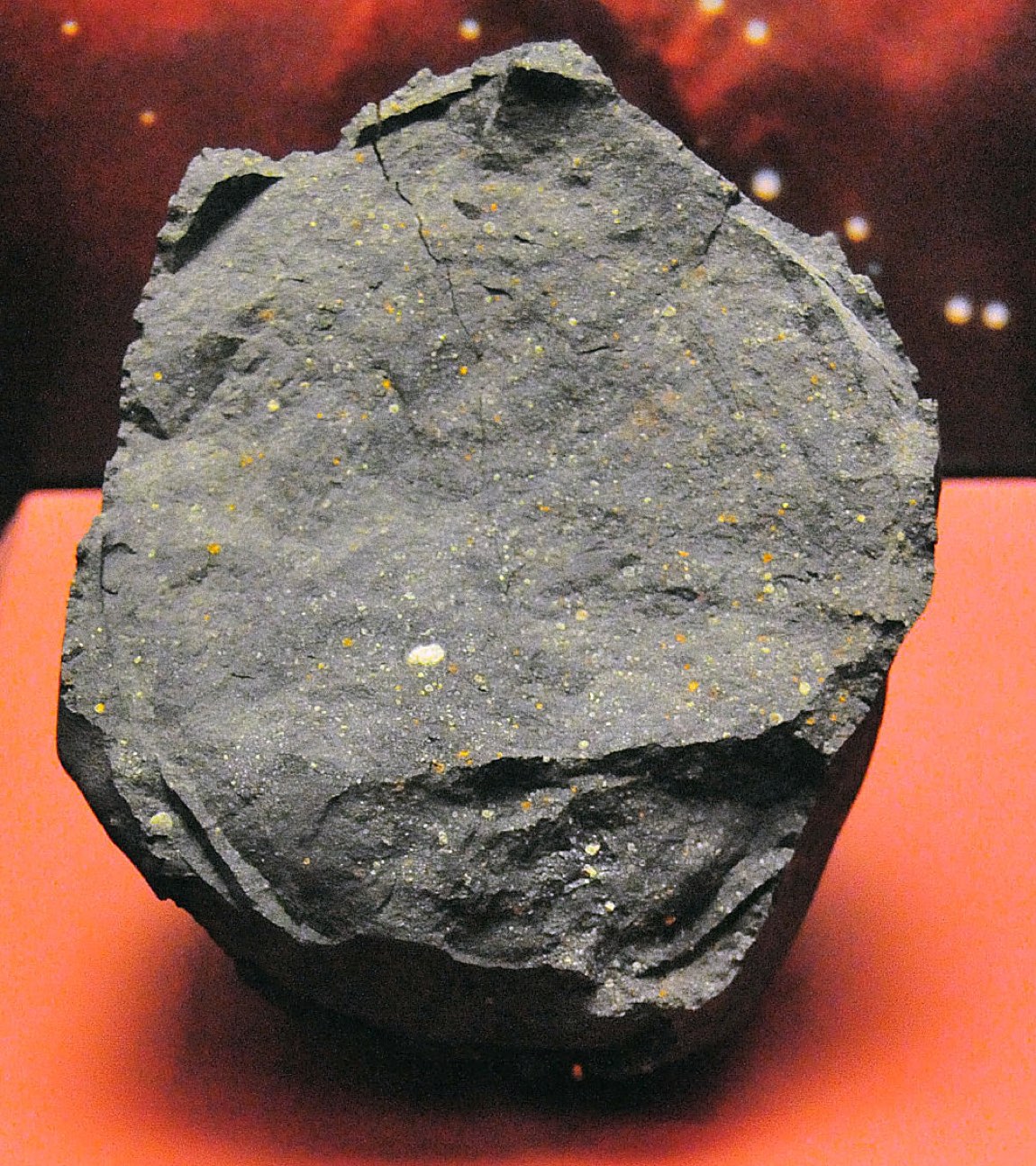
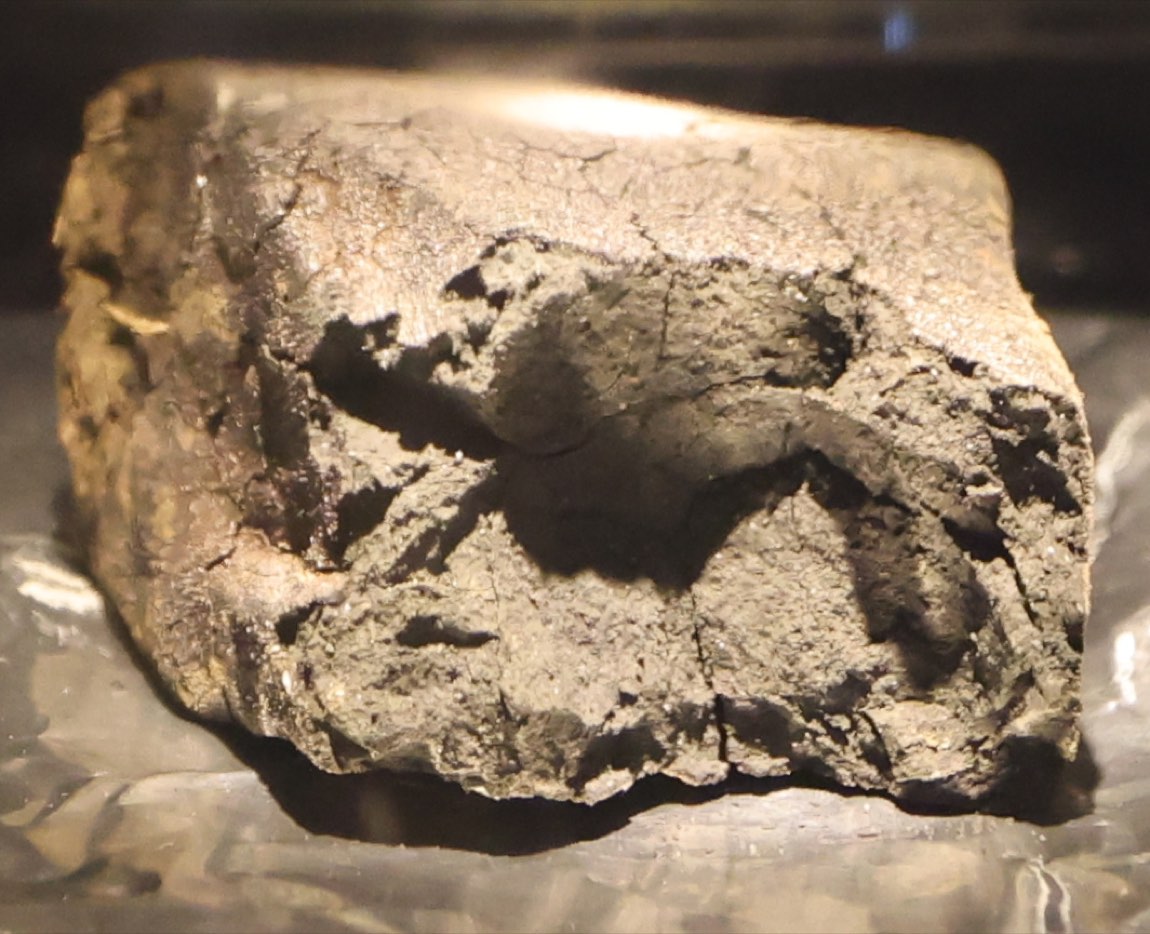
 Photograph · Richard Martin · CC BY 2.0
Meteorite · Deep guide
Tagish Lake Meteorite
Also called: Tagish Lake
Fragments of a primitive asteroid that landed on a frozen Canadian lake and were collected without thawing.
What is it?
On 18 January 2000, a meteoroid about 4 metres across exploded 30–50 km above northwestern British Columbia, releasing energy of roughly 1.7 kilotons of TNT. More than 500 dark fragments were gathered from the frozen surface of Tagish Lake. Because many were picked up from ice and kept cold, they are unusually free of contamination. The stones are an ungrouped carbonaceous chondrite packed with organic matter, amino acids and tiny nanodiamonds, and studies of their light suggest a link to dark, primitive D-type asteroids.
The deep dive
Researched for the Atlas from Wikipedia — Tagish Lake (meteorite) (6,769 characters read) · updated Nov 15, 2026
01 A Fireball That Fooled the Locals
When the Tagish Lake meteoroid tore into the atmosphere on 18 January 2000 at 16:43 UTC — 08:43 local time in Yukon — the airburst was violent enough to trigger satellites and seismographs across a wide region. People on the ground in southern Yukon and northern British Columbia looked up at a blazing fireball, then heard and felt the explosion. The smell that followed was distinctly sulfurous, and many residents immediately assumed a missile had been launched somewhere nearby. No missile, of course: a space rock roughly the size of a large SUV had just vaporized most of itself in the sky above them. The luminous trail it left behind persisted in the upper atmosphere for about half an hour after the event, long enough for researchers to photograph it and later reconstruct exactly where the object had come from and the angle at which it had entered. That lingering trail turned out to be one of the most scientifically valuable parts of the entire event, providing calibration data that no eyewitness account alone could have supplied.
02 How Much Rock Actually Survived
The original Tagish Lake meteoroid weighed an estimated 56 tonnes before it hit the atmosphere — roughly the mass of a loaded semi-trailer — and measured about 4 metres across. By the time it had finished ablating and fragmenting at altitudes between 50 and 30 kilometres, only about 1.3 tonnes of solid material remained. That means roughly 97 percent of the original rock simply vaporized. Much of that vaporized mass did not disappear cleanly; it became stratospheric dust, and that dust was actually visible as noctilucent clouds to the northwest of Edmonton at sunset, about 12 hours after the impact. Of the 1.3 tonnes of fragments that did reach the ground, only somewhat over 10 kilograms — about 1 percent of what survived the atmosphere — was ever found and collected. So in total, less than 0.02 percent of the original meteoroid ended up in a museum drawer. The numbers make clear just how destructive even a relatively small atmospheric entry event can be.
03 Collecting on a Frozen Lake in Winter
More than 500 fragments settled onto the frozen surface of the Taku Arm of Tagish Lake, which turned out to be both a blessing and a complication. The ice kept the pieces accessible and, crucially, kept them cold — an important factor for a meteorite rich in organic materials and water-bearing minerals that degrade when they warm up and get wet. A local resident collected the first fresh fragments in late January 2000 and had them transported to research facilities in their frozen state, preserving what scientists later called a pristine sample. When snowfall buried the rest of the fragments, a second search campaign had to wait until April 2000. Researchers from the University of Calgary and the University of Western Ontario led that effort and found that many of the later fragments had sunk a few centimetres to more than 20 centimetres into the ice. Some had to be cut out in frozen blocks, others scooped from meltwater holes. These later, partially thawed specimens are classified as degraded and are curated separately from the pristine material, mostly at those same two universities.
04 Two Rocks in One: Tagish Lake's Split Personality Deeper
Tagish Lake is classified as a carbonaceous chondrite of type C2 ungrouped — meaning it resembles known groups but fits neatly into none of them. It shares characteristics with both CI and CM chondrites, the two most chemically primitive classes known, yet is distinct enough from each to stand alone. One of its stranger physical properties is an unusually low density: it is less dense than any other type of chondrite. More surprising still, the meteorite is not a single uniform rock but is composed of two somewhat different lithologies. The key difference between these two rock types is the abundance of carbonate minerals — one lithology is poor in carbonates while the other is rich in them. This internal variation suggests the parent asteroid may have experienced heterogeneous aqueous alteration, with water-driven chemistry proceeding differently in different parts of the body. The meteorite also contains water-bearing serpentinite and saponite phyllosilicates, and gypsum has been identified, though the gypsum may be a weathering product of meteoritic sulfides rather than a primary mineral. Critically, isotopic measurements confirm the water is not Earthly contamination — it is isotopically distinct from terrestrial water.
05 A Record-Setting Stash of Nanodiamonds Deeper
Among the many unusual things found inside Tagish Lake, perhaps the most striking is the quantity of nanodiamonds — tiny diamond grains at most a few micrometres across. Tagish Lake contains more of these nanodiamonds than any other meteorite yet studied. Nanodiamonds in meteorites are understood to be presolar grains: dust particles that formed in stellar environments before the Sun existed and were then incorporated into the cloud of material that eventually became the solar system. Finding them intact inside Tagish Lake means the meteorite has preserved, essentially unaltered, some of the oldest solid material that can be physically handled in a laboratory. The meteorite also contains other unchanged stellar dust granules that may have been part of the cloud from which both the solar system and the Sun itself formed. At an estimated age of about 4.55 billion years, Tagish Lake is a relic of the very beginning of our planetary system, and its nanodiamond content makes it a particularly rich archive of the interstellar environment that preceded the Sun's birth.
06 Organic Chemistry Packed Inside Ancient Rock Deeper
Tagish Lake carries an abundance of organic materials, including amino acids — the molecular building blocks of proteins. The organics are thought to have originally formed either in the interstellar medium or in the solar protoplanetary disk before being subsequently modified inside the meteorite's asteroidal parent body, where aqueous chemistry could rework them over geological time. In 2020, NASA announced that hexamethylenetetramine had been identified in Tagish Lake, along with the Murchison and Murray meteorites. Then in 2022, a study detected purine and pyrimidine nucleobases — components of DNA and RNA — at parts-per-billion concentrations. In the Tagish Lake sample specifically, isonicotinic acid was found at 118 parts per billion, nicotinic acid at 108 parts per billion, and imidazole at 82 parts per billion, making these the most abundant nitrogen-heterocyclic compounds in that sample. These detections reinforce the idea that many of the chemical precursors relevant to biology were synthesized in space long before any life appeared on Earth, and were then delivered to planets by objects like Tagish Lake.
07 Tracing the Orbit Back to the Asteroid Belt Deeper
Reconstructing where a meteorite came from before it hit Earth is detective work that rarely succeeds, and Tagish Lake presented an extra challenge: none of the photographs taken at the time actually captured the fireball in flight. Instead, scientists worked from two calibrated photographs taken minutes after the event, which preserved the glowing trail and allowed them to determine the entry angle. Eyewitness accounts from the vicinity of Whitehorse, Yukon constrained the ground track azimuth from both sides of the trajectory. Combining these sources, researchers determined that Tagish Lake had followed a pre-entry Apollo-type orbit — a class of orbit that crosses Earth's path and extends outward into the asteroid belt. The analysis placed its origin in the outer reaches of that belt. As of the time the article was written, only eleven meteorite falls in total had accurately determined pre-entry orbits derived from photographs or video taken from two or more different angles, making Tagish Lake a rare member of a very small and precious set. Further spectral analysis then pointed to a specific source: 773 Irmintraud, a D-type asteroid.
08 What D-Type Asteroids Tell Us Deeper
The reflectance spectrum of the Tagish Lake meteorite — the way it absorbs and reflects light at different wavelengths — most closely matches that of D-type asteroids, specifically pointing to 773 Irmintraud as its likely parent body. D-type asteroids are dark, reddish objects found predominantly in the outer reaches of the main asteroid belt and among the Trojan asteroids associated with Jupiter. They are thought to be rich in organic compounds and anhydrous silicates, consistent with what has been found inside Tagish Lake. If the match to 773 Irmintraud holds up, Tagish Lake becomes one of the very few meteorites for which a specific parent asteroid can be proposed by name. This matters because it allows scientists to work in the other direction: properties measured carefully in the laboratory on a physical specimen can be projected back onto a whole class of outer-belt objects that have never been visited by spacecraft. The organics, nanodiamonds, and primitive mineral assemblages in Tagish Lake may therefore be representative of a large and poorly understood population of dark, carbon-rich bodies in the outer solar system.
09 The Double Plume and What It Means
Photographs and video taken after the Tagish Lake airburst showed something unexpected in the debris trail: a double plume structure rather than the single plume most observers would have anticipated. The same double plume phenomenon appeared in imagery of the 2013 Chelyabinsk meteor's dust trail, and researcher Peter Brown identified both cases as likely coinciding near the primary airburst location. Brown's explanation is that rising air rushed quickly into the center of the trail immediately after the explosion, producing a structure that behaves essentially like a moving three-dimensional version of a mushroom cloud. The dynamics are the same: the violent upward thrust of the explosion entrains surrounding air and creates the characteristic twin-column shape. Recognizing this pattern in both events suggests it may be a consistent signature of large atmospheric airbursts — a physical fingerprint that could help scientists identify and characterize past events recorded in photographs, even when no other data is available. It also illustrates how much information can be extracted from what might initially look like a simple smoke trail.
10 Where the Best Pieces Are Kept
The most scientifically valuable material recovered from Tagish Lake is the pristine fraction — fragments collected in their frozen state within days of the fall, before any significant exposure to liquid water or warm temperatures. More than 850 grams of this pristine material is currently held in two institutions: the Royal Ontario Museum and the University of Alberta. These samples are treated with particular care because warming and wetting would alter the organic compounds and water-bearing minerals that make Tagish Lake so scientifically interesting. The degraded fragments recovered during the April and May 2000 search, which had already spent weeks partially melted into the lake ice, are curated mainly at the University of Calgary and the University of Western Ontario. The two-tier curation system reflects a broader principle in meteoritics: not all specimens of the same fall are scientifically equal, and the conditions of collection and storage can matter almost as much as the properties of the rock itself. Initial studies of the fresh fragments were conducted in collaboration with researchers from NASA, giving the pristine material an early and thorough scientific examination.
11 What Makes This Fall Scientifically Rare
Several features conspire to make the Tagish Lake fall unusually significant even among the many thousands of meteorites in museum collections worldwide. It is the only large sample of a C2 ungrouped carbonaceous chondrite — a category so distinctive it cannot be assigned to any established group. It carries more nanodiamonds than any other known meteorite. It was collected fresh and frozen, preserving organic chemistry that would otherwise be destroyed. Its pre-entry orbit has been reconstructed with enough precision to propose a specific parent asteroid. And it delivered its material at a time and place where rapid, cold recovery was possible, almost by luck. The meteorite's combination of primitive mineralogy, abundant organics including amino acids and nucleobases, stellar dust grains, and isotopically distinct water all point to a body that experienced very limited processing since the earliest days of the solar system. In short, Tagish Lake is as close as scientists have yet come to holding a piece of the original interstellar cloud from which everything in our solar system — including Earth — ultimately descended.