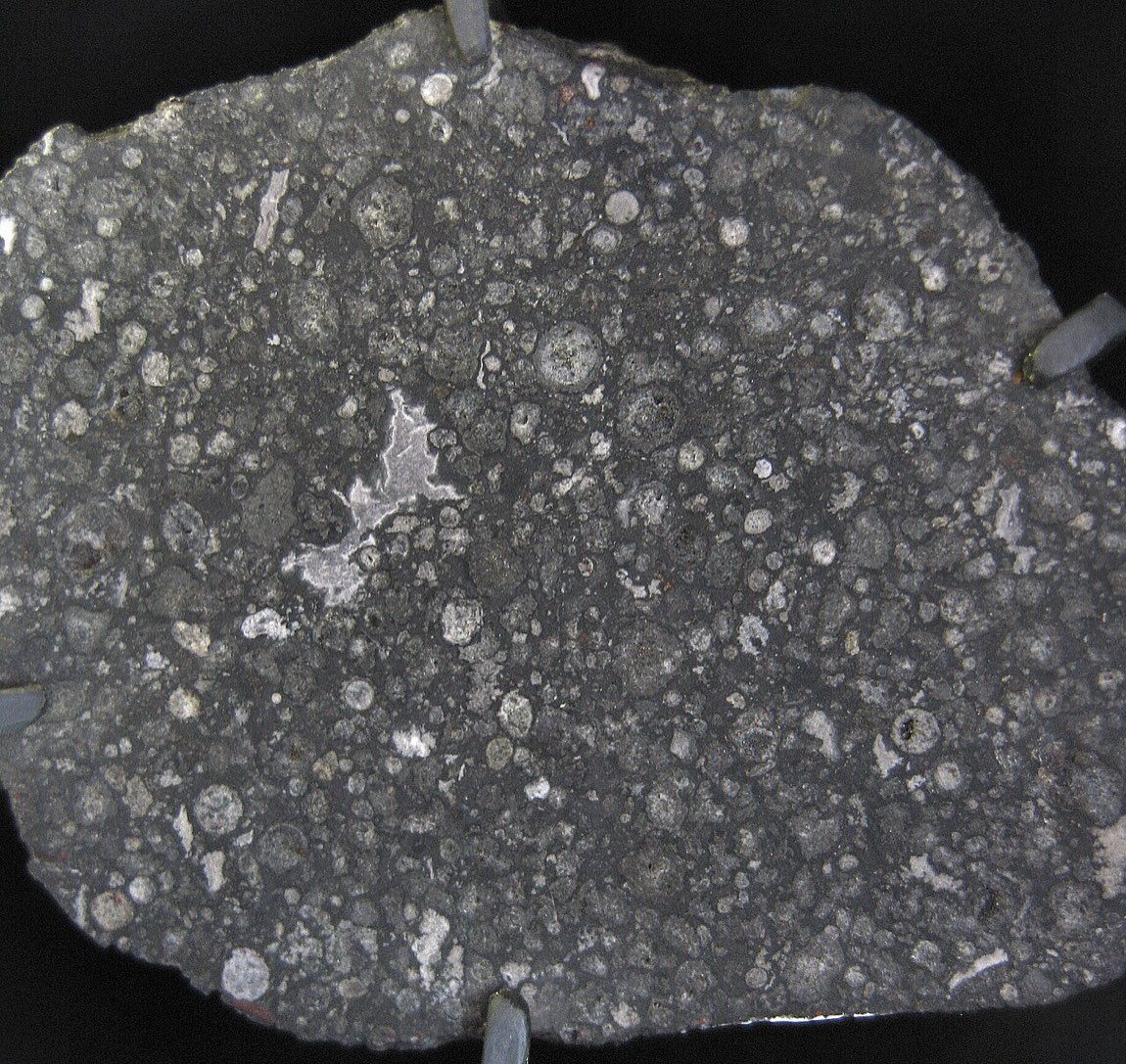
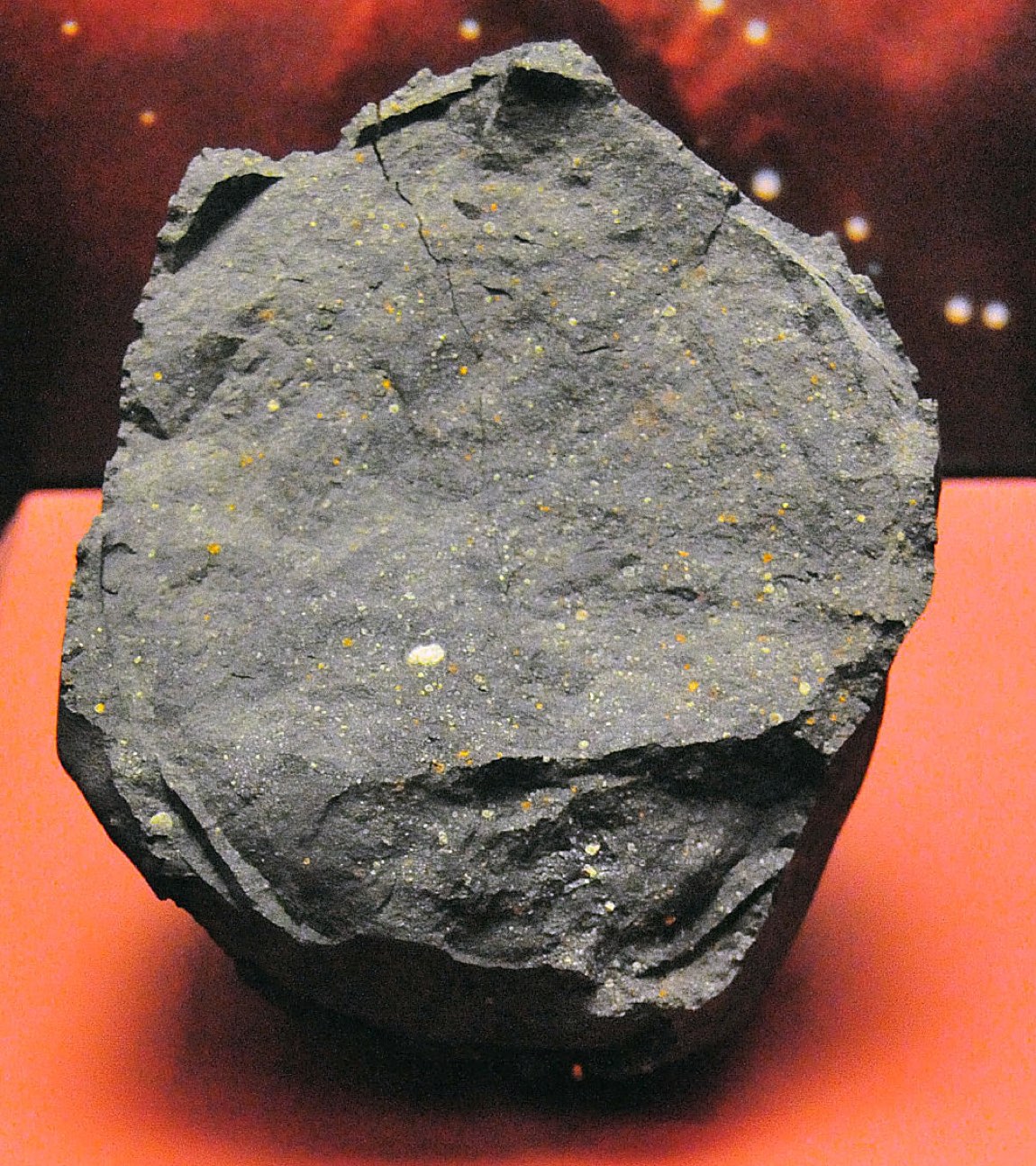
 Photograph · User:Basilicofresco · CC BY-SA 3.0
Meteorite · Deep guide
Murchison Meteorite
Also called: Murchison
An Australian space rock rich in organic molecules and stardust older than the Sun.
What is it?
On 28 September 1969, a fireball split into three pieces over the town of Murchison in Victoria, Australia, and scattered stones across more than 13 square kilometres. More than 100 kg were collected. Murchison is a carbonaceous chondrite, a type rich in carbon compounds and water-bearing minerals, and researchers have found amino acids and many other organic molecules inside it. It also holds tiny silicon carbide grains that formed around other stars before the Solar System existed; a 2020 study dated some to about 7 billion years old.
The deep dive
Researched for the Atlas from Wikipedia — Murchison meteorite (5,735 characters read) · updated Nov 15, 2026
01 The Fireball That Broke Through a Roof
On 28 September 1969, at approximately 10:58 in the morning local time, witnesses near Murchison, Victoria watched a brilliant fireball tear across the sky and split into three distinct fragments before vanishing behind a curtain of smoke. About 30 seconds after the light show ended, a tremor shook the ground. When searchers fanned out across the landscape, they found fragments scattered over an area larger than 13 square kilometres — roughly 3,200 acres — with single pieces weighing as much as 7 kilograms. One fragment, tipping the scales at 680 grams, punched straight through a roof and landed in a pile of hay. The total collected mass exceeded 100 kilograms, making Murchison one of the heaviest witnessed meteorite falls on record. Because people actually saw it fall, scientists could be confident that the material was freshly delivered and not contaminated by thousands of years of weathering on Earth's surface — a critical advantage for every laboratory study that followed.
02 What Kind of Rock Fell That Morning
Murchison belongs to the CM group of carbonaceous chondrites, a classification that tells researchers a great deal about its history before it ever reached Earth. CM chondrites are assigned petrologic type 2, which means the rock experienced extensive alteration by water-rich fluids while still inside its parent body — the asteroid or planetesimal from which it eventually broke free. That watery processing shuffled minerals around and helped create conditions in which complex chemistry could proceed. CM chondrites, alongside the CI group, are considered among the most chemically primitive meteorites known, retaining compositions that reflect the early Solar System with relatively little subsequent thermal destruction. Murchison also contains abundant calcium-aluminium-rich inclusions, tiny mineral grains that are themselves among the earliest solid material to condense from the solar nebula. Together, these features make the rock a kind of time capsule, preserving chemistry that predates the formation of the planets.
03 Grains Older Than the Sun Itself Deeper
In January 2020, cosmochemists reported a finding that rewrote the record books: silicon carbide particles recovered from Murchison are presolar grains — material that existed before our Solar System formed. The oldest of these grains was determined to be 3 ± 2 billion years older than the Solar System's own age of 4.54 billion years, putting its birth at roughly 7 billion years ago. To put that in perspective, 7 billion years ago the Sun had not yet ignited, and the Milky Way itself was less than half its current age. These grains almost certainly condensed in the outflows of dying stars and then drifted through interstellar space for billions of years before being swept up into the cloud that became our Solar System. The researchers were careful to note, however, that dust lifetime estimates rely heavily on theoretical models focused on small grains and built on assumptions carrying large uncertainties — so the precise ages carry meaningful error bars.
04 An Amino Acid Inventory Unlike Any on Earth
Murchison carries a remarkable pantry of organic molecules. Among the amino acids identified are familiar ones such as glycine, alanine, and glutamic acid — building blocks used by life on Earth — alongside more exotic molecules like isovaline and pseudoleucine that do not appear in terrestrial proteins. A specific family called diamino acids was also identified within the meteorite. Notably absent, however, were serine and threonine, which scientists would normally suspect as earthly contaminants; their absence actually reinforced the case that the other amino acids were genuinely extraterrestrial. By 2010, a study using high-resolution spectroscopy identified 14,000 molecular compounds in a single sample, including 70 distinct amino acids. The researchers estimated that the full analytical scope, using mass spectrometry, could reveal 50,000 or more unique molecular compositions, with the possibility of millions of distinct organic compounds residing within the meteorite's interior.
05 The Long Debate Over Chirality Deeper
One of the most scientifically charged puzzles surrounding Murchison concerns molecular handedness, or chirality. Life on Earth uses almost exclusively left-handed amino acids and right-handed sugars — a bias whose ultimate origin remains unexplained. When the meteorite's amino acids were first reported in 1970, they appeared racemic, meaning equal mixtures of left- and right-handed forms, consistent with abiotic chemistry. Then in 1982 researchers reported an excess of the left-handed form of alanine, but because alanine is a protein amino acid, many scientists suspected earthly contamination. The debate shifted again in 1997 when L-excesses were also detected in several non-protein amino acids, pointing toward a genuine extraterrestrial source for molecular asymmetry. Around that same time, an enrichment in the nitrogen isotope 15N was reported, though both findings were later questioned as potentially due to analysis error. In 2005, a team of Swedish chemists demonstrated that the homochirality seen in life could have been triggered or catalyzed by a left-handed amino acid such as proline — exactly the kind of molecule present in Murchison.
 ⤢
06 Sugar Molecules and the RNA Connection Deeper
In November 2019, Murchison contributed to a landmark discovery: alongside the Northwest Africa 801 meteorite, it provided the first evidence of pentoses — five-carbon sugars — in space, confirmed using gas chromatography–mass spectrometry. Among these sugars was ribose, the backbone of RNA, one of the central molecules of life's information-storage and catalytic machinery. All straight-chain five-carbon aldoses were detected in the samples. Researchers did not find tetroses, sugar alcohols, sugar acids, or deoxyribose, the sugar that forms the backbone of DNA. The presence of ribose in a meteorite supports the hypothesis that the chemical ingredients necessary for RNA-based life could have been delivered to early Earth from space. Combined with the meteorite's amino acid inventory, this finding strengthens the broader case that carbonaceous chondrites served as delivery vehicles for prebiotic chemistry during the period when life first emerged on our planet roughly 4 billion years ago.
07 Nucleobases With a Non-Terrestrial Signature Deeper
Murchison has also yielded purine and pyrimidine compounds — the nucleobases that form the information-carrying rungs of DNA and RNA. What makes these detections scientifically convincing rather than merely interesting is the isotopic evidence. Carbon isotope ratios measured for two specific compounds, uracil and xanthine, came in at δ13C values of +44.5‰ and +37.7‰ respectively. These values are far outside the range typical of terrestrial organic material, providing strong geochemical evidence that the compounds originated beyond Earth rather than drifting in as contamination from the laboratory or the surrounding environment. Taken alongside the amino acids, polyols identified by 2001, and the pentose sugars found in 2019, the nucleobase detections paint a picture of Murchison as a vessel carrying an impressively complete toolkit of prebiotic chemistry — not just one or two key molecules, but several of the classes of compounds that life on Earth relies on for its most fundamental functions.
08 Hexamethylenetetramine and Other Finds
The list of organic discoveries from Murchison has continued to grow. In 2020, NASA announced that hexamethylenetetramine had been detected not only in Murchison but also in the Murray and Tagish Lake meteorites. Hexamethylenetetramine is a cage-shaped molecule that can serve as a chemical reservoir, breaking down under certain conditions to release simpler organic compounds including amino acids and formaldehyde. Its presence in multiple carbonaceous chondrites suggests it may be a common product of chemistry occurring in cold interstellar clouds or in the outer Solar System. Earlier work had also isolated a complex mixture of alkanes from Murchison, strikingly similar to the mixture produced in the famous Miller–Urey experiment that simulated early Earth chemistry in the laboratory. This parallel between a lab simulation of primordial Earth and a rock from outer space has long captivated researchers probing the origins of life's molecular ingredients.
09 Why the Interior Matters More Than the Surface
Not every fragment of Murchison carries the same scientific value. Several lines of evidence indicate that the interior portions of well-preserved fragments are pristine — meaning the organic chemistry there reflects the original extraterrestrial material rather than molecules that seeped in after the rock landed. This distinction is crucial because carbonaceous chondrites are porous and can absorb terrestrial organic compounds remarkably quickly after falling. The observed fall in 1969 gave scientists a head start: because the meteorite was collected relatively soon after landing, and because researchers have been careful to work with interior samples rather than weathered surfaces, the organic inventory is considered a reliable record of what the rock carried from space. This methodological care is part of why decades of successive studies — from the first amino acid reports in 1970 through the 2019 sugar discoveries — have continued to build on rather than contradict one another.
10 A Rock That Keeps Giving After 50 Years
Few meteorites have sustained scientific productivity across more than half a century the way Murchison has. The first major findings — the amino acid inventory and the evidence of abiotic synthesis — appeared in 1970, just one year after the fall. The chirality debate played out through the 1980s and 1990s. Polyols were added to the organic inventory by 2001. The 2010 high-resolution spectroscopy study expanded the known molecular count to 14,000 compounds in a single sample. Sugar molecules arrived in 2019. Presolar grains made headlines in 2020. This sustained productivity reflects two things: the genuine richness of the meteorite's chemistry, and the steady improvement of analytical instruments over the decades. Techniques that could not detect certain compounds in 1970 became sensitive enough to find them by 2010 or 2019. With millions of organic compounds potentially present according to researchers' own estimates, Murchison is likely to continue generating discoveries as laboratory capabilities advance further.
 ⤢