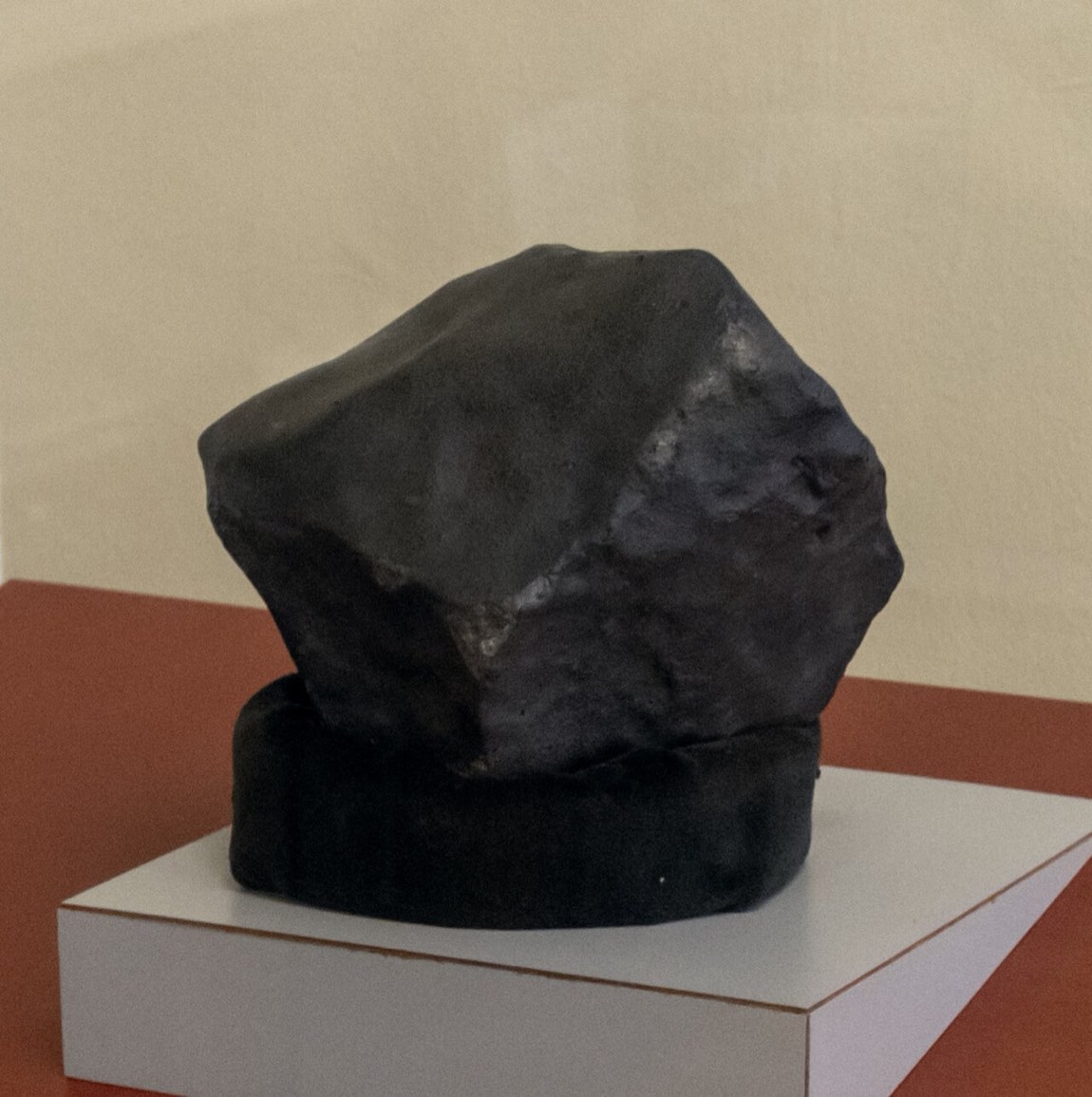
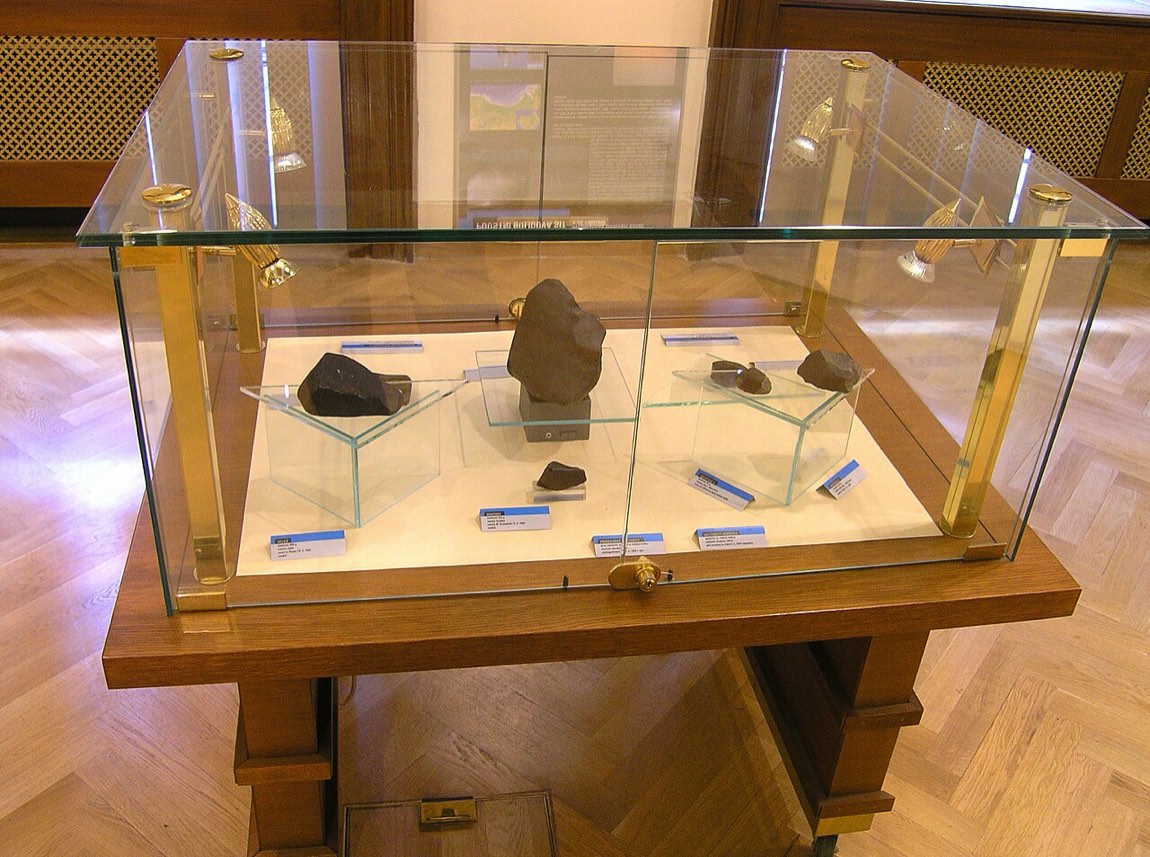
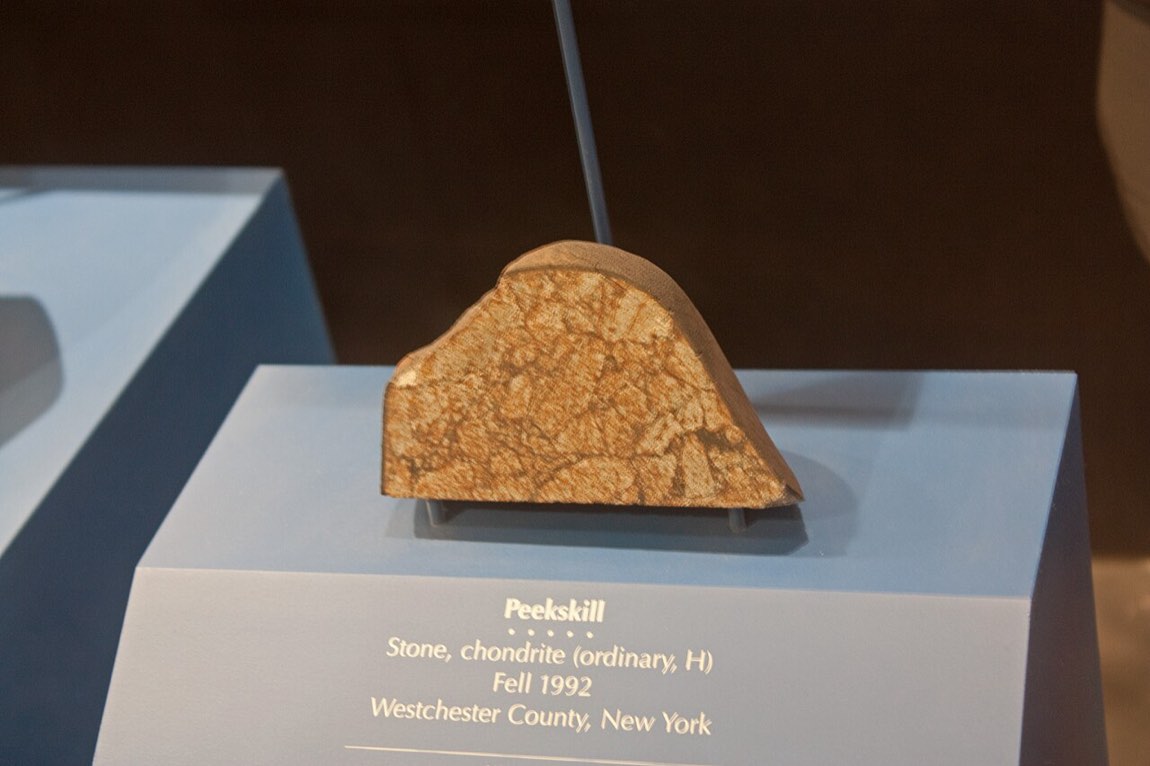
 Photograph · Wknight94 talk · CC BY-SA 3.0
Meteorite · Deep guide
Peekskill Meteorite
Also called: Peekskill
Filmed by at least 16 video cameras in 1992, it ended its trip by smashing into a parked car in New York.
What is it?
On the evening of 9 October 1992, thousands of people along the US East Coast saw a large greenish fireball. Sixteen separate video recordings caught it crossing the sky, often filmed by people at Friday-night football games. A 12.57 kg stone survived and struck a parked 1980 Chevy Malibu in Peekskill, New York, at about 7:50 p.m. The meteorite is an H6 ordinary chondrite whose texture records an ancient collision between asteroids. The videos let scientists work out its orbit.
The deep dive
Researched for the Atlas from Wikipedia — Peekskill meteorite (3,369 characters read) · updated Nov 15, 2026
01 A Friday Night Fireball Seen by Thousands
The Peekskill meteorite did not arrive quietly. On the evening of October 9, 1992, thousands of people along the United States East Coast looked up to see what witnesses variously described as a huge greenish fireball blazing across the sky. Residents of Pittsburgh, Philadelphia, and Washington D.C. all reported the same spectacular light. The timing was almost theatrical: it was a Friday evening during high school football season, and many fans had cameras rolling on the sidelines to record local games. Those cameras accidentally caught something far more extraordinary. Because so many recordings existed from so many different vantage points — sixteen in total — scientists were handed an unusually complete record of the event, one that allowed them to reconstruct the meteorite's precise flight path through the atmosphere with a level of accuracy rarely possible for a meteorite fall.
02 How Fast, and How Much Did It Slow Down? Deeper
Before it encountered Earth's atmosphere, the Peekskill meteorite was travelling at a cosmic velocity of 14.2 km/s — equivalent to 31,760 mph or 51,120 km/h. That speed is roughly forty times faster than a commercial airliner cruises. The atmosphere acted as an enormous brake. By the time the rock punched through the trunk of a parked car in Peekskill, New York, it had slowed dramatically to approximately 164 mph, or 264 km/h. That is still fast enough to cause serious damage — comparable to the speed of a pitched baseball multiplied many times over in terms of mass — but it represents a reduction of more than 99.5 percent of its original cosmic velocity. The braking was not gentle: the energy shed during that deceleration is what produced the brilliant fireball and the accompanying breakup of the object over Kentucky as it traced a north-northeast trajectory across West Virginia and Pennsylvania toward its final destination.
03 Breaking Apart Over Kentucky
The meteorite did not arrive as a single intact boulder sailing smoothly through the sky. It broke up over Kentucky, fragmenting under the intense aerodynamic and thermal stress of atmospheric entry. This kind of breakup is common for incoming space rocks and is part of what produces a fireball visible from so far away — each fragment burns brightly as it ablates. The object then continued on its north-northeast trajectory, passing over West Virginia and Pennsylvania before the surviving mass completed its journey to Peekskill, New York, where it struck the parked Chevrolet Malibu at approximately 7:50 pm Eastern Daylight Time. The 16 separate video recordings captured different segments of this long descent, and when scientists compared all the footage together, the multiple perspectives gave them the geometric data needed to calculate the full flight path.
 ⤢
04 The Car, the Crater Pit, and the Sulfur Smell
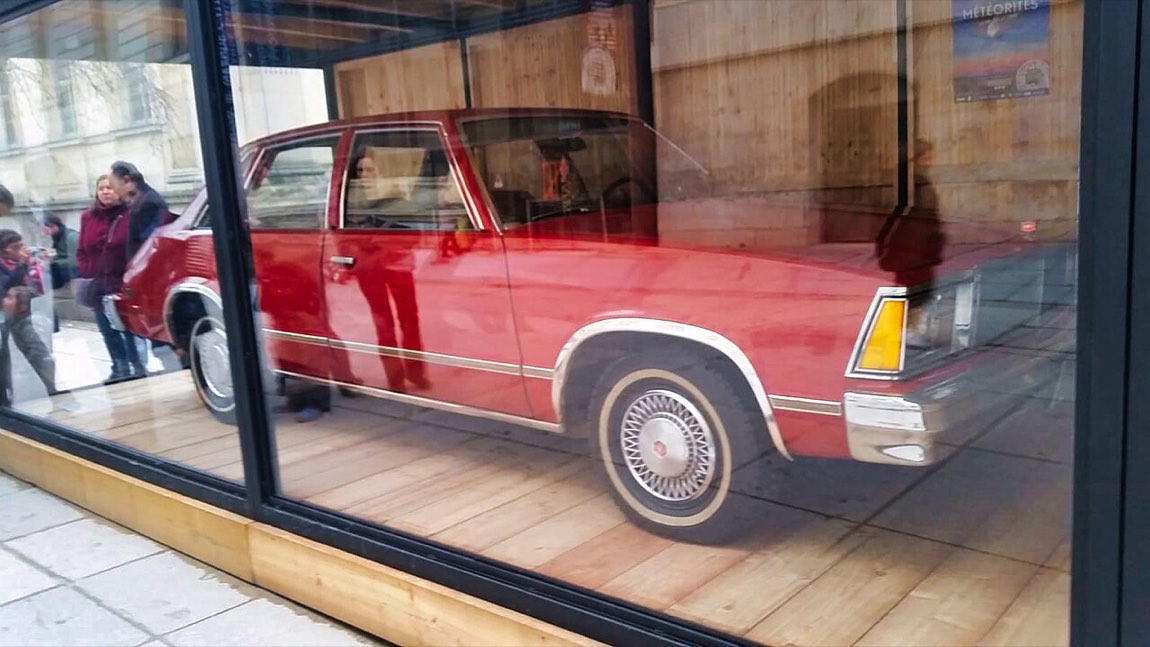
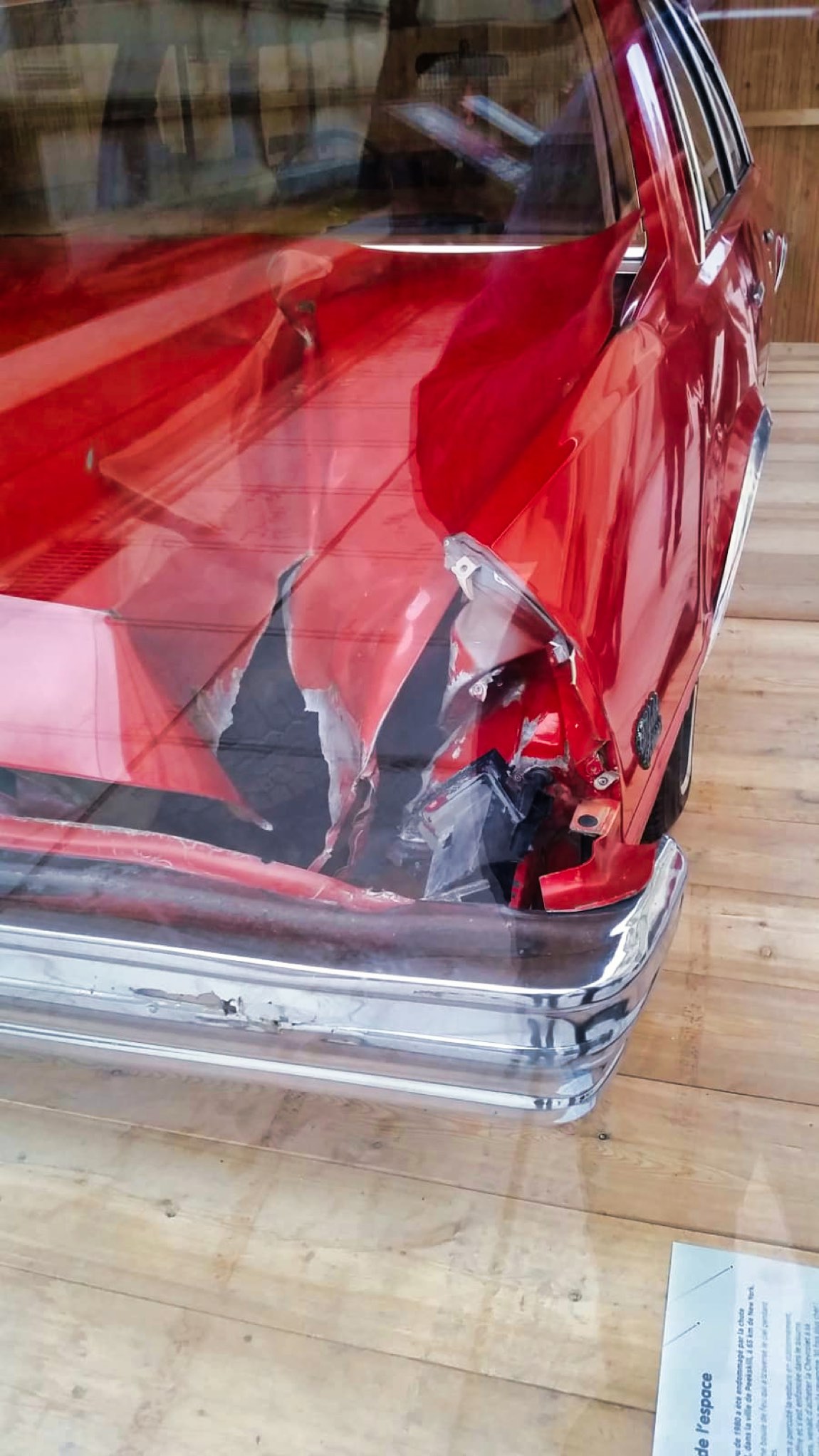
The meteorite smashed through the trunk of a red 1980 Chevrolet Malibu and narrowly missed the car's gas tank before coming to rest in an impact pit it had dug beneath the vehicle. Seventeen-year-old Michelle Knapp, who owned the car and was inside her home at the moment of impact, heard a sound she later described as being like a three-car crash. When she went outside to investigate, she found her car severely damaged and the meteorite sitting beneath it — still warm to the touch and smelling of sulfur. The meteorite at that point weighed 12.37 kilograms, or about 27 pounds 4 ounces. The fact that it missed the gas tank was fortunate; a direct strike on the fuel could have produced a fire or explosion. The impact pit beneath the car is a vivid reminder that even a decelerated meteorite still carries enormous destructive energy.
05 From $300 Car to $25,000 Relic
Michelle Knapp had bought the 1980 Chevrolet Malibu for just $300 shortly before it was destroyed. After the meteorite impact transformed it into a piece of scientific and cultural history, the car was sold to Iris Lang — wife of noted meteorite collector and dealer Al Lang — for $25,000, nearly eighty-four times what Knapp had paid for it. The meteorite itself changed hands too: Knapp sold it to a consortium of three dealers for $50,000. Both the car and the main surviving mass of the meteorite, which now weighs 890 grams (1 pound 15 ounces) — a significant reduction from the original 12.57 kilograms, reflecting how much material was distributed as specimens — are today part of the Macovich Collection of Meteorites. The car has since traveled to numerous museums around the world, including New York City's American Museum of Natural History and France's National Museum of Natural History.
06 Where Pieces of Peekskill Ended Up
The Peekskill meteorite was broken into specimens and distributed widely across major scientific institutions. Beyond the main mass held in the Macovich Collection, pieces can be found at Chicago's Field Museum, the National Museum of American History at the Smithsonian Institution, and Griffith Observatory in Los Angeles. This wide distribution ensures that researchers at multiple institutions can study the rock independently, which is standard practice for scientifically valuable meteorite falls. For those who want to own a fragment personally, small specimens of the Peekskill meteorite sell on the collector market for approximately $125 per gram — making even a modest fragment a significant investment, though one rooted in a genuinely extraordinary provenance. The combination of documented fall, video evidence, and known impact point makes Peekskill specimens especially desirable compared to meteorites found without any observed fall.
 ⤢
07 What Ancient Collisions Built This Rock Deeper
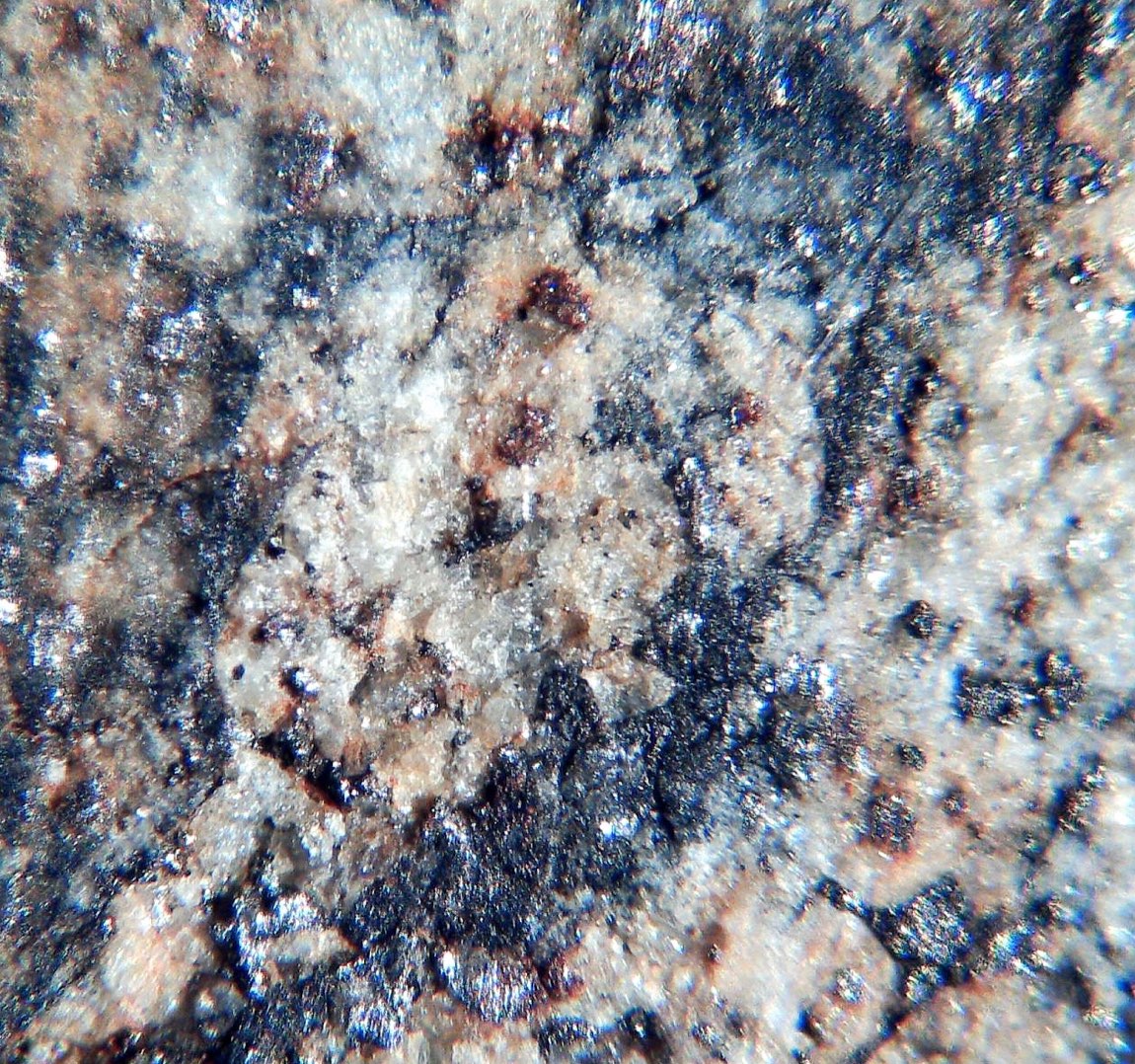
The Peekskill meteorite is classified as an H6 monomict breccia, and that classification tells a story of violence far older than its arrival on Earth. The term breccia refers to a rock made of angular fragments cemented together — evidence that the parent body was shattered and re-consolidated, or at minimum heavily shocked, by a collision between two asteroids in outer space. The H6 designation places it within the ordinary chondrite family, specifically the H group characterized by relatively high total iron content, with the number 6 indicating a high degree of thermal metamorphism. Its filigreed, intricately patterned texture is a direct physical record of the shocking and heating produced by that ancient asteroid impact. Approximately 20 percent of the meteorite's mass consists of tiny flakes of nickel-iron, scattered through the stony matrix — a composition that reflects the mixture of rocky and metallic material present in the original parent body.
08 A Rock 4.4 Billion Years in the Making Deeper
The Peekskill meteorite is estimated to be 4.4 billion years old — a figure that places its origin in the earliest period of solar system formation, when the Sun was newly ignited and the planets were still assembling from clouds of gas and dust. For context, Earth itself is approximately 4.5 billion years old, meaning the material in this meteorite formed at nearly the same time as our own planet. Unlike rocks on Earth, which are constantly recycled through volcanism, erosion, and plate tectonics, meteorites from the asteroid belt can preserve the primordial chemistry of that early era essentially unchanged. The H6 classification tells scientists that the rock experienced significant heating — enough to cause metamorphism — presumably from radioactive decay within its parent asteroid body in those first tens of millions of years. What fell on Peekskill, New York, on a Friday evening in 1992 was therefore a 4.4-billion-year-old artifact of the solar system's birth, delivered fresh to anyone willing to look up.
09 Only One Event Has More Camera Angles
Being captured on film at all makes the Peekskill event exceptional — only a handful of meteorite falls have ever been recorded on video. But Peekskill stands out even within that rare category. Of all documented meteorite events in history, only the 2013 Russian meteor event — the Chelyabinsk superbolide, which injured over a thousand people and was recorded by dashboard cameras, security cameras, and smartphones across a wide region of Russia — was captured from more angles and localities than Peekskill. The sixteen cameras that filmed Peekskill in 1992 did so by accident, their operators focused on high school football games and not the sky. That accidental simultaneity turned an ordinary Friday night into one of the best-documented meteorite falls ever recorded, and the footage remains scientifically valuable for understanding how incoming objects behave during atmospheric entry.
 ⤢