 Photograph · NASA · Public domain
Meteorite · Deep guide
Black Beauty (NWA 7034)
Also called: NWA 7034 · Northwest Africa 7034 · Black Beauty
A dark Martian rock with pieces 4.43 billion years old and more water than any other Martian meteorite.
What is it?
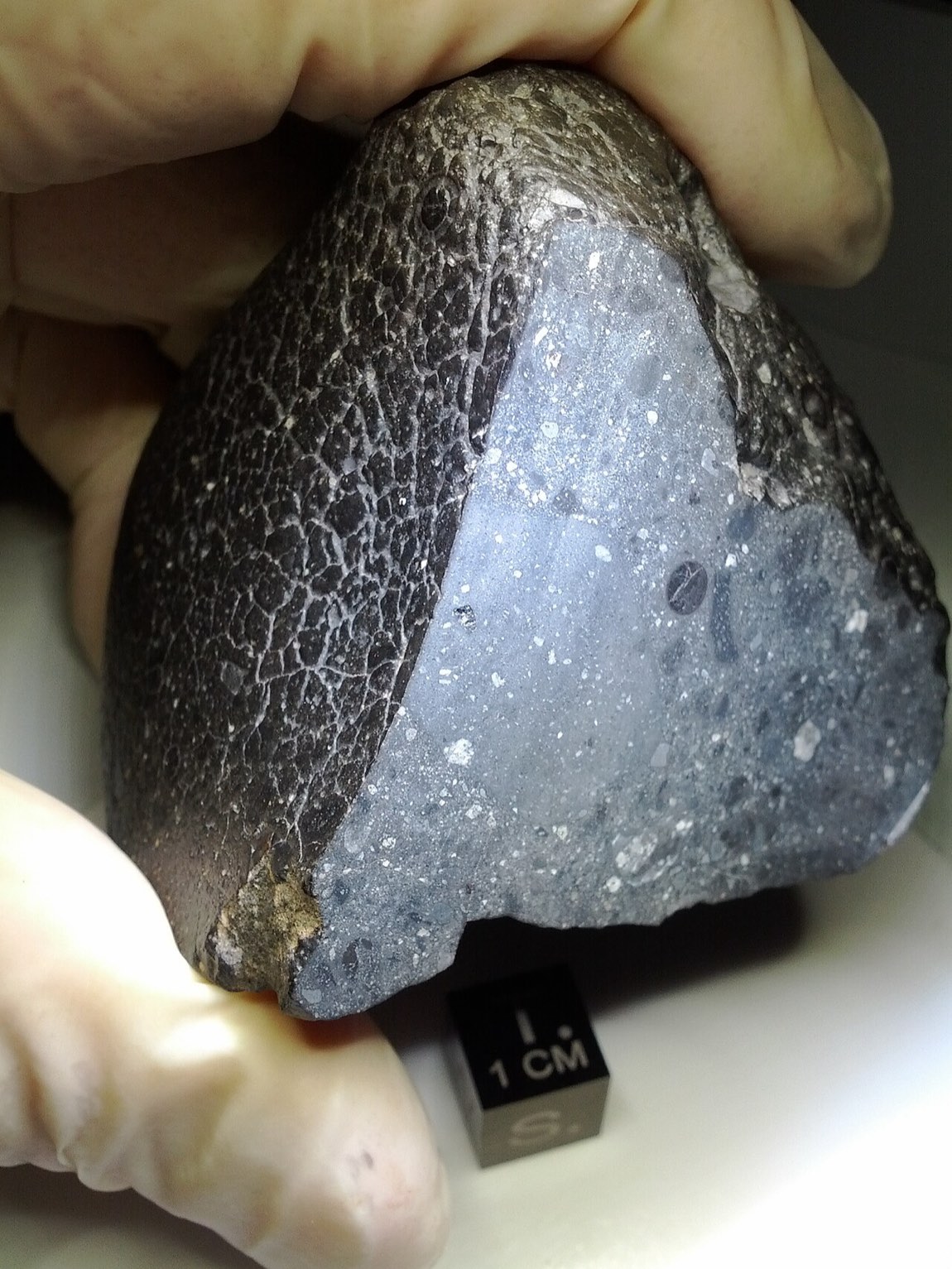
Northwest Africa 7034, nicknamed Black Beauty, was found by nomads in the Sahara in 2011 and sold through Morocco to a collector in the United States. It is a breccia: hundreds of rock fragments of many ages cemented together. Some pieces are about 4.43 billion years old, among the oldest known material from Mars, and it holds more water than any other Martian meteorite. It fits none of the three classic Martian meteorite families, so it founded a new group. A 2022 study linked it to the Karratha crater in Mars's southern highlands.
The deep dive
Researched for the Atlas from Wikipedia — Northwest Africa 7034 (3,861 characters read) · updated Nov 15, 2026
01 A rock that defied every known category
When scientists first examined NWA 7034, they expected it to slot neatly into one of the three established Martian meteorite groups: shergottite, nakhlite, or chassignite — the so-called SNC meteorites. It fit none of them. The rock is a breccia, meaning it is built from hundreds of fragments cemented together, mixing both very old and very young material in a single hand-sized stone. This made it the first confirmed Martian meteorite of its kind. The Meteoritical Society initially classified it as an ungrouped planetary achondrite, a catch-all label for things that don't belong anywhere else. In January 2013 the Society approved an entirely new designation: 'Martian (basaltic breccia).' That classification itself was later revised in 2018, when the Nomenclature Committee accepted a petition renaming the group 'Martian (polymict breccia)' — acknowledging that the stones contain not just basaltic material but impact melts, sedimentary rocks, and a wide variety of other rock types that the earlier label failed to capture.
02 What Black Beauty is actually made of Deeper
Look at a slice of NWA 7034 under a microscope and you find a surprisingly complex mineral world. The rock has a porphyritic texture: large crystals — called phenocrysts — of plagioclase feldspar (specifically andesine) and pyroxene minerals (pigeonite and augite) up to 5 mm across sit embedded in a much finer-grained groundmass. That groundmass itself contains fine-grained plagioclase, more pyroxene, various oxide minerals, and traces of iron sulfides. Among the accessory minerals are chlorapatite, chromite, goethite, ilmenite, magnetite, maghemite, alkali feldspar, and pyrite. Some clasts — fragments locked inside the breccia — are made of quenched magma, rock that cooled so rapidly it froze in a glassy state. The mineralogy points to a volcanic origin for the rock's protolith, but the brecciation means subsequent impacts smashed, mixed, and re-cemented that volcanic material with other crustal fragments before the meteorite ever left Mars.
03 The wettest Martian rock ever found on Earth
Of all the Martian meteorites recovered on Earth, NWA 7034 holds the record for water content — the highest ever measured in a sample from Mars. That water is not simply contamination from the Sahara Desert where the rock was found; whole-rock chemistry confirms it is genuinely part of the meteorite's composition. Where did it come from? One leading idea is that the volcanic rock that eventually became this meteorite erupted at a time when oceans or large bodies of water still existed on the Martian surface, and that water was incorporated into the minerals during or after the eruption. A team of Japanese researchers who studied the meteorite went further, concluding from this evidence that liquid water was present on Mars as far back as approximately 4.4 billion years ago — making the planet's watery history almost as old as Mars itself. That finding has significant implications for how early Mars might have supported conditions relevant to the origin of life.
04 An age almost as old as the solar system
NWA 7034 contains components dated at 4.42 ± 0.07 billion years old, placing them within the first hundred million years or so of solar system history. That makes it the second oldest Martian meteorite known. For scale, the entire solar system is roughly 4.56 billion years old, so parts of this rock crystallised when Mars was barely a toddler planet. Yet the story doesn't stop there — the meteorite also contains much younger material, and the whole rock was heated again during the Amazonian period of Martian geological history, the most recent and ongoing era on Mars. That means NWA 7034 is not a simple snapshot of one moment in time but a layered archive: ancient crust mixed with younger volcanic products and reworked by impacts across billions of years, all compressed into a single heterogeneous sample.
05 Two craters and a 5-million-year journey Deeper
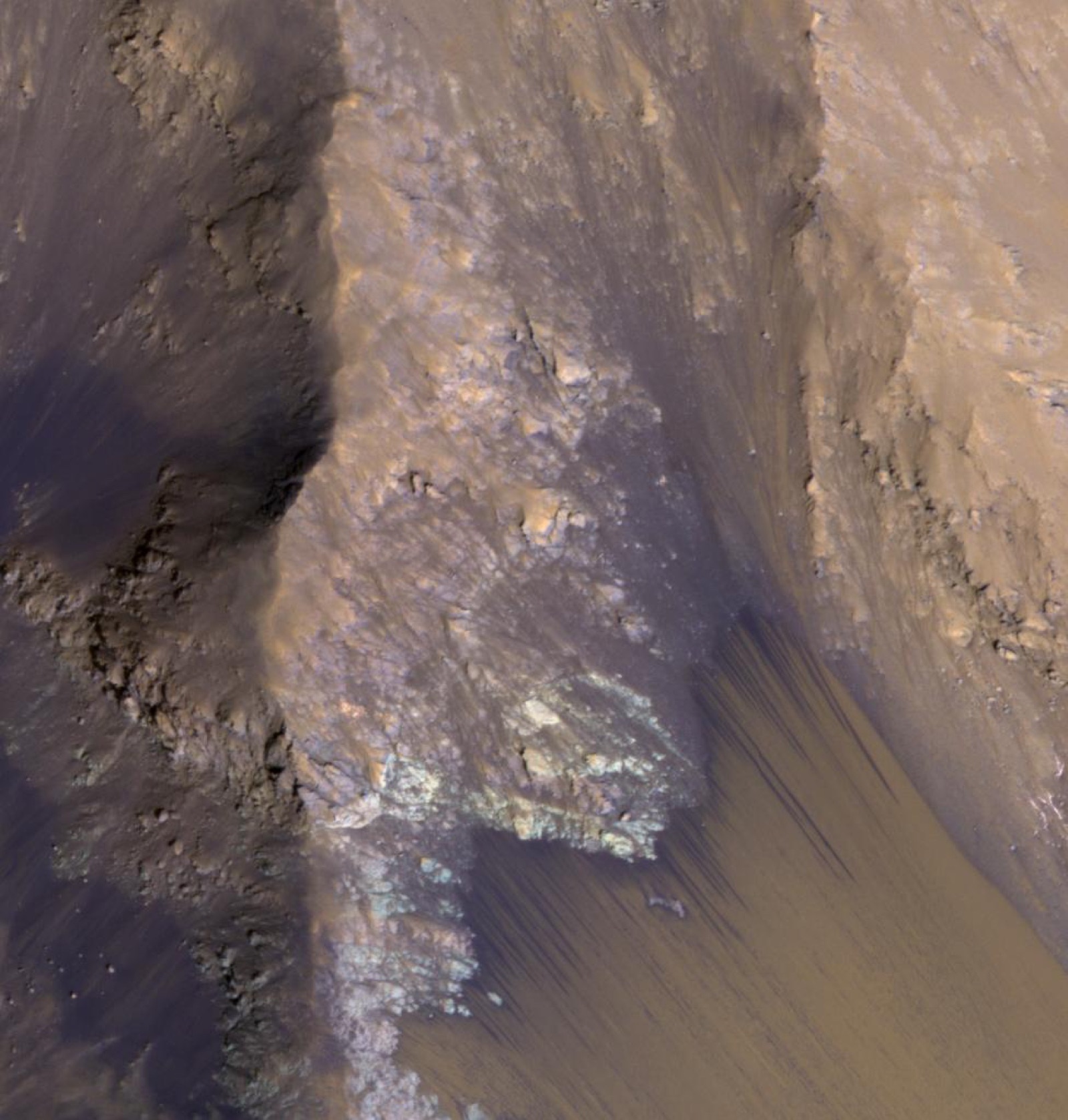
A 2022 study traced the meteorite's exact ejection point on Mars with unusual precision. The researchers concluded that NWA 7034 was blasted off the Martian surface by the impact that formed a crater named Karratha, located in the Terra Cimmeria–Terra Sirenum region of the southern highlands. That ejection event happened somewhere between 5 and 10 million years ago — geologically recent, though still an almost incomprehensible span of time by human standards. But the rock's history on Mars goes back much further. Before the Karratha impact sent it into space, the meteorite is thought to have already been part of the ejecta blanket deposited by an earlier, larger impact that formed the nearby Khujirt crater approximately 1.5 billion years ago. So the meteorite spent over a billion years sitting in Martian ejecta before a second impact finally gave it enough velocity to escape the planet's gravity entirely.
06 The oxygen isotope puzzle Deeper
One of the most puzzling aspects of NWA 7034 is its oxygen isotope signature. The iron-to-manganese ratio lines up perfectly with other confirmed Martian meteorites, strongly suggesting a Martian origin. But the oxygen isotopes tell a different story — they do not correlate with what is expected from Mars. Scientists have proposed several explanations for this discrepancy. Heavier or lighter isotopes may have been added or removed through some process, or the rock may have mixed with material that had a different isotopic ratio to begin with. One plausible mechanism is aqueous alteration of the Martian crust: water interacting with rock over long periods can shift isotopic compositions. Another possibility is isotopic contamination of the crust during the violent process of impact brecciation itself. No single explanation has been definitively confirmed, and the oxygen isotope anomaly remains one of the more actively debated aspects of Black Beauty's classification and origin story.
07 From desert nomads to a New Mexico laboratory
The chain of custody for NWA 7034 is itself a small story about how meteorites travel from the ground to science. Nomads found it in 2011 in the Rabt Sbayta area of the Ghredad Sabti region of Western Sahara, in the Sahara Desert. From there it passed to a meteorite dealer in Morocco, which crucially does not have meteorite export control laws — meaning the transaction was entirely legal. The dealer sold it to a private collector in the United States. That American owner then donated a slice of the meteorite to the University of New Mexico, where researchers were able to conduct the analyses that revealed its remarkable properties. The name follows the standard convention for meteorites found in large numbers or sold at markets: the geographic region (Northwest Africa) combined with a consecutively assigned number. The affectionate nickname 'Black Beauty' comes from the meteorite's striking dark colour.
08 Clasts that tell a geological life story Deeper
The 2018 reclassification from 'basaltic breccia' to 'polymict breccia' was driven by a growing appreciation of just how diverse the rock fragments — clasts — locked inside NWA 7034 actually are. The term 'polymict' means the breccia contains clasts of multiple different origins and rock types, as opposed to a monomict breccia where all fragments share a common source. Inside Black Beauty researchers have identified impact melt clasts, formed when asteroid or comet strikes briefly melted the Martian crust; sedimentary rock clasts, hinting at environments where material was deposited by water or wind; and a wide variety of other lithologies representing different episodes of Martian geological activity. This diversity is part of what makes the meteorite so scientifically valuable: it is less like a single rock and more like a compressed archive of different chapters of Martian surface history, all jammed together by repeated impacts over billions of years.
09 Why its southern highlands origin matters
Most of the other well-known Martian meteorites are thought to come from the younger volcanic terrains of Mars, particularly the northern lowlands or regions associated with the great Tharsis volcanic province. NWA 7034's origin in the Terra Cimmeria–Terra Sirenum region of the southern highlands makes it a rare sample from some of the oldest, most heavily cratered terrain on Mars. The southern highlands are thought to preserve a record of the earliest Martian crust and of the period known as the Late Heavy Bombardment, when the inner solar system was pelted with impactors. Retrieving a sample from that region — even indirectly, through a meteorite — gives scientists a window into early Martian geology that robotic landers have not yet directly accessed. The specific pairing of the Karratha and Khujirt craters as the source events connects the meteorite's chemistry to identifiable geographic locations that future missions might one day visit.
10 Paired stones and a growing meteorite group Deeper
NWA 7034 did not remain unique for long. In the years after its discovery and classification, additional meteorites were identified as belonging to the same pairing group — meaning they are almost certainly pieces of the same original rock or the same ejection event. The existence of a pairing group was significant enough that the Meteoritical Society's Nomenclature Committee formally accepted a petition in 2018 to reclassify the entire NWA 7034 pairing group under the new 'Martian (polymict breccia)' designation, rather than renaming just the original stone. This collective treatment recognises that the meteorites share the same unusual combination of Martian provenance, breccia texture, polymict clast diversity, and anomalous oxygen isotope signature. The growing group has allowed researchers to compare multiple samples and confirm which features are consistent properties of this rock type rather than peculiarities of a single specimen.