Meteorite · Deep guide
Kaidun Meteorite
Also called: Kaydun · Kaidun
A 2 kg jumble of nearly 60 minerals that some scientists think came from Mars's moon Phobos.
What is it?
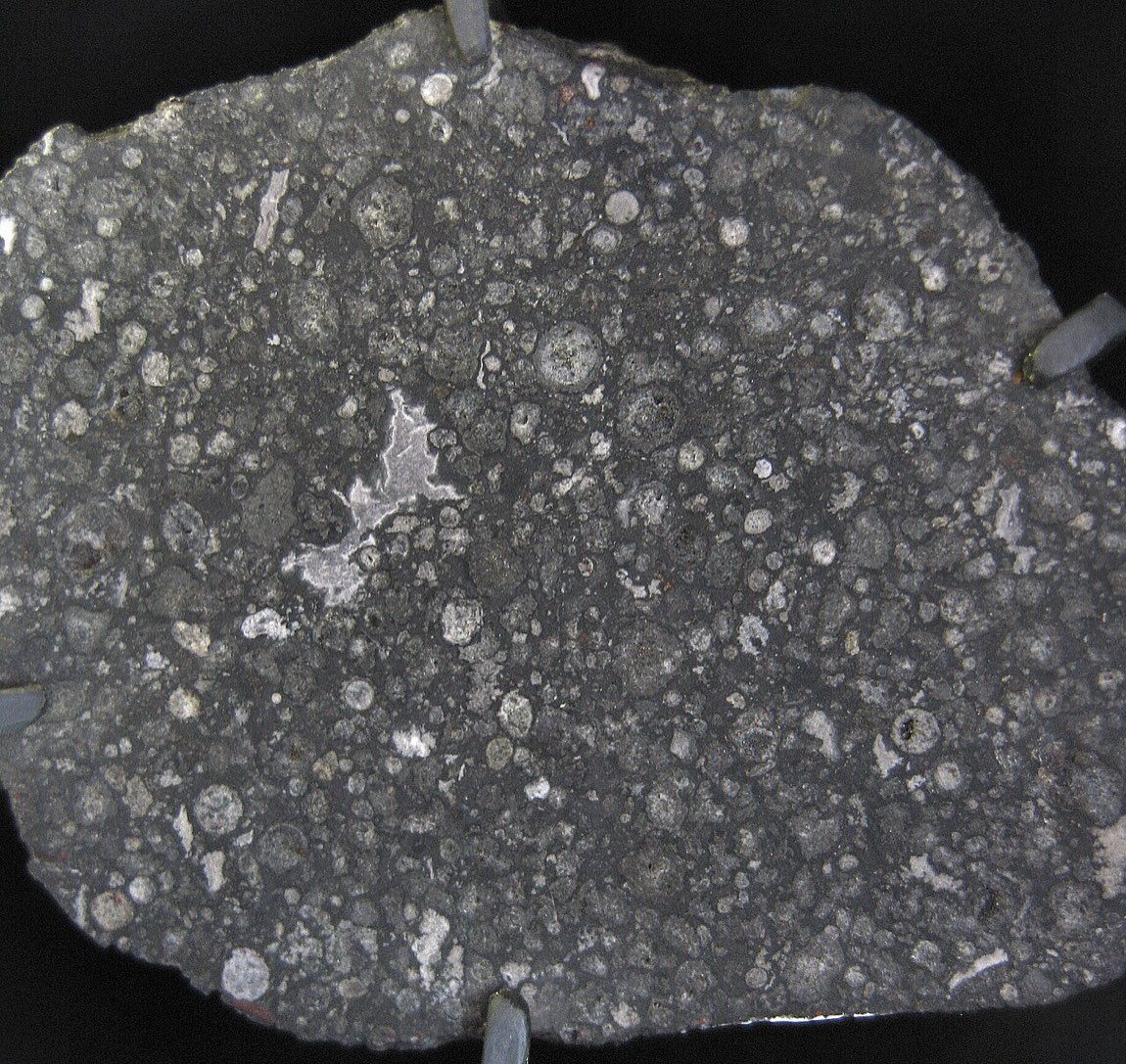
Kaidun fell on 3 December 1980 onto a Soviet military base in Hadhramaut, Yemen, after a fireball streaked across the sky; a single stone of about 2 kg was dug from a small pit. It is mostly CR2 carbonaceous chondrite, but it also contains pieces of several other meteorite types and nearly 60 minerals, some found nowhere else in nature. Because of two rare alkaline-rich fragments, a 2004 study suggested it might come from Phobos. That idea is disputed, and other evidence does not tie it to Mars.
The deep dive
Researched for the Atlas from Wikipedia — Kaidun meteorite (1,672 characters read) · updated Nov 15, 2026
01 A Fireball Over a Soviet Military Base
On 3 December 1980, witnesses at a Soviet military installation near what is now Al-Khuraybah in Hadhramaut, Yemen, watched a fireball arc across the sky from northwest to southeast. The event was dramatic enough to be recorded, and a search of the surrounding terrain turned up a single stone resting in a small impact pit. That stone weighed about 2 kilograms — roughly the heft of a large bag of sugar — and would eventually become one of the most scientifically debated meteorites ever recovered. The military setting meant the find was documented with unusual care for the region and era, preserving details about the fireball's trajectory that would later help researchers think about where in the solar system this rock had come from. The location in southern Yemen, combined with the Cold War context of the base, also meant the specimen took an unusual path before reaching the scientific community.
02 Why One Rock Holds Dozens of Mineral Types
What makes Kaidun genuinely extraordinary is not its size but its mineral diversity. Nearly 60 distinct minerals have been identified within this single 2-kilogram stone, and several of them have never been found anywhere else in nature. Among the unique finds is florenskyite, a mineral with the chemical formula FeTiP — an iron-titanium phosphide compound so unusual that it was named after a scientist and stands as a marker of exotic formation conditions. The bulk of the meteorite consists of carbonaceous chondrite material classified as type CR2, a relatively rare class of primitive stony meteorite. But embedded within that matrix are fragments of entirely different meteorite types: C1, CM1, and C3. Each fragment type records a different chemical and thermal history, meaning that this one rock is effectively a collection of samples from multiple distinct parent environments, all crammed into a single hand-sized stone.
03 A Rock Built From Many Different Parents Deeper
The presence of CR2, C1, CM1, and C3 fragments within a single meteorite is scientifically startling. Each of these carbonaceous chondrite subtypes formed under different conditions of temperature, water activity, and chemical environment in the early solar system. For all of them to end up in one rock, the parent body must have experienced repeated impacts that mixed together material from several distinct sources over geological time. This kind of polymict breccia — a rock made of fragments from multiple precursor bodies — is known in other meteorites, but Kaidun's breadth of incorporated material is considered uniquely wide. The fragments did not simply weather together on Earth; they were consolidated before the meteorite ever left its parent body. That consolidation process, and the violent impacts that enabled it, tell a story of a heavily bombarded object sitting in a part of the solar system where debris from many directions could reach it.
04 The Case for Phobos as the Source Body
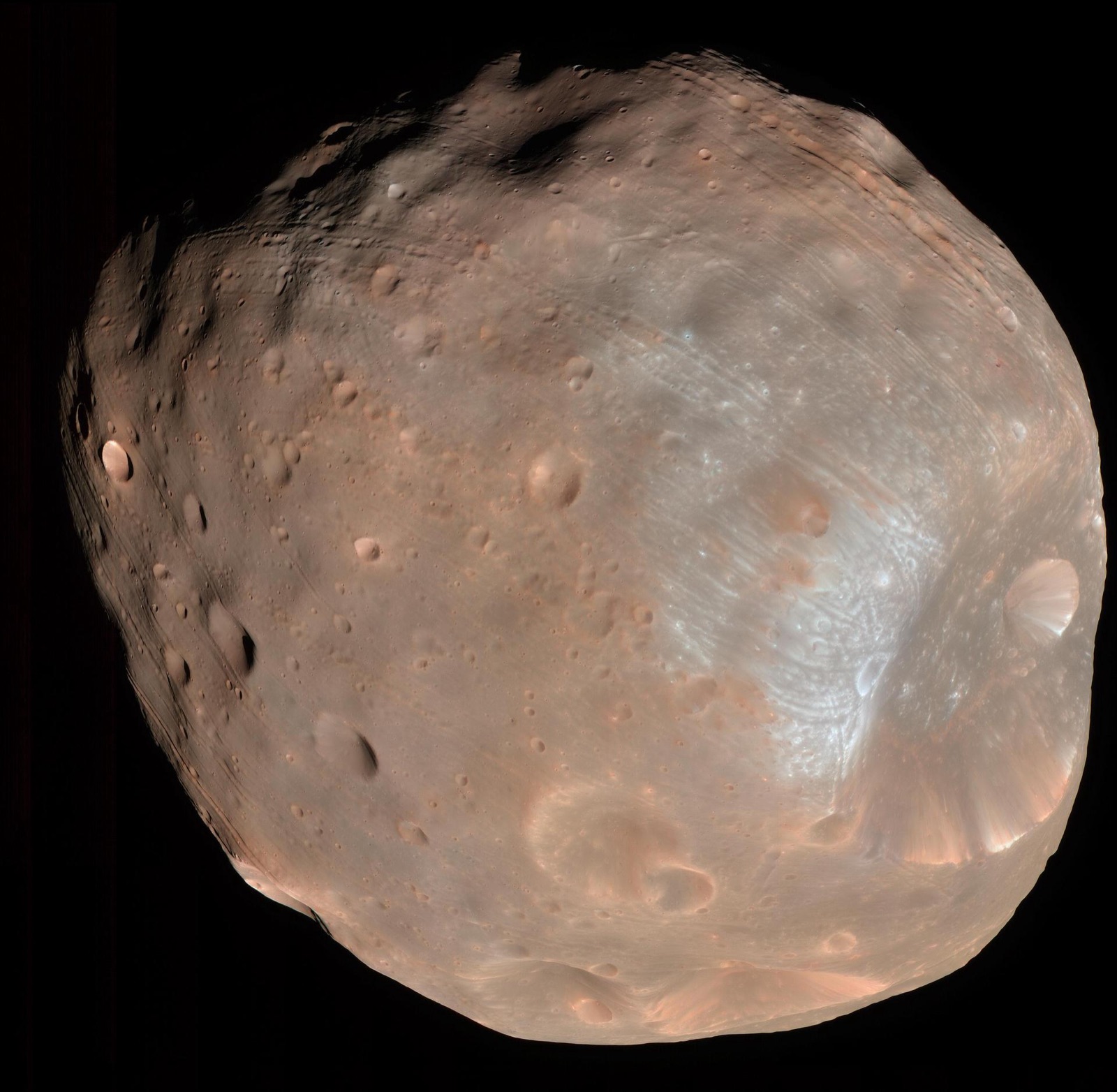
In March 2004, researchers proposed that Kaidun originated not from an asteroid belt body, as most carbonaceous chondrites do, but from Phobos, the inner moon of Mars. The central argument rests on two extremely rare alkaline-rich clasts found embedded in the meteorite. These clasts are chemically unusual because alkaline-rich rocks are almost exclusively produced through deep differentiation — a process requiring a large, geologically active planetary body. The fact that there are two such clasts, and that they appear to have entered the meteorite at different times, suggests the parent body had repeated access to material produced by deep planetary differentiation. Mars fits that description, and between its two moons, Phobos is considered a more likely contributor than Deimos simply because it orbits closer to Mars, making gravitational exchange of surface material between the planet and its moon more plausible.
05 Why the Phobos Link Remains Contested Deeper
Despite the intriguing alkaline-rich clasts, the hypothesis that Kaidun came from Phobos is explicitly described as tenuous at best. The critical problem is that mineralogical analysis and noble gas measurements — two of the most reliable tools for fingerprinting a meteorite's origin — do not connect Kaidun's lithic fragments to Mars in the way they do for other confirmed Martian meteorites. The scientific community has a well-established chemical and isotopic signature for Martian rocks, derived from meteorites whose Martian origin is not in doubt. Kaidun does not match that signature in its key fragments. The alkaline-rich clasts are suggestive circumstantially, but circumstantial evidence alone is insufficient to overturn the standard isotopic and mineralogical tests. The debate thus sits unresolved: the clasts point toward Mars, but the geochemistry does not conclusively confirm it.
06 Can a Rock Actually Travel From Phobos to Earth?
One practical objection to the Phobos hypothesis has always been the question of whether rocks knocked off that small moon could plausibly reach Earth at all. In 2017, two scientists at Western University addressed this directly and found that meteorites originating from Phobos — and even from the more distant Martian moon Deimos — can indeed travel to Earth. This computational work does not prove that Kaidun made that journey, but it removes a key theoretical barrier to the hypothesis. The dynamics involved are complex: an impactor must strike Phobos hard enough to eject material at escape velocity from the moon, that material must then navigate the gravitational influence of Mars, and eventually some fraction of it must intersect Earth's orbit. The 2017 finding confirms this chain of events is physically possible, lending at least gravitational credibility to what had seemed an exotic claim.
07 Florenskyite and the Minerals Found Nowhere Else Deeper
Among the nearly 60 minerals catalogued in Kaidun, several carry the distinction of being unknown in any other natural setting on Earth or in the meteorite collection as a whole. The most prominent of these is florenskyite, an iron-titanium phosphide with the chemical formula FeTiP. Phosphide minerals — those containing phosphorus bonded to a metal without oxygen — are extremely rare in nature because they typically form only under highly reducing conditions, where oxygen is essentially absent. Finding such a compound in a meteorite suggests that at least part of Kaidun's parent body, or one of the bodies that contributed fragments to it, underwent chemistry in a strongly oxygen-poor environment. The naming of florenskyite after a scientist memorializes the discovery while flagging that the mineral is genuinely new to science, not simply a rare variant of something previously known. Each new mineral identified in Kaidun adds another data point to the puzzle of how many different environments contributed material to this single stone.
08 CR2 Chondrites: What That Classification Means
The dominant material in Kaidun is classified as CR2 carbonaceous chondrite. The CR designation identifies a specific grouping of primitive meteorites — named after the Renazzo meteorite — that are thought to have formed in the outer solar system and to have experienced only mild aqueous alteration, meaning liquid water moved through them briefly but did not dramatically change their original chemistry. The number 2 in the classification reflects a petrologic grade indicating moderate aqueous alteration: enough water interaction to begin altering the original minerals, but not so much as to erase the primary textures. CR2 meteorites are relatively uncommon in collections and are valued because they preserve some of the most primitive, unprocessed solar system material available for study. That Kaidun's matrix falls into this category while also hosting fragments of C1, CM1, and C3 types makes it a kind of natural museum exhibit, with the primitive CR2 host serving as the frame around a gallery of exotic inclusions.
09 What the Two Alkaline Clasts Actually Tell Us Deeper
The two alkaline-rich clasts at the heart of the Phobos argument are significant on multiple levels. First, alkaline-rich rocks are rare in the meteorite record generally, because producing them requires deep differentiation — the process by which a large body melts internally and separates into chemically distinct layers, with alkaline materials migrating toward the surface over time. This requires a body large enough to generate internal heat, which rules out small asteroids. Second, the two clasts appear to have been incorporated into the host rock at different times, implying separate impact events on the parent body, each delivering alkaline material from an adjacent large planetary source. That the parent body was repeatedly struck by debris carrying alkaline signatures from a differentiated neighbor points strongly toward an object in close proximity to a planet like Mars. The argument is elegant, but elegance is not proof, and without matching noble gas or mineralogical fingerprints, the two clasts remain compelling but inconclusive.
10 Phobos vs. Deimos: Why the Inner Moon Wins
Mars has two moons, Phobos and Deimos, and both were considered as potential sources when the Phobos hypothesis was first proposed in March 2004. The researchers favored Phobos over Deimos for a straightforward gravitational reason: Phobos orbits much closer to Mars than Deimos does. Because it sits nearer to the planet, Phobos is more likely to receive ejecta blasted off the Martian surface by large impacts, and debris from Phobos itself more easily interacts with Mars's gravitational field. The closer proximity creates a more efficient exchange environment for rocky material between Mars and its inner moon. This reasoning does not exclude Deimos entirely — the 2017 Western University study confirmed that meteorites from Deimos can also reach Earth — but proximity makes Phobos the stronger candidate. The distinction matters because Phobos and Deimos likely have different surface compositions and histories, so identifying which moon contributed a meteorite would carry significant implications for understanding the origin of the Martian moon system itself.
11 Open Questions That Make Kaidun Worth Watching
Kaidun sits at the intersection of several unsolved problems in planetary science. The question of Phobos's composition and origin remains genuinely open: scientists do not agree on whether Phobos is a captured asteroid, a body that formed in orbit around Mars, or something else entirely. If Kaidun could be firmly linked to Phobos through geochemical fingerprinting, it would become the only sample of that moon available for laboratory study — an extraordinary scientific resource. Future missions to Phobos, including sample-return proposals, might eventually provide comparison material that either confirms or finally rules out the connection. Meanwhile, the minerals unique to Kaidun, including florenskyite, continue to attract study from researchers interested in the extreme chemical environments of the early solar system. And the broader question of how a single meteorite accumulated fragments from so many distinct parent environments remains a challenge to models of early solar system mixing and impact dynamics.