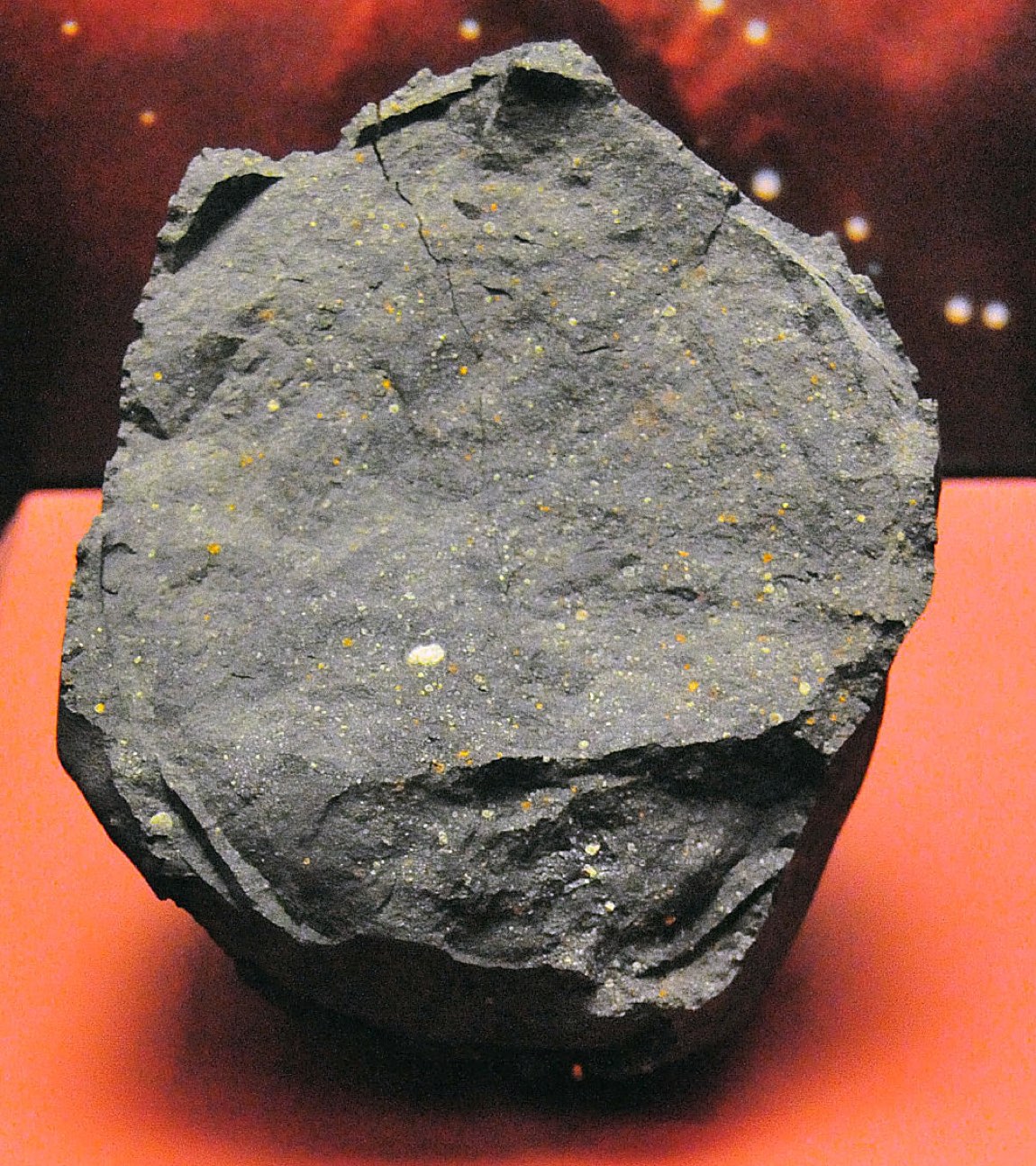
 Photograph · Shiny Things · CC BY 2.0
Meteorite · Deep guide
Allende Meteorite
Also called: Allende
A 1969 fireball over Mexico that delivered tonnes of the oldest solid material in the Solar System.
What is it?
Early on 8 February 1969, a brilliant fireball lit up northern Mexico and burst into thousands of pieces over the state of Chihuahua. More than 2 tonnes of fragments were collected, making Allende the largest carbonaceous chondrite ever found. It contains white specks called calcium–aluminium-rich inclusions, about 4.567 billion years old, which are among the very first solids to form around the young Sun. Because so much material was available, Allende is often called the best-studied meteorite in history.
The deep dive
Researched for the Atlas from Wikipedia — Allende meteorite (8,922 characters read) · updated Nov 15, 2026
01 A Fireball the Size of a Car
In the early hours of February 8, 1969, at exactly 01:05, a brilliant fireball streaked in from the southwest over the Mexican state of Chihuahua. The original stone is believed to have been roughly the size of an automobile, hurtling toward Earth at more than 16 km/s — that is about 36,000 mph, fast enough to cross the continental United States in roughly five minutes. As it plunged into the atmosphere, air resistance acted like a sudden, violent brake. The resulting pressure caused the stone to explode and shatter into thousands of fragments, lighting the sky and ground for hundreds of miles around. This kind of dramatic breakup is entirely typical for large stony meteorites; the same aerodynamic forces that slow them down also tear them apart. Pieces rained down near the small village of Pueblito de Allende, giving the meteorite its name. Because the fall happened in the predawn darkness, the fireball was especially spectacular to anyone awake to witness it.
02 One of the Largest Strewnfields on Record
When the original stone shattered high in the atmosphere, its fragments did not land in a neat pile but were spread across a vast elliptical region called a strewnfield — one of the largest ever documented. That strewnfield measures approximately 50 kilometres long by 8 kilometres wide, an area roughly comparable to the city of Los Angeles. The terrain helped enormously: the region is desert, mostly flat, with only sparse to moderate low vegetation, meaning dark meteorite fragments stood out against pale ground and were relatively easy to spot. Hundreds of pieces were collected almost immediately after the fall. Over the following 25 years, approximately 2 to 3 tonnes of material were gathered in total, though some estimates run as high as 5 tonnes — a figure that cannot be verified with any precision. Individual specimens range enormously in size, from fragments of just 1 gram to single stones weighing as much as 110 kilograms, which is heavier than an average adult human. Remarkably, new pieces are still occasionally discovered more than 50 years after the fall.
03 Why 1969 Was the Perfect Moment
Timing played an extraordinary role in making Allende the most studied meteorite in history. It fell in early 1969, just months before the Apollo program was scheduled to return the first Moon rocks to Earth. Planetary science was at a fever pitch: laboratories around the world were upgrading their instruments, new researchers were flooding into the field, and institutions were primed to analyze extraterrestrial material the moment it arrived. The Smithsonian Institution was among the museums that launched expeditions to Mexico almost immediately, collecting hundreds of kilograms of material. This combination — an unusually large supply of a rare meteorite type arriving at the most scientifically prepared moment in history — meant that Allende received an intensity of investigation that no earlier carbonaceous chondrite had ever experienced. Before 1969, the entire carbonaceous chondrite class was represented by only a small number of uncommon specimens, such as the Orgueil meteorite that fell in France in 1864. Allende alone provided more material to study than all previously known carbonaceous chondrite falls combined.
04 What You See When You Slice It Open
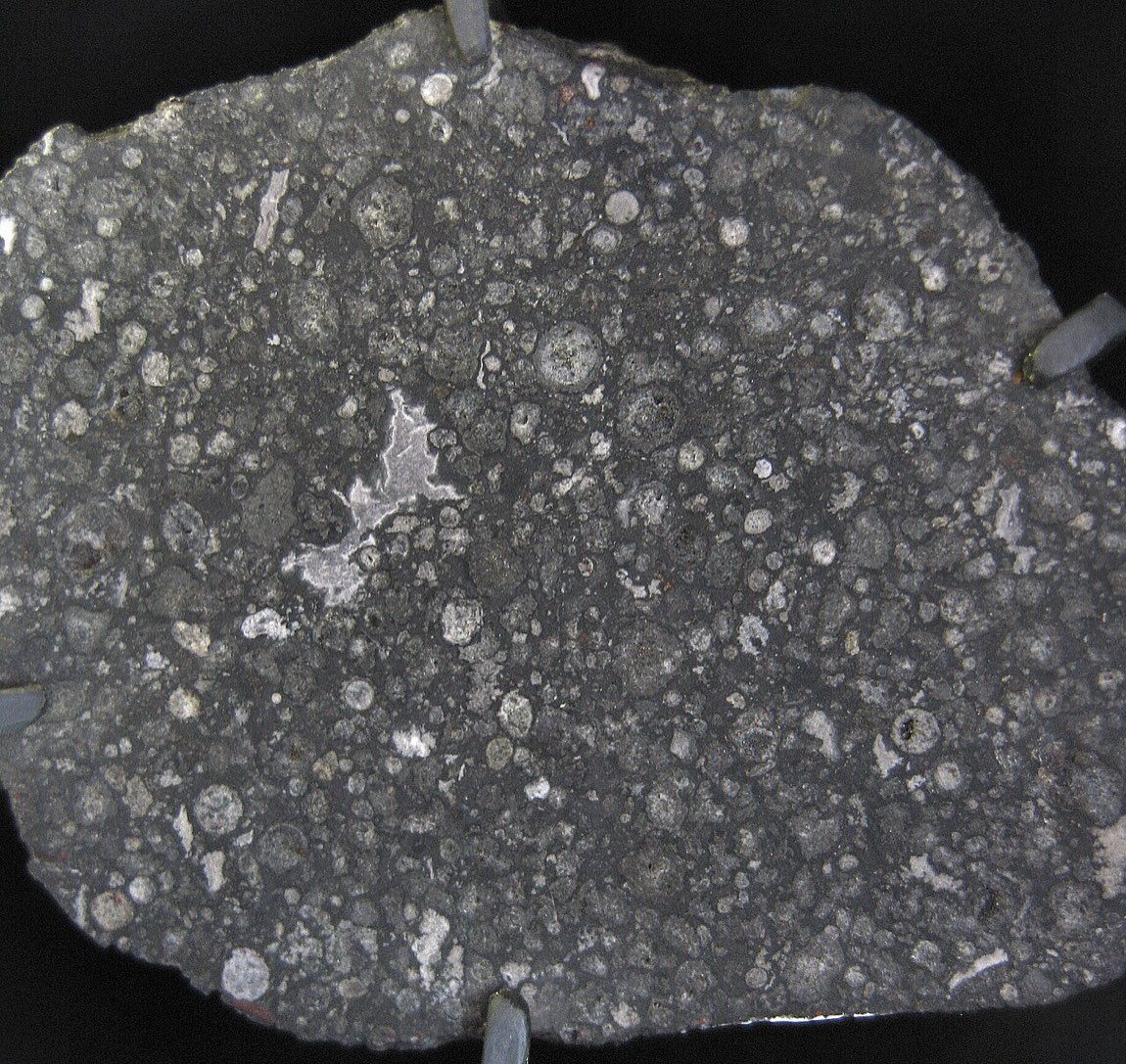
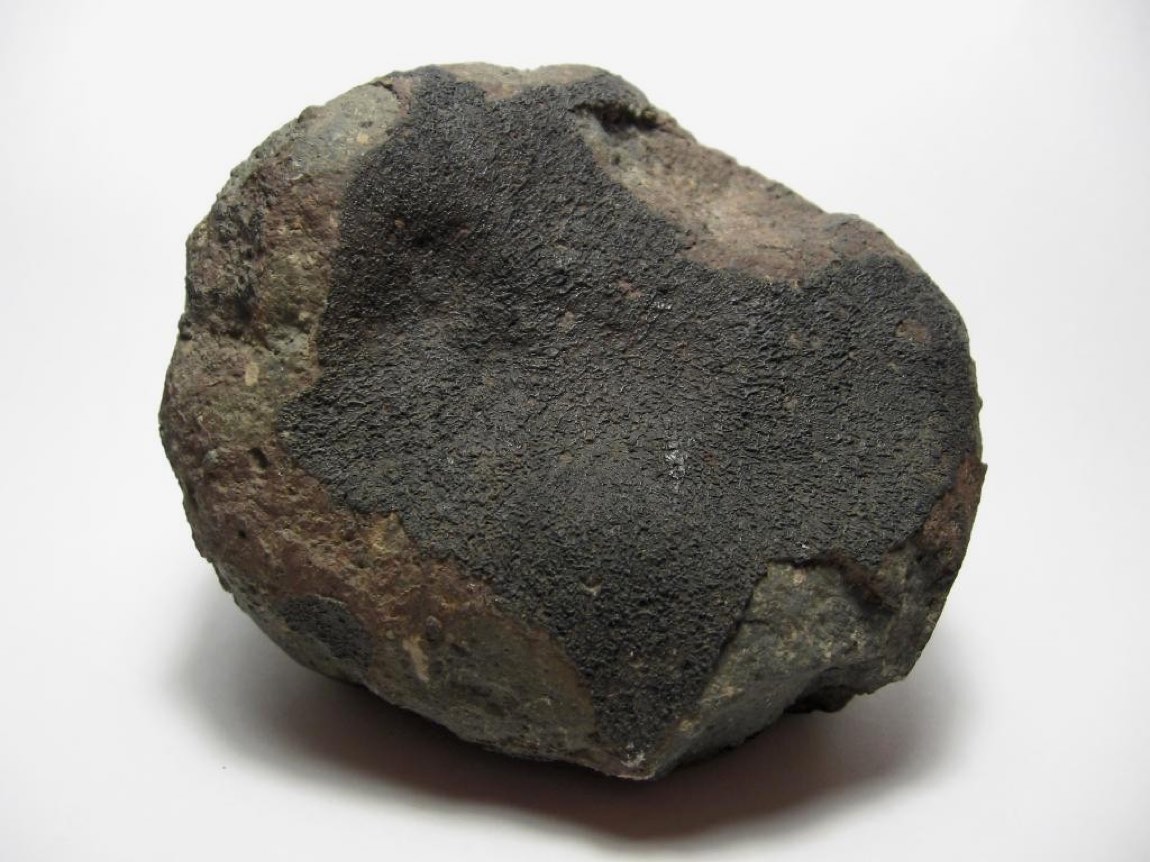
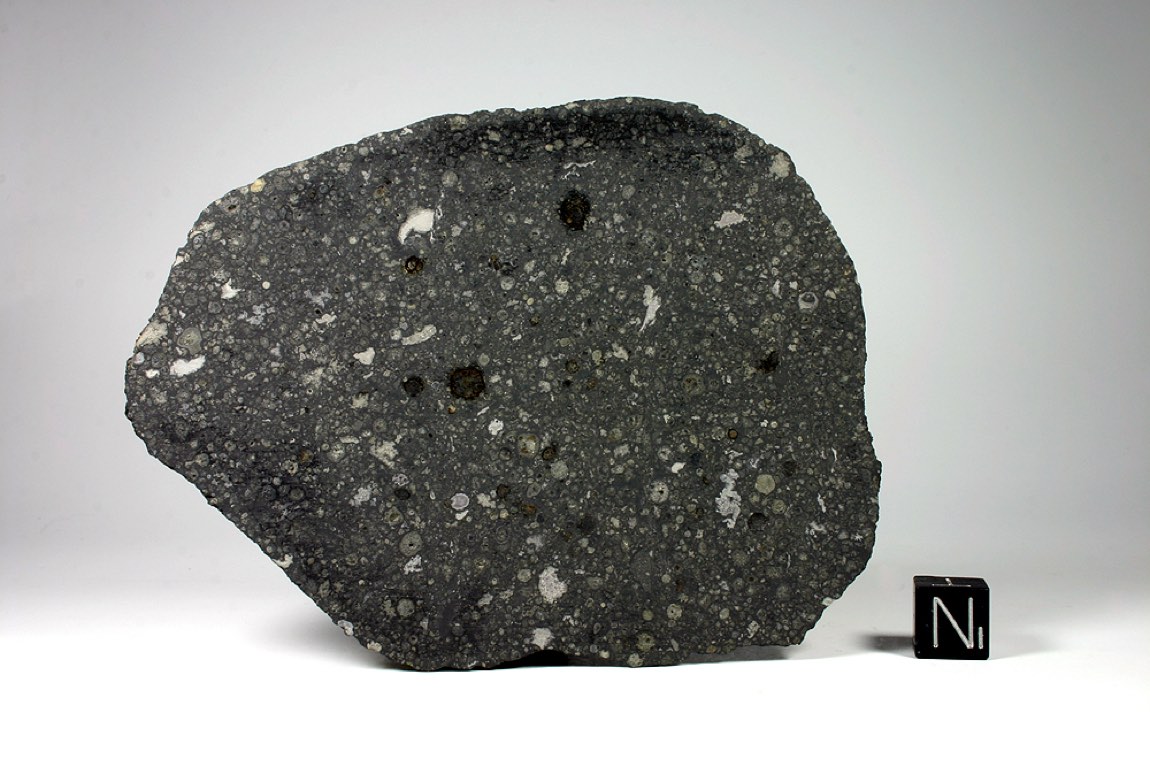
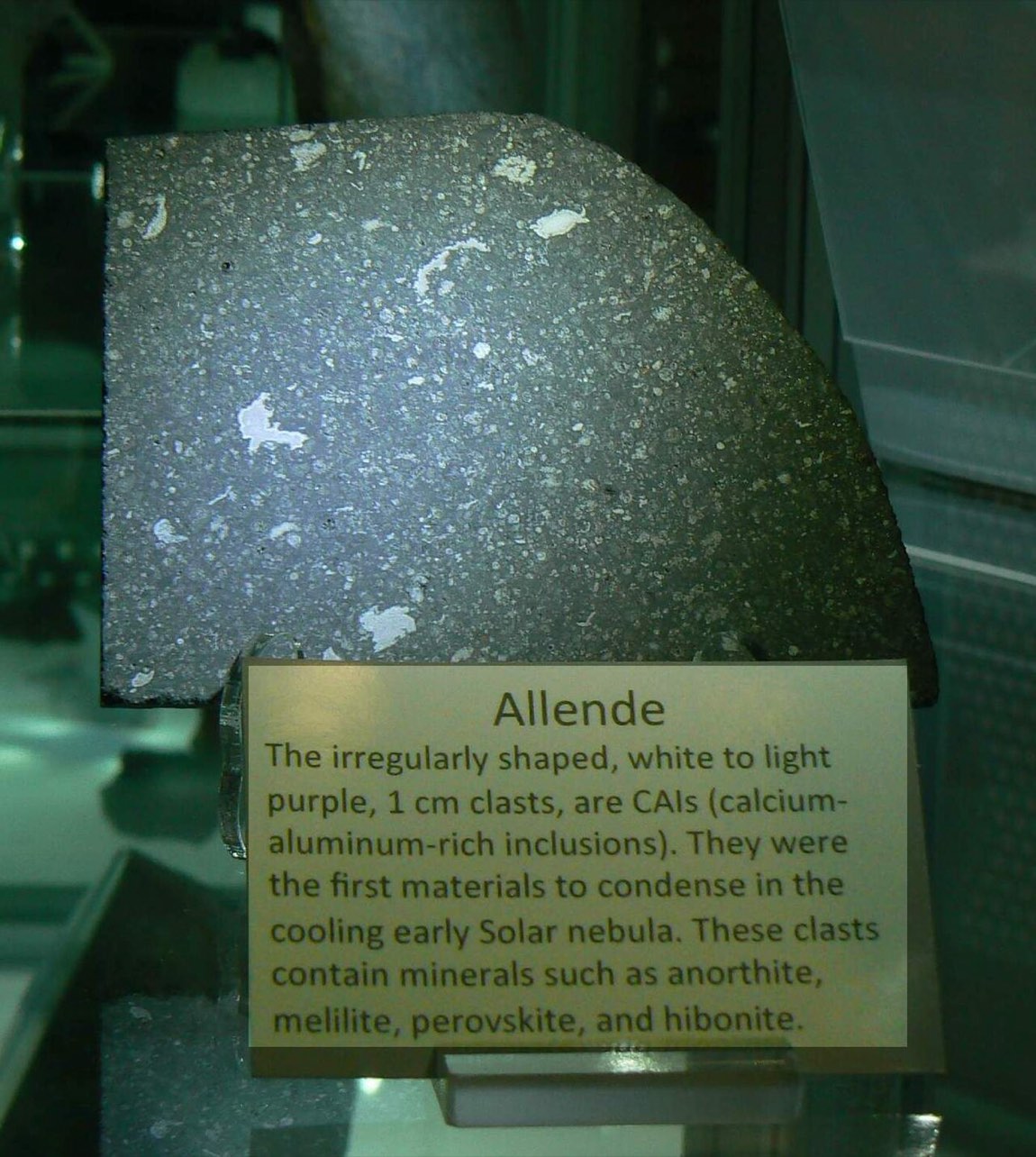
On the outside, most Allende stones are coated in a black, shiny fusion crust — a glassy skin formed when the exterior melted during the high-speed atmospheric descent. Slice one open and polish the cut face, however, and a completely different world appears. The interior is dominated by a dark matrix dotted with millimetre-sized lighter-coloured spheres called chondrules, tiny stony globules found only in meteorites and never in rocks formed on Earth. Scattered through this matrix are white inclusions ranging up to several centimetres across, their shapes varying from nearly spherical to wildly irregular, almost amoeba-like forms. These are the calcium–aluminium-rich inclusions, or CAIs, composed predominantly of calcium- and aluminium-rich silicate and oxide minerals. The rock itself is a breccia, meaning it contains dark clasts — chunks of material with a structure distinctly different from the surrounding meteorite. One particularly notable absence sets Allende apart from many other chondrites: it is almost completely lacking in iron–nickel metal, which is typically a common component of such rocks.
 ⤢
05 Chemistry That Tells the Solar System's Age Deeper
Allende is classified as a CV3 carbonaceous chondrite, a designation that packs a great deal of chemical information into three characters. The CV label reflects a composition rich in refractory elements — those that condense at high temperatures — such as calcium, aluminium, and titanium, while being notably poor in more volatile elements like sodium and potassium. The numeral 3 indicates that the rock has experienced minimal secondary heating, preserving its original structure with unusual fidelity. Like all CV chondrites, Allende is enriched in the oxygen isotope oxygen-16 relative to the less abundant isotopes oxygen-17 and oxygen-18. Its matrix and chondrules are dominated by the minerals olivine and pyroxene. The rock also contains small amounts of carbon, including both graphite and diamond, as well as many organic compounds — among them amino acids, some of which are not known to occur naturally on Earth. Iron, mostly in chemically combined form, makes up approximately 24% of the meteorite's total mass. In June 2012, researchers announced the discovery within Allende of panguite, a previously unknown form of titanium dioxide mineral.
06 The White Inclusions Older Than Earth Deeper
The CAIs embedded in Allende are estimated to be 4.567 billion years old, making them the oldest known solids to have formed in the Solar System — though presolar grains found in meteorites are older still, having originated in stars that existed before our Sun ignited. These white inclusions are 30 million years older than the Earth itself, and 193 million years older — with an uncertainty of plus or minus 6 million years — than the oldest rock ever identified on Earth. Because carbonaceous chondrites like Allende have undergone the least mixing and remelting since the earliest stages of Solar System formation, their age is frequently taken as the age of the Solar System as a whole. The CAIs carry highly unusual isotopic compositions that set them apart from Earth, Moon, and other meteorites across a wide variety of elements. Scientists interpret these isotope anomalies as fingerprints of processes that occurred inside other stars before our Solar System even existed, preserving a direct chemical memory of the presolar environment.
07 Radiation Damage Frozen in Chondrules Deeper
In 1971, a research team from Case Western Reserve University made a striking discovery while examining Allende's chondrules under close scrutiny. They found tiny black markings present at densities of up to 10 trillion per square centimetre — but these marks appeared only within the chondrules, not in the surrounding matrix. The team interpreted them as evidence of radiation damage, the kind caused by exposure to cosmic rays. Similar structures had been found in lunar basalts, but crucially, they are absent from their terrestrial equivalents, because Earth's atmosphere and geomagnetic field screen surface rocks from cosmic radiation. The pattern of damage told a specific story about timing: the chondrules must have been irradiated after they had already solidified as individual objects, but before the cold accretion process that gradually drew material together to build the parent body from which Allende eventually came. In other words, these tiny spheres spent time floating exposed in the early Solar System before being incorporated into a larger object, and the radiation scars they accumulated during that exposure are still readable today.
08 A Supernova May Have Sparked Our Solar System Deeper
A 1977 analysis conducted at the California Institute of Technology examined isotopes of calcium, barium, and neodymium within Allende and found that those elements appeared to have originated from a source outside the cloud of gas and dust that gave birth to the Solar System. This supports the hypothesis that shockwaves from a supernova — the catastrophic explosion of a massive ageing star — helped trigger or at least contributed to the Solar System's formation. The Caltech team also identified aluminum-26 within the meteorite, a short-lived and rare isotope of aluminium. Because aluminum-26 decays at a known rate, it functions as a radiometric clock, and its presence dated the supernova explosion to less than 2 million years before the Solar System formed. Subsequent research extended the picture further, finding isotopic signatures of krypton, xenon, nitrogen, and other elements whose specific forms are not naturally found within the Solar System. The collective conclusion from many studies is that the presolar disc contained fine dust grains seeded by nearby stars — including novas, supernovas, and red giants. These microscopic relics, known as presolar grains, survive intact inside Allende to this day.
 ⤢
09 A New Mineral Nobody Had Seen Before
Among the many scientific surprises locked inside Allende, one of the most recent came in June 2012 when researchers announced the discovery of a mineral that had never previously been identified anywhere on Earth or in space. Named panguite, it is a form of titanium dioxide unlike any previously catalogued mineral, found within one of the meteorite's calcium–aluminium-rich inclusions. The identification of a genuinely new mineral within a meteorite that had already been studied intensively for more than four decades illustrates just how much complexity is packed into this rock. Allende is not simply a time capsule from the early Solar System — it is a mineralogical treasure chest that continues to yield new findings even as analytical techniques improve. The discovery of panguite also underscores the value of maintaining large, well-distributed collections of Allende material in research institutions around the world, since the rock's sheer abundance is what makes such painstaking, targeted investigations possible in the first place.
10 Organic Molecules and an Unexpected Protein Claim Deeper
Allende contains a variety of organic compounds, including amino acids — some of which are not known to occur naturally on Earth. The presence of organics in a carbonaceous chondrite is itself significant, since these meteorites are among the most chemically primitive objects available for study, and their organic inventory offers clues about the chemistry present in the early Solar System before planets formed. More controversially, unpublished detailed work conducted in 2020 purportedly identified an iron- and lithium-containing protein of extraterrestrial origin within the meteorite, given the name hemoglycin. If verified, it would represent the first discovery of a protein in any meteorite. However, the article notes explicitly that this work was unpublished at the time it was described, meaning it had not yet passed through formal scientific peer review. The claim therefore remains tentative and contested by mainstream science. It illustrates the ongoing tension in meteorite research between exciting preliminary findings and the rigorous confirmation process that must follow before a discovery is accepted by the broader scientific community.
11 A Rarer Class of Rock Than You Might Think
It is easy to assume that carbonaceous chondrites are common simply because Allende is so well known, but in reality this class of meteorite is genuinely rare. Carbonaceous chondrites make up only about 4% of all meteorites that have been directly observed falling from space, making them far less common than ordinary chondrites, which dominate most meteorite collections. Before Allende arrived in 1969, the entire carbonaceous chondrite class was documented through only a small number of specimens. Many of those known examples were small, poorly preserved, and consequently poorly studied. Allende changed that situation almost overnight by supplying the scientific community with more carbonaceous chondrite material in a single event than had previously been available from the entire history of observed falls combined. This sudden abundance transformed the class from a curiosity represented by a handful of specimens into one of the best-characterised groups in meteoritics, all because a single car-sized rock happened to pass over a flat desert at the most scientifically opportune moment in the history of planetary science.
 ⤢