 Photograph · Wolfgang Sauber · CC BY-SA 3.0
Meteorite · Deep guide
Fukang Meteorite
Also called: Fukang
A tonne of space metal studded with gem-quality olivine crystals, found in China's mountains.
What is it?
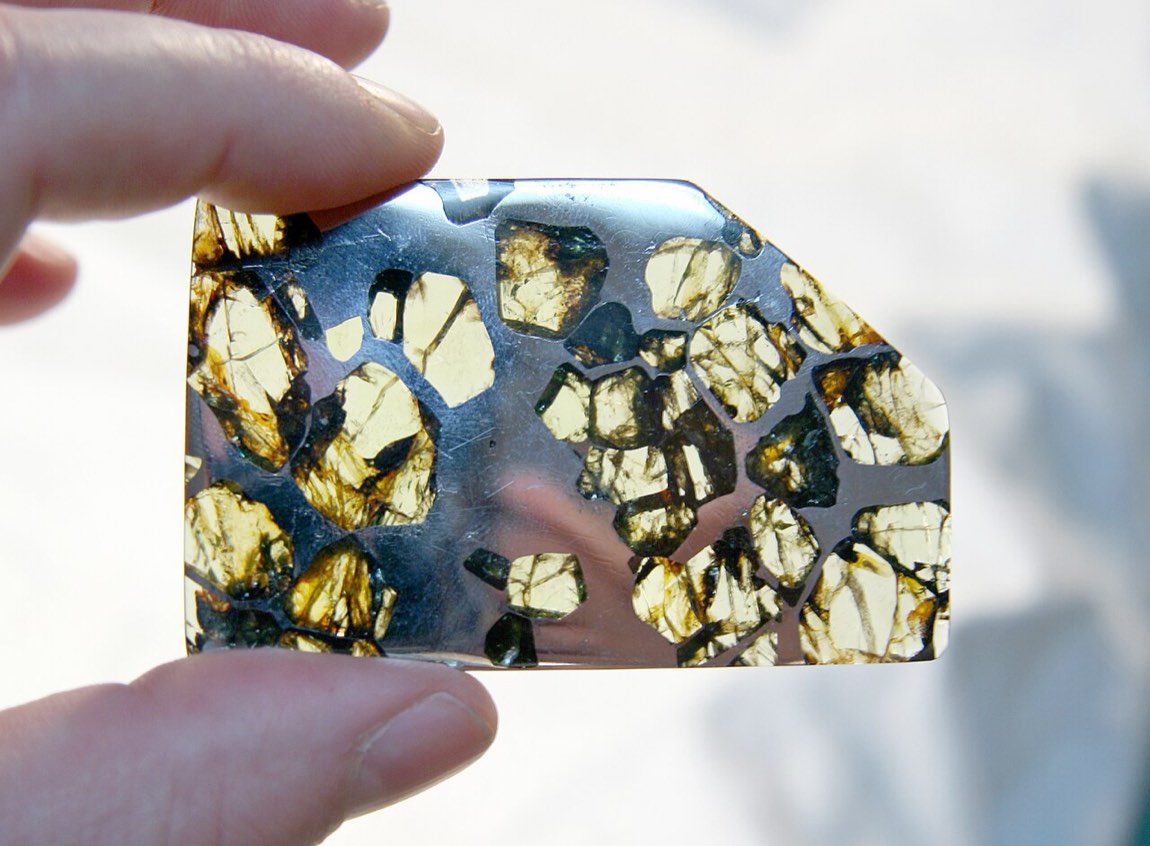
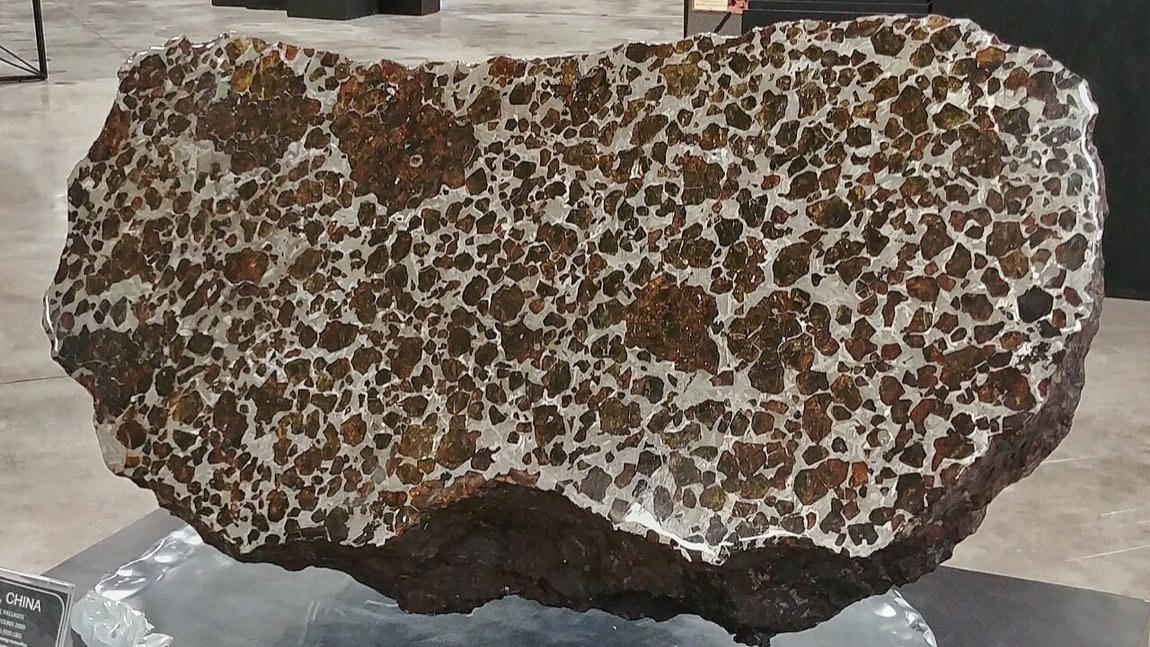
The Fukang meteorite is a pallasite, a rare stony-iron meteorite made of nickel-iron metal filled with yellow-green olivine crystals, the gem known as peridot. A mass of about 1,003 kg was obtained from the mountains near Fukang in Xinjiang, China, in 2000. When thin slices are cut and polished, light shines through the crystals like stained glass. Scientists at the University of Arizona studied it after it appeared at the Tucson Gem and Mineral Show in 2005. It is estimated to be about 4.5 billion years old.
The deep dive
Researched for the Atlas from Wikipedia — Fukang meteorite (2,182 characters read) · updated Nov 15, 2026
01 From the Mountains of Xinjiang to a Gem Show
The story of the Fukang meteorite's entry into scientific awareness is almost accidental. In 2000, a Chinese dealer recovered a massive stone — weighing 1,003 kilograms (2,211 lb) — from the mountains near Fukang, in China's Xinjiang Province. For years it sat largely unexamined, with the dealer removing about 20 kilograms (44 lb) from the main mass before eventually transporting it halfway around the world. In February 2005, the meteorite appeared at the Tucson Gem and Mineral Show in Arizona, one of the world's premier gatherings for minerals, gems, and meteorites. It was there that Dr. Dante Lauretta — a professor of Planetary Science and Cosmochemistry at the University of Arizona — encountered it. That chance sighting at a commercial show set the stage for a full scientific investigation, illustrating how significant specimens sometimes reach researchers through dealers and collectors rather than through formal expeditions or monitored falls.
02 The Research Team Behind the Discovery
After its debut at the Tucson show, the Fukang meteorite was brought to the Southwest Meteorite Center at the Lunar and Planetary Laboratory, University of Arizona in Tucson, Arizona. Dr. Dante Lauretta led the investigation alongside a team that included Dolores Hill, Marvin Killgore, Daniella DellaGiustina, and Dr. Yulia Goreva. The collaboration extended internationally when Dr. Ian Franchi of the Open University joined the effort. This mix of institutional and independent researchers — including Killgore, who is a noted private meteorite collector and analyst — reflects how meteorite science frequently bridges the gap between academia and the collector community. Each team member brought different expertise to characterize the meteorite's mineralogy, chemistry, and isotopic signature, turning what began as a gem-show curiosity into a rigorously documented scientific specimen.
03 What Makes a Pallasite So Visually Stunning
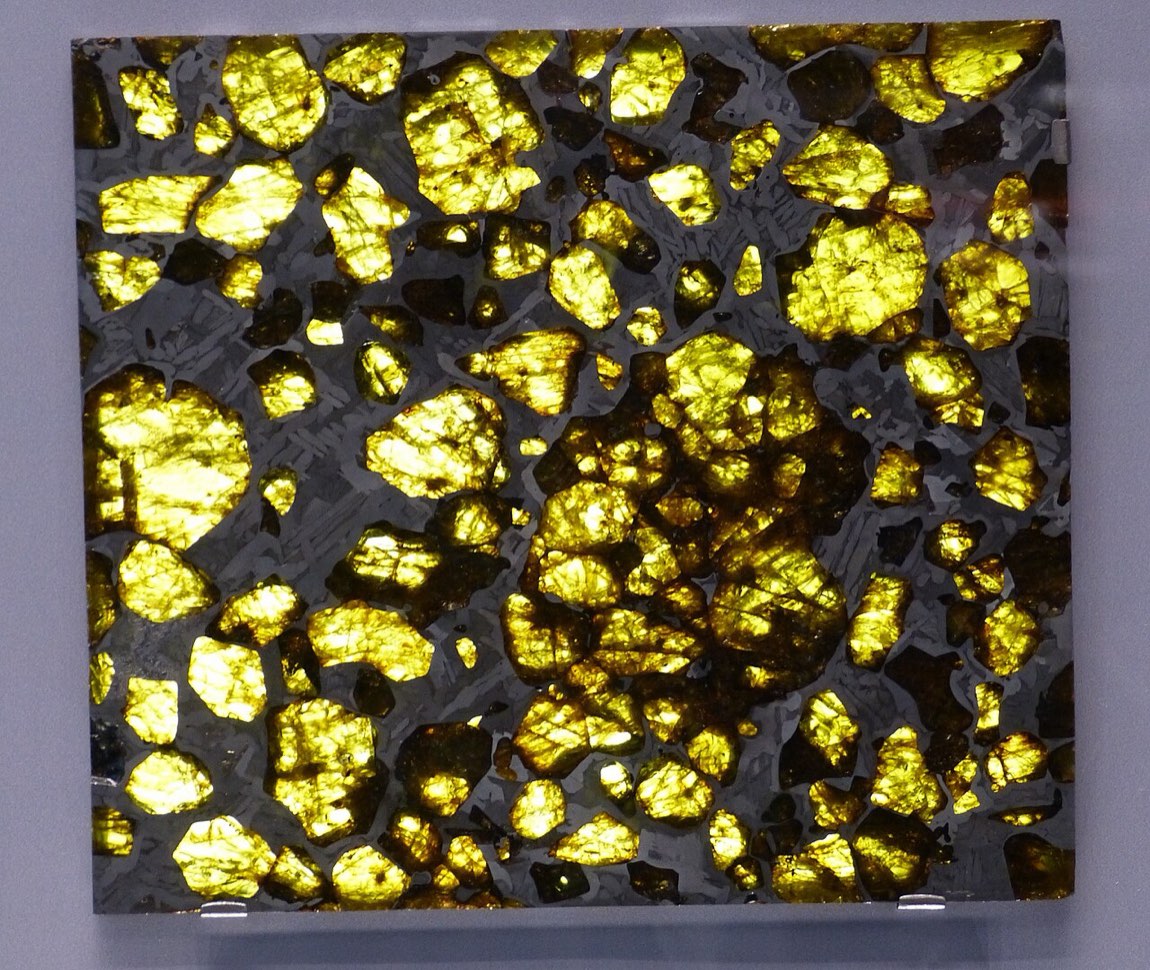
Pallasites occupy a unique place among meteorites because they combine two dramatically different materials into a single rock. The Fukang pallasite contains large, gem-quality olivine — the mineral also known as peridot — set within a nickel-iron metal matrix. When slices are cut thin enough for light to pass through, the olivine crystals glow in shades of gold and amber against the silver metallic background, producing an appearance unlike almost any other natural material on Earth. The olivine crystals at Fukang vary considerably in shape, ranging from rounded to angular, and many are fractured — evidence of the violent history these minerals have survived. Their sizes span a wide range, from less than five millimetres up to several centimetres, giving different sections of the meteorite very different visual textures and characters.
04 Massive Olivine Clusters and Metal Veins Deeper
Among the most striking structural features of the Fukang meteorite are regions within the main mass where olivine crystals cluster together into concentrated zones up to eleven centimetres (4.3 inches) in diameter. These massive olivine clusters are threaded through with thin metal veins, creating an intricate lattice that records the conditions under which the pallasite originally solidified billions of years ago. The interplay between the clustered crystals and the penetrating metal veins suggests a complex crystallization history, likely at or near the core-mantle boundary of a differentiated asteroid. The existence of such large, coherent olivine groupings — rather than randomly scattered individual crystals — implies relatively slow cooling that allowed crystals time to grow and migrate before the parent body was disrupted.
05 The Chemistry of the Olivine and Metal Deeper
The olivine in the Fukang meteorite has been chemically characterized with considerable precision. Its composition is recorded as Fo86.4, meaning that 86.4 percent of the iron-magnesium silicate sites in the crystal structure are occupied by magnesium rather than iron — placing it on the magnesium-rich end of the olivine series. The molar ratio of iron to magnesium is 0.1367, while the iron-to-manganese ratio is 40.37, and nickel content within the olivine is just 0.03 weight percent. The surrounding metal matrix is dominated by kamacite, the low-nickel iron-nickel alloy characteristic of meteoritic metal, with an average nickel content of 6.98 weight percent. Some olivine grains also contain vermicular — meaning worm-shaped — sulfide inclusions of the mineral troilite, which provides additional information about the sulfur chemistry of the original parent body environment.
06 Reading the Oxygen Isotopes Deeper
One of the most diagnostic tools for classifying meteorites and linking them to their parent bodies is oxygen isotope analysis, and the Fukang meteorite has been measured with precision. The values recorded are δ¹⁸O of 2.569 per mil, δ¹⁷O of 1.179 per mil, and a capital-delta ¹⁷O value of −0.157 per mil. These three numbers together define where Fukang plots on the oxygen three-isotope diagram that meteoriticists use to distinguish populations of meteorites from different parent bodies. The small negative value of ∆¹⁷O is characteristic of the main-group pallasite trend and helps researchers confirm that the meteorite fits within the broader pallasite family rather than representing a distinct, exotic parent body. Oxygen isotope data of this kind, combined with the metal and silicate chemistry, together build a coherent picture of Fukang's origins.
07 How the Main Mass Was Prepared for Viewing
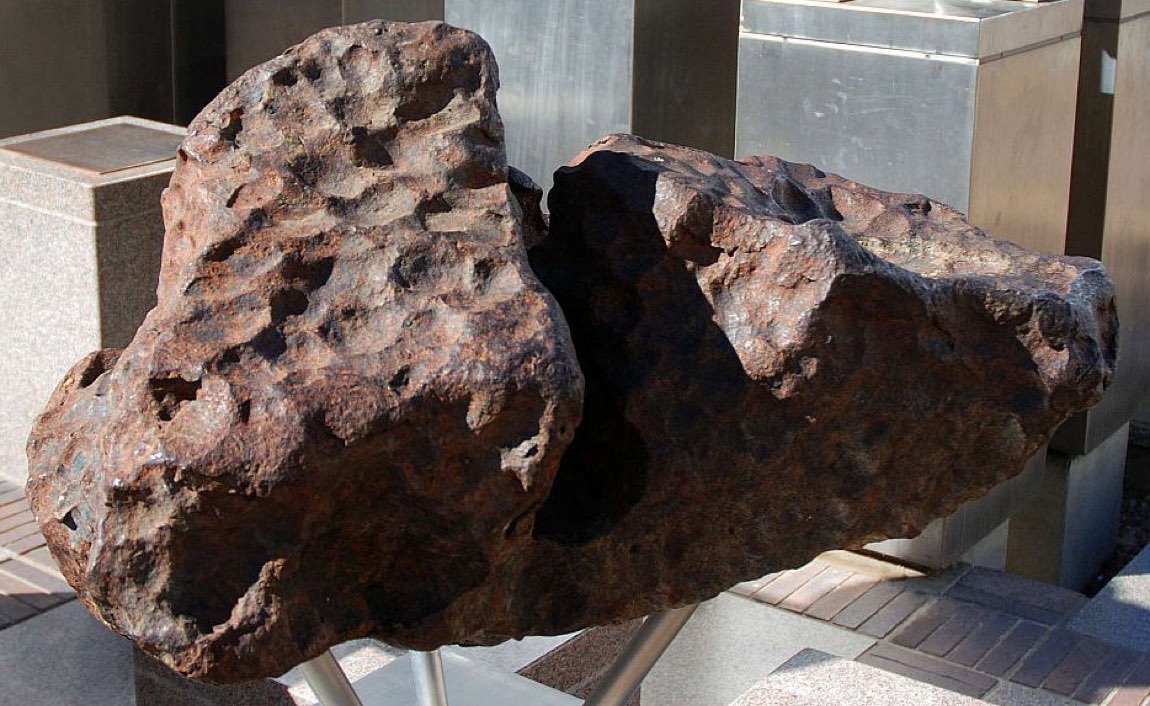
Even before the meteorite reached auction, preparers worked on the main mass to reveal its interior beauty. A so-called window area measuring 19 by 36 inches (480 millimetres by 910 millimetres) was cut and polished directly into the surface of the mass, creating a large flat face through which the gem-quality olivine areas could be seen without slicing the entire specimen into sections. This technique — essentially opening a window into the rock — is a practical compromise between scientific preservation and display, allowing the remarkable interior structure to be appreciated while keeping the bulk of the mass intact. The window's substantial size, nearly the area of a standard door, underscores just how large the main mass remains even after years of sectioning.
08 An Auction That Fell Short of Expectations
In April 2008, the auction house Bonhams offered the main mass of the Fukang meteorite at sale in Manhattan. The pre-sale estimate was ambitious: Bonhams expected the lot to fetch US$2,000,000, which would have made it one of the most valuable individual meteorite specimens ever sold at public auction. Despite the meteorite's extraordinary appearance and scientific pedigree, the lot remained unsold — meaning no bidder met the reserve price. This outcome highlights an interesting tension in the meteorite market between the aesthetic and scientific value that experts assign to a specimen and what buyers are ultimately willing to pay. The unsold result did not diminish the meteorite's scientific importance, but it left the question of its long-term public or institutional home unresolved at that time.
09 Where the Specimens Rest Today
The Fukang meteorite's total mass has been distributed among several holders, reflecting the complicated ownership path typical of commercially recovered meteorites. A type specimen section weighing 31 kilograms (68 lb) is on deposit at the University of Arizona, ensuring that a scientifically documented reference sample remains accessible to researchers in perpetuity. Marvin Killgore — one of the scientists who worked on the meteorite's characterization — holds an additional section of the same weight, 31 kilograms (68 lb), as well as the balance of the main mass. The original total mass recovered by the Chinese dealer was 1,003 kilograms (2,211 lb), with roughly 20 kilograms (44 lb) removed early on, so the remaining material still represents a substantial specimen by any standard.
10 A 4.5-Billion-Year-Old Relic
The Fukang meteorite is estimated to be 4.5 billion years old, placing its formation at the very dawn of the solar system. That figure is not unique to Fukang — most primitive and differentiated meteorites date to roughly this era, when the Sun had recently ignited and swarms of planetesimals were colliding and accreting throughout the inner solar system. What makes the age meaningful in context is that the olivine crystals and metal matrix visible today formed inside a small rocky body that no longer exists as an intact world. The parent asteroid differentiated — meaning it melted and separated into a metallic core and a rocky mantle — and was later shattered, sending fragments into space. The piece recovered near Fukang is a direct sample of that ancient differentiation event, preserved essentially unchanged for the entire history of the solar system.
11 Dante Lauretta and the Path to OSIRIS-REx
Dr. Dante Lauretta, the scientist who first recognized the Fukang meteorite at the 2005 Tucson show and led its investigation, would go on to become the principal investigator of NASA's OSIRIS-REx mission — the spacecraft that collected a sample from the near-Earth asteroid Bennu and returned it to Earth in 2023. While the article does not draw that connection explicitly, Lauretta's role at the Southwest Meteorite Center and Lunar and Planetary Laboratory, University of Arizona was part of the same career arc in planetary science and cosmochemistry that led to that landmark mission. His encounter with Fukang illustrates how individual researchers can bridge the worlds of commercial meteorite discovery and high-stakes space exploration, with each experience informing their broader understanding of solar system history.
12 Troilite and What It Tells Us Deeper
Among the minor minerals identified within the Fukang meteorite is troilite, a form of iron sulfide (FeS) that appears in a vermicular — that is, worm-like or intricately branched — habit within some of the olivine crystals. Troilite is a common accessory mineral in iron and stony-iron meteorites, and its presence in Fukang's olivine rather than exclusively in the metal matrix is chemically informative. It suggests that sulfur was present in the environment where these crystals grew, and that the sulfide was incorporated into or alongside the olivine during the cooling and crystallization process on the parent asteroid. The vermicular texture of the troilite also implies a specific cooling history, as such textures often reflect particular temperature gradients during solidification. Collectively, these details help scientists reconstruct the thermal and chemical conditions deep inside the long-destroyed asteroid that produced Fukang.
 ⤢