Explore the Universe. Understand Everything In It.
★
Menu
Home Tonight's Sky News
Explore Solar System PlanetsMoons StarsExoplanets GalaxiesBlack Holes NebulaeAsteroids & Comets Star ClustersMeteorites Constellations Space Exploration Space Industry
Sky Astronomy Calendar Launches
Learn & Tools Start Learning Astrophysics Scale of the Universe Timeline Glossary A–Z People Young Astronomers Top Lists Tools Compare Worlds Ask the Atlas AI Agents API
About About us Methodology Contact

Guided View
New to astronomy? We explain every term as you browse, in plain English. Same pages, with the help built in.

Expert View
You know the sky. Just the content, clean and compact, with no extra explanations. This is the default view.

Interface language
Light mode
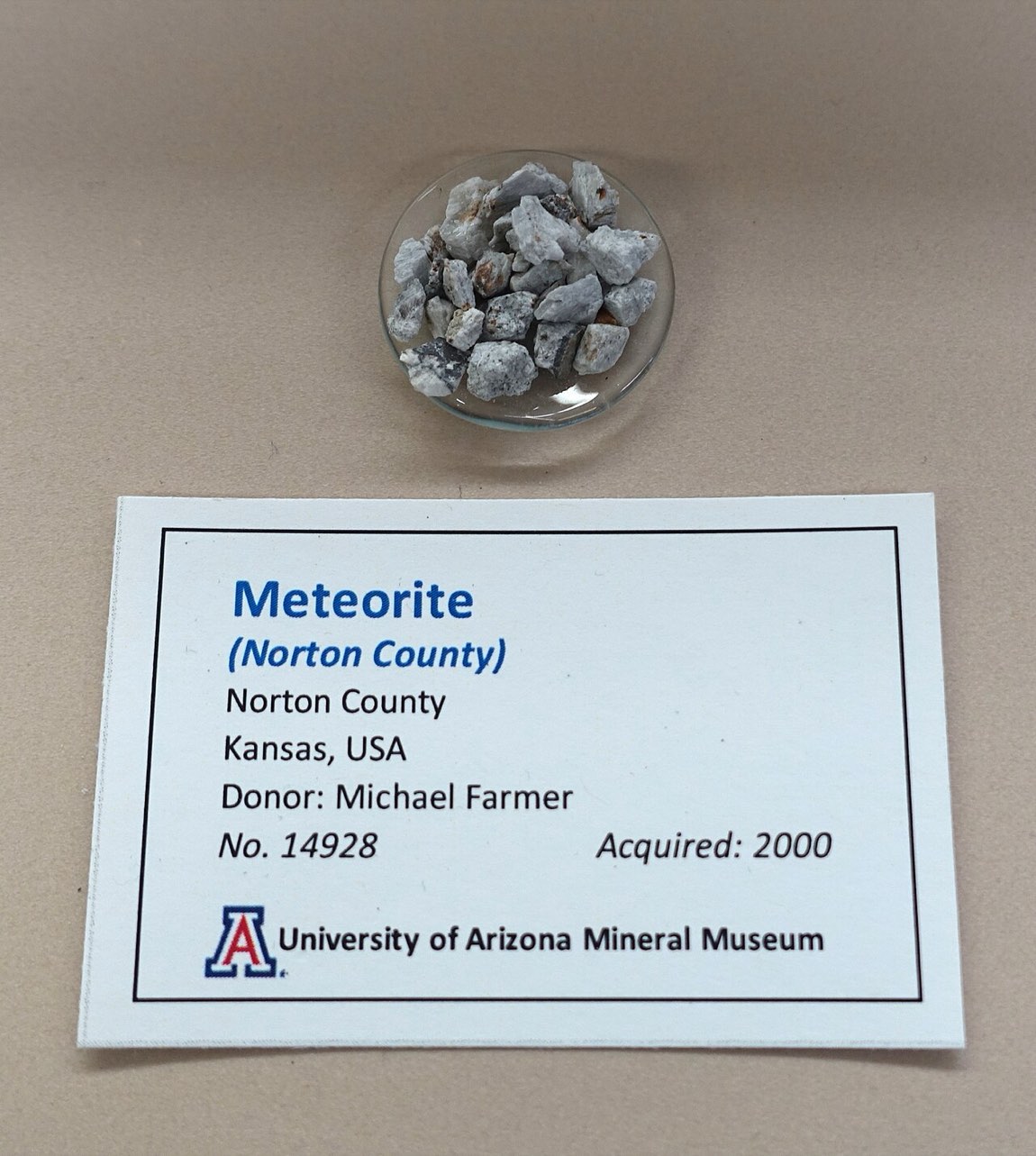
Norton County Meteorite Photograph · Daderot · CC0

Meteorite · Deep guide

Norton County Meteorite

Also called: Norton County

A 1948 Kansas fall that delivered more than a tonne of a rare, nearly iron-free achondrite.

None

What is it?

On 18 February 1948, a brilliant fireball and loud noise preceded a large shower of stones over Norton County, Kansas, and Furnas County, Nebraska. A University of New Mexico team set out in April to find the pieces, and everything it gathered went to the university. Norton County is an aubrite, a rare, pale achondrite poor in iron and calcium. Total known mass is about 1,100 kg, and the roughly 1,070 kg main mass is the centrepiece of the University of New Mexico's meteorite display.
✦ Keep exploring